
Blog
Industrial Site Security: The 2026 Protection Guide
Industrial site security compared: autonomous robots from €78,000, mobile towers from €8,900 versus €4,000-6,000/month manned guarding. Costs, coverage, ROI.

Dr. Raphael Nagel
August 5, 2026
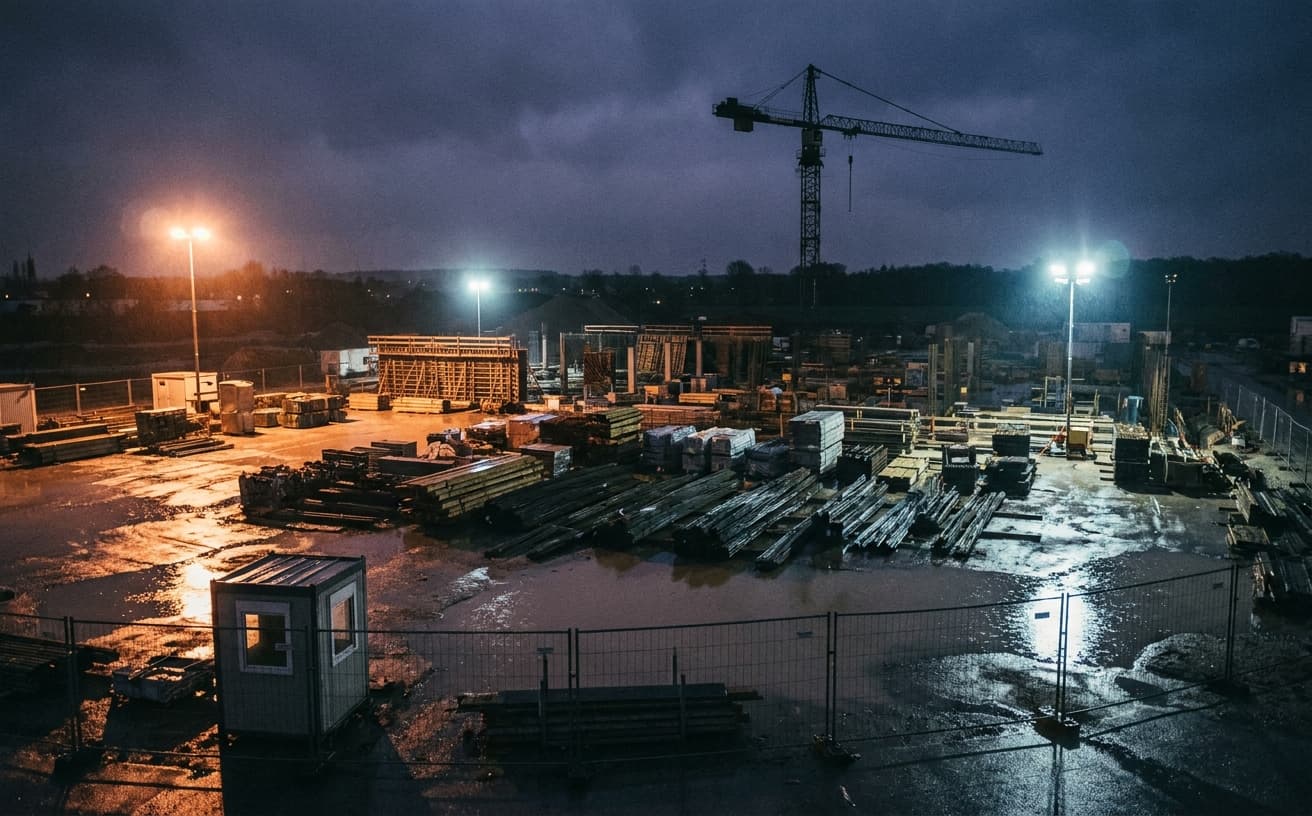
Industrial site security is the coordinated protection of manufacturing plants, logistics depots, storage yards and their perimeters against intrusion, theft, vandalism and sabotage. In 2026, the most cost-effective approach combines autonomous security robots (from €78,000) and mobile video surveillance towers (from €8,900) with a lean human command layer — delivering verified 24/7 coverage at a fraction of the cost of round-the-clock manned patrols, which typically run €4,000-6,000 per guard per month. This guide explains how modern industrial site security works, what it costs, and when robots and towers outperform classic guarding.
What does industrial site security actually protect against?
An industrial site is a high-value, low-visibility target. Copper cabling, catalytic converters, fuel, machinery, finished goods and raw metals are all liquid on grey markets. Beyond theft, operators face vandalism, arson, unauthorised access, and — for operators of critical infrastructure (KRITIS) — deliberate sabotage. Insurers increasingly treat physical security as a precondition for cover, not an optional extra.
Industry bodies estimate that metal and equipment theft costs European industrial operators several hundred million euros annually, and that the large majority of losses occur outside working hours, when sites are dark, empty and sparsely patrolled. The security gap is almost always temporal: it opens at 6pm and closes at 6am.
Which parts of a site are most exposed?
- The perimeter fence line — the first and most frequently breached layer.
- Open storage yards and laydown areas — hard to light, easy to conceal.
- Loading bays and gates — targeted for tailgating and staged theft.
- Remote or seasonal sites — plants in shutdown, new-build phases or off-peak depots.
How do autonomous robots and mobile towers work?
An autonomous security robot patrols a defined route across your site day and night, using thermal and optical cameras, LiDAR and AI-based object detection to distinguish a person from an animal, a vehicle or blowing debris. It never tires, never skips a round, and logs every patrol with timestamped, court-admissible evidence. On detecting an intrusion, it can illuminate, issue a live audio challenge and escalate to a human operator in seconds.
A mobile video surveillance tower is a rapidly deployable mast — solar-hybrid powered, connected over 4G/5G — fitted with pan-tilt-zoom and thermal cameras covering fixed high-risk zones such as gates, yards and fuel stores. Towers deploy in hours, require no groundworks, and relocate as a site evolves. Used together, robots deliver mobile, unpredictable coverage while towers hold static chokepoints.
BOSWAU + KNAUER has manufactured security technology in Filderstadt since 1892. Both platforms are KRITIS-capable and built for continuous 24/7 operation in demanding industrial environments.
Robots and towers versus manned guarding: what does it cost?
Manned guarding is priced per guard, per shift — and true 24/7 cover requires four to five guards to fill a single continuous post across shifts, holidays and sickness. Technology is a capital purchase (or lease) that runs continuously with no shift multiplier.
| Solution | Typical cost | Coverage | Key limitation | |---|---|---|---| | Manned guard (single post) | ~€4,000-6,000 / month per guard; ~€200,000+ / year for true 24/7 cover | 1 person, 1 location at a time | Fatigue, blind spots, sick days, wage inflation | | Mobile surveillance tower | From €8,900 (purchase) | Fixed high-risk zone, 24/7 | Static field of view | | Autonomous security robot | From €78,000 (purchase) | Mobile patrol across the whole site | Requires charging cycles | | Robot + tower + remote operator | Capex + lean monitoring fee | Whole-site, mobile and static, 24/7 | Upfront investment |
The economics are decisive over a two-to-three-year horizon. A single robot replaces the four-to-five-guard rota needed for one continuous patrol post, while a tower secures a critical zone for less than the quarterly cost of one guard. Because the hardware is owned, it removes exposure to rising security wages and staffing shortages.
Does technology replace people entirely?
No — it re-deploys them. The most resilient industrial site security model is a small, expert human command layer supervising a fleet of robots and towers across multiple sites from a single control room. People stop walking cold, empty perimeters and start managing verified alerts, so every dispatch is a confirmed event rather than a false alarm.
Frequently Asked Questions
How quickly can a mobile tower or robot be deployed?
A mobile surveillance tower can typically be positioned and live within a few hours, as it needs no foundations or fixed power. An autonomous robot requires an initial site survey and route mapping, usually completed within days. Both are far faster to stand up than recruiting, vetting and training a manned guarding team.
Is autonomous security suitable for KRITIS and regulated sites?
Yes. BOSWAU + KNAUER's robots and towers are KRITIS-capable, engineered for critical infrastructure operators with heightened resilience, continuous availability and tamper-resistant, auditable evidence trails. They suit energy, water, logistics and manufacturing sites subject to regulatory scrutiny.
What happens when an intrusion is detected at 3am?
The system detects, verifies and escalates automatically. The robot or tower confirms a genuine intrusion using thermal and AI analysis, issues a deterrent (light and live audio warning), records the event and alerts a human operator, who can challenge the intruder remotely and dispatch police or a response patrol — all within seconds, with evidence captured throughout.
Can one solution cover an entire industrial site?
Usually a combination performs best. Robots provide unpredictable, mobile patrols across yards and access roads, while towers lock down static chokepoints like gates and fuel stores. For most industrial sites, one robot plus one to two towers delivers comprehensive, layered coverage.
The modern standard for industrial site security
Classic manned guarding is expensive, hard to staff and inherently limited to one person in one place. Autonomous robots and mobile surveillance towers deliver continuous, verifiable, whole-site coverage — from €78,000 for a robot and €8,900 for a tower — while a lean human command layer turns raw alerts into decisive action. For operators facing rising wage costs, labour shortages and tougher insurance and KRITIS requirements, the shift from bodies-on-site to technology-on-patrol is no longer experimental; it is the new baseline.
Ready to see what layered coverage would cost for your site? Configure your robot and tower package or contact our industrial security team for a tailored assessment.
Related topics
- Property Protection Cost: Robots, Towers & Guards
- Property Protection: Robots & Towers vs Guards 2026
- Surveillance Tower: Mobile Video Towers Secure Sites 24/7
- Perimeter Security Systems: The Complete 2026 Buyer's Guide
- Mobile Video Surveillance: The Complete B2B Guide
Take the next step: See prices & ROI · Explore the products · Send a no-obligation request. BOSWAU + KNAUER – direct from the factory in Filderstadt, reply within 5 working days.
About the author
Dr. Raphael Nagel (LL.M.) is founding partner of Tactical Management. He acquires and restructures industrial businesses in demanding market environments and writes on capital, geopolitics, and technological transformation. raphaelnagel.com
More reading
Since 1892.
The firm is reached at boswau-knauer.de or +49 177 2266267.