
Blog
Construction Site Theft Liability: Who Actually Pays?
Construction site theft liability rarely falls on insurers alone. See who pays, why claims fail, and how a €78,000 robot beats a €5,000/month guard.

Dr. Raphael Nagel
August 5, 2026
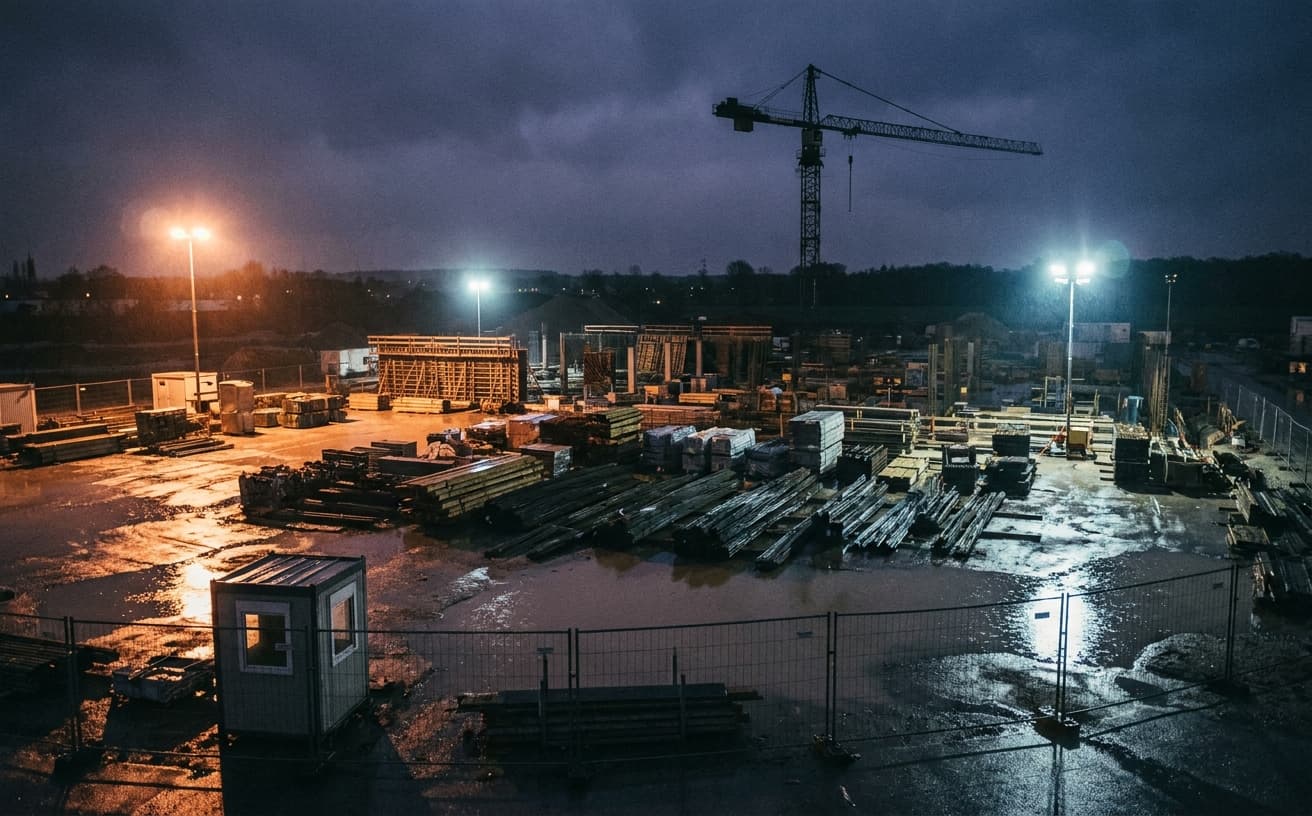
Construction site theft liability almost always lands on the main contractor or site operator, not the insurer, because most policies exclude losses caused by inadequate security or "unattended" plant. If tools, cabling, fuel or excavators disappear overnight, the party with the duty of care to secure the site typically absorbs the cost — and the delay. In short: unless you can prove reasonable protective measures were in place, you pay.
That is the uncomfortable answer most builders discover only after the first break-in. Below we set out who is liable, why insurance claims are refused, and how modern autonomous security compares with a traditional night guard on both cost and evidence.
Who is legally liable for theft on a construction site?
Liability follows the duty of care. Whoever controls the site — usually the principal contractor — is expected to take proportionate steps to prevent foreseeable loss. When a subcontractor's equipment is stolen from an unsecured compound, disputes commonly arise over who was responsible for perimeter security that night.
Three parties are typically in the frame:
- The main contractor / site operator, who holds overall control and the primary duty to secure the compound.
- Subcontractors, who are often contractually required to secure and insure their own plant and tools.
- The insurer, who will only indemnify if the agreed security conditions in the policy were met.
The practical outcome: if the site was left open, poorly lit and unmonitored, the loss usually rests with the operator regardless of who owned the stolen items.
Why do construction insurers refuse theft claims?
Contractors' All Risks and plant policies routinely carry security warranties — conditions that must be satisfied for cover to apply. Insurers refuse or reduce claims when they can show these were breached. Common grounds for refusal include:
- No monitored perimeter or alarm during non-working hours.
- Plant left unlocked, with keys on site, or fuel tanks accessible.
- No documented evidence of theft (no footage, no incident log).
- Repeat losses at the same site with no improved measures.
Industry loss adjusters report that a significant share of site-theft claims are contested or partially declined precisely because the operator cannot prove that reasonable protection was in place. Evidence, not just intent, is what settles a claim.
How big is the problem, really?
Construction is consistently ranked among the most theft-exposed sectors. Industry bodies estimate the annual cost of plant and tool theft across the sector runs into the hundreds of millions of euros, with only a minority of stolen machines ever recovered. Beyond the replacement cost, each incident triggers hire-in charges for substitute plant, idle labour, and programme delay — frequently two to three times the headline value of the stolen item.
The lesson is straightforward: preventing the theft is far cheaper than proving liability afterwards.
Guard, tower or robot: what actually protects the site?
Classic manned guarding is the default, but it is expensive, single-point, and produces little usable evidence. Autonomous towers and security robots cover the same perimeter continuously, generate court-ready footage, and shift the liability conversation in your favour. Here is how the options compare.
| Option | Typical cost | Coverage | Evidence produced | Liability benefit | |---|---|---|---|---| | Manned night guard | ~€4,000–6,000 / month, ongoing | One person, one patrol route | Patchy; human recollection | Weak — hard to prove diligence | | Mobile video surveillance tower | from €8,900 (one-off) | Fixed 360° zone, 24/7 | Continuous recorded footage | Strong — timestamped proof | | Autonomous security robot | from €78,000 (one-off) | Patrols the full compound | Live + recorded, mobile view | Strongest — active deterrence |
Over a 12-month project, a single guard can cost €48,000–72,000 and still leaves gaps at shift changes and across a large footprint. A surveillance tower from €8,900 is a one-off investment that pays back within months, while an autonomous robot from €78,000 patrols the entire site, deters intruders on approach, and delivers the documented, timestamped evidence insurers demand.
How does automated security change who is liable?
It reframes the whole question. With a monitored tower or patrolling robot in place, you can demonstrate reasonable, proportionate and continuous protection — the exact standard insurers and courts test against. Break-ins are deterred before they happen; when an incident does occur, you hold the footage rather than an argument.
BOSWAU + KNAUER has manufactured security and protection technology in Filderstadt since 1892. Our KRITIS-capable systems operate 24/7, combining autonomous security robots with mobile video surveillance towers so that both fixed compounds and evolving site layouts stay covered as the build progresses.
Frequently Asked Questions
Is the main contractor always liable for site theft?
Not automatically, but usually. The party controlling the site carries the primary duty of care. Where subcontractors are contractually obliged to secure their own plant, liability can shift — but in the absence of clear, evidenced security measures, the operator typically bears the loss.
Will my insurance cover stolen tools and plant?
Only if you met the policy's security warranties. Most Contractors' All Risks and plant policies require monitored perimeters, locked and immobilised machines, and documented evidence of the theft. Fail any of these and the claim may be reduced or refused entirely.
Is a security robot cheaper than a night guard?
Over a typical project, yes. A guard at ~€4,000–6,000 per month recurs indefinitely, whereas a surveillance tower (from €8,900) or robot (from €78,000) is a one-off asset that redeploys across future sites — usually paying back within the first project.
What evidence do insurers actually accept?
Timestamped, continuous video footage covering the incident, supported by an incident log. This is precisely what fixed towers and patrolling robots generate automatically, and what a lone guard rarely can.
Secure the site before the liability question arises
Construction site theft liability is decided long before the break-in — by the measures you can prove were in place. Move from recurring guarding costs to a one-off, evidence-generating system that deters intruders and protects your claim.
Configure your ideal setup in our online configurator, or contact the BOSWAU + KNAUER team to match a robot-and-tower solution to your site.
Related topics
- UK Construction Theft 2026: The Data & Insurance Response
- Mobile Camera Tower Comparison: Which Protects Best?
- Surveillance Tower: Mobile Video Towers Secure Sites 24/7
- Security Guard Service Cost: What You Really Pay 2026
- Stolen Tools on Site: Who Actually Pays
Take the next step: See prices & ROI · Explore the products · Send a no-obligation request. BOSWAU + KNAUER – direct from the factory in Filderstadt, reply within 5 working days.
About the author
Dr. Raphael Nagel (LL.M.) is founding partner of Tactical Management. He acquires and restructures industrial businesses in demanding market environments and writes on capital, geopolitics, and technological transformation. raphaelnagel.com
More reading
Since 1892.
The firm is reached at boswau-knauer.de or +49 177 2266267.