
Blog
Stolen Tools on Site: Who Actually Pays
Stolen tools construction insurance rarely covers the full loss. See who pays, typical excess levels, and how a robot from €78,000 stops theft before it starts.

Dr. Raphael Nagel
August 5, 2026
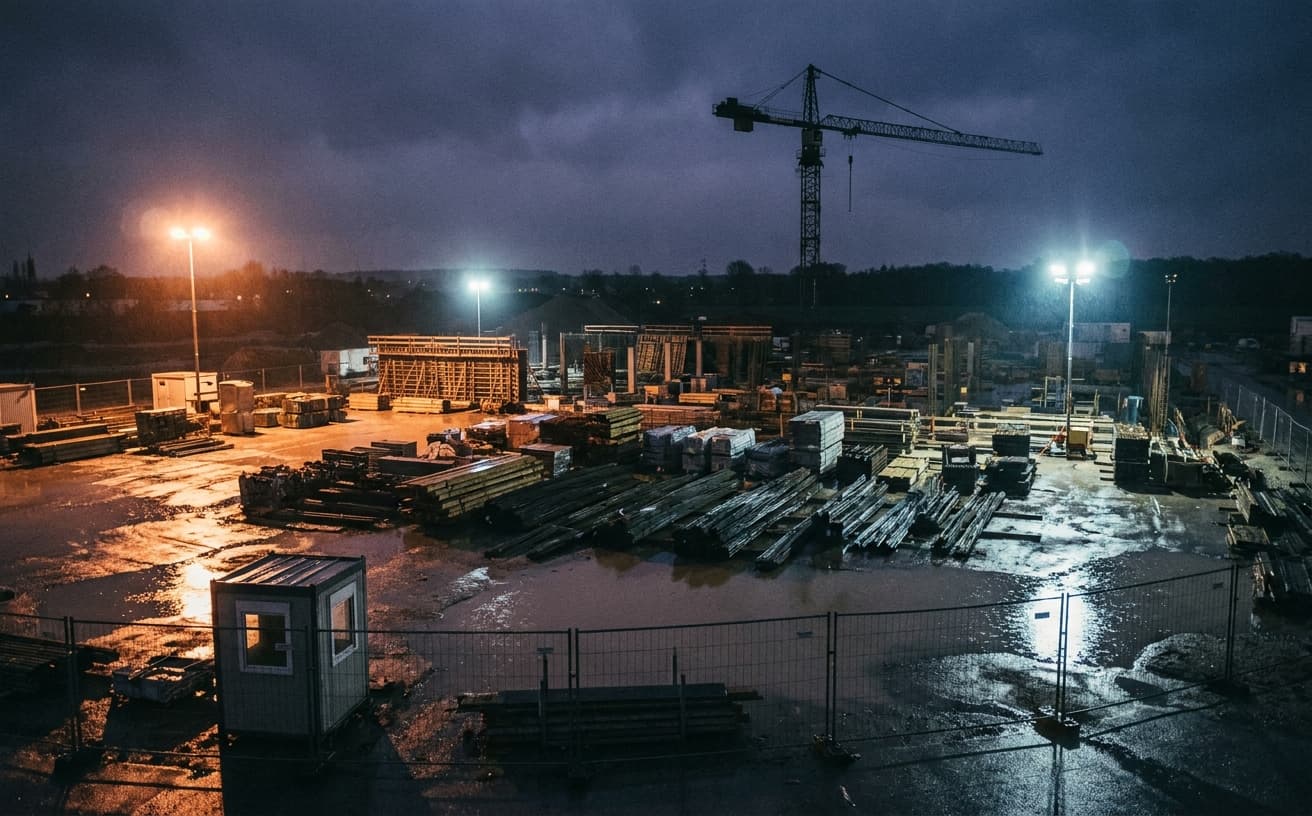
When tools are stolen from a construction site, stolen tools construction insurance often pays far less than site managers expect — and sometimes nothing at all. Most contractors' plant and tools policies exclude theft unless the equipment was locked away or the site was actively secured, and even valid claims carry an excess and a "new-for-old" clause that leaves a real gap. In practice, the contractor absorbs the deductible, the downtime, and the rising premium — which is why prevention now costs less than the claim.
Who pays when tools are stolen from a construction site?
Liability follows the contract and the policy wording, not fairness. Three parties are usually in the frame:
- The main contractor, whose site security obligations are written into the JCT or NEC contract and whose insurer will ask whether "reasonable precautions" were taken.
- The subcontractor or tradesperson, whose own tools-in-transit or hire-in-plant cover typically applies to hand tools and vans — often with a strict overnight-in-vehicle exclusion.
- The insurer, who pays only if the loss falls inside the policy definitions and the site met the security warranties on the schedule.
The result is that a single overnight break-in — a common event on unmanned UK and European sites — frequently ends with the contractor paying most of the bill directly.
What does construction insurance actually cover for stolen tools?
Cover varies, but the common threads matter more than the differences.
Is theft automatically included in a plant and tools policy?
No. Theft is usually covered only if there are signs of forced entry and the tools were secured — locked container, locked cabin, or a monitored compound. Items left loose on an open plot, or in an unlocked van overnight, are frequently excluded outright.
What is the typical excess and depreciation deduction?
Excesses commonly run from €500 to €2,500 per claim, and settlements are often indemnity (wear-and-tear adjusted) rather than new-for-old. A three-year-old set of power tools worth €12,000 new might settle at €6,000 — before the excess is applied.
Does a claim raise the premium?
Almost always. A single theft claim can lift the following year's premium by 15–30% and can trigger a security warranty requiring physical measures before renewal — turning a one-off loss into a recurring cost.
How much does construction site theft really cost?
Industry bodies estimate that tool and plant theft costs the European construction sector well over €1 billion a year, with the majority of losses occurring on sites left unmanned overnight and at weekends. Surveys of tradespeople consistently report that a large share have been victims at least once, and that roughly one in five never fully recover the value even where a policy exists.
The hidden costs compound the headline figure:
- Downtime while replacement tools are sourced — often the largest single loss.
- Programme delay and liquidated-damages exposure on the main contract.
- Excess and depreciation the insurer will not pay.
- Premium inflation at the next renewal.
A €12,000 tool loss can easily become a €25,000–€30,000 event once delay and premium effects are counted.
Guarding vs. robot vs. surveillance tower: what protects a site best?
Classic manned guarding deters — but only where the guard happens to be standing. Autonomous technology covers the whole perimeter, all night, without gaps or fatigue. The comparison below uses realistic figures.
| Option | Typical cost | Coverage | Deterrence | Best for | |---|---|---|---|---| | Manned guard (single, night shift) | ~€4,000–6,000 / month | One patrol point at a time | Human presence, but predictable and gappy | Short-term, staffed hours | | Mobile video surveillance tower | from €8,900 | 360° monitored view, live + recorded | Lighting, audio warning, verified alarm | Perimeters, compounds, access points | | Autonomous security robot | from €78,000 | Continuous patrol across the whole site | Unpredictable routes, thermal + AI detection, 24/7 | High-value plant, KRITIS-grade sites |
Over a 12-month project, a single night guard costs roughly €48,000–€72,000 — recurring, and gone at handover. A mobile surveillance tower from €8,900 or an autonomous robot from €78,000 is a capital asset that redeploys to the next site, integrates with monitoring, and produces court-ready evidence.
Why choose BOSWAU + KNAUER over classic guarding?
Built in Filderstadt with a manufacturing heritage dating to 1892, BOSWAU + KNAUER systems are engineered for the way sites are actually attacked — overnight, at the perimeter, in the gaps a single patrol cannot hold.
- Autonomous security robots patrol unpredictable routes with thermal imaging and AI-based intrusion detection, escalating verified events instantly rather than after the fact.
- Mobile video surveillance towers deliver 360° monitored coverage, active deterrent lighting and audio, and continuous recording — deployable in hours, no cabling required.
- KRITIS-capable, 24/7 operation meets the standards demanded on critical-infrastructure and high-value projects where a missed break-in is not an option.
The point is not to win the insurance claim after the theft. It is to record the forced-entry attempt, deter it, and keep the tools on site — so there is no claim, no excess, and no premium hike.
Frequently Asked Questions
Does construction insurance cover tools stolen from an unlocked van overnight?
Usually not. Most tools-in-transit and van cover carries an overnight exclusion for vehicles left on the public highway or on an unsecured site. Tools must typically be removed or locked in a secured store, or the claim is declined. Check the exact warranty wording on your schedule.
Who is liable — the main contractor or the subcontractor?
It depends on the contract. If site security was the main contractor's obligation under the JCT/NEC terms, liability and the insurance response usually sit with them. Subcontractors' own tools generally fall to their own policy. Written site-security responsibilities decide the outcome, so clarify them before works start.
Is a security robot cheaper than a night guard?
Over a full project, frequently yes. A night guard at ~€4,000–6,000 per month is a recurring cost that disappears at handover, while a robot from €78,000 or a tower from €8,900 is a redeployable asset with no gaps in coverage and lower whole-life cost across successive sites.
Will visible surveillance reduce my insurance premium?
Often. Insurers reward demonstrable security warranties — monitored towers, recorded coverage and access control can support lower excesses and reduce the likelihood of a declined claim, because you can evidence "reasonable precautions" and provide footage of any incident.
Protect the site before the claim
Stolen tools are a solved problem when the perimeter is watched every hour of the night. Configure an autonomous security robot or a mobile surveillance tower for your project, or speak to our team about a site-specific security plan.
Configure your system or contact BOSWAU + KNAUER to price coverage against your current guarding spend.
Related topics
- Construction Site Surveillance: The 24/7 Site Guide
- Security Guard vs Camera Tower Cost: Which Wins in 2026?
- Mobile Camera Tower Comparison: Which Protects Best?
- Autonomous Security Robot: Patrols That Replace Guards
- Security Guard Service Cost: What You Really Pay 2026
Take the next step: See prices & ROI · Explore the products · Send a no-obligation request. BOSWAU + KNAUER – direct from the factory in Filderstadt, reply within 5 working days.
About the author
Dr. Raphael Nagel (LL.M.) is founding partner of Tactical Management. He acquires and restructures industrial businesses in demanding market environments and writes on capital, geopolitics, and technological transformation. raphaelnagel.com
More reading
Since 1892.
The firm is reached at boswau-knauer.de or +49 177 2266267.