
Blog
Autonomous Security Robot: Patrols That Replace Guards
An autonomous security robot patrols 24/7 from €78,000. Compare robotic patrols, mobile surveillance towers and manned guarding on cost.
Dr. Raphael Nagel
August 5, 2026
An autonomous security robot is a self-navigating ground unit that patrols a defined site, detects intrusions with thermal and optical sensors, and streams verified alerts to a control room 24/7 — without a human walking the perimeter. Unlike a fixed camera, it moves; unlike a guard, it never tires, never takes a break, and logs every metre it covers. For sites that need continuous perimeter protection, robotic patrols are now a proven alternative to classic manned guarding.
BOSWAU + KNAUER — a German security manufacturer active since 1892 in Filderstadt — builds these robots from €78,000 and pairs them with mobile video surveillance towers from €8,900, giving operators a layered, KRITIS-capable defence that runs around the clock.
What is an autonomous security robot, and how does it work?
An autonomous security robot combines four systems in one platform: an autonomous drive train with obstacle avoidance, a multi-sensor payload (HD optical, thermal imaging, LiDAR), an onboard AI that classifies humans, vehicles and anomalies, and a secure uplink to a monitoring centre. It follows pre-mapped patrol routes, deviates to investigate movement, and escalates only verified events — cutting the false-alarm noise that plagues motion-triggered CCTV.
Because it operates on repeatable routes with GPS and inertial navigation, the robot delivers consistent coverage no manual patrol can match. Industry analyses of manned patrols regularly find that human guards physically cover only a fraction of a large perimeter on any given round, with attention degrading sharply after the first hours of a night shift. A robot maintains the same detection performance at 03:00 as at 15:00.
Where are security robots actually deployed?
The strongest use cases share one trait: large, low-footfall areas that are expensive and tedious to patrol on foot.
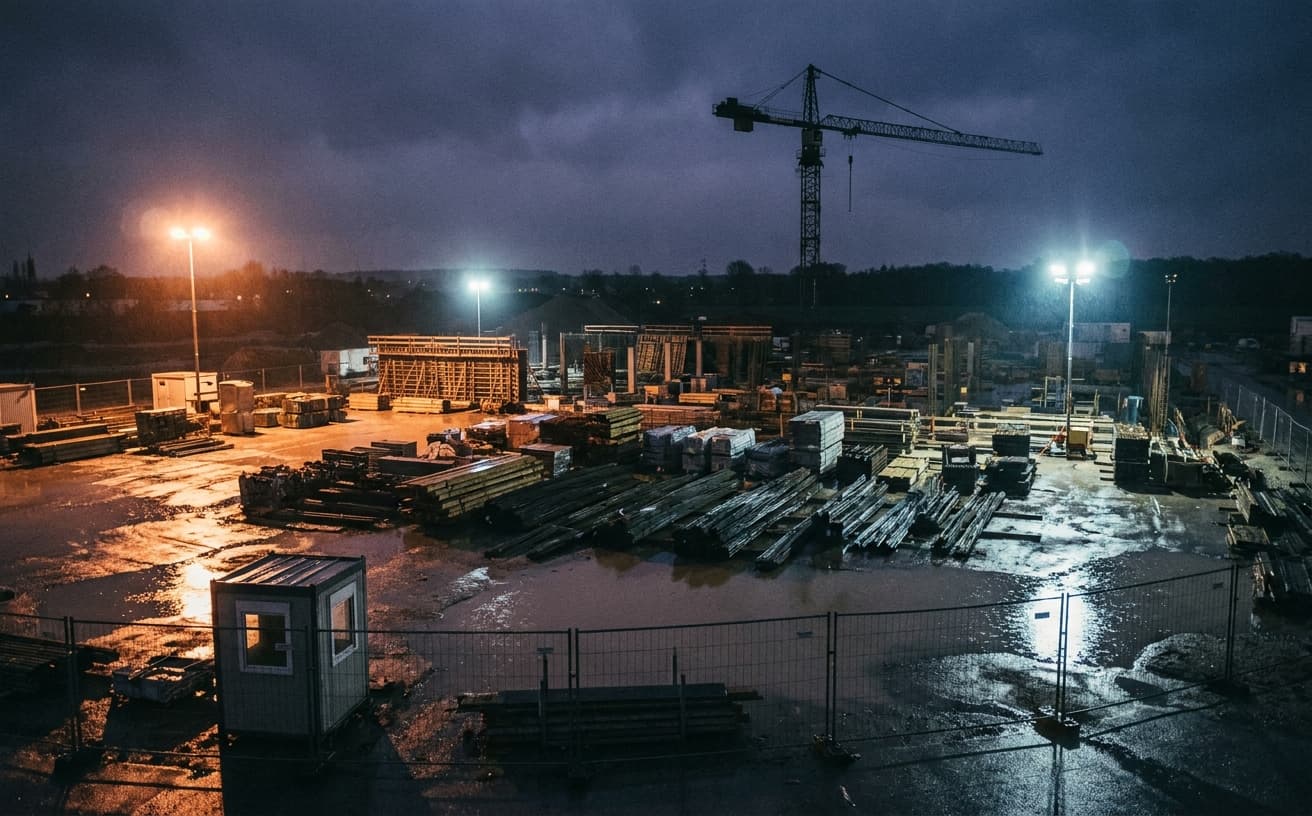
- Construction sites and material yards, where copper, plant and fuel theft run into the tens of thousands per incident
- Logistics hubs, distribution centres and vehicle compounds
- Solar and energy assets, substations and other KRITIS (critical-infrastructure) sites
- Industrial estates, ports and fenced storage areas
Robot vs tower vs guard: which security model wins?
Most buyers are not choosing between a robot and nothing — they are replacing or supplementing a manned guarding contract. The economics are the decisive factor. A single guard position covering nights and weekends typically costs €4,000–6,000 per month once shift premiums, holiday cover and management overhead are included, and that buys one pair of eyes in one place.
| Criterion | Autonomous security robot | Mobile surveillance tower | Manned guard | |---|---|---|---| | Indicative cost | From €78,000 (capital) | From €8,900 (capital) | €4,000–6,000 / month | | Coverage | Mobile, full perimeter | Fixed elevated overwatch | One position at a time | | Availability | 24/7, no breaks | 24/7, no breaks | Shift-limited | | Consistency | Identical every patrol | Constant field of view | Varies with fatigue | | Deployment time | Site-mapped, then autonomous | Hours to position | Days to staff | | Audit trail | Full digital log | Full digital log | Manual reports | | Scaling cost | Marginal per unit | Marginal per unit | Linear per head |
Over a typical multi-year horizon, the capital cost of a robot or tower is recovered against a guarding contract in well under two years, after which the ongoing cost advantage compounds. The robot brings mobility; the tower brings persistent elevated overwatch at a lower entry price. Deployed together, they close the two classic gaps in perimeter security — blind spots between fixed cameras, and the moments a lone patrol is on the far side of the site.
Does a robot really replace a security guard?
Not entirely — and the honest answer matters. A robot removes the repetitive, fatigue-prone patrolling and detection work, and it does so with perfect consistency and a complete digital record. The human role shifts to verified response: a monitoring operator assesses the robot's escalated alert and dispatches an intervention team only when needed. This is a force multiplier, not a straight one-for-one swap, and it is why layered models (robot + tower + remote operator) now outperform pure manned guarding on both cost and coverage.
Why choose BOSWAU + KNAUER?
Three factors set the offering apart. First, manufacturing heritage: over 130 years of German security engineering, not a rebadged import. Second, KRITIS readiness — the platform is built for the availability and data-security standards critical-infrastructure operators are held to. Third, a genuinely layered system: one supplier for both the mobile robot and the surveillance tower, configured to the specific site rather than sold as a fixed box.
Reported figures across the sector are consistent: verified, camera-confirmed alerts dramatically reduce false police call-outs versus motion-only CCTV, and sites with visible autonomous deterrence record markedly fewer intrusion attempts. Deterrence you can see — a patrolling robot and an illuminated tower — prevents incidents that a passive camera only records after the fact.
Frequently Asked Questions
How much does an autonomous security robot cost?
BOSWAU + KNAUER autonomous security robots start at €78,000 as a capital purchase, and mobile video surveillance towers start at €8,900. Compared with a manned guarding contract at €4,000–6,000 per month, the hardware typically pays for itself within roughly two years, then delivers continuing savings with no shift premiums or staffing overhead.
Can a security robot operate in all weather and at night?
Yes. Thermal imaging detects heat signatures in total darkness, fog and rain, while optical cameras handle daylight identification. The robot's autonomous navigation is built for outdoor sites — construction grounds, yards and industrial estates — and maintains identical detection performance across every hour of a 24/7 cycle.
Is a robotic patrol suitable for KRITIS and critical infrastructure?
It is designed for it. BOSWAU + KNAUER platforms are KRITIS-capable, addressing the continuous availability, secure data handling and auditable logging that critical-infrastructure operators require. Substations, energy assets, ports and utilities are core deployment scenarios.
How quickly can a robot and tower be deployed?
A mobile surveillance tower can be positioned and active within hours. A security robot requires an initial site mapping, after which it patrols autonomously. Both are far faster to bring online than recruiting, vetting and rostering a manned guarding team, which typically takes days to weeks.
Ready to compare your options?
Every site is different, and the right mix of robot, tower and remote monitoring depends on your perimeter, risk profile and existing contracts. Use our online configurator to build a solution for your site and get an indicative quote, or contact the BOSWAU + KNAUER team to arrange a site assessment. Move from reactive guarding to proactive, autonomous protection — around the clock.
Related topics
- Perimeter Security Systems: The Complete 2026 Buyer's Guide
- Stolen Tools on Site: Who Actually Pays
- Security Guard vs Camera Tower Cost: Which Wins in 2026?
- Construction Site Surveillance: The 24/7 Site Guide
- Camera Tower Surveillance: 24/7 Site Protection
Take the next step: See prices & ROI · Explore the products · Send a no-obligation request. BOSWAU + KNAUER – direct from the factory in Filderstadt, reply within 5 working days.
About the author
Dr. Raphael Nagel (LL.M.) is founding partner of Tactical Management. He acquires and restructures industrial businesses in demanding market environments and writes on capital, geopolitics, and technological transformation. raphaelnagel.com
More reading
Since 1892.
The firm is reached at boswau-knauer.de or +49 177 2266267.