
Blog
Construction Video Surveillance & GDPR: Legal in 2026?
Construction site video surveillance under GDPR is legal when necessary, signposted and privacy-scoped. See the rules.

Dr. Raphael Nagel
August 5, 2026
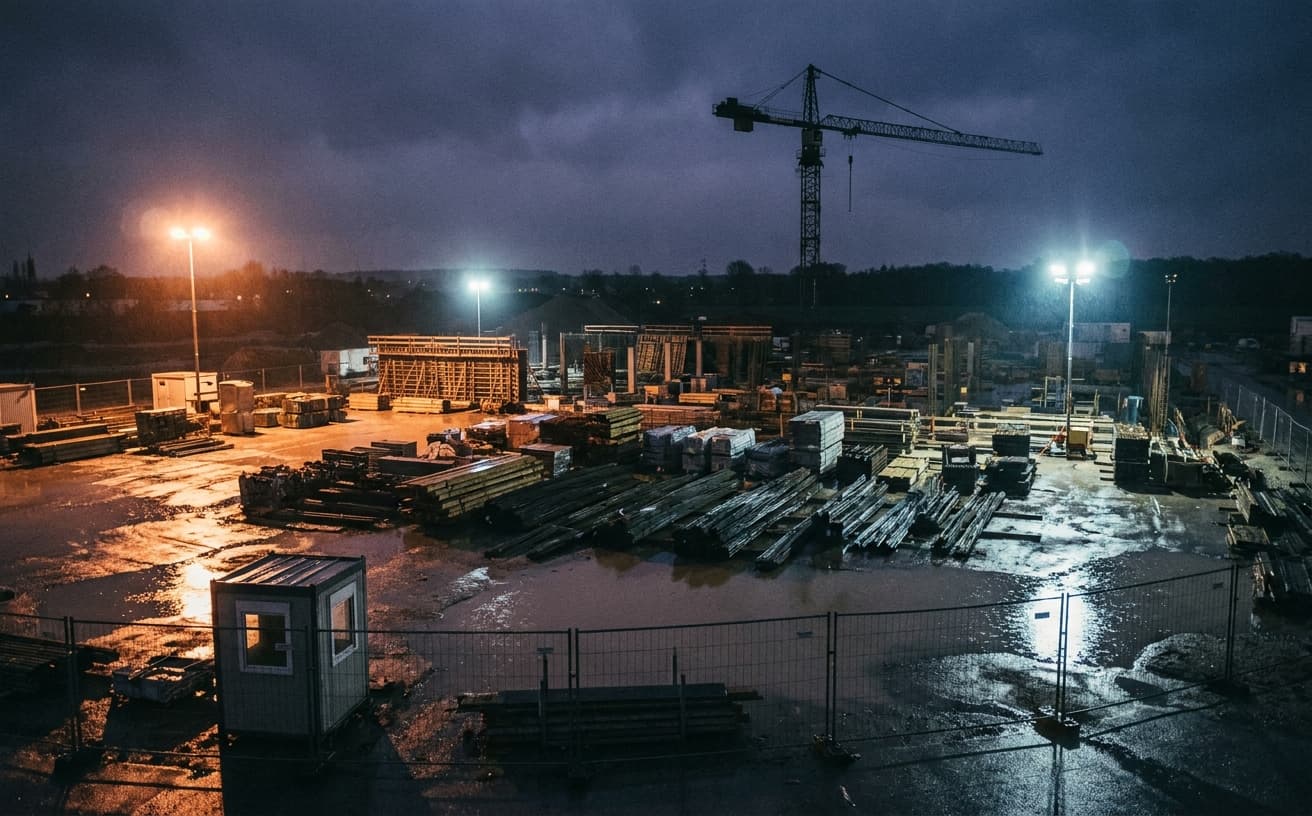
Construction site video surveillance is legal under the GDPR, provided the site operator can demonstrate a legitimate interest, restricts the camera's field of view to the site itself, and signposts the monitoring clearly. In practice, protecting expensive plant, materials and fuel against theft and vandalism is a textbook "legitimate interest" under Article 6(1)(f) GDPR — but the deployment must be documented, proportionate and privacy-aware. This guide sets out what British and international B2B buyers need to get right, and where a mobile surveillance tower or an autonomous security robot outperforms both fixed CCTV and traditional guarding.
Is construction site video surveillance allowed under the GDPR?
Yes. Video surveillance is treated as processing of personal data whenever it captures identifiable people, so it falls squarely under the GDPR (and, for UK sites, the UK GDPR plus the Data Protection Act 2018). The lawful basis on most sites is legitimate interest: preventing theft, arson, trespass and liability incidents. Construction sites are among the highest-loss environments in the built economy — industry bodies estimate plant and material theft costs the sector hundreds of millions of euros annually, and only a minority of stolen equipment is ever recovered. That loss profile is exactly what justifies proportionate monitoring.
The catch is that "legitimate interest" is not a blank cheque. It must survive a balancing test against the privacy rights of workers, subcontractors and passers-by. Get the scope right and you are compliant; overreach and you invite complaints, fines and unusable evidence.
What conditions must be met to stay compliant?
A compliant deployment rests on a short, testable checklist:
- Necessity and proportionality. Surveillance must be genuinely needed and no more intrusive than required — typically justified outside working hours, on perimeters and around high-value storage.
- Field-of-view discipline. Cameras must point at the site, not at neighbouring properties, public pavements or streets. Privacy masking of any bleed-over area is expected.
- Signage. Clear notices at every entrance stating who is monitoring, why, the lawful basis and how to exercise data-subject rights.
- Data minimisation and retention. Keep footage only as long as necessary — commonly 48 to 72 hours unless an incident triggers longer retention.
- Documentation. A Data Protection Impact Assessment (DPIA) and an entry in your record of processing activities.
How do the surveillance options compare on cost and compliance?
Buyers usually weigh three approaches: a live security guard, a mobile video surveillance tower, and an autonomous security robot. The compliance obligations above apply to all three — but the cost, coverage and evidential quality differ sharply.
| Approach | Typical cost | Coverage | GDPR profile | Best for | |---|---|---|---|---| | Manned guarding | ~€4,000–6,000 / month, recurring | One person, one vantage point; fatigue-limited at night | Lawful, but body-worn/handover footage is inconsistent | Short, staffed daytime phases | | Mobile surveillance tower | from €8,900 (one-off) | Fixed 360° zone, thermal + AI detection, 24/7 | Easy to scope, mask and signpost | Perimeters, laydown yards, single-point deterrence | | Autonomous security robot | from €78,000 (one-off) | Patrols the whole site on programmed routes | Route-based, evidential 4K + audit trail | Large, multi-zone or KRITIS-grade sites |
The economics are decisive. A single guard at roughly €4,000–6,000 per month exceeds €48,000–72,000 a year — recurring, indefinitely. A mobile surveillance tower from €8,900 pays for itself against guarding inside a single season and then runs at negligible cost, 24/7, without shift gaps. An autonomous security robot from €78,000 amortises over its service life while covering ground no static camera and no single guard can.
Why do a tower and a robot make compliance easier, not harder?
Because they make scope explicit. A mobile tower's cameras are fixed and configured on installation, so field-of-view masking and signage are set once and stay set. An autonomous robot patrols defined routes, producing a timestamped audit trail that documents exactly when, where and why footage was recorded — precisely the evidence a DPIA and an accountability review call for. Both systems are engineered for minimised retention and encrypted storage, and both are KRITIS-capable for critical-infrastructure projects where documentation standards are strictest.
Frequently Asked Questions
Do I need employee consent to film a construction site?
Generally no. Consent is a weak basis in an employment context because it is rarely "freely given". Most sites rely on legitimate interest instead, backed by a DPIA and transparent signage. Workers must be informed, but their individual consent is not the lawful basis you build on.
How long can construction site footage be kept?
Only as long as necessary for the purpose. A common, defensible practice is automatic deletion after 48–72 hours, with longer retention only where footage documents a specific incident under investigation. Indefinite retention is not compliant.
Can cameras cover the public pavement or a neighbour's land?
No. Surveillance must be confined to your own site. Any unavoidable overlap must be privacy-masked in software. Filming public space or adjacent property without justification is the single most common cause of GDPR complaints on construction sites.
Is a mobile surveillance tower more compliant than fixed CCTV?
It is easier to keep compliant. Its fixed field of view, built-in privacy masking, one-time signage and short-retention storage are configured on deployment and do not drift — reducing the risk of accidental over-collection that fixed multi-camera CCTV networks are prone to.
The modern, compliant alternative to classic guarding
Manned guarding is expensive, inconsistent overnight and hard to audit. Fixed CCTV is cheap but blind between cameras and easy to misconfigure. A mobile surveillance tower from €8,900 and an autonomous security robot from €78,000 close both gaps: continuous 24/7 coverage, AI-driven detection, encrypted evidential footage and the documentation trail the GDPR demands — engineered in Germany by BOSWAU + KNAUER, manufacturing since 1892 in Filderstadt.
Ready to specify a GDPR-compliant setup for your site? Configure your surveillance tower or security robot or contact our team for a proportionality assessment and a fixed quotation.
Related topics
- Buy a Video Surveillance Tower: The 2026 Buyer's Guide
- Security Guard vs Camera Tower Cost: Which Wins in 2026?
- Rent a Camera Tower: Costs, Options & When to Buy
- Mobile Video Surveillance: The Complete B2B Guide
- Construction Site Surveillance: The 24/7 Site Guide
Take the next step: See prices & ROI · Explore the products · Send a no-obligation request. BOSWAU + KNAUER – direct from the factory in Filderstadt, reply within 5 working days.
About the author
Dr. Raphael Nagel (LL.M.) is founding partner of Tactical Management. He acquires and restructures industrial businesses in demanding market environments and writes on capital, geopolitics, and technological transformation. raphaelnagel.com
More reading
Since 1892.
The firm is reached at boswau-knauer.de or +49 177 2266267.