
Blog
Security Robot vs Human Guard: The Honest Five-Year Math
A line-by-line model of total cost of ownership over five years, including downtime, training, and incident response.

Dr. Raphael Nagel
April 15, 2026
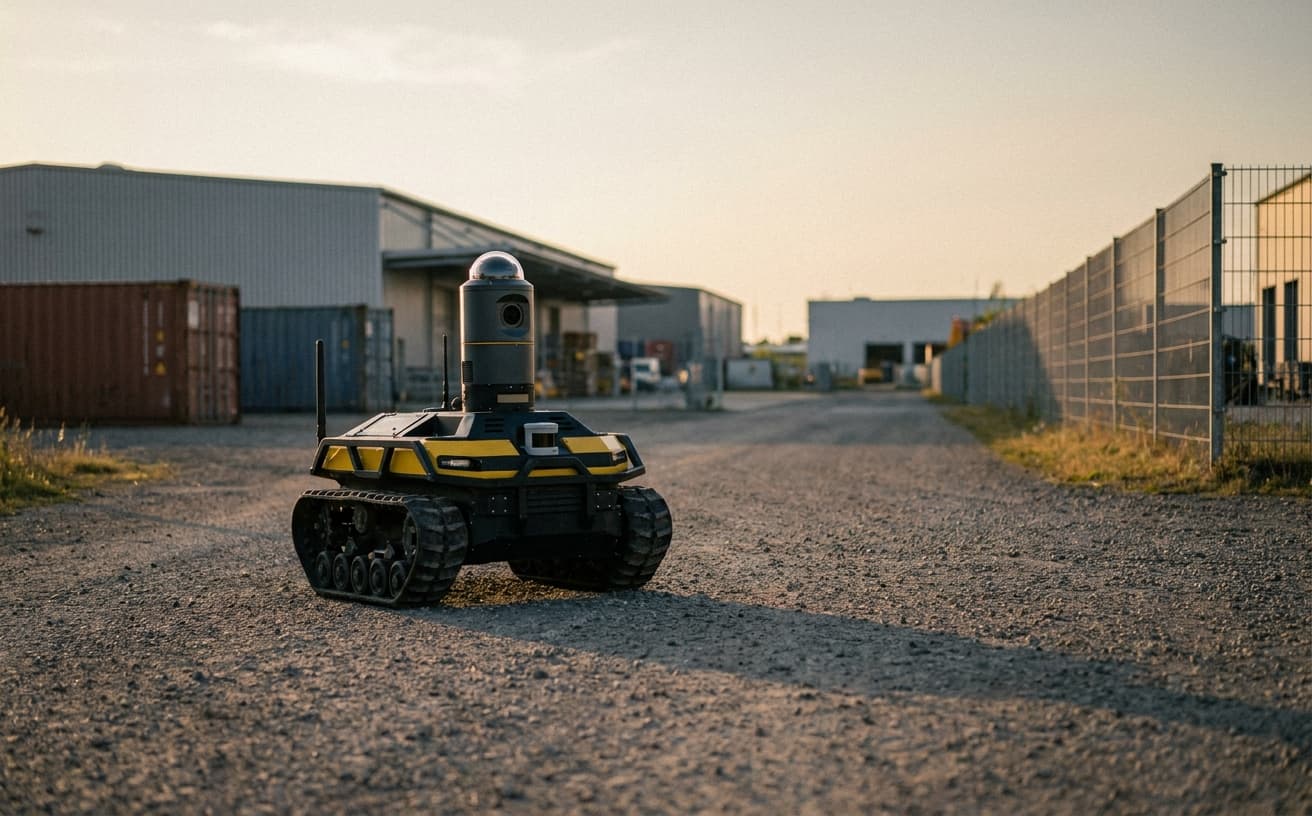
Most published comparisons between security robots and human guards are written by people who own one of the two. The honest number sits between the vendor brochure and the works council memo, and it is not a single number but a curve over five years.
The argument that follows assumes a real site, not a demonstration hall. It assumes weather, downtime, firmware updates, holidays, sick leave, insurance audits, and at least one incident the operator would prefer not to remember. It assumes that the question is not philosophical but financial: across sixty months of continuous operation, which configuration delivers more security per unit of capital spent. The answer depends on inputs that vendors avoid and that operators rarely model line by line.
The asymmetry of the starting line
A human guard appears cheap on day one because the cost structure is operating expenditure with no capital outlay. A security robot appears expensive on day one because the cost structure inverts: capital outlay first, operating expenditure later. Anyone who compares the two on day one will conclude that the guard is cheaper, which is correct and irrelevant. The relevant comparison is the integral under the cost curve, not the height of the curve at any single point.
For a single guarded position covered continuously, the staffing requirement in Germany lands between 4.2 and 4.6 full-time equivalents once vacation, sick leave, training hours, and statutory rest periods are accounted for. ASIS International publishes guidance on this multiplier and most operators arrive at a similar figure independently. At fully loaded cost, this position consumes a six-figure sum annually before any management overhead is added. The number is not controversial. What is controversial is the assumption that the position is actually covered for the hours billed, which audits across the German guarding sector regularly disprove.
A robot platform sized for the same coverage area carries an acquisition cost in the mid five figures to low six figures, plus a service contract that typically runs at fifteen to twenty percent of acquisition value per year. The robot does not take vacation, does not call in sick, does not lose attention at four in the morning, and does not negotiate its wage. It also does not climb stairs gracefully, does not de-escalate a confrontation, and does not testify in court. Each side has a list of things the other cannot do. The honest comparison reconciles both lists rather than pretending one is empty.
The asymmetry compounds over time because the guard cost rises with collective bargaining agreements, social security adjustments, and statutory minimum wage increases, while the robot cost falls in nominal terms as the asset depreciates and the service contract stabilises. By year three, the curves cross for most realistic configurations. By year five, the gap is wide enough that the conversation is no longer about whether technology pays back, but about which positions still warrant a human presence and why.
What the vendor pitch leaves out
Robotics vendors present cost models that assume one-to-one replacement of a guarded position, full uptime, and zero integration cost. None of these assumptions survives contact with a site. A robot replaces a guard only in the routine patrol component of the role, which in most positions accounts for forty to sixty percent of the working hours. The remaining hours involve access control, visitor handling, key management, incident response, and tasks that emerge because the guard happens to be the only person on site after eighteen hundred hours. A robot replaces the patrol. It does not replace the position.
Uptime is the second omission. A platform built for industrial duty will deliver above ninety-five percent availability in the first year, but only if the operator has factored in charging cycles, weather-related shelter requirements, firmware update windows, and the inevitable replacement of components that wear faster than the specification sheet suggests. Realistic budgeting assumes between six and ten percent of operating hours unavailable, with the bulk falling in the first six months as the integration matures. Vendors who quote ninety-nine percent are quoting laboratory conditions.
Integration cost is the third omission and the most consequential. A robot is not a stand-alone asset. It feeds into a video management system, an alarm receiving centre, an access control platform, and increasingly into the operator's insurance documentation chain. Each integration point carries engineering hours, licensing fees, and ongoing maintenance. NIST Cybersecurity Framework 2.0 and IEC 62443 both treat networked physical security devices as part of the operational technology perimeter, which means that the robot inherits the cyber hygiene obligations of any industrial endpoint. Operators who skip this step pay for it later in the form of insurance findings or, in regulated sectors, in audit deficiencies under ISO 27001 and NIST 800-53 control families that auditors increasingly extend into the physical layer.
The honest model includes all three items. A configuration that ignores them produces a payback period of eighteen months, which sells well and delivers poorly. A configuration that accounts for them produces a payback period between thirty-two and forty-four months for typical industrial and logistics sites, which sells less well and delivers as promised.
The five-year line items, in order
A defensible five-year model contains sixteen line items, divided into capital, operating, downtime, training, and incident response categories. The capital block contains acquisition of the platform, charging infrastructure, networking hardware, and integration engineering. The operating block contains the service contract, energy consumption, connectivity fees, software licences, and insurance adjustments. The downtime block contains expected non-availability and the cost of backfill, which in most configurations is a partial human presence during transition periods. The training block contains operator certification, refresher cycles, and the cost of the learning curve for the first two quarters. The incident response block contains the cost of human dispatch when the robot detects something that requires intervention.
Each line moves over time. Capital is front-loaded and depreciated over the five-year horizon, with a residual value that depends on the platform's resale market and on how aggressively the manufacturer iterates the product line. Operating costs rise modestly with inflation but stabilise as the platform matures. Downtime costs fall after the first year as integration issues are resolved. Training costs are highest in year one and drop to a maintenance level thereafter. Incident response costs vary with the threat environment and are the line item most often modelled badly because operators forget that a robot generates more verifiable detections than a guard, which means more dispatches in the early phase until the alarm tuning settles.
The guard comparison has fewer line items but each one is heavier. Wages including employer contributions, supervision overhead, training, equipment, vehicle costs where mobile patrols are involved, replacement during absences, and the loaded cost of recruitment in a market where the BSI and the GDV both note that qualified guarding personnel are increasingly scarce. NICB data from comparable markets confirms that turnover in private security exceeds twenty percent annually, which means that the cost of recruitment and training is not a one-time entry but a recurring one. A site that books a guard cost of fifty euros per hour is paying for the guard, the recruiter, the trainer, the supervisor, the vehicle, the radio, and the fraction of the position that is not actually being delivered. The robot pays for itself, the network, the service, and the operator who supervises ten of them at once.
When both models are built with the same discipline, the five-year total cost of ownership for a routine perimeter patrol position lands between sixty and seventy-five percent of the guarded equivalent for the robot configuration, depending on site complexity and integration depth. The lower end applies to industrial and logistics sites with simple geometries. The upper end applies to construction sites with frequent layout changes and to facilities where the integration into existing operational technology is non-trivial.
Where the robot wins later than vendors claim
Three categories of site delay the crossover beyond the typical thirty-six months. The first is multi-storey facilities with significant indoor coverage requirements. Current platforms handle outdoor perimeters and ground-floor industrial spaces well. They handle stairs, lifts, and complex indoor navigation less well. Sites with substantial indoor patrol requirements still benefit from a hybrid model in which the robot covers the outdoor envelope and a reduced human presence covers the interior. The crossover for these sites sits closer to forty-eight months.
The second category is sites with high visitor volumes and access control complexity. A robot can detect a person at the gate and alert an operator. It cannot read a contractor's identification, ask the right follow-up question, and decide whether the visitor is on the approved list for that day. Access control can be automated, but the marginal cost of full automation often exceeds the marginal cost of a human at the gate combined with technology in the patrol role. The crossover for these sites depends on visitor volume and is rarely before year four.
The third category is sites with legacy infrastructure that cannot easily accommodate the network and power requirements of a modern robotics platform. Retrofitting a thirty-year-old industrial facility to support continuous robotic patrol can add a six-figure capital line that the vendor's standard model does not include. CISA guidance on operational technology environments treats such retrofits as part of the resilience investment, but the operator carries the cost regardless of how it is classified. For these sites, the honest answer is that the robot is the right long-term choice but the wrong short-term one, and a phased approach over two budget cycles delivers a better outcome than a forced deployment.
These three categories do not invalidate the technology. They invalidate the vendor claim that the technology pays back universally within twenty-four months. The technology pays back, but it pays back when the site fits the platform, not when the platform is forced onto the site.
Where the robot wins earlier than skeptics believe
Two categories of site reach crossover faster than the average and often within twenty months. The first is large outdoor industrial and logistics sites with simple perimeters, stable layouts, and twenty-four-hour operations. These sites have the largest guarding cost base, the lowest integration friction, and the highest marginal benefit from continuous documented patrol. The robot delivers an audit trail that the guard cannot match, which compounds the financial argument with a compliance argument that becomes more relevant each year as supply chain security obligations expand.
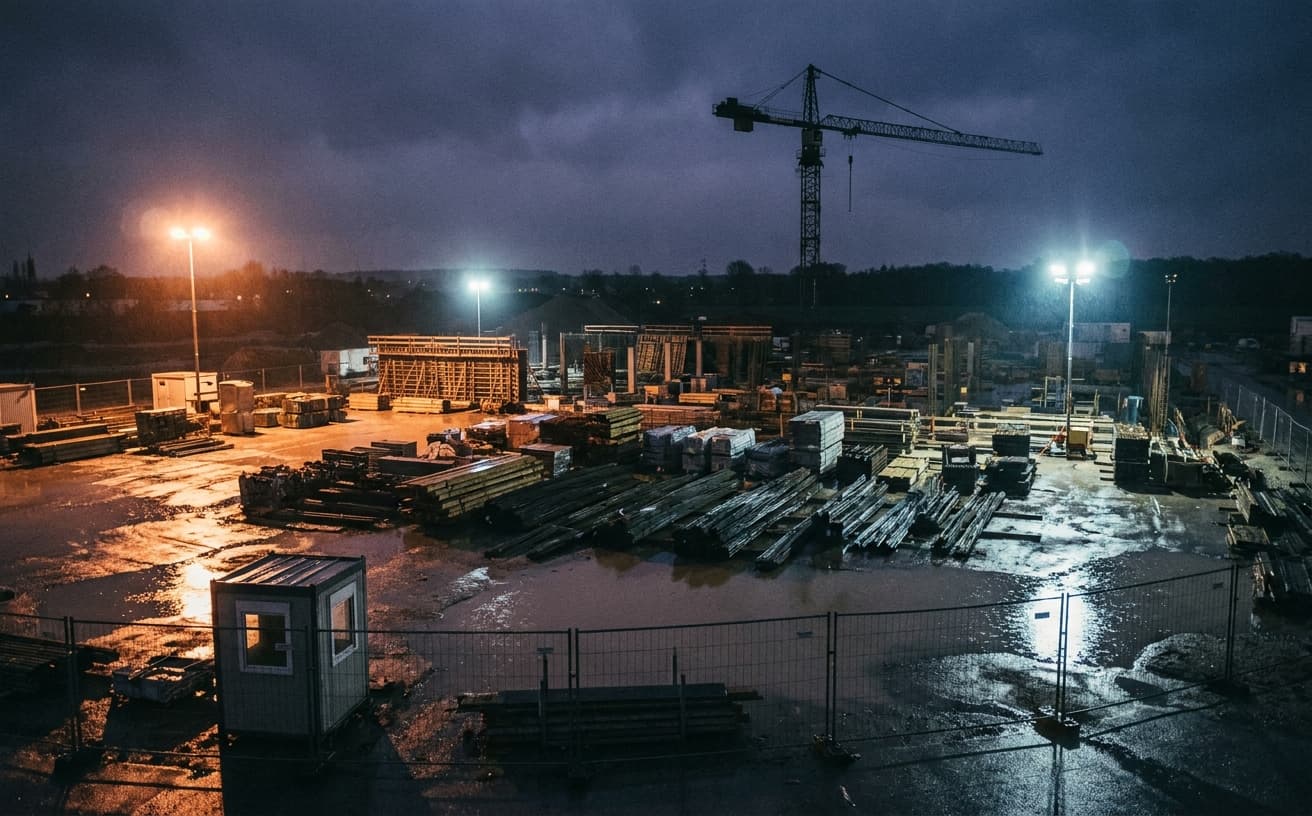
The second is construction sites with material values above the single-digit million range. The chapter on security as investment in BOSWAU + KNAUER. From Building to Security Technology develops this argument in detail. Construction sites have short horizons, high material exposure, and a guarding cost structure that scales linearly with site duration. A mobile robotics deployment combined with a video tower and remote operation can reach payback within a single project phase if the site duration exceeds nine months. The skeptic position assumes that construction sites are too temporary to justify the investment. The reverse is true for any site above the value threshold, because the cost of a single major incident exceeds the entire technology investment for the project duration.
The deciding variable in both categories is not the technology cost but the incident cost. A site that has never suffered a significant incident underestimates the value of prevention. A site that has suffered one knows the value precisely. Most operators learn this in the wrong order.
What the model does not capture
The model captures cost. It does not capture the second-order effects that determine whether the deployment succeeds beyond the spreadsheet. A robot that performs as specified but is resented by the remaining guarding staff will be sabotaged in subtle ways that show up as availability problems and never as deliberate acts. A deployment that is announced as a cost-cutting measure produces this outcome reliably. A deployment that is announced as a force multiplier and that pairs the robot with retained human personnel in elevated roles produces the opposite outcome. The same hardware, the same software, the same site. The framing determines the result.
The model also does not capture the insurance dimension. GDV statistics show that insurers are increasingly differentiating premiums based on the documented quality of the protection regime. A site that can demonstrate continuous documented patrol with timestamped video evidence and tamper-resistant logging negotiates differently from a site that relies on guard reports written in pencil. The premium delta is rarely the headline number, but over five years it accumulates into a meaningful contribution to the return on investment.
Finally, the model does not capture the strategic option value. A site that deploys a robotics platform builds operator capability, integration experience, and data infrastructure that compounds across future projects. The first deployment is expensive. The fifth deployment is cheap, because the organisation has learned. Operators who model only the first deployment underestimate the return because they treat each deployment as a standalone investment. The honest model treats the first deployment as a capability investment whose return is realised across the next four.
What holds
The five-year math favours the robot for most industrial, logistics, and large construction sites, with a payback window between thirty-two and forty-four months for typical configurations and a meaningful improvement in documented coverage quality from day one. The math favours the guard for sites with high human-interaction requirements, complex indoor geometries, and limited site duration below the value threshold. The math favours a hybrid model for almost everything in between, which is most of the market.
The honest conclusion is not that the robot wins or the guard wins. The honest conclusion is that the operator who models the question line by line, with realistic assumptions on uptime, integration, training, and incident response, makes a better decision than the operator who relies on either the vendor brochure or the works council memo. Most operators have not run this model. The ones who have rarely regret the deployment that follows.
For operators considering a structured assessment, the three to five day audit described in the closing pages of BOSWAU + KNAUER. From Building to Security Technology produces the five-year model for a specific site with documented assumptions and a defensible payback calculation. The output is a report the operator can act on, with or without further engagement. A sixty-minute confidential conversation precedes the audit for operators who want to test the approach before committing budget. The ninety-day pilot follows for operators who want to validate the model with measured data rather than projected data. The sequence is the same in every case: model first, then measure, then scale.
Frequently asked questions
When does a security robot reach ROI parity with a guard?
For typical industrial and logistics sites with simple outdoor perimeters and continuous operations, parity is reached between month thirty-two and month forty-four after deployment, assuming realistic uptime, integration, and training costs. For large construction sites above the material value threshold and with durations exceeding nine months, parity can occur within a single project phase. For sites with complex indoor coverage requirements, high visitor volumes, or significant retrofit needs, parity moves to month forty-eight or later. The variable that matters most is not the technology cost but the guarding cost base being displaced and the integration friction at the specific site.
What downtime should be budgeted for a robot?
A realistic budget assumes between six and ten percent of operating hours unavailable in the first year, falling to three to five percent from year two onward. The first six months carry the bulk of integration-related downtime as alarm tuning, navigation mapping, and operator workflows mature. Charging cycles, scheduled maintenance, firmware updates, and weather-related interruptions account for the remainder. Vendors who quote above ninety-five percent availability for year one are quoting laboratory conditions. Operators who budget below ninety percent for year one are over-provisioning. The honest planning range sits between ninety and ninety-four percent for the first twelve months.
How does insurance treat a robot deployment?
German insurers, guided by GDV frameworks, increasingly differentiate premiums based on documented protection quality rather than headcount. A robot deployment that produces tamper-resistant logs, timestamped video evidence, and verifiable patrol coverage typically supports a premium discussion that a traditional guarding regime does not. The discount is rarely automatic and depends on the underwriter, the site profile, and the integration with the alarm receiving centre. Operators should model insurance impact as a contributing line rather than a headline driver. Documentation discipline aligned with ISO 27001 and ASIS International guidance strengthens the negotiation. The savings are real but secondary to the direct cost displacement.
What guard tasks does a robot not perform?
A robot does not handle access control decisions that require judgement, does not de-escalate human confrontations, does not testify credibly in court, does not perform first aid, does not handle key management for ad-hoc visitors, and does not navigate complex indoor environments with stairs and lifts gracefully. It also does not represent the operator to third parties in the way a uniformed human presence does, which matters on sites where visible authority is part of the protection regime. For these reasons, the realistic deployment model is rarely full replacement and almost always a hybrid in which the robot absorbs routine patrol while a reduced human presence handles the tasks that require judgement, dexterity, or institutional representation.
Related topics
- Extreme Heat & Security Robots in the Gulf: 55C
- Security Robots in Saudi Arabia: Vision 2030 & NEOM
- Security Robot Rental: What Pricing Says About Vendors
- Security Robots in Qatar: MOI Standards & Legacy
- Who Is Liable When a Security Robot Misses an Incident
Take the next step: See prices & ROI · Explore the products · Send a no-obligation request. BOSWAU + KNAUER – direct from the factory in Filderstadt, reply within 5 working days.
About the author
Dr. Raphael Nagel (LL.M.) is founding partner of Tactical Management. He acquires and restructures industrial businesses in demanding market environments and writes on capital, geopolitics, and technological transformation. raphaelnagel.com
More reading
Since 1892.
The firm is reached at boswau-knauer.de or +49 177 2266267.