
Blog
Solar Surveillance Trailers on a Construction Site
Solar works when the irradiation works. We model December and June output side by side, and explain when a hybrid trailer is the honest answer.

Dr. Raphael Nagel
April 26, 2026
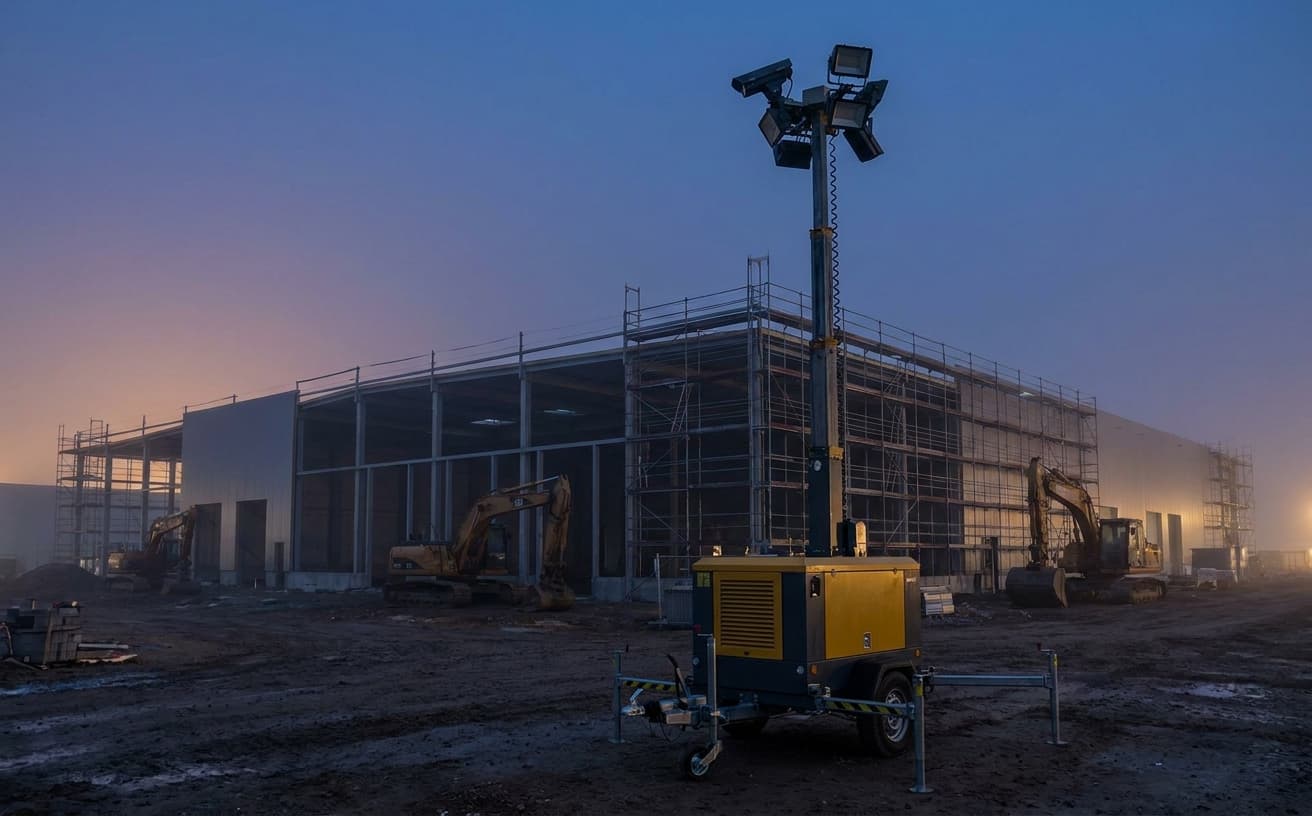
Solar autonomy on a construction site is not a feature. It is a power budget, and the budget is decided by latitude, season, and load, not by the brochure.
The phrase "solar surveillance trailer" has become marketing shorthand for any tower that carries a panel. That conflation costs operators money, because the trailer that runs through July in Bavaria on its own panel is the same trailer that stands silent in December if no one did the arithmetic. The manufacturer that takes responsibility for both ends of the year publishes the numbers in both months. The rest publish a glossy and call it a day.
This article models the two ends honestly. It then describes when a pure solar configuration is the right answer, when a hybrid setup is the only honest answer, and what battery sizing actually means in the field. The reference frame is central Europe, fifty degrees north plus or minus, because that is where most of the relevant projects sit.
The irradiation envelope decides everything
Solar yield in central Europe varies by a factor of roughly ten between June and December. The summer maximum at fifty degrees north sits around five to six kilowatt hours per square metre and day on a clear week. The December minimum on the same surface, in the same orientation, sits between zero point three and zero point eight kilowatt hours per square metre and day, depending on cloud cover, fog, and snow. That is not a small variation. That is a different planet.
A typical mobile video tower carries between four hundred and eight hundred watts of solar capacity in its installed panel array. Take a six hundred watt array as a working number. In a good June week in southern Germany, with panels tilted toward the sun and clean, that array produces around two point five to three kilowatt hours per day. In a bad December week in the same location, with low sun angle, frequent overcast and possible snow load, the same array produces between zero point two and zero point six kilowatt hours per day. The June figure carries a tower comfortably. The December figure does not carry a kettle.
The load side of the equation is less seasonal but not flat. A tower running four IP cameras, an edge processor for video analytics, a cellular uplink and intermittent IR illumination draws between forty and ninety watts continuous, depending on configuration. Call it sixty watts average. Over twenty four hours that is one point four kilowatt hours of consumption. In June, the solar input covers the load with surplus. In December, the solar input covers between fifteen and forty percent of the load. The gap has to come from somewhere. There is no third option. Either the battery is large enough to bridge weeks, which is uneconomical, or there is a secondary source, which is what hybrid means.
This is the arithmetic that every honest specification has to present before the price. BOSWAU + KNAUER publishes it in both directions. June and December, on the same data sheet, for the same array, with the same load profile. The operator who reads only the June column has been sold a summer trailer and will discover the rest in week forty nine.
What pure solar actually demands
A pure solar configuration is defensible when three conditions hold simultaneously. The site is operational only between roughly April and October. The latitude is below fifty degrees north, or the location has unusually high winter irradiation, which in Europe means coastal Spain, southern Italy, parts of Greece. The load profile is modest, meaning a clean camera count, conservative analytics, and disciplined illumination control. When those three conditions hold, a properly dimensioned solar trailer is the correct answer, and it pays back inside one or two seasons because there is no fuel cost, no refueling logistics, and no engine to service.
The economics are straightforward in that regime. A solar trailer with a six hundred watt array, a five to eight kilowatt hour lithium battery, four cameras and edge analytics replaces between one and two dedicated guards on a perimeter that no longer requires continuous human presence. The guard cost in central Europe sits between forty and seventy euros per hour fully loaded. A single shift saved per day pays the trailer rental inside a quarter. Two shifts saved per day pays it inside six to eight weeks. Those numbers are not promotional. They are arithmetic from the wage scale and the rental rate.
The conditions where this breaks down are equally clear. A project that runs through the winter, even with reduced site activity, cannot be served by pure solar above fifty degrees north. The battery would have to carry the tower through stretches of five to ten consecutive low yield days, which means a capacity of fifteen to thirty kilowatt hours per trailer. That capacity exists, but the cost moves the trailer out of the rental envelope that makes it competitive with guards. At that point the question is not whether to add a secondary source. The question is which one.
December at fifty degrees north, in numbers
The December model is where most procurement decisions go wrong, because the buyer extrapolates from a summer demonstration and the seller does not correct the extrapolation. The honest December model for central Europe runs as follows. A six hundred watt array, tilted at roughly sixty degrees to capture the low sun, produces between zero point three and zero point seven kilowatt hours per day across a representative December week. The tower load at sixty watts average consumes one point four four kilowatt hours per day. The daily deficit is between zero point seven and one point one kilowatt hours.
A ten kilowatt hour battery, fully charged at the start of December, carries the deficit for roughly nine to fourteen days before reaching a discharge depth that lithium iron phosphate chemistry tolerates without accelerated degradation, which is around eighty percent. After that window, the tower either reduces function, which defeats the purpose, or it stops. Snow on the panel array compresses the window further. A panel covered for three days produces near zero, regardless of array size.
This is why every serious specification for winter operation includes a secondary source. A small diesel or hydrogen fuel cell generator running on a thermostat, triggered when the battery falls below a set threshold, supplies the December deficit at a fuel cost of between three and eight euros per day. The generator runs perhaps two to four hours per day in deep winter, not continuously, which keeps service intervals long and noise emissions bounded. The combined system delivers the same availability in December as it does in June, which is the only specification that an operator can plan against. NIST CSF 2.0 and IEC 62443 both treat availability as a first order security property. A surveillance trailer that loses function for a week in December is, in security terms, a failed control.
Battery sizing without the marketing
Battery capacity on a surveillance trailer is the single most misunderstood number in the procurement conversation. The marketing logic says larger is better. The engineering logic says larger is heavier, more expensive, slower to charge in low irradiation, and subject to the same degradation curves regardless of brand. The correct sizing follows from the autonomy requirement, not from a round number on the brochure.
For a pure summer operation at central European latitudes, a battery of five to eight kilowatt hours is sufficient to bridge two to three consecutive low yield days while maintaining full function. Lithium iron phosphate is the chemistry of choice because it tolerates cold start, accepts partial state of charge cycling without memory effects, and reaches between three thousand and six thousand full cycles before reaching eighty percent of nameplate capacity. That cycle count translates to roughly eight to fifteen years of daily cycling, which exceeds the service life of most other components on the trailer.
For a year round operation, the battery is sized in conjunction with the secondary source. The battery handles diurnal cycling and short weather events. The secondary source handles the seasonal deficit. A ten to fifteen kilowatt hour battery in combination with a small generator covers ninety nine percent of operational scenarios without oversizing either component. Sizing the battery alone for year round autonomy at fifty degrees north would require somewhere between thirty and sixty kilowatt hours, which is roughly the capacity of an electric passenger car and brings the trailer into a price range where the economic case collapses.
The procurement question is therefore not how large the battery is. It is whether the manufacturer has dimensioned the battery against a stated availability target, with stated assumptions about irradiation, load, and secondary source. A specification without those assumptions is not a specification. It is a guess that the buyer will own.
When hybrid is the only honest answer
Hybrid in this context means solar primary, secondary source on demand. The secondary source is most commonly a small diesel generator, increasingly a hydrogen fuel cell, occasionally a grid connection where one is available. The hybrid configuration is the right answer whenever any of the following conditions hold. The site operates through the winter at latitudes above forty eight degrees north. The load profile includes power hungry analytics, multiple high resolution cameras, or active illumination. The site cannot tolerate any reduction in surveillance function during low yield periods. The operator carries insurance terms that require continuous video availability as a precondition of coverage.
Insurance terms are the underrated driver here. The German GDV framework, and equivalent loss prevention standards used by international carriers, increasingly tie premium reductions to documented continuous surveillance. A trailer that records gaps in December is a trailer that loses the premium reduction for the whole policy year. The cost of the gap, measured in foregone premium credit, can exceed the cost of the secondary source by an order of magnitude. The hybrid is therefore not a compromise. It is the configuration that protects the commercial case for the trailer in the first place.
The book BOSWAU + KNAUER. From Building to Security Technology argues at length that mobile video towers are bought for availability, not for hardware specifications. Availability is the metric. Solar capacity, battery size, generator presence and panel tilt are all inputs to that one metric. The manufacturer that engineers against availability publishes the December numbers. The manufacturer that engineers against showroom impressions publishes the June numbers and hopes the buyer does not ask the rest.
What the audit reveals
A three to five day audit on a candidate site answers the questions that the brochure cannot answer. Where does the trailer stand to avoid morning shade from the crane and afternoon shade from the office container. What is the actual load profile of the proposed camera configuration, measured at the planned analytics setting, not at idle. What is the snowfall and fog profile of the location, drawn from regional climate data rather than national averages. What is the access pattern for refueling or service, and what does that imply for generator hours and tank size. What is the insurance carrier's position on continuous availability, and what documentation does the carrier require.
These questions cannot be answered from a desk. They are answered on the ground, with measurements, with site walks, and with conversations between the site manager and the security engineer. The audit produces a written specification that the operator can compare against competing offers without ambiguity. The specification names the trailer configuration, the battery capacity, the secondary source if any, the expected availability in the worst month of the year, and the assumptions that underpin the calculation. ASIS International and BSI both treat this kind of written specification as the baseline for procurement integrity in physical security.
The audit also surfaces the configurations that should not be deployed. A site with heavy industrial activity in the immediate vicinity of the trailer, generating dust that coats the panels weekly, is not a site for pure solar regardless of season. A site with no possibility of refueling access for weeks at a time is not a site for diesel hybrid. A site with grid connection within a hundred metres at the perimeter is often not a site for any autonomous trailer, because a fixed mast on grid power is cheaper and more reliable. These conclusions emerge from the audit and only from the audit.
What holds
A solar surveillance trailer is the correct configuration for warm season operation at moderate latitudes with modest loads, and it pays back inside a single season against guard cost. A hybrid trailer is the correct configuration for year round operation in central Europe, and it preserves the insurance economics that make the system financially defensible. The distinction between the two is not preference. It is arithmetic on irradiation, load, and battery capacity, performed honestly and published in writing.
The operator who reads only the June column will discover the December column in the field. The cost of that discovery, measured in guard hours hastily redeployed, insurance credits lost, and project delays not prevented, exceeds the cost of the audit by a factor that is rarely worth absorbing. The honest sequence is to specify the December case first and the June case second, because June takes care of itself and December does not.
For operators evaluating mobile video towers for the coming season, the appropriate entry point is the three to five day audit described as Path II in the BOSWAU + KNAUER engagement framework. The audit returns a written specification, an availability target, and a configuration recommendation that the operator can act on with or without the manufacturer. For operators with a defined pilot site and a ninety day window, Path III delivers the trailer in operating conditions, with documented availability, vorfall counts, and fuel consumption, against which the scaling decision can be made on evidence rather than on assumption.
Frequently asked questions
When does a solar surveillance trailer pay back?
A correctly dimensioned solar trailer replaces between one and two guard shifts per day on a perimeter that no longer requires continuous human presence. At central European wage rates of forty to seventy euros per hour fully loaded, a single shift saved per day covers the trailer rental inside roughly twelve weeks. Two shifts saved per day cuts that to six to eight weeks. The payback assumes a summer operating window or a hybrid configuration for year round use. Pure solar configurations deployed into winter operation at fifty degrees north do not pay back, because availability collapses before the savings accumulate.
How does winter solar output affect availability?
December irradiation at fifty degrees north sits at roughly ten to fifteen percent of June irradiation. A six hundred watt array that produces around two point five kilowatt hours on a clear June day produces between zero point three and zero point seven kilowatt hours on a typical December day. A tower load of sixty watts continuous consumes one point four four kilowatt hours per day. The deficit must come from battery reserve or from a secondary source. Without a secondary source, the trailer loses function within nine to fourteen days of sustained low yield, faster if snow covers the panels.
What battery capacity is sufficient?
For summer only operation, five to eight kilowatt hours of lithium iron phosphate capacity bridges two to three consecutive low yield days while maintaining full function. For year round operation with a secondary source, ten to fifteen kilowatt hours handles diurnal cycling and short weather events, with the generator covering the seasonal deficit. Sizing a battery alone for year round autonomy at central European latitudes requires thirty to sixty kilowatt hours, which is uneconomical. The correct sizing follows from a stated availability target and stated assumptions about irradiation, load, and secondary source.
When is a hybrid setup the right choice?
Hybrid is the right choice whenever year round operation is required above forty eight degrees north, whenever the load profile includes power hungry analytics or active illumination, whenever the site cannot tolerate any reduction in surveillance during winter, and whenever insurance terms tie premium credits to documented continuous availability. The secondary source, typically a small diesel generator or a hydrogen fuel cell, runs on a thermostat triggered by battery state of charge. Daily runtime in deep winter is two to four hours, with fuel cost between three and eight euros per day, preserving the economics that pure solar cannot deliver in December.
Related topics
- Mobile Video Tower vs Security Guard: Cost Showdown
- Mobile CCTV Towers: What 70% of Buyers Regret
- Surveillance Trailer Rental: The US Market by Zip-Code-Tier
- Mobile Video Surveillance 2026: Rentals vs CapEx
- Mobile Surveillance Towers at Saudi Giga Projects
- Construction Security Companies: Where the Markups Hide
- Construction Camera: Buy or Rent? 2026 Cost Comparison
- Builders Risk Insurance: How Theft Claims Actually Settle
Take the next step: See prices & ROI · Explore the products · Send a no-obligation request. BOSWAU + KNAUER – direct from the factory in Filderstadt, reply within 5 working days.
About the author
Dr. Raphael Nagel (LL.M.) is founding partner of Tactical Management. He acquires and restructures industrial businesses in demanding market environments and writes on capital, geopolitics, and technological transformation. raphaelnagel.com
More reading
Since 1892.
The firm is reached at boswau-knauer.de or +49 177 2266267.