
Blog
AI Video Analytics for RTA Dubai: Traffic Meets Security
RTA-managed corridors, smart pole infrastructure, AI as joint traffic-security signal. Where public and private overlap in Dubai.

Dr. Raphael Nagel
May 23, 2025
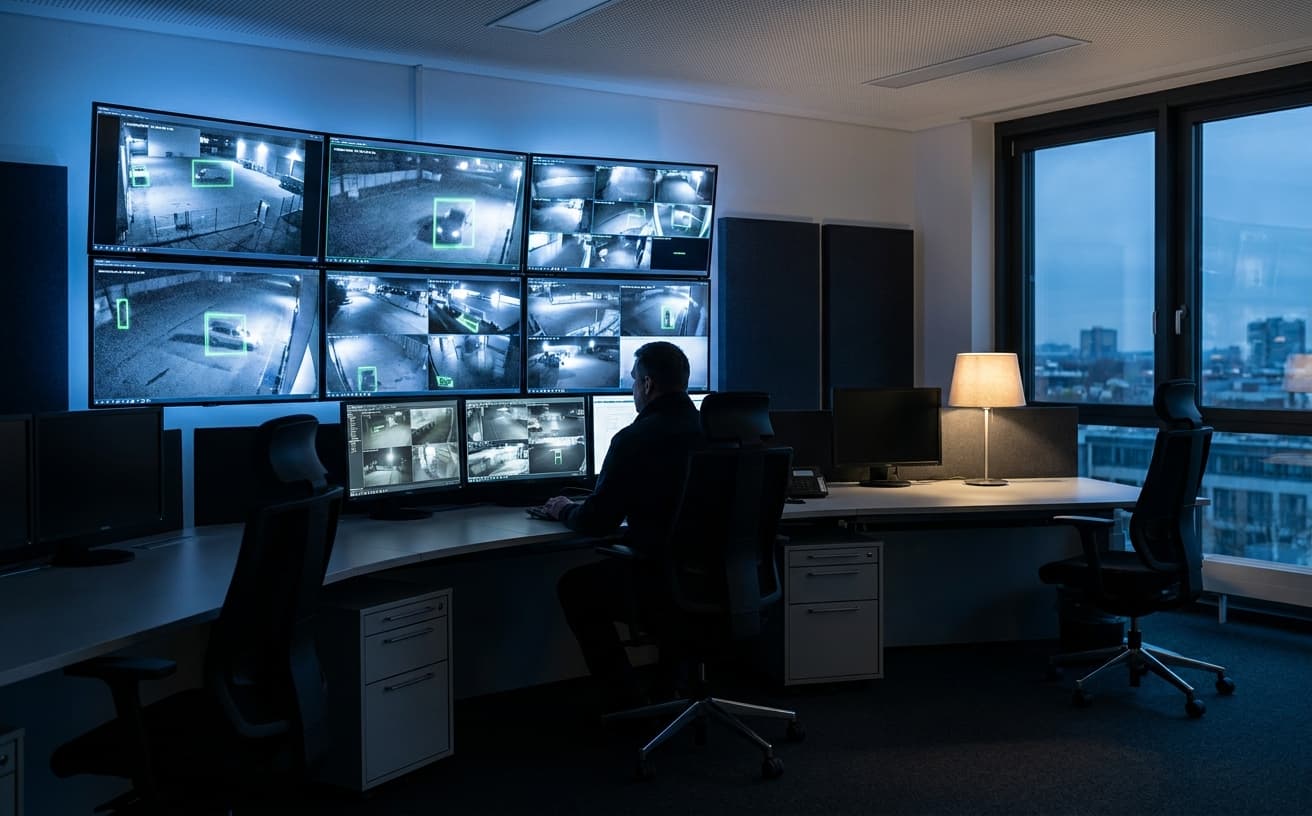
In Dubai, the line between a traffic signal and a security signal is no longer a line. It is a question of who reads the data first.
The Roads and Transport Authority operates one of the densest sensor estates of any city in the Gulf. Cameras at junctions, automatic number plate readers on Sheikh Zayed Road, weight sensors in bridges, induction loops at toll gantries, and a generation of smart poles that combine all of these in one mast. The original purpose of the estate was traffic management. The data, however, does not stop at the boundary of traffic. It crosses, almost by accident, into the territory of public security, perimeter protection, incident response, and forensic reconstruction. The operator who recognises this crossing earlier than the others gains an advantage that is structural rather than tactical.
This article describes the overlap as the manufacturer sees it from the private side of the fence. It is not a description of what the RTA does internally. It is a description of where the private operator, the construction site manager, the logistics yard supervisor, and the industrial security lead come into contact with RTA-managed infrastructure, and what that contact implies for how a private AI video analytics deployment should be designed.
The estate the RTA actually runs
The Roads and Transport Authority manages an infrastructure base that is, in scale and integration, closer to a national transport ministry than to a municipal traffic department. The corridors under its control include the principal motorways of the emirate, the Dubai Metro, the tram network, public bus operations, marine transport along the Creek and the coast, and the e-hailing and taxi framework. Each of these subsystems generates a continuous data stream. Each stream is, in some form, observable. The question for the private operator is not whether the RTA sees something. The question is what subset of what it sees is available for joint operational use, and under what conditions.
Smart pole infrastructure illustrates the point. A smart pole on a Dubai arterial road carries lighting, a traffic camera, an ANPR unit, environmental sensors for air quality and noise, and in many cases a fifth-generation cellular small cell. The pole is a single physical asset with multiple logical owners. The lighting belongs operationally to Dubai Municipality through DEWA. The traffic camera belongs to the RTA. The ANPR may be shared between the RTA and Dubai Police. The cellular small cell belongs to du or Etisalat. The pole itself is procured under a unified specification, which means that integration at the hardware layer is, by design, already solved. The integration that is not solved, in any city of comparable scale, is the governance layer. Who is allowed to query whose feed, at what latency, under which legal basis, with which retention.
For the private operator next to this infrastructure, the practical consequence is twofold. The site does not need to replicate what the public estate already provides at the boundary. And the site must accept that the boundary is observed by an authority whose priorities will, in a contested moment, override the site's own. The design of the private deployment has to take both points seriously. A camera plan that ignores the smart pole twenty metres from the gate is a camera plan that pays twice for the same field of view. A camera plan that assumes the smart pole will always be available, in the form it has today, is a plan that has not read its own assumptions.
Where traffic data becomes security data
The conversion from traffic data to security data is not a technical operation. It is a question of interpretation. The same vehicle trajectory across the same junction at the same time of day means one thing to a traffic engineer optimising signal phases and another thing to an investigator reconstructing the movement of a target vehicle. The pixels are identical. The classification, the retention period, the access control, and the downstream workflow are not.
AI video analytics is the discipline that performs this conversion at scale. A model trained on the RTA's traffic flow data learns what normal looks like at every junction, every hour, every day of the week. Anomalies that are invisible to a human observer, because the human observer cannot hold the baseline of ten thousand junctions in mind, become legible to the model. A vehicle that loiters at a service road entry for longer than the local distribution would predict is flagged. A pedestrian path through a logistics yard that does not match the shift schedule of the operator is flagged. A convoy of vehicles whose plates have not previously appeared together on the same corridor at the same time is flagged. None of these flags is, by itself, a security event. Each is a signal that an operator with security responsibility can examine alongside other signals.
The architecture that supports this conversion has to satisfy two requirements that do not naturally coexist. It has to be fast enough to act on signals that decay within seconds, which means inference at the edge. It has to be deep enough to detect patterns that are only visible across weeks of data, which means a central analytics layer. The standard reference for this kind of dual architecture is found in the NIST Cybersecurity Framework 2.0 and in the industrial control system guidance of IEC 62443, both of which separate the function of real-time detection from the function of forensic analysis without treating them as belonging to different products. BOSWAU + KNAUER. From Building to Security Technology argues, in its chapter on AI-supported video analytics, that the manufacturer who cannot deliver both layers in the same platform is delivering half a system.
The private deployment that sits next to RTA infrastructure inherits this dual architecture as a constraint. The edge has to work without the public network. The centre has to work with the public network when the public network is available. Neither can assume the other.
The smart pole as a shared physical layer
The smart pole programme in Dubai was conceived as a unification of street furniture. In practice, it has become a unification of sensor budgets. A single mast that carries lighting, traffic observation, environmental monitoring, and cellular access is cheaper to deploy and maintain than four separate masts. It also concentrates risk. A failure at the base of the pole takes out four functions. An attack on the pole, physical or logical, reaches four authorities simultaneously.
For the private operator considering whether to extend cameras onto adjacent public infrastructure, the smart pole is both opportunity and exposure. The opportunity is reach. A camera mounted on a smart pole twenty metres into the public right of way sees the approach to the site, not only the perimeter. The exposure is sovereignty. A camera mounted on infrastructure that is owned and managed by the RTA is a camera whose feed sits, at least in the logical sense, on someone else's network. The contractual terms under which such a camera can be installed are not standard across operators or across emirates. They are negotiated case by case, and the negotiation is conducted by parties whose interests are not aligned with the manufacturer's.
The manufacturer's position, in this situation, is to design for both possibilities. The system should work when the smart pole is available as a host. It should work when the smart pole is not available, and the operator has to deploy a mobile mast on the private side of the fence. The decision between the two should be operational, not architectural. A platform that requires re-engineering when the host changes is a platform that has bound the customer to a single jurisdictional assumption. The manufacturer who has done the work of separating the camera, the analytics, and the host loses nothing when the host changes. The customer who has bought such a platform retains the ability to negotiate with the public authority from a position of independence.
This is the practical meaning of the principle that runs through the longer work referenced above: build for portability, build for separation of concerns, and refuse to build for a single political configuration. The configuration changes. The asset has to outlive the configuration.
Joint use, governance, and the limits of cooperation
The phrase joint use, in the context of public-private security cooperation, has a specific meaning in Dubai that differs from its meaning in European or North American contexts. In Europe, joint use is generally understood as data sharing under a formal agreement, often constrained by GDPR or its national equivalents. In the United States, joint use is governed by a patchwork of state laws and federal guidance, with CISA providing voluntary frameworks for critical infrastructure operators. In Dubai, joint use is closer to a system of layered access, in which the public authority retains primary control of its data and grants secondary access to private operators under conditions that are reviewed continuously.
The practical effect for the manufacturer is that the integration interface to RTA systems is not a published API. It is a relationship. Access is granted to operators who have demonstrated capability, who have submitted to the relevant security clearances, who have committed to data handling standards that are at least equivalent to ISO 27001 controls, and who have built their systems on architectures that satisfy the principles of IEC 62443. The relationship is not transactional. It is cumulative. An operator who has worked with the RTA on three projects has a different position from an operator who is presenting credentials for the first.
This has consequences for how a private deployment should be designed at the data layer. The deployment has to be capable of operating in three modes. The first is fully autonomous, with no data exchange with public systems, which is the default for new operators or for sites where joint use has not been agreed. The second is unidirectional, in which the private operator receives alerts or context from public systems but does not transmit. The third is bidirectional, in which the private operator both receives and transmits, under defined conditions. A platform that supports only one of these modes is a platform that will be re-engineered every time the operator's relationship with the public authority advances.
The governance frameworks that inform this design are not unique to Dubai. The work of ASIS International on enterprise security risk management, the guidance of the BSI in Germany on critical infrastructure protection, and the NIST 800-53 control catalogue all converge on the same principle. The interface between private and public security data is a control point, not a pipe. It has to be designed as a control point from the beginning.
What sensors actually do the work
A useful question for any private operator entering this environment is which sensors generate the data that matters. The answer is not the camera alone. The camera generates the highest volume of data, but it is not always the sensor with the highest information density per event. The sensors that do the operational work in the Dubai context fall into four groups.
Optical cameras with sufficient resolution and frame rate to support both human review and machine classification. These are the primary sensor for perimeter, approach, and incident reconstruction. The relevant standards for placement, coverage, and resolution are set by ASIS International and by the relevant local regulations on private surveillance.
Automatic number plate recognition units, which in Dubai are deployed at a density that is unusual by international standards. The RTA operates ANPR at toll gantries, at major junctions, and along selected corridors. The private operator who installs ANPR at the site perimeter generates a data stream that is, at the format level, compatible with the public stream. Compatibility does not imply access, but it does imply that the data, if access is granted, can be correlated without re-engineering.
Thermal and short-range radar sensors, which provide the second channel that the multichannel verification logic requires. The principle, drawn from industrial alarm engineering, is that a single sensor produces too many false positives to be operationally useful. Two sensors that observe the same event through different physical principles produce a verified alarm. The ratio of false alarms to true alarms drops by an order of magnitude when this principle is applied with discipline.
Environmental and acoustic sensors, which are increasingly relevant in mixed-use urban environments. Acoustic gunshot detection, glass break detection, and engine signature recognition are no longer experimental. They are operational in deployments where the cost of a missed event justifies the additional sensor channel. The acoustic signature of a forced entry, of a vehicle ramming a barrier, or of an unauthorised power tool on a construction site at night is distinct enough that a well-trained model produces actionable signals at a useful latency.
The manufacturer's task, in selecting and integrating these sensors, is to maintain the architectural discipline that the longer work calls platform thinking. The sensors are not the platform. The platform is the layer that converts the sensor outputs into operational signals, that filters them against context, that escalates the verified ones to the operator, and that retains the unverified ones for forensic use. A deployment that purchases sensors without purchasing the platform is a deployment that has bought a data lake and called it a security system.
What holds
The overlap between traffic management and security management in Dubai is not a temporary condition. It is the structural consequence of an infrastructure programme that placed the sensors in the right physical locations before the question of secondary use was settled. The operator who recognises this, and who designs a private deployment that respects both the opportunity and the constraint, builds an asset that ages well. The operator who treats the public infrastructure as either invisible or guaranteed builds an asset that ages poorly.
The position of the manufacturer is to remain on the private side of the boundary, to build systems that operate independently of public infrastructure where they must, and to integrate with public infrastructure where the operator has the relationship to make integration legal and useful. The position is not neutral. It is a deliberate refusal to bind the customer's asset to a configuration that the customer does not control.
For operators considering how to position themselves against this overlap, the appropriate starting point is a three to five day audit of the site in its relationship to the surrounding public infrastructure, conducted with a fixed scope and a defined deliverable. The audit produces a written report that the operator can act on without further engagement, or that can be developed into a ninety-day pilot at a single site with a pre-agreed success metric. Either path is available. The choice depends on how much of the question the operator has already answered internally.
Frequently asked questions
What does the RTA operate?
The Roads and Transport Authority operates the principal road corridors of Dubai, including the major motorways and arterial routes, together with the Dubai Metro, the tram network, public buses, marine transport, and the regulatory framework for taxis and e-hailing. Its sensor estate includes traffic cameras, automatic number plate recognition at toll gantries and selected junctions, induction loops and weight sensors at fixed points, and a growing inventory of smart poles that combine traffic, environmental, lighting, and cellular functions in a single mast. The operational scope is closer to a national transport authority than to a city department.
How does it share data?
Data sharing with private operators is not transactional and is not governed by a published interface. Access is granted through a layered system in which the RTA retains primary control of its data and grants secondary access under conditions that are reviewed continuously. Operators who wish to receive or transmit data must demonstrate organisational capability, submit to relevant security clearances, and operate systems whose architecture satisfies recognised standards such as ISO 27001 and IEC 62443. The relationship is cumulative, built through completed projects rather than negotiated in a single contract.
Who governs joint use?
Joint use sits at the intersection of several authorities. The RTA governs the traffic data layer. Dubai Police governs the public security overlay, including the ANPR streams that cross both domains. The Telecommunications and Digital Government Regulatory Authority governs the cellular and data transport layer that connects the sensor estate. Dubai Municipality, through DEWA, governs the physical street furniture on which much of the sensor estate is mounted. A private operator entering this environment engages with all four, sequentially or in parallel, depending on the scope of the deployment and the data flows it requires.
What sensors are deployed?
The operational sensor mix on the public side includes optical traffic cameras, automatic number plate recognition units, induction loops, weight and axle sensors at toll points, environmental sensors for air quality and noise, and, on smart poles, fifth-generation cellular small cells. On the private side, deployments that work well in this environment combine optical cameras with thermal and short-range radar for multichannel verification, ANPR at the perimeter for compatibility with the public stream, and acoustic sensors where the cost of a missed event justifies the additional channel. The platform that integrates these sensors is more important than any single sensor type.
Related topics
- AI Video Analytics in France: The CNIL JO 2024 Rules
- Critical Infrastructure Sweden: MSB & Vattenfall
- ANSSI and Critical Infrastructure in France: OIV and OSE
Take the next step: See prices & ROI · Explore the products · Send a no-obligation request. BOSWAU + KNAUER – direct from the factory in Filderstadt, reply within 5 working days.
About the author
Dr. Raphael Nagel (LL.M.) is founding partner of Tactical Management. He acquires and restructures industrial businesses in demanding market environments and writes on capital, geopolitics, and technological transformation. raphaelnagel.com
More reading
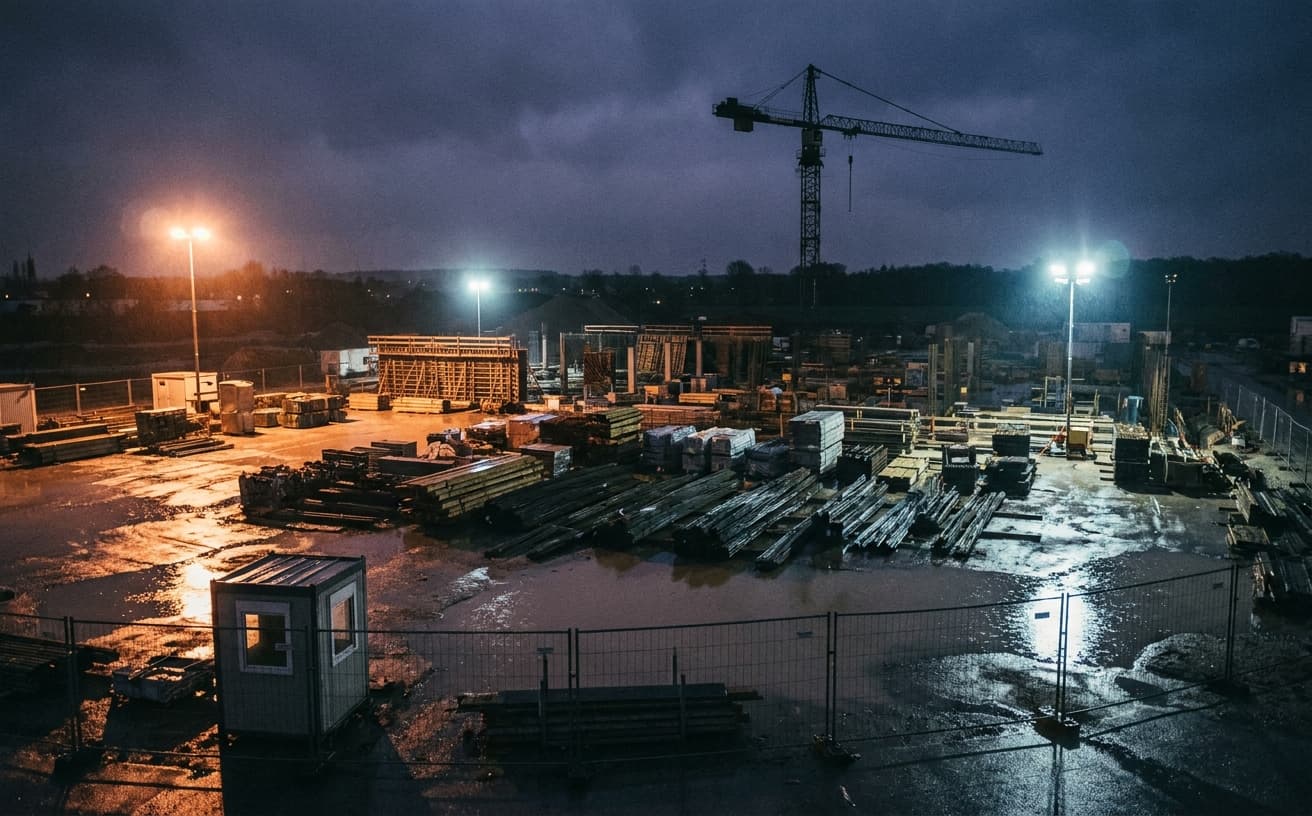
Since 1892.
The firm is reached at boswau-knauer.de or +49 177 2266267.