
Blog
AI Video Analytics for Perimeter Security: Buyer Guide
The category is crowded. We separate the vendors who train their own models on real perimeter footage from those who deploy generic object detectors.

Dr. Raphael Nagel
April 8, 2026
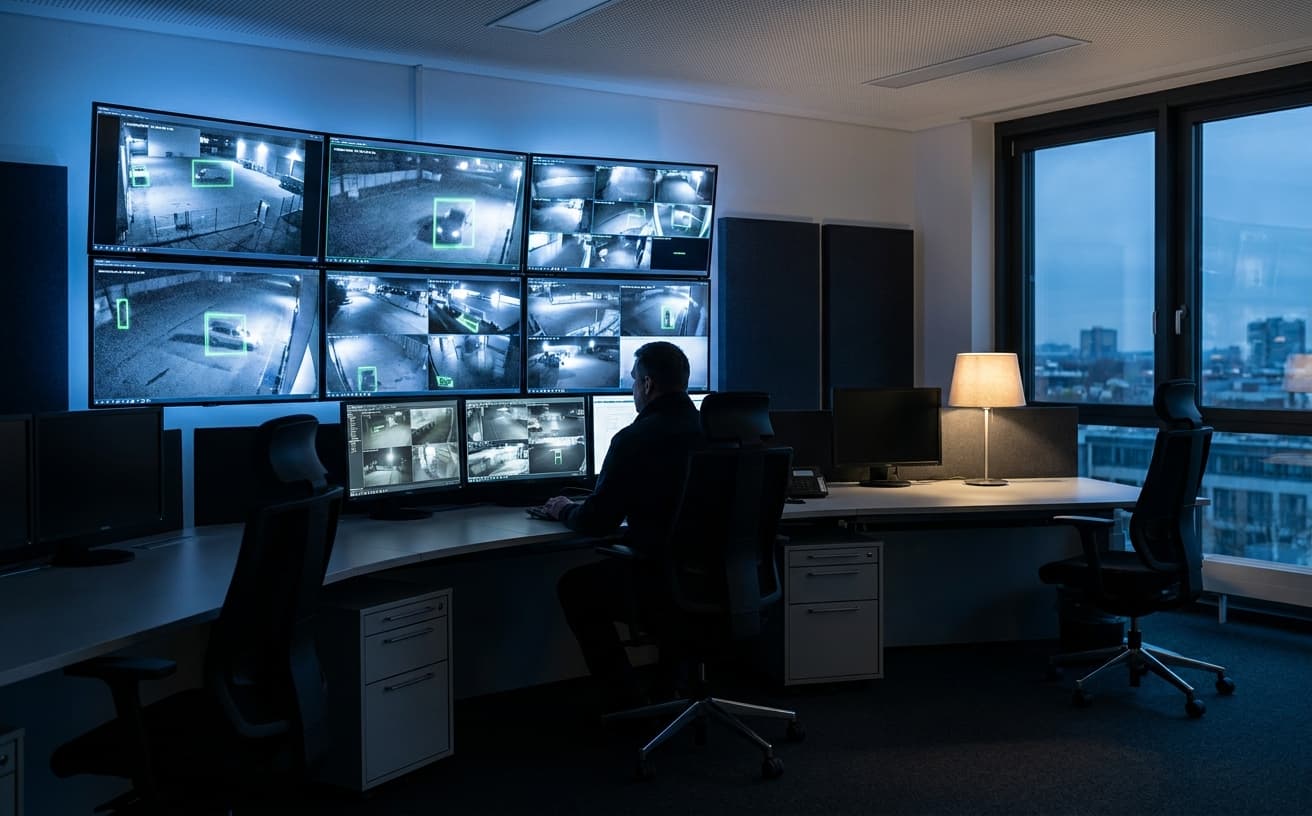
Most products sold as AI video analytics for perimeter security are object detectors with a marketing layer. That distinction matters, because object detection trained on consumer datasets behaves predictably on city streets and unpredictably on a quarry, a substation, a logistics yard at three in the morning.
The category has grown faster than the underlying engineering. A buyer who treats every vendor pitch as equivalent will end up with a system that flags every fox, every plastic bag, every shadow at dusk, until the operator silences the alarms and the camera becomes a recorder. A buyer who knows what to ask separates the manufacturers who have spent years on real perimeter footage from the integrators who licensed a generic model and rebadged it. The questions are not difficult. They are simply not asked often enough.
The category has split, even if the marketing has not
Five years ago, AI video analytics for perimeter security meant one thing in practice: a person-and-vehicle classifier laid over a recorded stream. The vendor either built the classifier themselves or licensed one. Performance varied, but the architecture was uniform. The category has since split into at least three groups that share a label and very little else.
The first group consists of manufacturers who own the model. They collect their own footage from operational sites, label it under their own taxonomy, retrain at defined intervals, and version their releases the way mature software companies version any other safety-relevant code. Their false-alarm performance on a new site is bounded by what they have seen before, which is usually a wide range of perimeter conditions: floodlight, infrared, sodium vapour, rain, wind-driven vegetation, mixed industrial backgrounds. They publish accuracy ranges with named conditions, not single numbers.
The second group consists of integrators who license a third-party engine, usually an off-the-shelf object detector trained on automotive or surveillance datasets. They add a user interface, a configuration layer, a sales channel. The engine itself is opaque to them. When the model misbehaves on a particular site, they cannot retrain it. They can adjust thresholds and write masking rules, which is what they call tuning. The product looks similar to the first group on a slide. It is not similar in field use.
The third group consists of pure software platforms that resell analytics from several model providers, brokered through a single dashboard. They are useful in mature operations that already run multiple camera estates and want a unified view. They are dangerous for a buyer who treats them as a model vendor, because they are not one. They are an abstraction layer. The accuracy of any deployment depends on which underlying engine was selected and how it was configured, and the platform vendor has no incentive to volunteer those details.
A serious procurement process starts by placing every candidate vendor into one of these three groups. The conversation that follows is different in each case. Most failures in this category begin with a buyer who did not draw the line and a vendor who was happy to leave it blurred.
What real perimeter training data looks like
Training data is the single largest variable in the performance of perimeter analytics, and it is the variable that vendors are most reluctant to discuss in concrete terms. The reason is straightforward. Most published model benchmarks use public datasets recorded under conditions that have almost nothing to do with a fenced perimeter at night. A model that scores well on those benchmarks may still confuse a deer with an intruder at one in the morning under infrared illumination, because the model has rarely seen a deer under infrared illumination during training.
Real perimeter training data has several properties that a buyer can verify in conversation. It is recorded on operational sites, not staged. It covers the full lighting cycle, including the transitions at dawn and dusk, which are the periods most generic models handle worst. It includes the camera technologies actually deployed in the segment: thermal, low-light CMOS, conventional CCTV with infrared illuminators. It contains the negative examples that matter on real fences, which are not pedestrians and cars but wildlife, vegetation movement, weather artefacts, reflections from wet surfaces, and the slow drift of light through a long night.
A manufacturer who has invested in this data can describe it. They can name the camera models they trained on, the climate zones, the typical scene types. They can show how their labelling taxonomy distinguishes a person climbing from a person walking, a vehicle approaching from a vehicle passing, a tool being removed from a tool being inspected. They can talk about edge cases they have specifically engineered against, because every operational deployment surfaces a list of them within the first ninety days. A vendor who deflects these questions toward generic accuracy figures, framework names, or GPU specifications is signalling that the data work has not been done. The accuracy figures, in such cases, were measured on a dataset that does not resemble the buyer's site.
NIST has published guidance through the Face Recognition Vendor Test programme and related efforts that establishes the principle clearly enough: model performance is meaningless without a description of the data it was tested against. The same principle applies to perimeter analytics, even though no equivalent independent benchmark exists for this narrower domain. In the absence of an external test, the buyer has to do the testing themselves. The audit format described later in this article is one structured way to do that. The cheaper alternative is to pilot on the buyer's own site and measure under buyer-defined conditions.
How accuracy claims are built and how to read them
Accuracy claims in perimeter analytics are usually presented as a single number, often above ninety-five percent, occasionally above ninety-nine. The number is technically true under the conditions in which it was measured. The conditions are rarely disclosed in the same document. A buyer who treats the number as transferable to their own site is making an assumption the vendor never made.
There are four numbers that matter, and a vendor capable of producing all four is usually a vendor worth talking to further. The first is the true positive rate on intrusions: of the genuine perimeter breaches in the test set, how many did the system classify correctly. The second is the false positive rate per camera per twenty-four hour period: how often does the system alarm on something that is not a breach. The third is the latency from event to alert: how many seconds pass between the intruder crossing the line and the operator seeing the notification. The fourth is the degradation curve: how all three of the above numbers change as lighting deteriorates, weather worsens, and the scene becomes more cluttered.
A vendor who quotes the first number without the second is hiding the false-alarm tax that the buyer will eventually pay in operator attention. A vendor who quotes the second without context is hiding what scene types the number was measured on. A vendor who refuses to discuss latency is signalling either that their architecture pushes inference to a remote cloud with no fallback or that they have not measured it. A vendor who cannot describe degradation under bad conditions has only tested under good ones.
There is a parallel question on the operator side, which IEC 62443 frames in its industrial automation context but which applies equally here. A model that updates without versioning, without change documentation, and without a regression suite is a model that can silently degrade after a vendor push. The buyer ends up with a different system than the one they procured, without notice. Manufacturers who take this seriously version their models, document the training data delta between versions, and provide a defined rollback path. They are still the minority. The buyer who insists on this clause during procurement gets fewer surprises in year two.
Sensors that complement video, and why a video-only perimeter is fragile
A video-only perimeter is a single-modality system, and single-modality systems have known failure modes. Fog defeats optical cameras. Heavy rain defeats both optical and most thermal cameras within a certain range. Direct sun into the lens at the wrong angle defeats almost any camera for a window of minutes per day. A perimeter that depends entirely on video for detection has accepted these failure modes whether the buyer realises it or not.
Serious perimeter architectures combine video with at least one independent sensing modality, and the choice depends on the site. Fibre-optic cable buried along or attached to the fence detects vibration patterns that correspond to climbing, cutting, or digging, and discriminates these from wind and rain through pattern analysis. Microwave or radar curtains detect movement across a defined plane regardless of optical conditions. Seismic and acoustic sensors detect activity in zones where cameras have limited coverage. Lidar, increasingly affordable, generates a three-dimensional model of the protected volume and detects intrusions geometrically rather than visually.
The integration question matters more than the sensor question. Two independent sensors that each generate their own alerts and never cross-correlate produce twice the false-alarm load with no improvement in detection certainty. Two independent sensors fused in a single decision logic, where an alert is escalated only when both modalities agree within a defined temporal window, produce a dramatic reduction in false alarms and an equivalent improvement in operator trust. ASIS International has documented this principle in its perimeter security guidelines for years. It is older than the AI category and will outlast it.
The manufacturer's view on this point is operator to operator. A perimeter analytics deployment that arrives without a clear position on multi-sensor fusion is a deployment that will need a second project within twenty-four months to add what was missing the first time. The book BOSWAU + KNAUER. From Building to Security Technology describes this layering in detail and explains why the platform logic, rather than the individual component, is the correct unit of procurement.
Operator workflow, false alarms, and the silent failure mode
The most expensive failure of a perimeter analytics system is not a missed intrusion. Missed intrusions are rare, dramatic, and traceable. The expensive failure is the one nobody notices: the slow degradation of operator attention under a sustained false-alarm load, until the operator silences the channel, mutes the notifications, or reroutes the alerts to a folder that is reviewed once a week. At that point the system has been switched off in practice, while continuing to function on paper. The buyer is paying for software that no longer informs any decision.
CISA has commented on this pattern in the context of operational technology environments, where the same dynamic appears in intrusion detection systems for industrial networks. The mechanism is identical. Humans cannot sustain high vigilance against signals that are wrong more often than they are right. The threshold at which operators begin to disengage is lower than most vendors assume, somewhere between five and ten unjustified alerts per shift in most documented studies. Above that level the system loses trust, and trust, once lost, is not recovered by a firmware update.
A serious evaluation of perimeter analytics measures the false-alarm load in the buyer's own operational rhythm, not in the vendor's demo environment. It measures it across the full diurnal cycle, across a representative spread of weather conditions, and across the camera positions actually installed, not a curated subset. It also measures it after the rule logic has been tuned by the operator, not at the moment of installation, because installation-day performance is meaningless. The number that matters is the number on day ninety, after the system has been challenged by the real site.
This is the rationale behind the ninety-day pilot described in the book. Three months is the minimum window in which an operator can observe the full operational envelope of a perimeter analytics deployment, including the seasonal effects that a shorter test cannot capture. A buyer who skips this step and commits to a multi-site rollout on the basis of a two-week demo is gambling against odds the vendor has not disclosed.
Procurement language that separates the serious vendors
The contract language a buyer uses during procurement determines which vendors stay in the process and which excuse themselves. A few clauses, written clearly, accomplish more than a long technical specification, because the long specification can be answered with parallel marketing language while the short clauses cannot.
The first clause covers training data provenance: the vendor describes, in writing, the data their current production model was trained on, including the camera types, environmental conditions, and labelling taxonomy. The second clause covers measurement transparency: the vendor commits to publishing, on request, the test conditions under which any quoted accuracy figure was generated, with enough detail to allow independent replication. The third clause covers model versioning: the vendor commits to a defined release cadence, change documentation for each release, and a rollback path that the buyer can invoke if performance degrades after an update. The fourth clause covers data sovereignty: the vendor specifies where training data and inference data are processed, under which jurisdiction, with explicit reference to GDPR obligations for European deployments and any sector-specific regulations such as those derived from the NIS2 directive for operators of essential services.
NIST Cybersecurity Framework 2.0 and ISO 27001 provide the broader context for the security posture around the analytics platform itself. A perimeter analytics system is a network-connected device with software updates and remote management. It is, in itself, an attack surface. Vendors who cannot describe their own security posture in those frameworks are vendors whose products will eventually become the vector rather than the defence. The German BSI has published guidance for video surveillance systems that aligns with this view and is relevant for any deployment in or connected to the European market.
The cumulative effect of these clauses is filtering. Vendors in the first group described earlier in this article can answer them in writing within a normal procurement cycle. Vendors in the second group struggle with the training data and versioning clauses. Vendors in the third group struggle with the data sovereignty clause because they often do not fully control the answer. The buyer ends up with a shortlist that has filtered itself.
What holds
AI video analytics for perimeter security is a real capability, and the manufacturers who have built it seriously have produced systems that materially reduce both intrusions and operator workload. The category is also full of products that share the label without sharing the substance. The difference is visible to a buyer who asks specific questions about training data, accuracy measurement, sensor fusion, and operator workflow, and who treats the procurement document as a filter rather than a formality.
The cost of getting this wrong is not the price of the wrong product. It is the cost of an operational deployment that is silently switched off, the false sense of coverage that follows, and the incident that arrives during the window in which the system was technically running and effectively absent. A buyer who has lived through that sequence does not need to be persuaded of the value of a disciplined evaluation. A buyer who has not lived through it is choosing whether to learn the lesson before or after.
For organisations evaluating perimeter analytics at scale, the structured path is the three-to-five day audit described in the appendix of BOSWAU + KNAUER. From Building to Security Technology. The audit examines the current camera estate, the operational rhythm of the security function, the integration with existing sensor and access systems, and the realistic performance envelope of the candidate vendors against the buyer's own conditions. The deliverable is a procurement document that an internal team or an external integrator can execute, with or without further involvement from the manufacturer. The audit does not bind. It informs.
Frequently asked questions
What is the difference between perimeter and access analytics?
Perimeter analytics detects events at the boundary of a protected area: a person climbing a fence, a vehicle approaching a gate, a tool crossing a tripwire. Access analytics works inside the boundary and identifies who an authorised entrant is, usually through face or licence-plate recognition, sometimes through behavioural analysis of movement within a building. The two categories use related computer vision techniques but solve different problems, are governed by different privacy regimes, and have different failure modes. A vendor strong in one is not automatically strong in the other, and procurement should treat them as separate evaluations.
How are models trained for perimeter conditions?
Models that perform well on real perimeters are trained on footage from operational sites, covering the full lighting cycle, the camera technologies actually deployed in the field, and the negative examples that dominate perimeter false alarms: wildlife, vegetation, weather artefacts, reflections. Training is iterative. The manufacturer collects edge cases from deployments, labels them under a defined taxonomy, retrains at a defined cadence, and versions each release with documented changes. Models trained primarily on public datasets such as automotive or urban surveillance footage generalise poorly to perimeter environments and produce the false-alarm patterns that defeat operator trust within months.
What sensors complement video analytics?
The strongest perimeter architectures combine video with at least one independent modality. Fibre-optic vibration sensing along the fence detects climbing, cutting, and digging through pattern analysis. Microwave and radar curtains detect movement across a plane regardless of optical conditions. Lidar generates a three-dimensional model of the protected volume. Seismic and acoustic sensors cover zones where camera placement is constrained. The decisive factor is fusion: alerts escalated only when two independent modalities agree within a temporal window. ASIS International has documented this principle in its perimeter guidelines, and it predates the AI category by a considerable margin.
How do you evaluate vendor accuracy claims?
Accuracy figures are meaningful only with the test conditions attached. A buyer should request, in writing, the true positive rate, the false positive rate per camera per twenty-four hour period, the latency from event to alert, and the degradation curve under deteriorating conditions. Each figure should be linked to a described dataset, ideally one that resembles the buyer's own site. Single headline numbers above ninety-five percent, presented without context, indicate a marketing document rather than an engineering one. The structured test is a ninety-day pilot on the buyer's own perimeter, measuring all four figures under the buyer's actual operational envelope.
Related topics
- Reducing False Alarms in AI CCTV: Two Techniques
- Object Detection vs Anomaly Detection in Security
- AI Video Analytics Under the EU AI Act: The Dutch Reading
- EU AI Act and Physical Security: The Article 6 Test
- AI Video Analytics Software: Nine Vendors Compared
Take the next step: See prices & ROI · Explore the products · Send a no-obligation request. BOSWAU + KNAUER – direct from the factory in Filderstadt, reply within 5 working days.
About the author
Dr. Raphael Nagel (LL.M.) is founding partner of Tactical Management. He acquires and restructures industrial businesses in demanding market environments and writes on capital, geopolitics, and technological transformation. raphaelnagel.com
More reading

Since 1892.
The firm is reached at boswau-knauer.de or +49 177 2266267.