
Blog
Autonomous Security Robots on the Construction Site
A close look at what an autonomous security robot does on a real construction site, what it cannot do, and where the line of credible deployment runs in 2026.

Dr. Raphael Nagel
December 25, 2025
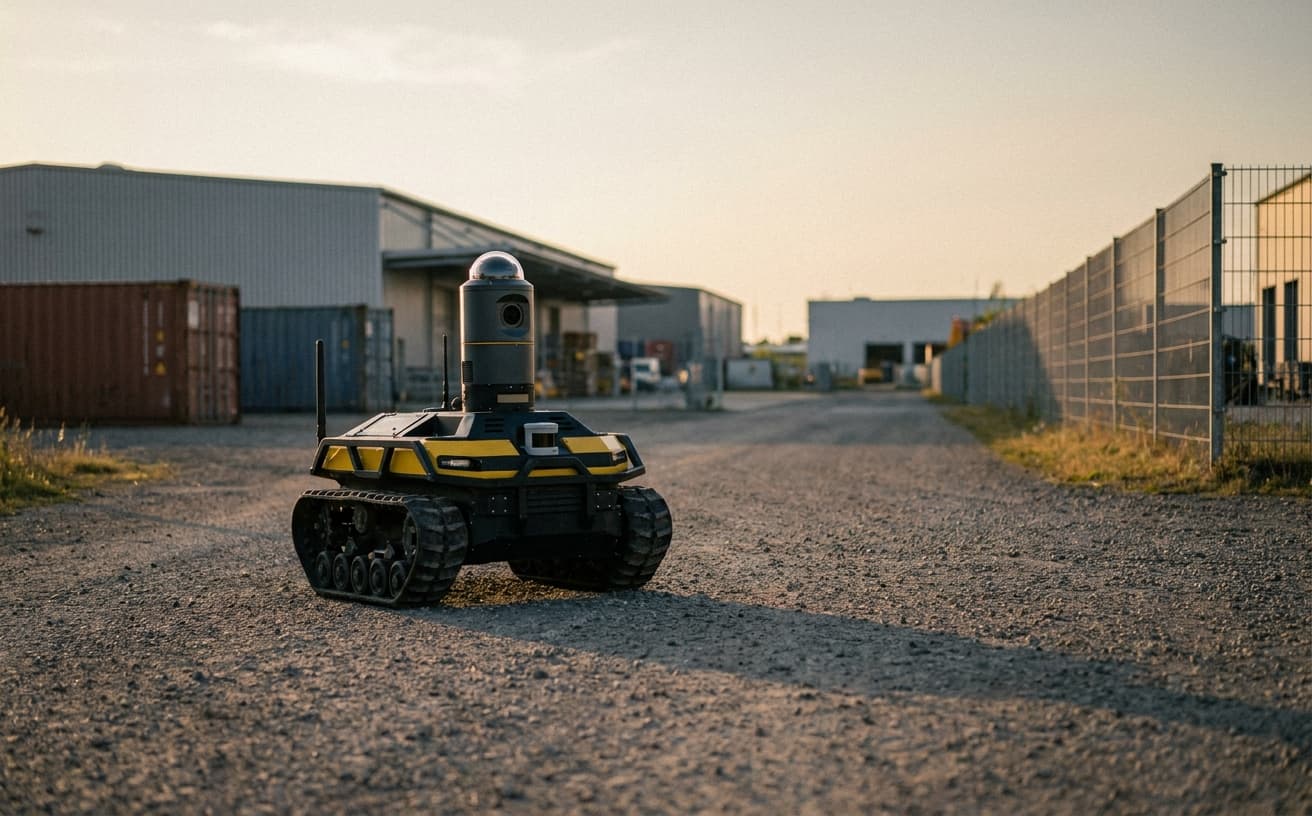
An autonomous security robot is not a guard on wheels. It is a moving sensor platform with a defined operating envelope, and most of the marketing language attached to it confuses the two.
That confusion is expensive. Operators who buy the guard narrative end up disappointed when the robot stops at a puddle, refuses to climb a slope it does not recognise, or hands an exception back to a control room that was not staffed to receive it. Operators who buy the sensor platform narrative get something else. They get a machine that extends the reach of a small human team across a site that no plausible roster could cover by foot. The difference between the two narratives is not vocabulary. It is the difference between a deployment that holds and one that gets quietly switched off in month four.
This article sets out what the category actually delivers on a working construction site in 2026, what it does not deliver, and where the line of credible deployment runs. It draws on the manufacturer perspective developed in BOSWAU + KNAUER. From Building to Security Technology, and on the operational pattern that emerges when robots are deployed alongside mobile video towers and analytics rather than against guard services.
The category gap the market has produced
The visible names in autonomous security robotics, Knightscope among them, built their reputations on campus environments. Parking structures, corporate plazas, retail perimeters. Surfaces are paved, gradients are predictable, lighting is engineered, and the threat model leans toward presence detection and incident documentation rather than active deterrence against organised theft.
A construction site shares none of those properties. The ground is loose, uneven, and changes weekly. Lighting is provisional. The threat model is dominated by tool theft, cable theft, fuel theft, and the kind of opportunistic damage that turns a three-day delay into a quarter-end miss. The boundary between the site and the surrounding street is porous by design, because materials and vehicles move through it constantly. A robot built for a corporate campus does not survive its first month on a German Rohbau, and operators who tried it know this without being told.
The gap that opens between the campus product and the construction reality is the gap this category has not yet closed in any convincing way. Several manufacturers point at it. Few have shipped a product that holds up under the conditions that matter. The technical question is not whether a robot can patrol. The technical question is whether it can patrol on rubble, in February rain, after the site has been reconfigured three times since the last map update, and whether it can do so without a service technician on standby. The answer, for most platforms on the market, is no. The answer for a small set of platforms, deployed inside a wider security architecture rather than as standalone units, is yes, conditionally.
That conditional yes is the only honest position. Anything else is sales material. CISA's guidance on physical security for critical infrastructure, and the corresponding work inside NIST CSF 2.0 on detection and response, both make the same point in different language. Technology without an operational concept around it is decoration. Technology embedded in a defined detection-to-response chain is protection. The robot is a component, not a solution.
What the robot actually does on a working site
In the deployments that hold, the robot does four things. It patrols defined routes on a schedule that combines fixed and randomised elements. It carries optical, thermal, and acoustic sensors that feed a video analytics layer in near real time. It announces its presence through visible lighting and recorded audio when it detects a person inside a defined zone. And it documents every traversal in a format that can be audited after the fact, by an insurer, by site management, or by law enforcement.
None of these functions are revolutionary in isolation. The point is the integration. A patrol without analytics is a moving camera. Analytics without a patrol is a static observation post. Documentation without a chain of custody is a video file that loses evidentiary weight in week two. The robot creates value because it carries the sensor array through space, and because the space it covers per shift exceeds what a single watchman covers by a factor that depends on site size but typically lies between three and seven.
The robot also creates value because it does not get tired. The last two hours before sunrise are statistically the highest-risk window on most construction sites, according to data patterns reported by the GDV and by industry analyses cited by ASIS International. Human attention degrades across a night shift in ways that are well documented. A robot's detection probability at five in the morning is identical to its detection probability at midnight. That consistency, more than any single technical specification, is the reason the category exists at all.
What the robot does not do is intervene. It does not physically stop a person. It does not detain, restrain, or pursue. It alerts. The alert lands in a control room or with a mobile response unit, and the human chain takes over from there. Operators who confuse the alert with the intervention build a system that fails on first contact. The robot is the trigger. The response remains human, and the response time of that human chain determines whether the system protects anything at all. IEC 62443, in its language on industrial cyber-physical systems, calls this the response envelope. The same principle holds here.
The conditions that decide whether it holds
Four conditions decide whether an autonomous security robot deployment holds beyond the pilot. The first is terrain. The robot needs a site plan it can navigate. Modern platforms handle gravel, compacted earth, light snow, standing water up to a defined depth, and gradients within a specified range. They do not handle deep mud, exposed rebar fields, or trenches without barriers. Site management has to understand the envelope and configure the route accordingly. Where this conversation does not happen before deployment, the robot ends up immobilised within the first fortnight.
The second condition is connectivity. The robot transmits data to an analytics layer, and the analytics layer feeds the control room. Construction sites have notoriously unreliable connectivity. A platform that depends entirely on cloud-side analytics will fail every time the mobile network drops, which on most sites is several times a day. Platforms that run analytics locally on the device, with cloud as a redundancy rather than a dependency, hold up. The architectural decision matters more than the sensor specification.
The third condition is integration with site access control. A robot that does not know who is supposed to be on site at any given hour generates noise. It flags every legitimate worker as an anomaly, the control room learns to dismiss its alerts, and within weeks the system is producing data that nobody reads. Integration with the site's access control system, whether that is a badge reader at the gate, a contractor management platform, or a simple shift roster, turns the robot from a noise generator into a signal generator. NIST 800-53 family controls on access enforcement and audit logging describe the principle in formal terms. On a construction site the implementation is more pragmatic, but the logic is identical.
The fourth condition is the human response chain. A robot deployment without a defined response within a defined time window is theatre. The response can be a mobile patrol contracted from a security service provider, an in-house intervention team, or a direct line to local police where the threat profile justifies it. What it cannot be is undefined. Sites that deploy robots without specifying who responds, in what time, with what authority, discover within the first incident that the robot has produced excellent documentation of a theft that nobody prevented. The robot is part of a system. The system either exists or it does not, and the absence of the system cannot be compensated for by the quality of the robot.
What the numbers actually look like
Honest numbers in this category are rare, because most published figures come from manufacturers with an interest in the outcome. The defensible observations are the following. Coverage area per robot, on a typical mid-sized construction site of between two and ten hectares, falls in the range of one to three hectares per platform depending on terrain and patrol density. Battery cycles support six to twelve hours of continuous operation between charges, with autonomous docking handling the charge interval. Detection accuracy for human presence in defined zones, under conditions that match the training data, lies above ninety-five percent for modern analytics layers. False alarm rates, with multi-channel confirmation logic, sit below one event per platform per twenty-four-hour period in stable deployments.
The economic comparison most operators run is against a guard service. A single guard on a twelve-hour night shift, charged at typical European service rates, costs in the range that a robot deployment recovers within twelve to eighteen months when amortised over multiple sites. The comparison is misleading in both directions. A robot does not replace a guard. It replaces the coverage gap that the guard cannot fill, because no single guard can patrol a ten-hectare site at the frequency required to deter organised theft. The right comparison is between a site protected by a guard plus a robot, and a site protected by two guards. In that comparison the robot wins on cost, on coverage, and on documentation. In the comparison against a single guard, the robot loses on flexibility and on the ability to handle the unexpected non-security event, which on construction sites is more common than the security event itself.
NICB data on construction equipment theft in the United States, and corresponding GDV figures for Germany, both indicate that recovery rates for stolen construction equipment sit well below twenty-five percent. The economic argument for prevention, rather than recovery, is therefore not subtle. What the autonomous robot adds to that argument is documented deterrence and documented response. Both matter to insurers, and both increasingly factor into premium calculations under the broader frameworks that ISO 27001 and BSI guidance have established for physical security adjacencies.
Where the deployment line runs in 2026
The credible deployment line in 2026 runs through three tests. First, the site has to be large enough that the coverage advantage of the robot pays for itself against the alternative of additional foot patrols. Below two hectares, the economics rarely work. Above five hectares, they almost always do. Second, the project duration has to be long enough to amortise installation, mapping, and integration. Below three months, the setup cost dominates. Above six months, it disappears into the operating budget. Third, the operator has to have, or be willing to build, the response chain that turns alerts into interventions. Without that chain, the deployment is decorative.
Sites that meet all three tests are the natural home of the category. Large infrastructure projects, multi-phase commercial developments, industrial expansions on greenfield sites, logistics platforms under construction. These are the contexts in which autonomous security robots earn their cost. Smaller sites, shorter projects, and operators without a defined security operating concept are better served by mobile video towers, AI-supported analytics on fixed cameras, and contracted patrol services. The robot is not the universal answer. It is a specific answer to a specific class of problem.
What has changed between 2023 and 2026 is not the underlying technology. The platforms are incrementally better. The sensors are incrementally cheaper. The analytics models are incrementally more accurate. What has changed is the operational maturity of the deployments. Operators who learned the hard way in earlier years now write tenders that specify integration requirements, response chains, and documentation standards before they specify hardware. The market has caught up with the technology, and the credible deployments are the ones where the operator drove the specification rather than the manufacturer.
What holds
An autonomous security robot on a construction site holds when it is deployed as part of a system, not as a system in itself. It holds when the terrain matches its envelope, when connectivity is architected for unreliable networks, when access control integration removes the noise floor, and when the human response chain is defined before the platform arrives. It does not hold when any of these conditions is missing, and it does not hold when the operator expects it to replace functions it was never designed to perform.
The honest position for any manufacturer in this category, in 2026, is that the robot is a component. A valuable component, in the right context, with a measurable economic case. But a component. The system that protects a construction site is built from sensors, analytics, mobile towers, defined response, and human judgment. The robot fits inside that system. It does not substitute for it.
For operators considering whether the category fits their portfolio, the first step is not a product demonstration. The first step is a sixty-minute conversation about the site, the threat profile, the existing security architecture, and the response chain. Path I in BOSWAU + KNAUER's three-path framework exists exactly for that purpose. Where the conversation indicates that a structured assessment is warranted, a three to five day audit produces the standort-level evidence that a serious investment decision requires. Where the audit indicates that a robot deployment is justified, a ninety-day pilot on a defined site produces the operating data that turns the decision from a hypothesis into a calculation. The sequence is deliberate. Skipping steps is what produces the disappointed deployments that have given the category its uneven reputation.
Frequently asked questions
Are security robots reliable on construction sites?
They are reliable within a defined operating envelope. Modern platforms handle gravel, compacted earth, light snow, and gradients within specification. They do not handle deep mud, exposed rebar without barriers, or unmapped terrain changes. Reliability in practice depends less on the platform than on the deployment discipline around it. Sites that map the route, define the response chain, and integrate the robot with access control achieve uptime above ninety-five percent. Sites that deploy without these conditions experience repeated immobilisation events within the first month. The platform is reliable. The deployment has to be engineered.
What weather conditions does a security robot tolerate?
Current generation platforms operate in temperatures between roughly minus ten and plus forty degrees Celsius, in rain up to defined intensity, in light snow, and in standing water up to specified depths. They do not operate in heavy snow accumulation, in flooding, or in extreme heat without thermal management. Wind affects sensor stability rather than mobility. The practical answer is that platforms handle ninety to ninety-five percent of European weather conditions across the year. The remaining percentage requires either a fallback to alternative coverage or a planned operational pause. Manufacturers who claim full all-weather operation are overstating the envelope.
Can a robot replace night watch on a small site?
On a small site, below roughly two hectares, the economics rarely justify replacement. The fixed cost of platform, mapping, and integration exceeds the savings against a single guard. On larger sites, the question is misframed. The robot does not replace the guard. It extends the coverage that one guard can effectively maintain, by patrolling areas that foot rounds cannot reach at the required frequency. The credible deployment combines a reduced human presence with robotic patrol, producing better coverage at comparable cost. Operators who frame the decision as replacement rather than extension typically conclude that the category does not fit, and they are usually correct in that specific framing.
How is the robot integrated with site access?
Integration runs through the access control system already in place on the site. Where a badge reader, contractor management platform, or shift roster exists, the robot's analytics layer consumes that data and uses it to distinguish authorised presence from anomalies. Where no system exists, the robot generates noise, because every legitimate worker registers as an unexpected event. Building the integration is typically a one to three day exercise during initial deployment, and it determines whether the system produces signal or noise from day one. ISO 27001 access control principles and NIST 800-53 audit logging requirements provide the architectural reference points that serious integrations follow.
Related topics
- Security Robot Companies 2026: The Twelve Real Vendors
- Security Robots For Sale vs Rental: When CapEx Actually Wins
- Security Robot vs Human Guard: The Honest Five-Year Math
- Extreme Heat & Security Robots in the Gulf: 55C
- Security Robots in Saudi Arabia: Vision 2030 & NEOM
Take the next step: See prices & ROI · Explore the products · Send a no-obligation request. BOSWAU + KNAUER – direct from the factory in Filderstadt, reply within 5 working days.
About the author
Dr. Raphael Nagel (LL.M.) is founding partner of Tactical Management. He acquires and restructures industrial businesses in demanding market environments and writes on capital, geopolitics, and technological transformation. raphaelnagel.com
More reading
Since 1892.
The firm is reached at boswau-knauer.de or +49 177 2266267.