
Blog
Can a Security Robot Replace a Guard? Five Honest Steps
The honest answer: in some scenarios fully, in some partially, in some not at all. We describe the five tests an operator runs to decide which scenario applies.

Dr. Raphael Nagel
January 29, 2026
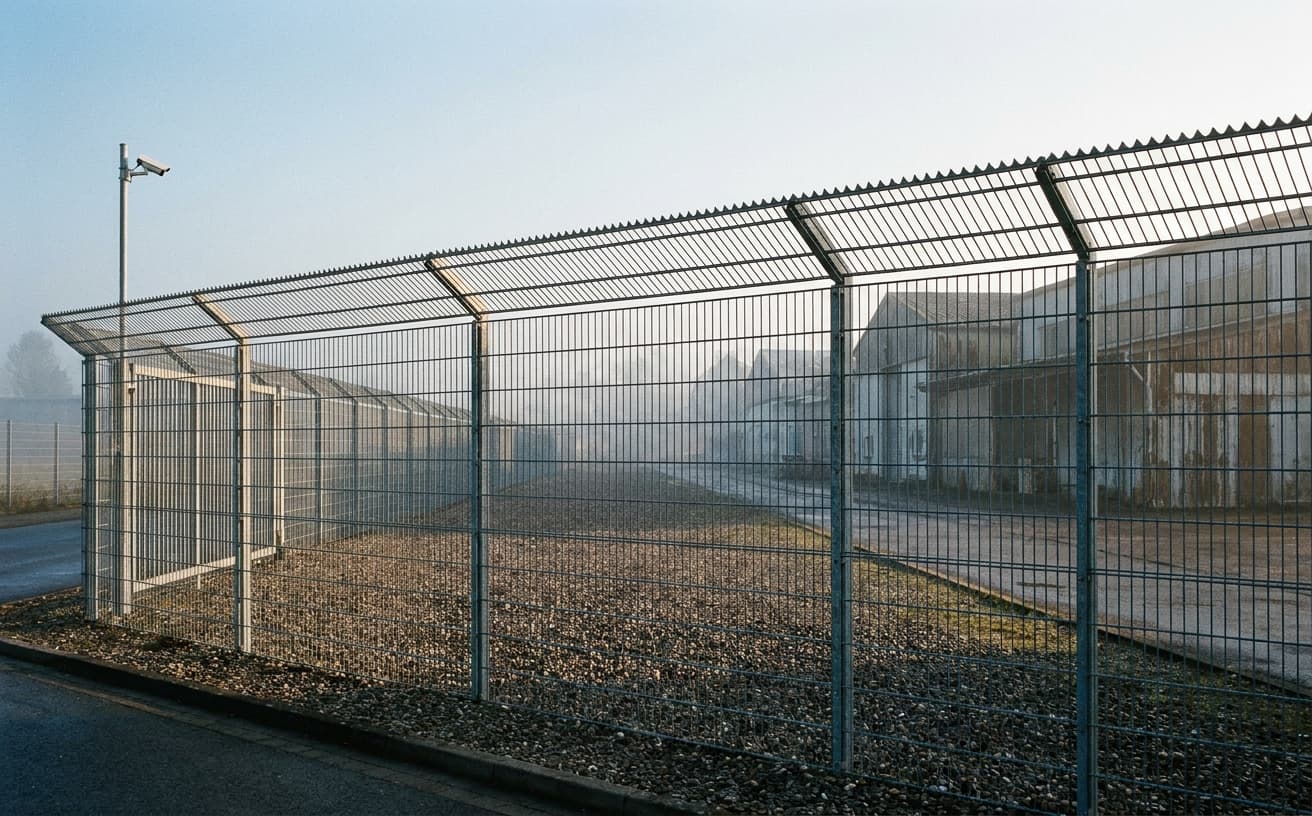
The question is wrongly framed. A security robot does not replace a guard the way a forklift replaces a labourer; it replaces a specific set of tasks the guard performs, and leaves others in place.
The honest answer is therefore conditional. In some scenarios the robot covers the work fully, and the human role disappears from the site. In some scenarios the robot covers most of the work, but a human remains in the loop, usually in a remote operator role rather than on the ground. In some scenarios the robot cannot replace the guard at all, and pretending otherwise damages the operator's risk posture. The five tests below decide which scenario applies. They are derived from deployments in construction, industry and logistics, and they reflect what regulators, insurers and operations directors actually look at when the question moves from brochure to procurement.
Test one: the task decomposition
A guard shift is not one job. It is a stack of activities that have been bundled together for historical reasons, mostly because a human body was the only available platform that could do all of them at once. The first test is to take that bundle apart.
In a typical perimeter shift on a construction site or a distribution yard, the guard performs roughly the following activities: route patrols at fixed and randomised intervals; observation of fixed points such as gates, fuel tanks, container blocks and crane bases; verification of access for vehicles and personnel; first response to alarms from fixed sensors; documentation of incidents in a logbook or a digital system; and presence as a deterrent, which is hard to quantify but real. A robot platform with the right sensor suite can perform the first, second, fourth and sixth activities at a level that meets or exceeds a single human walking the same route, because it does not tire, does not skip the last hour before sunrise, and produces a complete log without effort. It cannot perform the third activity in any meaningful sense, because verification of access for an unknown person involves judgement, communication and, in many jurisdictions, legal authority that a machine does not hold. It cannot perform the fifth activity to the standard required by insurers and by frameworks such as ISO 27001 or IEC 62443, which expect human accountability at defined points in the response chain.
The first test, therefore, is whether the site's actual task mix is dominated by the activities a robot does well, or by the activities it does not do at all. A bulk fuel depot at night is dominated by patrol, observation and alarm response. A visitor-facing reception is dominated by verification and judgement. The same hardware is suitable in the first case and unsuitable in the second. Operators who skip this decomposition end up either with expensive technology that sits unused, or with a thinned-out guard force that has lost the very capability it was retained for.
Test two: the environment
The second test is about where the work happens, not what it consists of. A security robot is a physical platform with defined tolerances. Those tolerances determine whether it can do the work at all, regardless of how well decomposed the task list is.
The environment matrix has four dimensions that matter. Surface and terrain decide whether the robot can move at all; a graded yard, a paved logistics apron and a finished warehouse floor are friendly, while an active construction site with rebar, mud, trenches and shifting obstacles is hostile to most platforms below a certain ruggedness class. Weather decides whether the platform can sustain operation through the year; rain, snow, dust, frost and heat each strip a percentage of availability from systems that were not designed for them, and a platform with a stated operating range of minus ten to plus forty degrees Celsius is not the same as one rated to minus twenty-five. Lighting and visual clutter decide whether the perception stack actually works; reflective surfaces, sodium lighting, fog and dense vegetation degrade detection performance, and the published accuracy numbers from a clean test environment do not survive contact with these conditions. Connectivity decides whether the platform can be supervised at all; a yard with reliable LTE coverage is one case, a remote substation with intermittent satellite link is another.
The second test asks the operator to map the actual environment against the platform's actual tolerances, not against the brochure. CISA's guidance on physical security assessments, and the BSI's reference work on infrastructure protection, both treat environmental fit as a precondition, not a footnote. A robot that cannot reliably traverse the site at three in the morning in February is not replacing anyone. It is creating a new dependency on the guard who has to retrieve it.
Test three: the failure mode
The third test is the one most operators avoid, because it forces an honest conversation about what happens when the system does not work. A human guard fails in known ways. They miss a sound, they skip a route, they sit in the gatehouse longer than they should. These failure modes are familiar, they are bounded, and the insurance industry has decades of data on them. A robot fails differently. It can stop dead in the middle of a patrol because a wheel encoder lost its reference. It can hand off correctly to the operator console and find that the operator has stepped away. It can classify a deer as a person, or a person as a deer, in conditions that the training data did not cover well. NIST CSF 2.0 and NIST 800-53 both push organisations to consider these residual risks explicitly, under the headings of detection coverage and response capability.
The right question is not whether the robot ever fails. It is whether the failure modes are detected, bounded and recoverable within a time that the operator can tolerate. A platform that stops in place and raises an alarm is acceptable. A platform that drifts off route silently is not. A perception stack that returns a confidence score with every detection is acceptable. One that returns a binary answer is not, because the operator has no way to weight the alert. The third test asks whether the failure behaviour of the candidate system is documented, observable and aligned with the site's tolerance for false negatives, which is usually much lower than the tolerance for false positives. In high-value logistics, a single missed intrusion can cost more than a year of robot operation. In a construction yard at the foundation stage, the tolerance is higher, because the assets at risk are smaller. The answer scales the deployment, not the marketing.
Test four: the regulatory and contractual surface
The fourth test moves from operations to law. A guard, in most jurisdictions, is not just a pair of eyes. They hold a licence, they are insured, they are trained to a regulated standard, and they have defined authority to challenge, detain in limited circumstances, and act as the operator's representative on the ground. Replacing the guard with a robot does not transfer those rights to the machine. It either redistributes them to a remote operator who must hold the corresponding qualifications, or it leaves a gap.
In the German market, guard services fall under §34a of the Gewerbeordnung, and insurers reference the GDV's framework conditions when they price commercial property cover. ASIS International publishes guidelines on the use of autonomous systems in security operations that explicitly preserve human accountability for use-of-force decisions and for verified response to suspected criminal activity. The NICB tracks loss patterns in industries where robotic monitoring has been deployed and notes that recoveries improve when the technology supports a documented human response chain, not when it replaces it. The fourth test, therefore, is whether the proposed deployment leaves the operator compliant with the contractual obligations to the client, the insurance policy and the local regulatory regime. If the answer is no, the deployment is not a replacement. It is a downgrade with a technology label.
This is where the operator-to-operator conversation tends to harden. A property manager who tells their insurer that the night shift has been replaced by a robot, without restructuring the response chain, will discover at the next renewal that the premium reflects the change, and not in the direction they hoped. A construction client who removes the on-site guard from a contract that specifies guarded presence will find themselves in breach, regardless of the technology in place. The book BOSWAU + KNAUER. From Building to Security Technology develops this point in the chapter on partnership models: the technology displaces tasks, it does not displace contracts, and the contracts must be renegotiated in parallel or the displacement creates exposure where it claimed to remove it.
Test five: the economics over the asset life
The fifth test is the one that decides whether the previous four matter. A robot deployment that passes the task, environment, failure and regulatory tests can still fail on economics. Conversely, a deployment that looks marginal on a single site can become compelling when the platform is amortised across a portfolio.
The relevant calculation has three layers. The direct comparison is the simplest: the fully loaded cost of a guard shift, including wages, social charges, holiday cover, training and supervision, against the fully loaded cost of the robotic system, including hardware, software, connectivity, maintenance, remote operator capacity and replacement parts over the asset's useful life. On a single site with a single shift, the direct comparison often favours the human, because the robot's fixed costs are large relative to a single deployment. On a portfolio of five to fifty sites supervised from a single operations centre, the direct comparison inverts, because the operator's time is the scarce resource and the robot's fixed cost is spread thin. The indirect comparison includes the value of consistent documentation, which has measurable effects on insurance premiums and on dispute resolution with clients. The strategic comparison includes the operator's ability to scale into markets where guard labour is simply not available at any price, which is the situation in several European industrial regions at present.
The fifth test asks whether the deployment makes sense at the level of the operator's actual portfolio and growth plan, not at the level of the individual site. An operator who runs three sites and intends to stay at three sites will rarely find the economics compelling. An operator who runs thirty and intends to reach a hundred will find that the question has already answered itself.
What holds
The robot replaces the guard fully where the task mix is dominated by patrol and observation, the environment is within tolerance, the failure modes are bounded, the regulatory chain is rewritten to reflect the change, and the economics work across the portfolio. The robot replaces the guard partially, with a remote operator in the loop, where the task mix includes verification and judgement, the environment is mixed, or the regulatory regime requires a licensed human at defined points in the response. The robot does not replace the guard at all where the work is dominated by interaction with people, where the environment defeats the platform, or where the contractual surface forbids it.
None of these answers is universal. Each of them is the result of running the five tests against a specific site, a specific platform and a specific operator profile. The mistake is to treat the question as a yes or no, when it is in fact a decomposition exercise. Operators who decompose well save money and improve their risk posture. Operators who do not decompose buy expensive technology and discover, usually in the second year, that they have neither replaced the guard nor strengthened the perimeter.
For operators who want to test this on their own portfolio, the most direct route is Path II, a three to five day audit that walks the five tests across the sites that matter, with a written report that includes the task decomposition, the environmental fit, the failure surface, the regulatory map and the economic model. The audit does not bind the operator to any downstream procurement. It produces a document that can be used internally, taken to a different vendor, or filed away. What it does not allow is the continuation of the conversation in the same vague terms it began with.
Frequently asked questions
In which scenarios can a robot replace a guard?
Full replacement is realistic where the work consists almost entirely of patrol, fixed-point observation, alarm verification and documentation; where the environment is paved, lit and within the platform's stated operating range; where connectivity supports continuous supervision from a remote operations centre; and where the contractual and regulatory regime permits the displacement of the on-site human. Typical examples include perimeter monitoring of finished logistics yards at night, surveillance of fenced industrial laydown areas, and observation of remote infrastructure such as substations or storage tank farms.
In which scenarios must a guard remain in the loop?
A human must remain present, or at minimum on call with defined response times, wherever the work involves access verification for unknown persons, judgement under ambiguity, physical intervention, or contractually mandated guarded presence. Sites with public-facing reception, sites under regulated guarding contracts referencing §34a of the German Gewerbeordnung or equivalent regimes elsewhere, and sites where insurance cover assumes human first response all fall into this category. The robot in these cases extends the human's reach rather than replacing them, which is a different deployment model with different economics.
How is the decision made operationally?
The decision is made by running the five tests in sequence: task decomposition, environmental fit, failure mode analysis, regulatory and contractual surface, and economics over the asset life. Each test produces a documented answer. Sites that pass all five tests are candidates for full replacement. Sites that pass three or four are candidates for hybrid deployment with a remote operator in the loop. Sites that pass fewer than three are not candidates for replacement at all, and the operator's capital is better spent elsewhere in the security stack. The decision is therefore a portfolio decision, not a site-by-site impulse.
How do regulators view robot-only deployments?
Regulators in most European jurisdictions have not issued blanket positions, but the direction is consistent across CISA guidance, BSI reference frameworks, ASIS International standards and the GDV's loss prevention notes. Autonomous platforms are accepted as part of the security architecture, provided that human accountability remains assigned at defined points in the response chain, that the platform's failure modes are documented, and that the deployment does not contradict licensing regimes for the guarding profession. Robot-only deployments without a documented human response capability tend to be treated as a reduction in protection, with corresponding effects on insurance terms.
Related topics
- Security as Code: Platform Thinking for Physical Defense
- Private Security Robot vs Human Guard: Pros & Cons
- Perimeter Security Systems: The Seven-Layer Model
- Mid-Market Industrial Security: The Cost of Waiting
- Security Robot vs Human Guard: The Honest Five-Year Math
Take the next step: See prices & ROI · Explore the products · Send a no-obligation request. BOSWAU + KNAUER – direct from the factory in Filderstadt, reply within 5 working days.
About the author
Dr. Raphael Nagel (LL.M.) is founding partner of Tactical Management. He acquires and restructures industrial businesses in demanding market environments and writes on capital, geopolitics, and technological transformation. raphaelnagel.com
More reading
Since 1892.
The firm is reached at boswau-knauer.de or +49 177 2266267.