
Blog
CWA 15793 Construction Site Security: The Unread Standard
CEN Workshop Agreement 15793, normative recommendations, real adoption patterns. A standard with no teeth but useful framework.

Dr. Raphael Nagel
May 18, 2025
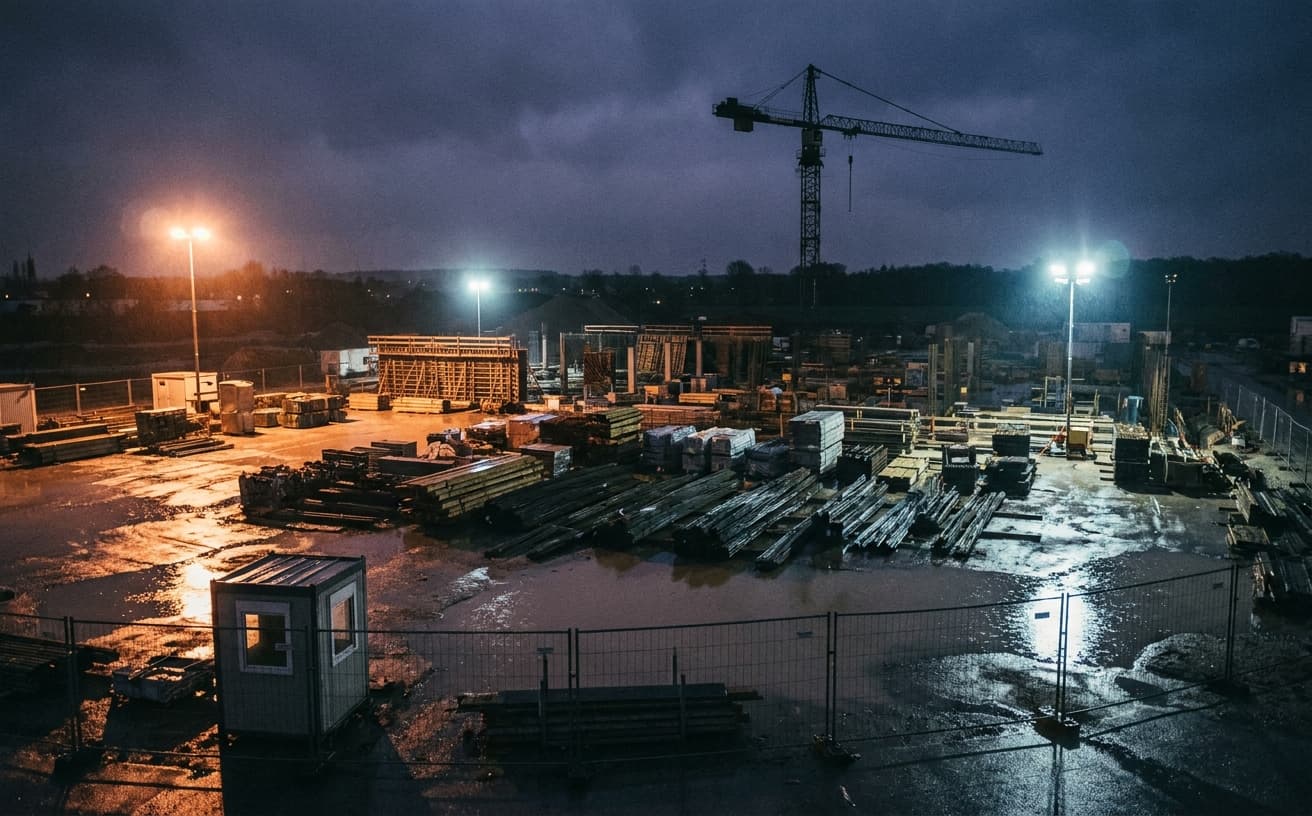
CWA 15793 is the most frequently cited construction site security document in Europe that almost nobody on a construction site has ever opened.
The text exists. It carries the imprimatur of CEN, the European Committee for Standardization. It runs to several dozen pages of normative-sounding language about risk assessment, perimeter protection, access control, lighting, and the documentation duties of a site manager. It has been referenced in tender documents, in insurance memos, in due diligence checklists, in academic papers on construction loss prevention. And yet, on the average European construction site, with the average site manager and the average security subcontractor, CWA 15793 has approximately the operational weight of a weather forecast from the previous quarter. It is known to exist. It is not consulted.
This article describes what the document actually is, who wrote it, why its real-world adoption is so thin, and why, despite all of that, it remains the most useful framework an operator can hold in one hand when redesigning the security of a construction site. The point is not to praise the standard. It is to use it.
What CEN Workshop Agreements actually are
A CEN Workshop Agreement, or CWA, is not a European Norm. It is one rank below. The European Committee for Standardization produces several categories of document, and the rank matters. A full EN, a European Norm, is the product of a multi-year process involving national mirror committees, public enquiry, formal voting, and obligatory transposition into the national standards catalogues of CEN member states. An EN, once published, replaces conflicting national standards. It has weight. It can be cited in legislation and is regularly cited in tender law.
A CWA sits at a different level. It is the product of a CEN workshop, an open group of interested parties who write a document under CEN procedures but without the full national voting process. The output is a consensus among the workshop participants, not among the member states. CEN publishes the CWA, hosts it, and gives it a number, but the legal status is consultative. A CWA is, in plain language, a structured opinion from a competent group, distributed under a respectable letterhead.
This matters for CWA 15793. The number signals that the text passed through a real CEN process, with named participants, terms of reference, and editorial oversight. It does not signal that any government, any insurance regulator, or any contracting authority has bound itself to its content. The text was written to be useful. It was not written to be enforced. Operators who confuse the two read the document with the wrong expectations and abandon it when they discover that no one will sanction them for ignoring it. The correct reading is different. A CWA gives a structured vocabulary and a defensible reference. In a domain like construction site security, where most operators work from habit and the cheapest available wholesaler, a defensible reference is worth more than its formal rank suggests. It allows an operator to anchor decisions in something other than personal preference, and that anchor holds in court, in insurance discussions, and in conversations with clients.
What the text actually says about construction sites
The substance of CWA 15793, stripped of its standards-language, is a structured walk through the security problem of a temporary, high-value, semi-open site. The text starts with risk assessment, which it treats as the foundation of every subsequent decision. Before perimeter, before cameras, before patrols, the document insists on a written analysis of what is on the site, what it is worth, who might want it, and how a loss event would propagate through the project schedule. This is not novel. It is the same logic that ISO 27001 applies to information systems and that IEC 62443 applies to industrial control systems. The novelty, in the context of construction, is that the logic is written down and addressed to construction operators rather than to general security professionals.
The risk assessment then drives a layered set of recommendations. Perimeter, broken down into fencing standards, gate construction, sight lines, and the management of openings during working hours. Access control, broken down into the identification of personnel, the management of visitors and subcontractors, the handling of deliveries, and the procedures for closing the site at the end of the shift. Lighting, with explicit attention to the trade-off between visibility for security and glare for neighbouring uses. Surveillance, with notes on camera placement, recording duration, and the legal handling of footage under data protection law. Detection, covering motion sensors, glass break, vibration, and the integration of detection signals into a response chain. Response, with reference to internal staff, external guarding, and law enforcement.
The text is qualitative rather than quantitative. It does not say how many lux a site should have at three in the morning. It does not specify a fence height in millimetres. It does not mandate a particular camera resolution. Instead, it gives the operator a checklist of considerations and asks for a documented decision in each category. This restraint is deliberate. CEN workshops are aware that prescriptive numbers age badly and that construction sites vary too widely to support a single specification. The text aims at structure, not at uniformity. An operator who works through the document and produces a written security concept that addresses each of the named categories has done something that ninety percent of European construction sites have not done. The benefit of the standard is procedural. The numbers come from elsewhere, from insurance schedules, from GDV recommendations in Germany, from NICB data in the United States, from in-house loss statistics. CWA 15793 provides the file structure. The operator provides the content.
Why adoption is thin in practice
The honest answer is that nobody is forcing anyone. Construction site security in Europe sits in a regulatory gap. Worker safety has a dense and enforced regulatory layer, with national labour inspectorates, mandatory training, documented procedures, and penalties for non-compliance. Environmental protection on construction sites has its own enforced layer. Theft prevention does not. It is treated as a private matter between the contractor, the insurer, and the client. The contractor pays the premium, the insurer pays the claim, the client tolerates the schedule slippage, and the cycle continues. No public authority audits the security concept of a construction site in the way a labour inspector audits the safety concept.
In that environment, a non-binding CEN Workshop Agreement struggles to find traction. Site managers under schedule pressure do not read documents that no one will check. Security subcontractors do not invoke a framework that does not appear in the tender. Insurers, who would in principle benefit from standardised risk concepts, work from their own internal schedules, which they consider proprietary and which they do not align with public standards. The result is a document that is widely cited in literature and rarely opened in practice.
There is a second reason for the thin adoption. The construction industry has a strong oral culture. Knowledge moves through site managers, polishers, and security supervisors in spoken form, on the site, in the container, over coffee. Written standards compete for attention with the working drawing, the construction schedule, the safety plan, and the daily report. The security concept, which is rarely the most urgent document on any given morning, loses that competition. CWA 15793 cannot fix this. What it can do is provide a backbone for the rare cases where someone takes the time to write a real concept, and that minority of cases is growing as material values rise, as electronic components become more attractive to organised theft, and as insurers tighten their conditions. The standard is being pulled into use by economic pressure, not by regulatory pressure, and the pull is slow but real.
How serious operators use the document
Operators who treat CWA 15793 seriously use it in three ways. The first is as a template for the written security concept that increasingly appears as a contractual requirement in larger projects. Public construction tenders in several European jurisdictions now ask the contractor to submit a security concept as part of the bid. The tender does not always say what the concept should contain. CWA 15793 fills that gap. A bidder who structures the concept along the document's categories produces a deliverable that is recognisable, defensible, and complete in the eyes of an evaluator who has read the same document.
The second use is as a checklist during the risk assessment phase of a new site. Before mobilisation, the project security lead walks through the document's categories and asks, for each one, what the answer for this specific site is. Perimeter, decided. Access, decided. Lighting, decided. Surveillance, decided. Detection, decided. Response, decided. The walk takes a few hours. It produces a document of perhaps fifteen to twenty pages, specific to the site, that can be handed to the site manager, the security subcontractor, and the insurer. That document is more than most sites have. It is also the artefact that survives, in court or in an insurance dispute, when a loss event needs to be reconstructed and the question arises of whether the operator took reasonable care.
The third use is internal benchmarking. A contractor with multiple active sites can use CWA 15793 categories as a common grid to compare the security posture across sites, identify outliers, and direct investment to where it produces the largest reduction in expected loss. This is the use that aligns most closely with NIST CSF 2.0 thinking, which treats security maturity as a portfolio question rather than a site-by-site question, and with ISO 27001 thinking, which treats the management system as the unit of measurement rather than the individual control. Operators who run security across a portfolio of sites need a common language. CWA 15793 supplies one. It is not the only possible language, but it has the advantage of being public, free, and uncontested.
The book BOSWAU + KNAUER. From Building to Security Technology develops this portfolio view in detail, arguing that the economic case for serious construction site security only becomes visible when losses are aggregated across projects and the cascading effects on schedule, contractual penalties, and client trust are counted alongside the direct material loss. CWA 15793 supports that aggregation by giving each site a comparable structure.
What the document does not contain
It is worth being precise about the limits. CWA 15793 does not contain a technology specification. It does not endorse any particular camera, any particular sensor, any particular access control system, any particular guarding model. The document predates the current generation of mobile video towers, autonomous security robots, and AI-driven video analytics, and it has nothing to say about them directly. An operator who wants to know whether a mobile tower is preferable to a fixed installation, or whether an autonomous patrol robot replaces a watchman, will not find the answer in the standard. The standard tells the operator to assess the risk, document the decision, and apply layered protection. It does not tell the operator which technology to buy.
This is a feature, not a defect. Technology specifications age in years. The categories in CWA 15793 have been stable for more than a decade and will remain stable for at least another decade. An operator who builds a security concept on the document's structure can swap in new technology without rewriting the concept. The structure holds, the contents change. This is the same logic that makes IEC 62443 useful in industrial control, that makes NIST 800-53 useful in federal information systems, and that makes ISO 27001 useful in information security generally. The standard is a frame. The picture inside the frame is the operator's responsibility.
Operators looking for technology guidance should look elsewhere. ASIS International publishes guidelines on physical security that are more current on equipment. The BSI in Germany publishes technical guidelines that occasionally touch on construction-relevant equipment. National police crime prevention units publish recommendations on perimeter protection that descend to product-level detail. None of these replace CWA 15793 as a structure, and CWA 15793 does not replace them as sources of equipment-level recommendations. The serious operator reads all of them and decides what applies to the specific site.
What holds
CWA 15793 is a non-binding European document that nevertheless deserves to sit on the desk of anyone responsible for construction site security. Its lack of enforcement is not a reason to dismiss it. Its structured vocabulary, its category-based approach to risk assessment, and its compatibility with the broader family of management-system standards make it the cheapest available foundation for a serious security concept on a complex site.
The document will not protect a site. It will not stop a theft. It will not reduce an insurance premium by itself. What it does is provide a backbone around which a real concept can be built, a real conversation with the insurer can be conducted, and a real benchmarking exercise across a portfolio of projects can be performed. Operators who treat the standard as a piece of paper to be checked off in a tender will get nothing from it. Operators who treat it as a working tool will find that it pays for the few hours it takes to read.
For operators ready to translate the framework into a defensible site-specific concept and a measurable reduction in loss, the relevant next step is a structured audit. A three to five day audit, conducted on site and through the project documentation, produces a written report aligned to the CWA 15793 categories, a quantified loss baseline, and a prioritised investment plan. The audit is Path II in the three paths set out in the book and is the format in which the standard moves from text to operational reality.
Frequently asked questions
What is CWA 15793?
CWA 15793 is a CEN Workshop Agreement, a consultative document published by the European Committee for Standardization, that provides a structured framework for the security of construction sites. It covers risk assessment, perimeter, access control, lighting, surveillance, detection, and response, organised as a sequence of categories that an operator is expected to address in writing. The document is qualitative rather than prescriptive, deliberately avoiding numerical specifications in favour of a procedural structure. It is published under CEN procedures but does not carry the binding status of a full European Norm.
Who wrote it?
The document was drafted by a CEN workshop, an open working group convened under CEN procedures and composed of representatives from construction companies, security service providers, insurers, equipment manufacturers, and academic institutions across several European member states. The workshop operated under terms of reference agreed at the outset and produced the text through a structured consensus process, with editorial oversight from CEN. The named participants are listed in the document itself. No single national delegation owns the text. It is a European document in the procedural sense, even though its national uptake has been uneven.
Is it mandatory?
No. A CEN Workshop Agreement is not a binding standard. No European directive incorporates CWA 15793 by reference. No national legislation, to the author's knowledge, requires compliance with it. Insurers do not condition coverage on it, although some reference it informally during underwriting. Public tenders occasionally ask for a security concept aligned to it, but this is a contractual condition specific to the tender, not a regulatory obligation. Operators who ignore the document are not in breach of any law. Operators who follow it gain a defensible structure but no certificate, no seal, and no formal recognition.
How is it used?
Serious operators use it in three ways. First, as a template for the written security concept that increasingly appears in large construction tenders, giving the deliverable a recognisable structure. Second, as a checklist during the pre-mobilisation risk assessment, ensuring that each category of protection has been considered and documented for the specific site. Third, as a common grid for benchmarking security maturity across a portfolio of sites, allowing the operator to direct investment to where it produces the largest reduction in expected loss. In all three uses, the standard supplies structure, not content.
Take the next step: See prices & ROI · Explore the products · Send a no-obligation request. BOSWAU + KNAUER – direct from the factory in Filderstadt, reply within 5 working days.
About the author
Dr. Raphael Nagel (LL.M.) is founding partner of Tactical Management. He acquires and restructures industrial businesses in demanding market environments and writes on capital, geopolitics, and technological transformation. raphaelnagel.com
More reading
Since 1892.
The firm is reached at boswau-knauer.de or +49 177 2266267.