
Blog
Industrial Fencing Standards: EN 1717, EN 1090 in Practice
EN 1717 backflow prevention adjacency, EN 1090 steel-fencing, real-world durability. The standards that govern Europe perimeter steelwork.

Dr. Raphael Nagel
September 29, 2025
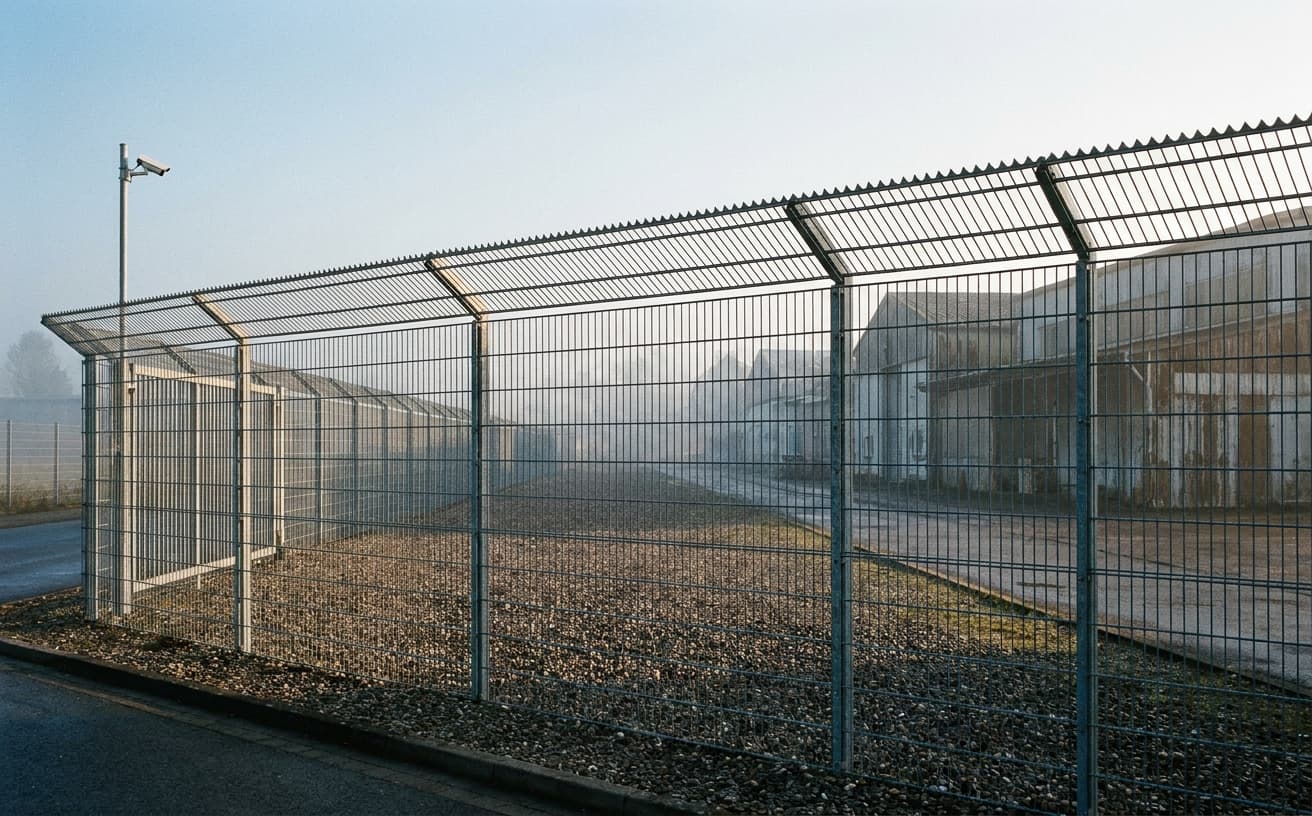
A perimeter fence is not a product. It is a load-bearing steel structure with a security function, and European law treats it accordingly.
That sentence, simple as it reads, sorts the market. Operators who understand it buy fences that hold. Operators who do not, buy fences that look right in the catalogue and bend in the third winter. The difference between the two is rarely visible at procurement. It becomes visible in the second incident, when the post twists at the base plate, the mesh deforms around the impact point, and the manufacturer cites a tolerance that no one read before the contract was signed. The European standards landscape, in particular EN 1090, exists precisely to remove that ambiguity. It is not paperwork. It is the codification of what steel must do when it stands at a perimeter for fifteen years.
This article works from the manufacturer's view at BOSWAU + KNAUER. The position is operator to operator, not consultant to client. The terrain covered is narrow. EN 1090 for structural steel and its application to fencing. EN 1717 as an adjacent water standard that operators confuse with fencing standards and should not. Real-world durability, measured rather than declared. And the institutional architecture that decides who certifies what, and what that certification is worth on a procurement table.
EN 1090 in plain terms
EN 1090 is the European harmonised standard for the execution of steel structures and aluminium structures. It is not a fencing standard. It is a structural standard that fencing falls under whenever the fence has a structural function, which, for industrial perimeters above a defined threshold, it almost always does. The standard is split into parts. EN 1090-1 covers conformity assessment of structural components. EN 1090-2 covers technical requirements for steel structures. EN 1090-3 covers aluminium. Together they define what a manufacturer must demonstrate to place a CE-marked structural steel product on the European market.
The mechanism is execution classes. EN 1090-2 defines four execution classes, EXC1 through EXC4, with rising rigour. EXC1 covers structures with low consequence of failure, typical small structures without dynamic loading. EXC2 covers most ordinary buildings, including standard fencing for non-critical perimeters. EXC3 covers structures with significant consequence of failure or dynamic loading. EXC4 covers structures where failure would have extreme consequences, bridges and the like. For industrial fencing protecting critical infrastructure, EXC2 is the practical floor. For perimeters that integrate with detection systems, vehicle barriers or anti-ram functions, EXC3 enters the discussion.
The execution class drives everything downstream. Welding qualifications, traceability of steel, tolerances on cut and fit, surface preparation, coating systems, documentation. An EXC2 product is not interchangeable with an EXC1 product even when the visible geometry matches. The post that holds at EXC2 is not the post that bends at EXC1, because the steel chemistry, the weld procedure and the coating thickness are not the same. Operators who specify only the height and the mesh aperture leave the execution class to the supplier, and the supplier optimises for price. The result is a fence that meets the brief and fails the function.
The CE mark on a fence is not decoration. It is a declaration that the manufacturer holds a Factory Production Control certificate audited by a notified body under EN 1090-1. Operators who do not ask for the notified body number, the FPC certificate number and the declared execution class are buying a product whose conformity has not been demonstrated to them. The supplier may be entirely legitimate. The audit trail, however, sits in a folder the operator has not opened.
Where EN 1717 belongs and where it does not
EN 1717 is the European standard for protection against pollution of potable water in installations and general requirements of devices to prevent pollution by backflow. It is a plumbing standard. It governs the prevention of contaminated water entering the drinking water network through cross-connections, backflow, or back-siphonage. It has nothing to do with fencing in the structural sense.
It enters the perimeter discussion only at the interface. Industrial sites have potable water supplies. Those supplies cross the perimeter through service ducts, hose connections for fire fighting, irrigation taps used by site staff, and increasingly, water connections for mobile equipment including cleaning vehicles and certain robotic platforms. Each of these crossings is a potential backflow point. EN 1717 defines fluid categories from 1, drinking water, to 5, water representing a human health hazard through the presence of microbiological or viral elements. The standard then prescribes the type of backflow prevention device required at each interface. An external tap at a perimeter, used by a contractor with an unknown hose history, is treated very differently from a sealed irrigation line. Category 5 separation, typically by air gap or by an AA, AB or AD type device, becomes mandatory at points where the operator cannot guarantee the downstream fluid quality.
The reason this standard appears in a fencing article is that procurement teams routinely confuse standards adjacency with standards equivalence. A specification document for a perimeter package will list EN 1090, EN 10223 for mesh, ISO 1461 for hot-dip galvanising, and then EN 1717 because someone copied the previous tender. EN 1717 in that list is either a real requirement, because the perimeter integrates water service points and the contract makes the fencing supplier responsible for them, or it is noise. Both cases occur. The serious case is the first. The perimeter is not just steel. It is steel, gates, control panels, intercom stations, sometimes power distribution, and sometimes water points for fire-brigade access. EN 1717 governs those water points and the responsibility for compliance has to sit with someone named. The fencing contractor, the plumbing subcontractor, or the site operator. If the answer is "we assumed", the answer is wrong.
BSI in the United Kingdom, DIN in Germany and AFNOR in France publish national versions of EN 1717 with annexes. Operators with multi-country footprints should confirm which national annex applies at each site. The core requirements are harmonised. The notification thresholds and the type-approval requirements for devices are not always identical.
What durability actually means in steel
Durability in fencing literature is usually expressed as a coating warranty. Twenty-five years on the galvanising, ten years on the polyester topcoat. These numbers are not wrong. They are also not what they appear to be. A coating warranty is a contractual statement about the coating system under defined exposure conditions, typically referenced to ISO 12944 corrosivity categories. C1 is interior dry. C5 is industrial or marine high-corrosion. CX is extreme, offshore or chemical exposure. The same coating system carries a very different effective life across these categories. A polyester powder coat that lasts twenty years in C2 may degrade in eight in C4.
Industrial perimeters in mainland Europe sit predominantly in C3 and C4. Coastal logistics hubs, chemical sites, and any installation near a motorway with salt spray reach C4 routinely. The procurement document that specifies "hot-dip galvanised to ISO 1461 with polyester topcoat" without naming a corrosivity category has specified nothing useful. The supplier defaults to the cheapest interpretation, which is typically C2 or C3, and the operator discovers in year seven that the topcoat is chalking and the galvanising is starting to bloom at cut edges.
Real durability is measured in three dimensions, not one. First, base steel chemistry and section thickness, which determine residual structural capacity after corrosion has begun. A 3 mm wall thickness post with 5 percent section loss is still structurally sound. A 1.5 mm wall thickness post at the same loss is not. Second, coating system suitability for the actual corrosivity category, verified by independent salt-spray testing referenced to ISO 9227 and field-correlated rather than catalogue-cited. Third, mechanical integrity at connections. The weakest point of an industrial fence is rarely the centre of a panel. It is the post-to-baseplate weld, the panel-to-post bracket, and the gate hinge. These are the points where dynamic loading, vehicle impact, vegetation pressure, and human attack concentrate. ASIS International's perimeter security guidelines, IEC 62443 where the fence integrates with electronic detection, and the German BSI guidance for critical infrastructure all converge on the same observation. The fence is as strong as its connections, not as its panels.
The manufacturer's own testing programme is what separates a serious supplier from a catalogue intermediary. BOSWAU + KNAUER tests panels and connections under impact loading, freeze-thaw cycling, and salt-spray conditions that simulate twenty years of C4 exposure compressed into accelerated protocols. Components that fail the protocol do not enter the catalogue. The discipline is the same one described in BOSWAU + KNAUER. From Building to Security Technology. Build for runtime. Document the assumptions. Remove from the programme what does not hold.
How European certification actually works
The institutional architecture matters because procurement teams use it as a shortcut. A CE mark, a notified body number, a TÜV certificate, an ISO 9001 quality system. Each of these has a defined scope, and the scopes do not overlap as cleanly as procurement language suggests.
The CE mark on a fence under EN 1090-1 is the manufacturer's declaration that the product conforms to the harmonised standard. It is supported by a Factory Production Control system that is audited by a notified body. The notified body issues a certificate referencing FPC, not the product. The product itself is covered by the manufacturer's Declaration of Performance, which states the execution class, the welding standard EN ISO 3834 level, the steel grade and the coating system. The notified body does not test every batch. It audits the production system. The integrity of the declaration depends on the integrity of the FPC, which depends on the manufacturer's discipline.
TÜV and similar bodies in Germany, Austria and Switzerland offer additional product certifications that go beyond EN 1090 compliance. These typically address resistance classes under EN 1627 for manual attack resistance, or specific anti-ram performance under PAS 68 or IWA 14-1 for vehicle impact. EN 1627 defines six resistance classes, RC1 through RC6, characterised by the tool kit and the time an attacker requires to breach. RC4 and above are relevant for industrial perimeters with significant asset values or critical infrastructure functions. PAS 68 and IWA 14-1, while published outside the EN framework, are routinely referenced in European procurement for sites where vehicle-borne threats are part of the risk picture.
ISO 9001 is a quality management standard. It says the manufacturer has documented processes. It does not say the product holds. ISO 14001 covers environmental management. ISO 45001 covers occupational health and safety. These are useful in supplier qualification, irrelevant in product specification. Operators who confuse the two layers buy on certificates that do not certify what they think they certify.
NIST CSF 2.0 and ISO 27001 enter the perimeter discussion when the fence integrates with detection, video analytics, or access control. IEC 62443 specifically governs industrial control systems and the cybersecurity of the operational technology stack. A modern perimeter is rarely just steel. It is steel plus sensors, sensors plus analytics, analytics plus a SOC connection. Each of those layers carries its own certification regime, and the responsible operator names a single integrator who owns the conformity across them. NICB perimeter loss data and ASIS International benchmarks remain useful reference points for risk pricing, even if they do not certify anything.
What real-world performance looks like
Catalogue performance and field performance diverge for predictable reasons. The catalogue assumes installation according to specification. The field delivers installations under time pressure, on uneven ground, with foundations that are sometimes correctly poured and sometimes not. The catalogue assumes maintenance as prescribed. The field delivers maintenance windows that get postponed when production demands the available labour. The catalogue assumes the fence stands alone. The field places the fence next to vegetation that grows into it, vehicles that brush against it, and contractors who lean ladders on it.
A fence that performs in the field is engineered for the gap between assumption and reality. The post base plate is oversized relative to the calculated minimum, because the foundation depth varies by twenty millimetres across the perimeter and the moment arm changes accordingly. The coating system is specified one corrosivity category above the nominal, because the actual exposure includes microclimates the survey did not capture. The connection brackets are stainless rather than galvanised carbon steel, because the maintenance cycle in year eight will not include re-galvanising and a degraded bracket fails the fence regardless of panel condition. The gate operator is sized for double the daily cycle count, because the actual usage exceeds the projection in every site BOSWAU + KNAUER has measured.
These choices add cost at procurement. They subtract cost across the lifecycle. The arithmetic only works if the operator thinks in lifecycle terms. Procurement teams measured on capex compression will not make these choices. Operations teams accountable for total cost of ownership will. The institutional question, then, is which team holds the specification authority. The answer determines whether the perimeter is a depreciating asset or a recurring cost.
Field data accumulated by GDV and similar insurance bodies in Europe shows a consistent pattern. Sites with documented EN 1090 EXC2 or EXC3 fencing, ISO 12944 C4 coatings, and EN 1627 RC3 or higher resistance class at vulnerable sections report intrusion frequencies materially below sites with unclassified fencing. The reduction is not driven by the fence alone. It is driven by the fact that operators who specify to this level also specify the rest of the security system to a comparable level. The fence is a marker of operator seriousness. Insurers read the marker and price accordingly.
What holds
The European standards landscape for industrial fencing is not difficult. It is precise. EN 1090 governs the structural steel. EN 1627 governs the attack resistance. ISO 12944 governs the coating system. ISO 1461 governs the galvanising. EN 1717, when relevant, governs the water service points at the perimeter. Each standard has a defined scope. Each has a defined certification path. Operators who specify with this precision get fences that hold. Operators who specify with catalogue language get fences that bend.
The manufacturer's responsibility is to make the specification possible. Datasheets that name the execution class, the corrosivity category, the resistance class, the notified body and the FPC certificate number. Test reports that reference accredited laboratories. Field references that an operator can call. These are not marketing materials. They are the audit trail that converts a procurement decision into a defensible investment.
For operators who want to move from catalogue specification to standards-anchored specification, BOSWAU + KNAUER offers three paths. A confidential sixty-minute conversation at the executive level, in which the perimeter as currently specified is read against the standards that govern it. A three to five day on-site audit, in which the existing perimeter is assessed against EN 1090, EN 1627 and ISO 12944, with a written report that names the gaps and quantifies the lifecycle cost of closing them. A ninety-day pilot in which a defined section of perimeter is replaced or upgraded to the recommended specification and the resulting performance is measured against the baseline. The choice among the three depends on where the operator stands. The standards do not change.
Frequently asked questions
What is EN 1090?
EN 1090 is the European harmonised standard for the execution of steel and aluminium structures. It defines how structural components must be designed, fabricated, welded, coated and documented to carry the CE mark for placement on the European market. The standard is divided into parts, with EN 1090-1 covering conformity assessment, EN 1090-2 covering steel and EN 1090-3 covering aluminium. It introduces execution classes EXC1 through EXC4 that scale rigour with consequence of failure. For industrial perimeters, EXC2 is the practical floor and EXC3 enters where dynamic loading or critical infrastructure functions apply.
How does it apply to fencing?
Any fence with a structural function falls under EN 1090, which in industrial perimeters is essentially every fence above a basic boundary marker. The standard governs the steel grade, welding qualifications, tolerances, surface preparation, coating compatibility and documentation. The CE mark on the fence is the manufacturer's declaration of conformity, supported by a Factory Production Control certificate audited by a notified body under EN 1090-1. Specifications that do not name the execution class leave the choice to the supplier, who optimises for price. The result is a fence that meets the catalogue brief and fails the field function.
Who certifies?
Certification involves three layers. The manufacturer holds the Factory Production Control system and issues the Declaration of Performance. A notified body, an accredited certification organisation listed under the Construction Products Regulation, audits the FPC and issues the FPC certificate with a four-digit notified body number that appears on the CE mark. Independent test laboratories, accredited under ISO 17025, conduct the type tests that support the declaration. Operators verify all three by requesting the FPC certificate number, the notified body identification and the underlying test reports. ASIS International and BSI provide additional reference frameworks for procurement teams.
How is durability tested?
Durability is tested across three dimensions. Coating systems are evaluated under ISO 12944 corrosivity categories, with accelerated salt-spray testing per ISO 9227 correlated to real exposure. Structural elements are tested under static and dynamic loading to verify capacity at connections, the weakest points of any fence. Attack resistance is tested under EN 1627, which defines six resistance classes from RC1 to RC6 based on the tool kit and time an attacker requires to breach. Serious manufacturers, BOSWAU + KNAUER included, combine accredited laboratory testing with field-correlated programmes that compress twenty years of exposure into months. Catalogue numbers without test references should be treated as marketing.
Related topics
- Perimeter Security Systems: The Seven-Layer Model
- Layered Perimeter Security on an Industrial Site
- Industrial Perimeter Fencing in the Gulf: Failure Modes
- Security as Code: Platform Thinking for Physical Defense
- Industrial Perimeter Security: Architecture Layered for Cost
Take the next step: See prices & ROI · Explore the products · Send a no-obligation request. BOSWAU + KNAUER – direct from the factory in Filderstadt, reply within 5 working days.
About the author
Dr. Raphael Nagel (LL.M.) is founding partner of Tactical Management. He acquires and restructures industrial businesses in demanding market environments and writes on capital, geopolitics, and technological transformation. raphaelnagel.com
More reading
Since 1892.
The firm is reached at boswau-knauer.de or +49 177 2266267.