
Blog
Construction Site Theft in France 2026: The FFB Data
FFB statistics, regional theft patterns, copper theft in PACA and IDF. The honest French construction-theft picture.

Dr. Raphael Nagel
October 28, 2025
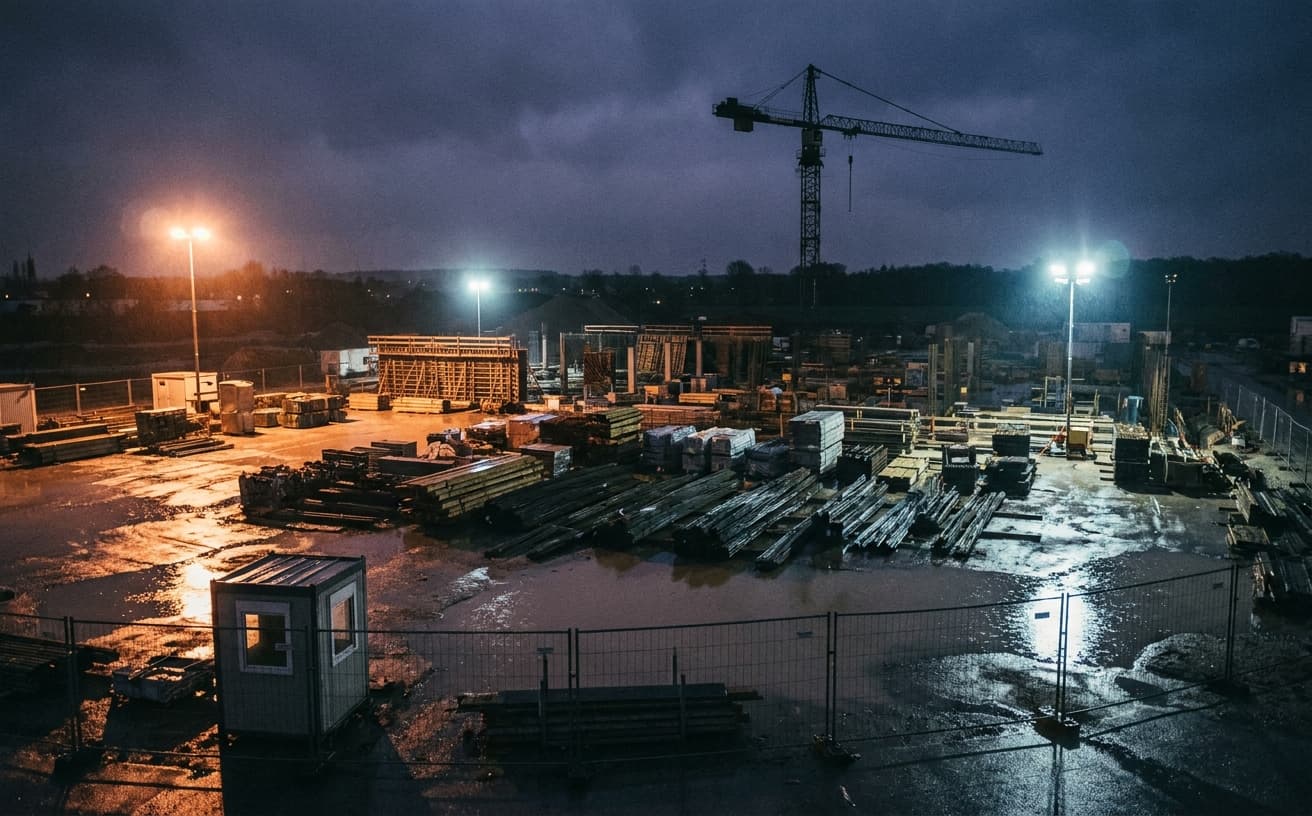
Construction site theft in France is not a question of bad luck, it is a line item that the industry has stopped writing down honestly.
The Federation Francaise du Batiment publishes figures every year, insurers publish their own, and the gendarmerie publishes a third set. None of them agree, and that disagreement is itself the most reliable indicator of the problem. Where reporting is fragmented, losses are larger than the published number. Operators who run sites in Ile-de-France, Provence-Alpes-Cote d'Azur, and the industrial belts around Lyon and Bordeaux know this from their own after-the-fact calculations. The insured loss is one number. The schedule slippage, the rental contracts that keep running on stolen plant, the disrupted handover dates, the renegotiated penalties with the maitre d'ouvrage, those are several other numbers, and they are usually larger.
This article assembles what can honestly be said about the French picture going into 2026, what the FFB data shows, where the regional concentrations sit, and what the practical operator response looks like when the classical triad of fence, light, and gardien has stopped scaling.
What the FFB actually measures
The Federation Francaise du Batiment is the principal employers' federation for the French construction industry. It represents the bulk of the small, medium, and large building companies in France and publishes periodic surveys on theft, vandalism, and site security. Its numbers are drawn from member declarations, which means they capture the losses that companies are willing to declare to their federation. They do not capture what insurers see, and they certainly do not capture what stays in the after-the-fact reconciliation between the site manager and the controlling.
For 2024 and into 2025, the FFB and its regional chambers have communicated repeatedly that construction site theft remains a structural cost driver for the sector, with annual aggregate losses for the French construction industry consistently estimated in the hundreds of millions of euros when direct and indirect costs are combined. The exact number depends on which costs are folded in. If only stolen material and tools are counted, the number is one order of magnitude. If schedule slippage, replacement rental, insurance excesses, and lost margin on penalised contracts are included, the number is another order of magnitude entirely. Operators who have run a serious post-incident reconciliation know that the second number is the true one.
The FFB data also shows that small and medium contractors are disproportionately affected. A large general contractor can absorb the loss of a power distribution cabinet or a generator across a portfolio of sites. A regional artisan with three active sites cannot. When the FFB publishes a figure indicating that a significant majority of construction firms have experienced theft within the previous twenty-four months, that figure is the visible tip of a structural problem that is older than the survey instrument. The industry has lived with site theft as a background cost for decades. What has changed is the speed at which the cost line is growing relative to the margin line.
Insurers see a different picture again. The Federation Francaise de l'Assurance and individual carriers report rising claim frequencies on construction sites, with copper and non-ferrous metals, fuel, tools, and electronic site equipment dominating the loss schedules. The discrepancy between FFB declarations and insurer claim data is itself diagnostic. Many losses are absorbed below the deductible threshold and never declared to insurers. Others are declared neither to insurers nor to the federation because the operator has decided, rationally, that the administrative cost of declaration exceeds the recoverable amount.
Regional concentration: Ile-de-France and PACA
The geography of French construction theft is not uniform. Two regions dominate the loss statistics in absolute terms and in incident frequency: Ile-de-France and Provence-Alpes-Cote d'Azur. The reasons are structural and they will not change quickly.
Ile-de-France concentrates the largest volume of active construction in France, including the residual Grand Paris Express infrastructure works, ongoing residential development across the petite and grande couronne, and a permanent flow of commercial fit-out activity. Volume creates opportunity. The density of sites, the constant churn of subcontractors, the logistical complexity of urban deliveries, and the proximity of resale and export channels through the northern ports combine to make the region the natural centre of gravity for organised construction theft in France. Copper cabling, hydraulic components, lithium tool batteries, and small plant disappear in patterns that suggest knowledge of delivery schedules rather than opportunistic intrusion.
Provence-Alpes-Cote d'Azur shows a different but equally durable pattern. The region combines significant residential and tourism-driven construction with proximity to the port of Marseille, which functions as an export hub for non-ferrous metals into the Mediterranean and beyond. Copper theft in PACA has been a documented preoccupation for both the FFB regional chamber and the gendarmerie for more than a decade. The price of copper on the London Metal Exchange remains the single most reliable leading indicator of theft frequency on sites in the region. When copper trades above a certain threshold, the marginal economics of stripping a site become attractive enough to draw in semi-organised crews who treat the activity as a trade.
The industrial belts around Lyon, Bordeaux, Toulouse, and Lille show their own concentrations, often tied to specific infrastructure projects or to the proximity of logistics corridors. Brittany and the Pays de la Loire show lower absolute incident counts but higher relative impact, because the contractor base is smaller and the regional resale channels are less anonymous. A stolen mini-excavator in Finistere is harder to fence locally than the same machine in Seine-Saint-Denis, which does not mean it does not happen, only that the economics of theft shift with geography.
The honest reading of the FFB and gendarmerie regional data is that no French region is exempt, but two regions absorb a disproportionate share of the national loss total. Any operator running sites in Ile-de-France or PACA should treat the regional baseline as a planning assumption, not as a risk to be discovered after the fact.
Copper, fuel, and the commodity logic of theft
The materials that disappear from French construction sites are not random. They follow a commodity logic that any operator who has reconciled a site inventory will recognise.
Copper dominates the loss schedules in value terms. Bare copper cabling, copper-clad earthing components, copper pipework destined for HVAC installations, and copper-bearing distribution gear are all targets. The theft is rarely opportunistic. It is typically executed by crews who know what to cut, how to strip insulation in the field or off-site, and where to deliver the metal for cash settlement. The French recycling industry operates under traceability obligations that have tightened over successive legislative cycles, but the cash market for stripped copper persists, and the export channels through major ports remain.
Fuel is the second commodity. Diesel theft from site tanks, from plant fuel reservoirs, and from delivery vehicles is a permanent feature of French sites, with frequency tracking the retail diesel price. When fuel is expensive, fuel theft becomes attractive to a much wider population of opportunistic actors than copper theft, which requires technical knowledge. A site that loses two hundred litres of diesel overnight has lost a quantifiable amount of money and a less quantifiable amount of operational time, because the plant that was supposed to run the next morning does not run.
Tools and small plant constitute the third category. Cordless tool batteries have become a particular target because of their high value-to-weight ratio and their fungibility on secondary markets. Small generators, compactors, laser levels, and survey equipment disappear in patterns that suggest both opportunistic and organised theft. Lithium battery theft has grown faster than any other tool category over the past five years, tracking the growth of cordless tool adoption itself.
Larger plant, the mini-excavators, telescopic handlers, and compact loaders that populate French sites, are stolen less frequently than tools but with much higher unit value. The recovery rate for stolen plant in France remains low, with international organisations such as the NICB in the United States and equivalent European bodies pointing to systematic gaps in plant identification, registration, and cross-border tracing. A stolen telehandler in Marseille can be in a North African port within forty-eight hours, and the recovery probability collapses past that horizon.
The commodity logic matters because it determines what a serious site protection strategy needs to address first. The site that protects its copper cabling, its fuel storage, and its battery inventory has addressed the bulk of its statistical exposure. Everything else is residual risk.
Why the classical triad has stopped scaling
The standard French site protection package is well known to every site manager: a Heras fence, a few floodlights, and a gardiennage contract that puts a human presence on site during defined hours. Each of these elements has its justification. None of them scales to the threat profile that the FFB data now describes.
The fence keeps honest people out and discourages casual intrusion. It does not stop a crew that has come to cut a specific cable run. The floodlights shift the activity into shadow rather than eliminating it. Modern thieves work around fixed lighting patterns with no difficulty. The gardiennage contract delivers human presence, but the cost per hour per agent has risen steadily over the past five years, the available labour pool has tightened, and the wakefulness of a single agent across a long winter night in a large site is a known operational weakness. Any operator who has reviewed gardiennage incident reports honestly knows that the hours between three and six in the morning are systematically under-covered.
The arithmetic of scaling the classical approach is brutal. Doubling the gardiennage hours doubles the cost and produces a less-than-doubled reduction in loss, because the marginal hour of presence adds less protection than the first hour. The cost line crosses the loss line at a point that is unfavourable to the operator on most large sites. This is the structural reason that French construction operators have begun, often quietly, to add technology to the mix.
Technology in this context means mobile video towers with autonomous power, networked sensors with multi-channel verification to suppress false alarms, video analytics trained on construction site conditions to distinguish a fox from a person, and, on larger sites, mobile security robots that perform routine patrols on randomised schedules. The IEC 62443 framework for industrial automation security and the ISO 27001 framework for information security management both apply once these systems are networked, and any serious deployment will reference NIST CSF 2.0 as the underlying architecture for how detection, response, and recovery functions are organised.
The point is not to replace the gardien. It is to extend his reach. One operator monitoring eight sites through a properly engineered video and sensor platform delivers more verifiable presence than eight gardiens distributed across the same sites, at a fraction of the cost. This is the logic that has driven the shift from building to security technology that the author has described in BOSWAU + KNAUER. From Building to Security Technology, and it is the logic that French operators will increasingly apply over the 2026 to 2030 horizon.
Insurance, declaration, and the politics of the loss number
The relationship between the French construction industry and its insurers is a negotiation that runs in parallel with the relationship between the industry and its theft losses. The two negotiations are linked, but they are not the same.
Insurers price construction site policies on declared loss histories, on site security measures documented at the time of underwriting, and on regional and sectoral loss ratios. An operator who declares fewer losses pays lower premiums in the short term but signals less risk to the underwriter, which can be advantageous until the next significant claim arrives. An operator who declares every loss, including those below the deductible, generates a more accurate risk picture but accepts a higher premium baseline. Most French operators sit somewhere between these poles, declaring the losses that exceed the administrative threshold and absorbing the rest.
The Federation Francaise de l'Assurance and the carriers it represents have communicated for several years that construction site claim frequency is rising and that the loss ratios on certain regional and sectoral combinations are no longer sustainable at historical premium levels. This translates into rising premiums, rising deductibles, and tightening underwriting requirements, including explicit demands for documented security measures on sites above defined contract values. The operator who shows up to renewal with a serious security architecture, documented detection and response procedures, and quantified loss reduction over the previous policy period will negotiate from a different position than the operator who shows up with a Heras fence and an invoice for gardiennage hours.
The honest reading is that the insurance market is moving from indemnification to risk co-management. The carrier wants to see that the insured has done what a reasonable operator would do to prevent the loss in the first place. This is not unique to France. It is a pattern visible across European construction insurance markets, with parallels in the guidance published by the German GDV and the operational expectations communicated by major Mediterranean and Benelux carriers. The French operator who reads this trajectory correctly will invest in detection and documentation now, because the cost of that investment will be more than recovered in the next two renewal cycles.
What holds
The honest picture of French construction site theft in 2026 is not the picture that any single source publishes. It is the composite of the FFB declarations, the insurer claim data, the gendarmerie regional reporting, and the after-the-fact reconciliations that operators run privately. The aggregate annual loss to the French construction industry, when direct and indirect costs are combined, sits in the hundreds of millions of euros, concentrated disproportionately in Ile-de-France and PACA, driven by commodity logic on copper, fuel, and tool batteries, and absorbed unevenly across firm sizes.
The classical protection triad of fence, light, and gardien remains necessary but is no longer sufficient on sites of meaningful value. The operators who will write down their loss line over the coming three years are the operators who add detection, verification, and documented response to the architecture, and who treat security as a documented capability rather than a recurring expense.
For the operator who recognises the picture and wants to act on it, three paths are available. A confidential sixty-minute conversation will establish whether the loss profile justifies a structured response. A three to five day audit will produce a documented assessment of the standorts, the loss history, and the economic case for a modernised protection architecture, with deliverables that can be used internally or with third parties. A ninety-day pilot at a defined site will produce the operational data on which a scaling decision can be made with confidence. Each path stands on its own. None of them commit the operator to anything beyond the next deliverable.
Frequently asked questions
How much is stolen each year?
The aggregate annual loss to the French construction industry from theft and vandalism is consistently estimated in the hundreds of millions of euros when direct and indirect costs are combined. FFB declarations capture part of this. Insurer claim data captures another part. The schedule slippage, replacement rental, contractual penalties, and lost margin that follow significant incidents are often larger than the directly stolen value, and they are typically not visible in any single published figure. Any operator who has run a serious post-incident reconciliation will recognise that the published numbers understate the true cost.
Which regions are worst?
Ile-de-France and Provence-Alpes-Cote d'Azur dominate the French loss statistics in both absolute terms and incident frequency. Ile-de-France concentrates the largest volume of active construction and the densest resale and export channels. PACA combines significant residential and tourism construction with proximity to the port of Marseille and a documented copper theft pattern that tracks LME copper prices. Industrial belts around Lyon, Bordeaux, Toulouse, and Lille show their own concentrations. No French region is exempt, but the two regions named absorb a disproportionate share of the national total.
What is FFB?
The Federation Francaise du Batiment is the principal employers' federation for the French construction industry, representing the bulk of small, medium, and large building companies across France. It conducts periodic surveys on theft, vandalism, and site security, publishes regional and national data, and serves as the industry interlocutor with insurers, public authorities, and legislators on matters affecting construction site operations. Its data is drawn from member declarations and captures the losses that companies choose to declare to their federation, which is not the same as the total economic loss.
Who insures these losses?
The French construction insurance market is served by major domestic and pan-European carriers operating under the framework of the Federation Francaise de l'Assurance. Coverage typically combines tous risques chantier policies for the works themselves with separate or extended coverage for plant, tools, and site installations. Deductibles, exclusions, and security requirements vary by carrier and contract value. Operators with documented security architectures and verifiable loss reduction histories negotiate more favourable terms. The market is moving from pure indemnification toward risk co-management, with explicit underwriting expectations on detection and response capability.
Related topics
- UK Construction Theft 2026: The Data & Insurance Response
- Stolen Tools on Site: Who Actually Pays
- Mobile Camera Tower Comparison: Which Protects Best?
- Surveillance Tower: Mobile Video Towers Secure Sites 24/7
- Security Guard Service Cost: What You Really Pay 2026
Take the next step: See prices & ROI · Explore the products · Send a no-obligation request. BOSWAU + KNAUER – direct from the factory in Filderstadt, reply within 5 working days.
About the author
Dr. Raphael Nagel (LL.M.) is founding partner of Tactical Management. He acquires and restructures industrial businesses in demanding market environments and writes on capital, geopolitics, and technological transformation. raphaelnagel.com
More reading
Since 1892.
The firm is reached at boswau-knauer.de or +49 177 2266267.