
Blog
Mobile Surveillance Towers in France: The Olympic Legacy
JO Paris 2024 security legacy, prefecture coordination, and what changed in mobile surveillance after the Games. How modular towers now deploy across France.

Dr. Raphael Nagel
July 9, 2025
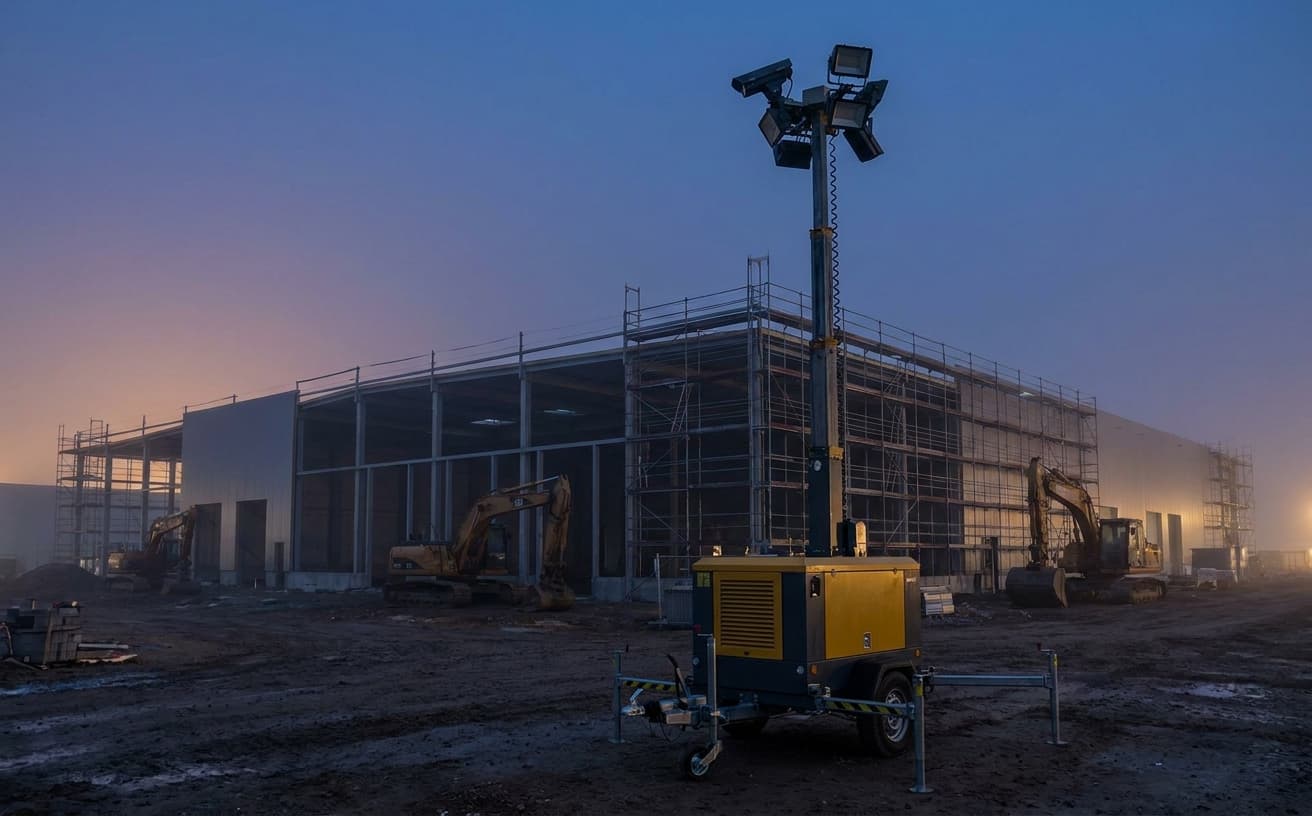
Legacy, in the security trade, is the word used when an event ended without a catastrophe and someone needs to justify the spend. The honest version is narrower. A legacy is the set of operational reflexes, supplier relationships, and deployable hardware that remain available to the state and to private operators after the cameras of the world have moved on.
By that measure, the Paris 2024 Olympic and Paralympic Games left France with something genuine. The country, through the Préfecture de Police de Paris, the Service National des Données de Voyageurs, the DGSI, and the gendarmerie's specialized units, ran one of the densest temporary surveillance perimeters in European peacetime history. A meaningful share of that perimeter was built on mobile, mast-mounted camera platforms, rapidly deployable towers, and modular video posts. Most of these platforms did not disappear when the closing ceremony ended. They were redistributed, re-tasked, and absorbed into the routine inventories of prefectures, SNCF, RATP, and the larger private operators who held Games-adjacent contracts. The question for the manufacturer is what that absorption actually means for the French market in the next procurement cycle.
What the Games actually required
The security architecture around Paris 2024 was not a single perimeter. It was a layered, multi-jurisdictional arrangement that combined fixed CCTV (the existing Plan de Vidéoprotection de Paris, around thirteen thousand municipal and prefectoral cameras at the time of the Games), national police mobile assets, gendarmerie field deployments around competition sites outside the Île-de-France, and a substantial volume of private, contracted surveillance assets covering athlete villages, fan zones, training facilities, transport hubs, and the river corridor used for the opening ceremony. Mobile surveillance towers played a specific role inside that architecture. They covered the transitional zones, the spaces that were not permanently surveilled before the Games and would not be permanently surveilled after them.
The transitional zones included temporary fan zones in arrondissements without dense pre-existing camera coverage, the perimeters around hotels housing delegations, parking and logistics areas serving competition venues, the approaches to Seine quays during the opening ceremony, and the buffer zones around the Olympic Village in Saint-Denis. The operational requirement in each case was the same: a deployable mast capable of carrying a PTZ camera, a panoramic or thermal sensor, sometimes an acoustic sensor or a directional speaker, with autonomous power for at least seventy-two hours and a hardened cellular or radio link back to a command post. The mast had to be visible enough to deter and discreet enough not to dominate the visual field of a residential street.
French integrators delivered against this requirement in volume. Some of the hardware was procured for the Games and capitalized on prefectoral budgets. Some was leased from European manufacturers under framework agreements signed in the months before. Some was supplied through the contracts awarded to the major private security players, who built their own fleets to honour Games-related mandates and then needed those fleets to continue earning revenue afterwards. The result, by the autumn of 2024, was a French market saturated with deployable surveillance towers and a customer base, public and private, that had spent eighteen months learning how to use them properly.
Why prefectures changed how they buy
Before the Games, the typical prefectoral procurement for mobile video was reactive. A specific operation, a manifestation, a sensitive demonstration, a sporting fixture, a Tour de France stage, triggered a request that was either fulfilled from a small in-house pool or contracted to a regional supplier on short notice. The supplier base was fragmented, the equipment was inconsistent, and the integration with the centre d'information et de commandement of the prefecture was rarely standardised. Each deployment was a small project.
The Games forced a different posture. The volume was such that prefectures could no longer treat mobile surveillance as an exception. The Direction Générale de la Police Nationale and the Direction Générale de la Gendarmerie Nationale required interoperability between deployed assets and central command. Image streams had to be transferable between operational units. Operator training had to be transferable between sites. The supplier had to be capable of standing up dozens of units within forty-eight hours and of removing them as fast. After the Games, this expectation did not reset. It became the new baseline against which prefectures evaluate their winter procurement cycles.
The practical consequence is a tightening of supplier qualification criteria. Prefectures now ask, in their cahiers des charges, for documented compliance with the RGPD and with the Loi Informatique et Libertés as enforced by the CNIL, with the cybersecurity baseline articulated by the ANSSI for sensitive public sector deployments, and with the technical standards used during the Games for image transfer, authentication, and chain of custody. They ask for references from Games-related deployments, which excludes a significant share of pre-2024 suppliers. They ask for autonomous deployment in under two hours by a team of two, and they verify that claim. The manufacturer who treated the Games as a one-off contract is now disadvantaged relative to the manufacturer who treated the Games as a standardisation event. The book BOSWAU + KNAUER. From Building to Security Technology makes the same point about platform logic in a different context, that standardisation is the precondition of scale and the precondition of credibility against an informed buyer.
What private operators did with the surplus
The private security market in France absorbed a fleet of mobile towers that, in normal years, it would have taken three to five years to acquire. The major operators, Securitas France, Fiducial, Seris, Samsic Sécurité, and the specialised players working in critical infrastructure, financed or co-financed Games-related deployments under the assumption that the equipment would have a useful life beyond the event. They were right, but the redeployment did not run as smoothly as the procurement.
Several issues surfaced in the first six to nine months after the Games. The first was utilisation. Towers that ran continuously during the Games sat idle for weeks in late 2024 because clients who would benefit from them did not yet know that they were available at the previous fleet cost. The second was the technical drift between Games configurations and post-Games operational reality. Devices optimised for crowd density estimation in fan zones were less directly useful for construction site monitoring or industrial logistics yards, where the analytics priority is intrusion and not density. The third was personnel. The operators trained during the Games were operating under exceptional conditions, with command structures and reaction times that no private contract reproduces.
The operators who navigated this transition well did three things. They reconfigured analytics on the existing hardware to address the routine French market, perimeter intrusion, construction site theft, logistics yard surveillance, événementiel for sub-Olympic events. They renegotiated with prefectures for framework agreements under which their fleets could be called upon for public missions on short notice, generating predictable revenue for assets that would otherwise sit. They built service contracts with industrial clients that integrate the tower not as a temporary measure but as a continuous component of the site's security posture, often replacing or supplementing static CCTV that was failing under age or vandalism.
The operators who navigated poorly continued to treat the tower as an event product and watched its utilisation drop below the threshold of profitability. The lesson, for the manufacturer, is that the equipment is only part of the value. The configuration, the analytics, and the operational doctrine determine whether the equipment earns its place after the event for which it was bought.
The CNIL question and what it actually constrains
Surveillance hardware in France operates inside a legal envelope that is among the strictest in Europe. The CNIL has consistently held that mobile video surveillance in public space requires a specific legal basis, proportionality assessments, signage, retention limits, and, where the analytics involve biometric processing, additional safeguards. During the Games, the French legislator passed a temporary authorisation, Loi du 19 mai 2023, that permitted the experimentation with algorithmic video processing on public space images, under tightly defined conditions and for the duration of the event and a limited follow-up window. This authorisation expired on the schedule defined by the law, and the regime returned to the baseline.
For the manufacturer and the operator, this means that hardware capable of running advanced analytics, crowd density estimation, anomaly detection, behaviour classification, is not automatically authorised to run those analytics on French public space. The analytic must be selected for the deployment, the deployment must be supported by a legal basis appropriate to its purpose, and the data flows must be documented in a register that the CNIL can audit. The same tower that ran density analytics legally in a fan zone in July 2024 cannot, by default, run the same analytics on a public square in March 2026.
The market response has been twofold. Configurable analytics suites that can be enabled or disabled at the deployment level have become a procurement requirement, not a feature. Prefectures and operators ask for hardware that can run the analytics they need for the legal basis they have, without forcing them into a regulatory posture they cannot defend. Documentation has become a part of the product. The manufacturer who supplies a tower without supplying the privacy impact assessment templates, the data flow diagrams, and the configuration log that an inspector can read is no longer competitive in the French public sector. This is not a French peculiarity. It is the direction of travel in any European jurisdiction implementing the GDPR seriously, and France happens to be where the doctrine is sharpest.
Modular deployment as the operational baseline
The word modular is used loosely in the surveillance trade. The operational definition that emerged from the Games is more demanding. A modular tower is one that can be configured at the deployment site, by the deploying crew, for the mission of that deployment, without requiring the manufacturer's intervention. The crew arrives, sets the mast, selects the sensor package from a documented inventory, powers up, registers the device with the command post, configures the analytics from a pre-approved list, and leaves the site in a condition that an inspecting authority can validate.
This baseline has implications for the manufacturer that go beyond the bill of materials. The product must include a deployment kit that addresses the realistic conditions of French sites, urban kerbsides, rural verges, industrial perimeters with uneven ground, semi-permanent installations on private land with easement complications. The product must include a command and control interface that the operator's existing personnel can use, not a proprietary console that requires a dedicated workstation. The product must include a power management module that allows the crew to extend autonomy with auxiliary battery packs, solar extensions, or fuel cell backups without compromising the certification of the unit. And the product must include a documentation package that travels with the device, not on a server that may or may not be accessible during deployment.
Manufacturers who have absorbed these requirements compete on a different basis than those who treat the tower as a standalone object. The competition is no longer about the camera resolution, which is now uniformly adequate across the qualified supplier base. It is about the speed and reliability of deployment, the depth and configurability of the analytics suite, the quality of the documentation, the responsiveness of the service network, and the ability to integrate with the command systems that prefectures and operators have standardised on after the Games. Authorities such as ASIS International and the IEC 62443 industrial security framework have, in adjacent domains, articulated similar requirements about the integration of physical security with documented operational doctrine. The French market has, through the Games, internalised this in its own vocabulary.
What holds
The Olympic surveillance legacy in France is not a stock of equipment. It is a standard, partly written and partly tacit, against which mobile surveillance procurement is now evaluated. The standard covers deployment speed, sensor flexibility, analytic configurability, legal documentation, command integration, and service depth. Manufacturers who meet the standard are eligible to compete for the framework agreements that prefectures are now writing and for the private contracts that operators are now structuring against post-Games utilisation curves. Manufacturers who do not meet the standard will find themselves competing in the lower-margin segments where the Games never reached.
For an operator considering investment in mobile surveillance assets for the French market or for cross-border deployments where French references matter, the question is no longer whether the equipment exists. It is whether the operational doctrine around the equipment is documented in a form that survives the next regulatory audit and the next operational stress test. That doctrine cannot be bought off the shelf. It is built, site by site, decision by decision, and it is verified in pilot conditions before it is scaled.
Operators ready to test this doctrine against their own perimeter, urban, industrial, logistic, or transitional, can begin with a structured ninety-day pilot at a single site, with a defined performance baseline measured before installation and a documented data package delivered at the end. That is Path III of the framework set out in BOSWAU + KNAUER. From Building to Security Technology, and it is the format in which a manufacturer can prove what its equipment does without asking the operator to commit beyond what the data justifies.
Frequently asked questions
What did JO Paris deploy?
The Paris 2024 security architecture combined the existing Plan de Vidéoprotection de Paris with a large surge of mobile and modular surveillance assets, mast-mounted PTZ cameras, thermal and panoramic sensors, acoustic detection units, and rapidly deployable towers, distributed across fan zones, athlete accommodation perimeters, competition venue approaches, and transport hubs. The exact unit counts vary by source and by operator, but the operational signature was clear: a layered, multi-jurisdictional perimeter that integrated fixed CCTV, prefectoral mobile assets, gendarmerie field deployments, and contracted private surveillance. Mobile towers covered the transitional spaces that fixed infrastructure could not.
What is the legacy infrastructure?
The legacy is operational as much as material. The hardware, several thousand mobile surveillance units across public and private inventories, was redistributed to prefectures, transport operators, and the major French private security firms after the Games. More importantly, the procurement standards, deployment doctrines, and interoperability expectations established for the Games have become the baseline against which subsequent purchases are evaluated. French prefectures now expect Games-grade deployment speed and documentation from any supplier qualifying for their framework agreements. The legacy is, in effect, a raised floor for the entire mobile surveillance market in France.
Who supplies prefectures?
Prefectoral procurement in France is structured around UGAP central purchasing for some categories and around direct procedures for specialised equipment. Mobile surveillance towers fall mostly into the second category. The qualified supplier pool includes French integrators, European manufacturers with French service networks, and a smaller number of specialised manufacturers offering integrated platforms. The decisive criteria are deployment speed, analytic configurability, RGPD and CNIL compliance documentation, ANSSI cybersecurity alignment, references from Games-related deployments, and the depth of the French service organisation. Suppliers without verified French operational presence are now structurally disadvantaged regardless of equipment quality.
How is privacy managed?
Privacy in French mobile surveillance is governed by the RGPD as enforced by the CNIL, the Loi Informatique et Libertés, and the sector-specific provisions for public space surveillance. The temporary authorisation for algorithmic video processing during the Games, granted by the Loi du 19 mai 2023, expired on its scheduled window and is not the baseline. Operators must document the legal basis for each deployment, conduct proportionality assessments, post mandatory signage, respect retention limits, and maintain a register accessible to the CNIL. Analytics capable of biometric processing require additional safeguards or are excluded from the configuration. Compliance is now a procurement criterion, not an afterthought.
Related topics
- Mobile Surveillance Towers in the Gulf: Solar Truth
- Mobile Surveillance Trailer 2026: Six Criteria That Matter
- UK Construction Mobile Surveillance: Why Operators Switch
- Mobile Surveillance at the Port of Rotterdam
- Mobile Surveillance Towers on UAE Megaprojects
Take the next step: See prices & ROI · Explore the products · Send a no-obligation request. BOSWAU + KNAUER – direct from the factory in Filderstadt, reply within 5 working days.
About the author
Dr. Raphael Nagel (LL.M.) is founding partner of Tactical Management. He acquires and restructures industrial businesses in demanding market environments and writes on capital, geopolitics, and technological transformation. raphaelnagel.com
More reading
Since 1892.
The firm is reached at boswau-knauer.de or +49 177 2266267.