
Blog
The Construction Site of the Future: Real-Time Control
A site that controls in real time does not respond to incidents, it prevents them. A look at the architecture and human roles in next-generation building.

Dr. Raphael Nagel
December 26, 2025
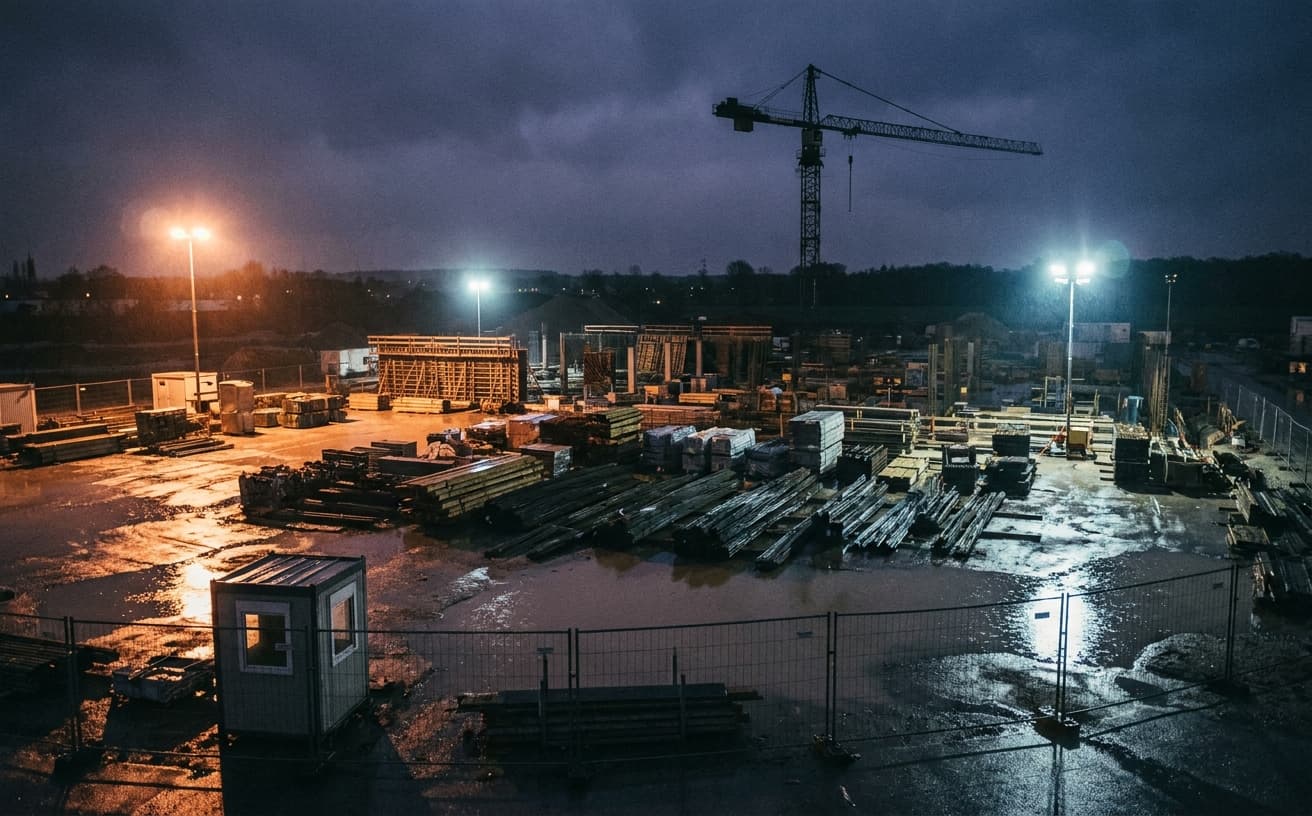
Real time is not a feature. It is a load-bearing property of the site itself, and most construction operations still confuse it with fast reporting.
A site that reports incidents quickly is not the same as a site that controls in real time. The first registers what happened after the fact and routes it through a chain of approvals before anything moves. The second observes a state, compares it to an expected state, and acts before the deviation produces a loss. The difference is structural, not technological. It runs through the architecture of sensors, the placement of decision authority, the contracts with insurers, and the way the site foreman speaks to a control desk that may be two hundred kilometres away. The construction site of the future is not the one with the most cameras. It is the one in which the gap between observation and response is short enough that incidents lose their economic significance.
This is not a forecast. It is a description of operations that already exist in industrial logistics, in critical infrastructure, in a small number of large building projects in Central Europe. The question is no longer whether such sites are possible. The question is when they become the operational default for projects above a certain volume, and what the manufacturers, operators, and insurers do in the years before that default arrives.
The architecture beneath the phrase
Real-time site control has a specific architecture, and the phrase loses its meaning when this architecture is replaced by marketing. At the base sits a layer of distributed sensors. Optical, thermal, acoustic, kinetic. They are not interchangeable. A camera that sees nothing in fog is not redundant with a thermal sensor that sees through it, and a vibration sensor on a fence does not replace either of them. The first design discipline is to know which physical signal carries which information, and to instrument the site so that every relevant state has at least two independent signal paths. NIST 800-53 calls this defence in depth in a security context. On a construction site it is the only way to keep false alarms in a range that the control function can absorb.
Above the sensor layer sits the analysis layer. Here, models classify what the sensors register. A person, a vehicle, a tool, a behaviour pattern. The models do not need general intelligence. They need to be accurate within a narrow operational domain and they need to be transparent enough that an operator can understand why a classification was made. The IEC 62443 logic, originally written for industrial control systems, applies cleanly. The system is segmented, the segments communicate through defined interfaces, and the interfaces are auditable.
Above the analysis layer sits the decision layer. This is the layer that distinguishes a control system from a reporting system. Routine events are resolved by the system itself. Exceptions are routed to a human operator with the context required to decide in seconds rather than minutes. The decision is documented in the same data structure as the event. There is no second log, no parallel record, no narrative reconstruction after the shift. This single-source documentation is what allows insurers, courts, and clients to verify the system afterwards, and it is what allows the operator to learn from the exception without the typical lag.
The top layer is integration. The control system speaks to the project management software, the access control hardware, the alarm receiving centre, and where necessary the local police interface. None of this is exotic. All of it is unusual on a typical European construction site in 2025, because the components have historically been bought from different suppliers with different protocols and no shared semantics. The construction site of the future is the one where these four layers are designed together rather than assembled afterwards.
What real time actually costs the operation
Real time is expensive when it is treated as a feature to be added to an existing site, and it is economical when it is treated as a design parameter of the project itself. The distinction matters because most operators encounter real-time control as a retrofit, where the cost looks high and the benefit looks abstract. The same architecture, planned from the outset, integrates into the site preparation phase and competes with the cost of guards, fences, and post-incident loss provisions, where it usually wins.
The cost components are predictable. Sensors and their mounts. Connectivity, which on most sites means a private wireless network because public networks fail under load. Edge computing, because relying on a cloud connection for primary decisions is a single point of failure that no serious operator accepts. A control function, either in-house or contracted, that can respond within agreed time windows. Maintenance, which on a properly designed system runs at a known interval and is not the source of surprise costs. Insurance coordination, which is often forgotten in early budgets but pays back when premiums are negotiated. The GDV publishes guidance for German operators on how documented security measures translate into premium structures, and the math is consistent enough that it can be modelled before installation.
The benefit components are also predictable, though they appear in places that the security budget does not normally see. Lower direct loss. Lower indirect loss, which is usually the larger number, because a stolen distribution cabinet does not only cost the cabinet but the days of electrical work and the cascade through every following trade. Lower insurance premiums where the insurer accepts the documentation. Higher trust from clients who have learned to ask for security posture before signing. Reduced personnel cost, not through replacement of guards but through the multiplication of their reach. ASIS International has published reach factors in the range of one operator to five or seven sites depending on configuration, and the manufacturer's own field data sits in the same range for projects of comparable size.
The decisive economic point is that real time changes the relationship between incidents and losses. A site without real-time control treats incidents as events that produce losses in proportion to their severity. A site with real-time control treats incidents as states that can be intercepted before they produce losses at all. The total number of attempted incidents may not fall. The number of completed incidents falls sharply. Operators who have measured this in pilot deployments report ratios that do not exist in conventional security reporting, because conventional security reporting does not measure interceptions, only completions.
The human roles that do not disappear
A common misreading of real-time control is that it removes humans from the site. The opposite is true. It removes humans from tasks that produce no value when performed by humans, and it concentrates human attention on tasks where attention is the scarce resource. The construction site of the future has fewer guards walking perimeters and more operators interpreting exceptions. It has fewer foremen rebuilding the timeline of an incident from fragmented sources and more foremen using the timeline as a tool to adjust the plan.
The operator role is the most underestimated. An operator who supervises five or seven sites simultaneously is not a watchman with more screens. The operator works against a queue of classified events, makes decisions within seconds, dispatches responses, and documents outcomes in the same interface. The cognitive load is significant, and the training is not trivial. CISA has written extensively on the design of security operations centres for critical infrastructure, and the principles transfer to construction once the volume justifies the structure. The shift pattern, the handover discipline, the escalation paths, the boundary between operator authority and contractor authority. All of this is a profession in its own right and it does not exist on a site that has not been designed for it.
The site foreman's role changes as well. Real-time control gives the foreman a view of the site that no walk-through can produce. Material flows, access events, deviations from plan, all visible in a single interface that updates as the day moves. The foreman becomes a decision-maker working with current data rather than yesterday's summary. ISO 27001 frames this in terms of information assets, but the construction translation is simpler. The foreman who knows what is happening on the site at the moment of the decision makes better decisions than the foreman who reconstructs the situation afterwards.
The role that does disappear, in the form it has taken for the last forty years, is the night-shift perimeter guard on a single site. This is not because the function is unnecessary but because the function has become uneconomical. A single guard on a single site at three in the morning is the most expensive form of attention per square metre that the construction industry has ever paid for, and the attention itself degrades after the second hour of the shift. The BSI, in its guidance for the protection of physical assets, has been clear for years that human surveillance at low information density is the weakest link in a defended perimeter. Real-time control does not abolish the guard. It abolishes the configuration in which the guard's attention is wasted.
How sensor data turns into decisions
The transformation from sensor reading to decision is where most systems fail in practice, and where the manufacturer's product discipline matters most. The chain has four stages and each stage has its own failure modes.
The first stage is detection. A signal crosses a threshold or matches a pattern. The threshold is set by configuration, and the configuration is the place where a system either fits the site or fights it. A construction site near a railway line needs different vibration thresholds than one in a quiet industrial zone. A logistics yard with regular night deliveries needs different motion patterns in the model than a dormant building site. Configuration is not a one-time exercise. It is a continuous discipline, and the systems that take it seriously distinguish themselves from those that ship with factory defaults and never look back.
The second stage is classification. The detected signal is interpreted. A moving object is identified as a person, a vehicle, an animal, a piece of wind-blown material, or an unclassified anomaly. NIST CSF 2.0 calls this the identify and detect function. The classification needs to be accurate enough that the next stage receives clean inputs, and uncertain enough that the system flags rather than discards events it cannot place. Overconfident classification is the dominant failure mode in cheap video analytics. It produces both false negatives, which are losses waiting to happen, and false positives, which destroy operator trust within weeks.
The third stage is correlation. A single classified event is rarely a decision basis. The decision basis is the relationship between events. A vehicle at the perimeter is one event. A person climbing the fence two minutes later is another. A motion in the lay-down area thirty seconds after that is a third. Correlated, the three events describe an intrusion in progress. Uncorrelated, they are three notifications that an operator can dismiss in isolation. Correlation requires that the system holds context, and context requires that the architecture was designed for it rather than retrofitted.
The fourth stage is action. The decision is executed, either automatically for routine cases or by the operator for exceptions. Lights activate, an audio warning plays, a mobile unit is dispatched, the police are notified, the site management is informed. The action is logged in the same record as the events that produced it, with timestamps that survive scrutiny. The NICB has noted, in the context of vehicle and equipment theft, that prosecution rates rise sharply when documentation meets evidentiary standards from the moment of detection, and the construction industry's prosecution rates remain low primarily because documentation does not meet those standards. Real-time control changes this not by adding documentation but by making documentation a by-product of operation.
This is the chain that the book BOSWAU + KNAUER. From Building to Security Technology describes in its later chapters as the manufacturer's core discipline. Building each stage as a separable, testable, and replaceable component is what allows the chain to evolve without the operator being trapped in a single vendor's roadmap.
When the model becomes the default
Forecasting adoption timelines in construction is a hazardous exercise. The industry is conservative for sound reasons. The buildings outlast the technology several times over, the contractors operate on margins that do not absorb experimental costs, and the regulatory environment lags actual practice by a decade or more. Predictions of rapid digital transformation in construction have been wrong consistently for thirty years, and there is no reason to believe the current cycle is different.
What can be observed is the structure of pressure. Material values continue to rise, particularly in electrical and HVAC components that have become prime theft targets. Insurance markets are tightening, and insurers are increasingly willing to differentiate premiums on the basis of documented security posture. Labour markets for security personnel are constrained across Europe, and the trend is not reversing. Regulatory frameworks, including the NIS2 directive in its application to critical infrastructure construction and the evolving GDPR jurisprudence on construction site cameras, are converging towards documented, auditable, and proportionate security measures rather than improvised arrangements. Each of these pressures pushes in the same direction without coordination.
The likely path is segmentation. Large projects above a certain volume, particularly those with public or institutional clients, will adopt real-time control architectures within the next three to five years. The pressure from insurers and clients combined makes any other path uneconomical at that scale. Mid-sized projects will follow with a lag of three to seven years, depending on the country and the structure of the local contractor base. Small projects will continue with conventional arrangements for the foreseeable future, because the fixed costs of a control architecture do not amortise across short timelines and small footprints. This segmentation is not a problem to be solved. It is a market structure to be designed for.
The manufacturers who position themselves for this segmentation are the ones who build platforms rather than products. A platform that scales from a single site to fifty sites without rearchitecting is the only economical answer to a market in which the same operator may run a small site this quarter and a large one next. Platform thinking is also what allows the manufacturer to support clients across the transition, because the same components serve the conventional configuration and the real-time configuration, with the difference sitting in the software layer rather than the hardware procurement.
What holds
The construction site of the future is already operational in a small number of European projects. It is not a vision. It is an architecture that combines distributed sensors, classified analysis, single-source documentation, and a control function that closes the gap between observation and response. The architecture is not exotic, but it is not yet standard, and the path from current practice to the new default is a matter of years rather than months.
The operators who move first will not do so because they have read a book about it. They will move because their loss data, their insurance negotiations, or their client expectations have made the current arrangement untenable. The manufacturers who serve them will be the ones who have built platforms that survive the transition and who have done the field work to understand how a construction site actually behaves under pressure. Everything else is presentation.
For operators who want to understand where their own site stands before any conversation about technology, the natural first step is the three- to five-day audit described in Path II of the book's structure. The audit produces a written report with six defined deliverables, including a vulnerability catalogue, a two-year incident reconstruction where records permit, and a three-scenario economic model. The report is the operator's property. What happens after the report is the operator's decision.
Frequently asked questions
What does real-time site control look like in practice?
It looks like a site where sensors observe continuously, classified events route to a control function within seconds, and routine deviations are resolved without human intervention while exceptions reach an operator with full context. Visually, the site has fewer guards on patrol and more visible technology at the perimeter and across critical zones. Operationally, the site foreman works with current data rather than morning summaries. The control function may sit on-site for large projects or in a shared operations centre serving several sites. The architecture is consistent across configurations.
Who staffs the control function?
In most current deployments, the control function is staffed by a specialised security operator who works in shift patterns modelled on industrial operations centres rather than traditional guard rotations. The operator handles exceptions across multiple sites simultaneously, typically five to seven depending on configuration and event density. Training is non-trivial and includes the system itself, the escalation paths, the legal framework, and the specific characteristics of each supervised site. Operators are often employed by specialised security firms that have integrated the manufacturer's platform into their service offering, with clear contractual boundaries.
How does sensor data flow into decisions?
The flow has four stages. Detection registers signals against configured thresholds. Classification interprets the signals into recognised categories such as person, vehicle, or anomaly. Correlation relates events to each other across time and space to identify patterns rather than isolated points. Action executes the response, either automatically for routine cases or through the operator for exceptions. Each stage is documented in the same record, which means evidentiary quality is a by-product of normal operation rather than a separate effort. The chain is designed so that any stage can be inspected and improved independently.
When does this model become standard?
The realistic horizon is three to five years for large projects above defined volume thresholds, particularly those with institutional clients or critical infrastructure components. Mid-sized projects will follow with a lag of several years, driven primarily by insurance pressure and labour constraints. Small projects will retain conventional arrangements for the foreseeable future because the fixed costs of a control architecture do not amortise across short timelines. The transition is therefore segmented rather than uniform, and the manufacturers serving the market will need to support both configurations during the overlap period.
Related topics
- London Mayor Crime Strategy and the Construction Cordon
- Poland Construction Boom and Site Security
- Italian Construction Night Security: The Real Cost
- How to Secure a Construction Site Overnight
- Construction Site Theft Patterns in the GCC: The Data
Take the next step: See prices & ROI · Explore the products · Send a no-obligation request. BOSWAU + KNAUER – direct from the factory in Filderstadt, reply within 5 working days.
About the author
Dr. Raphael Nagel (LL.M.) is founding partner of Tactical Management. He acquires and restructures industrial businesses in demanding market environments and writes on capital, geopolitics, and technological transformation. raphaelnagel.com
More reading
Since 1892.
The firm is reached at boswau-knauer.de or +49 177 2266267.