
Blog
GCC Cargo Theft Corridors: Jebel Ali to Riyadh
Cross-border cargo theft, Land Transport Authority data, organized ring patterns. The freight reality across the Gulf.

Dr. Raphael Nagel
September 20, 2025
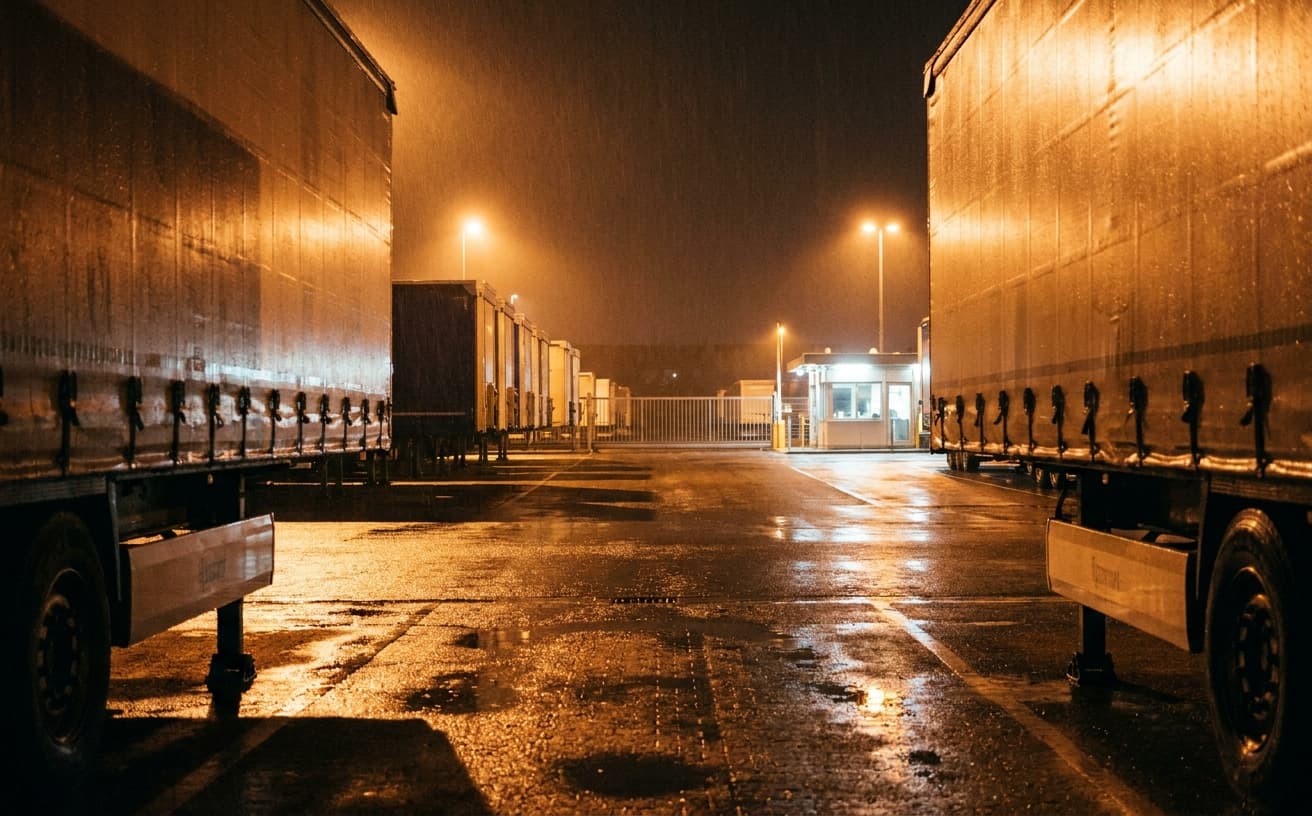
Cargo theft in the Gulf is not a series of isolated incidents. It is an industry, with its own logistics, its own intelligence cycle, and its own profit margins, and it operates along the same corridors that move legitimate freight.
The operators who run that legitimate freight know this. They see it in shrinkage reports, in driver statements taken at three in the morning at a roadside coffee stop near Ghuwaifat, in the discrepancy between what left Jebel Ali on a Tuesday and what arrived at a Riyadh distribution centre on a Thursday. What they often do not see, because no single authority publishes it, is the pattern. Theft on the Jebel Ali to Riyadh axis behaves differently from theft on the Dammam to Manama axis. Theft of consumer electronics behaves differently from theft of pharmaceuticals or copper. Without that pattern, the security spend tends to be flat where the risk is sharp, and sharp where the risk is flat. The result is a logistics security posture that looks reasonable on paper and fails predictably in practice.
The corridor as a unit of analysis
The standard unit of analysis in cargo security is the shipment. The relevant unit, for operators serious about reducing loss, is the corridor. A corridor combines a route, a typical cargo mix, a set of chokepoints, a customs regime at each end, and a population of actors who know all of the above better than most carriers do. The Jebel Ali to Riyadh corridor is the dominant example in the GCC. It carries the bulk of high-value containerised freight entering Saudi Arabia from the UAE, and it concentrates risk at predictable points: the parking areas around Ghweifat and Al Batha, the staging yards near Khafji on alternative routings, the desert stretches where mobile coverage is thin and where a truck can sit for forty minutes before anyone notices it has stopped.
The Dammam to Manama corridor presents a different profile. It is shorter, denser, and more heavily monitored, but it carries a disproportionate share of pharmaceutical and electronics flows that justify the effort of organised theft. The King Fahd Causeway creates a single chokepoint where dwell times are predictable to within minutes, which suits both legitimate operators and those observing them. Theft on this corridor tends to be cleaner, more targeted, and less likely to register as a violent incident, because the operating model relies on documentation fraud and driver collusion rather than on hijacking. The Hofuf to Abu Dhabi corridor, less discussed, carries industrial goods and project cargo and shows a third pattern again, with losses concentrated at transhipment points rather than en route.
Treating the corridor as the unit of analysis changes the security question. It is no longer how to protect a shipment, but how to harden a flow. Hardening a flow requires data the individual carrier does not have, intelligence the individual shipper does not collect, and coordination the regulator has not yet institutionalised. That gap is the structural reason cargo theft in the GCC remains profitable.
What the data sources actually say
There is no single authoritative GCC-wide dataset on cargo theft. The UAE Ministry of Interior tracks reported incidents through individual emirate police authorities. The Roads and Transport Authority in Dubai and the Land Transport Authority figures across the Emirates capture commercial vehicle incidents in their own systems. Saudi Arabia's Transport General Authority maintains its own records, and the Public Security Directorate publishes selective statistics. Bahrain, Qatar, Oman and Kuwait each operate similar fragmented arrangements. Cross-border consolidation does not happen at the operational level that would make the data useful to a logistics director.
External references help calibrate but do not replace this gap. The National Insurance Crime Bureau in the United States provides methodology for classifying cargo theft by commodity, modus operandi and recovery rate. ASIS International publishes guidance on supply chain security that the better GCC operators use as a baseline. The German GDV and BSI publish freight-loss observations that, while regionally specific, illustrate how mature reporting frameworks look. None of these is a substitute for GCC-specific data, but they establish that the order of magnitude of cargo theft, in mature freight economies, sits in a range that most operators in the region underestimate by a factor of two or three when they rely only on their own claims history.
The reason for the underestimation is structural. Insurance claims capture only what is claimed. What is claimed is only what exceeds the deductible and what the operator chooses to declare. Below the deductible, losses are absorbed into operating cost and disappear from the visible record. The result is that the real cost of cargo theft to a GCC logistics operator is rarely the figure in the insurance file. It is the figure in the variance line of the year-end financial review, the one nobody traces back to its origin because nobody has the data to do so.
The organised ring pattern
Cargo theft in the GCC is not predominantly opportunistic. The opportunistic layer exists, and it accounts for the smaller losses that show up on driver statements and warehouse audits. The losses that matter, in volume and in value, come from organised rings that operate with the discipline of a small logistics company. They observe routes, time deliveries, identify drivers with vulnerabilities, cultivate relationships at staging yards, and maintain onward distribution channels that absorb stolen goods within hours of the theft. A pallet of mid-range smartphones taken near Ghuwaifat on a Sunday evening can be unpackaged, relabeled and crossing a different border by Tuesday morning.
The ring pattern shows in the data, when the data is available. Thefts cluster by commodity in ways that random opportunity cannot explain. They cluster by time of day in ways that correspond to driver fatigue cycles and shift handovers at receiving warehouses. They cluster by route in ways that match the predictable gaps in escort coverage and telematics monitoring. The clustering is the signature of a rational operator working with information. The countermeasures available to the carrier are mostly designed against an irrational operator working without information, which explains why they underperform.
The rings adapt. When the Saudi authorities tightened controls on the Salwa crossing in response to specific incident patterns, the displacement to alternative routings was measurable within weeks. When particular telematics platforms became standard in UAE-licensed trucks, the operating model shifted toward documentation fraud at the destination rather than physical theft in transit. Adaptation is the defining feature of an organised threat. Static defences against an adaptive threat lose value at a rate the budget cycle rarely captures. This is the central problem the book BOSWAU + KNAUER. From Building to Security Technology addresses in its chapters on industrial and logistics security: a defence that does not learn at the same rate as the threat is a defence with a shelf life, and the shelf life is shorter than most operators assume.
What gets stolen and why it matters
The composition of stolen freight tells an operator more about its exposure than the absolute loss number. Consumer electronics dominate the high-value thefts, because the resale market is deep, the goods are small relative to their value, and the chain of custody is hard to verify once the original packaging is removed. Pharmaceuticals are the second category, with the additional risk that stolen product re-enters legitimate supply chains in ways that create liability beyond the financial loss. Copper, both as cable and as scrap from construction sites adjacent to logistics yards, is a persistent third. Luxury goods, automotive parts, and refined fuels round out the bulk of the value, with regional variations that matter.
The reason composition matters is that the countermeasures are commodity-specific. Protecting a load of pharmaceuticals from organised theft requires temperature-controlled, GPS-tracked, escort-supported transit with documented handover at every transhipment point. Protecting a load of copper scrap requires perimeter hardening of the yard where the scrap accumulates, because the theft happens at rest, not in motion. Protecting consumer electronics requires a combination of in-transit tracking, driver vetting, and end-point verification, because the theft can happen at any of three stages. An operator who applies the pharmaceutical model to copper scrap, or the copper model to electronics, is overspending in one direction and underprotecting in the other.
The further consequence is that the security budget should be allocated by commodity flow, not by warehouse or route alone. Most GCC operators allocate by site, because that is how the cost centres are organised. The misalignment is hidden until it is exposed by a loss event, and by then the discussion has moved from prevention to recovery, which is the most expensive ground on which to fight.
What countermeasures actually hold
The countermeasure stack that performs on GCC corridors has four layers. The first is intelligence. An operator that does not collect and analyse its own incident data, including near-misses and below-deductible events, is operating blind on the only ground that matters. Building this capability is not expensive. It requires discipline more than technology. The second layer is hardening at the chokepoints, which means perimeter surveillance, lighting, and reaction capability at the yards where freight rests and at the staging points where it transits. The IEC 62443 framework for industrial control system security, while developed for process industries, provides usable principles for the technology elements of this layer. The third layer is in-transit protection, combining telematics, geofencing, driver protocols, and where the value justifies it, physical escort. The fourth layer is destination verification, the documentation and reconciliation processes that catch the theft that has already happened before it disappears into operating cost.
Each layer carries a cost and produces a measurable effect. The first layer, intelligence, has the highest return per unit of spend, because it directs the other three. NIST CSF 2.0, in its identify and detect functions, provides a structure for organising the intelligence layer that translates cleanly from cybersecurity into physical security. ISO 27001, similarly, offers a management system logic that scales from the data layer into the operational layer. CISA's published guidance on supply chain security, while US-focused, identifies threat patterns that hold across borders. The point is not that any of these frameworks is a turnkey solution for GCC cargo theft. The point is that the operators who outperform on loss numbers tend to be the ones who have adopted a framework, any framework, and operated it with discipline, while the operators who underperform tend to be the ones who treat security as a series of independent purchasing decisions.
Technology contributes where it is integrated. A mobile video tower at a staging yard near Ghuwaifat, networked to a remote operator who covers five sites simultaneously, replaces a guard who patrolled one site partially. A security robot at a Jebel Ali container yard, running both scheduled and randomised routes, raises the cost of observation for the rings that depend on predictability. AI-supported video analysis at the chokepoint cameras reduces the false alarm rate to a level where the operator's attention is actually available when a real event occurs. None of these technologies, individually, solves the problem. Integrated, they shift the economics against the threat, which is the only test that matters.
What holds
Cargo theft on GCC corridors is a structural feature of the regional logistics economy, not a series of accidents. It is operated by actors who treat it as a business, and it succeeds against operators who treat security as a cost line. The corridor, not the shipment, is the relevant unit. The commodity, not the route alone, determines the countermeasure. The data the operator collects on its own losses, including the losses it has historically absorbed without recording, is the foundation of everything else.
The honest position for a logistics director or industrial security manager in the region is that the visible loss number is almost certainly an undercount, that the unrecorded loss number is the one that matters for budget allocation, and that the threat is more organised, more adaptive, and more commodity-specific than the standard security posture acknowledges. None of this is reason for paralysis. It is reason for a posture that begins with intelligence, hardens the chokepoints, protects the in-transit phase proportionally to commodity value, and closes the loop with destination verification.
For operators who want to test whether their current posture matches their actual exposure, the appropriate first step is the three to five day audit described in the book BOSWAU + KNAUER. From Building to Security Technology. The audit produces a written report with six defined deliverables, including a site-by-site vulnerability catalogue, a reconstruction of the incident history of the last twenty-four months where records permit, and a three-scenario economic case. The report is the operator's property. What is done with it is the operator's decision. The alternative, which is to continue allocating security spend without knowing whether the allocation matches the corridor-level risk, has a cost that the year-end variance line will eventually disclose.
Frequently asked questions
What corridors are highest-risk?
Three corridors carry most of the documented cargo theft exposure in the GCC. Jebel Ali to Riyadh is the dominant axis by volume and value, with risk concentrated at the desert stretches around Ghuwaifat and Al Batha and at staging yards near the Saudi border. Dammam to Manama, including the King Fahd Causeway, carries high-value pharmaceutical and electronics flows with a documentation-fraud profile rather than a hijacking profile. The Hofuf to Abu Dhabi corridor shows industrial and project cargo losses concentrated at transhipment points. Each requires a different countermeasure mix.
What is stolen?
Consumer electronics dominate high-value cargo theft because of small size, deep resale markets, and difficult chain-of-custody verification once unpackaged. Pharmaceuticals are second, with the additional risk that stolen product re-enters legitimate supply chains. Copper, both cable and yard scrap from construction sites, is a persistent third category, mostly stolen at rest rather than in motion. Luxury goods, automotive parts, and refined fuels complete the bulk of the loss value, with variation by corridor. The composition matters because countermeasures must be commodity-specific to perform.
Who tracks the data?
No single GCC-wide authority consolidates cargo theft data at a level useful to operators. UAE emirate police authorities, the Roads and Transport Authority, and the Land Transport Authority capture parts of the picture. Saudi Arabia's Transport General Authority and Public Security Directorate maintain separate records. Bahrain, Qatar, Oman and Kuwait operate similar fragmented arrangements. External references such as NICB methodology, ASIS International guidance, GDV observations, and CISA supply chain advisories provide useful calibration but do not substitute for region-specific data. Operators must build internal intelligence.
What countermeasures help?
A four-layer stack performs against organised cargo theft. First, intelligence collection on the operator's own incident data, including near-misses and below-deductible events. Second, chokepoint hardening at yards and staging points using surveillance, lighting and reaction capability, informed by frameworks such as IEC 62443, NIST 800-53 and ISO 27001. Third, in-transit protection combining telematics, geofencing, driver protocols and value-justified escort. Fourth, destination verification through documentation and reconciliation. Integrated technology, including mobile video towers, security robots and AI-supported video analysis, shifts the economics against the threat when deployed as a system rather than as point solutions.
Related topics
- UK Port Security: Felixstowe, Southampton & Brexit Reality
- Rolling Out a Security Robot in a Warehouse
- European Port Cargo Theft: TT Club 2025 Data Mapped
- Cargo Theft Statistics 2026: The Carrier Breakdown
- Building a UK Industrial SOC: TUPE, SIA & Living Wage Math
Take the next step: See prices & ROI · Explore the products · Send a no-obligation request. BOSWAU + KNAUER – direct from the factory in Filderstadt, reply within 5 working days.
About the author
Dr. Raphael Nagel (LL.M.) is founding partner of Tactical Management. He acquires and restructures industrial businesses in demanding market environments and writes on capital, geopolitics, and technological transformation. raphaelnagel.com
More reading

Since 1892.
The firm is reached at boswau-knauer.de or +49 177 2266267.