
Blog
Gulf Construction Overnight Security: Heat and Towers
Heat-stress regulations, MOHRE compliance, and why mobile video towers beat a traditional watch in the Gulf summer. The overnight economics that hold up.
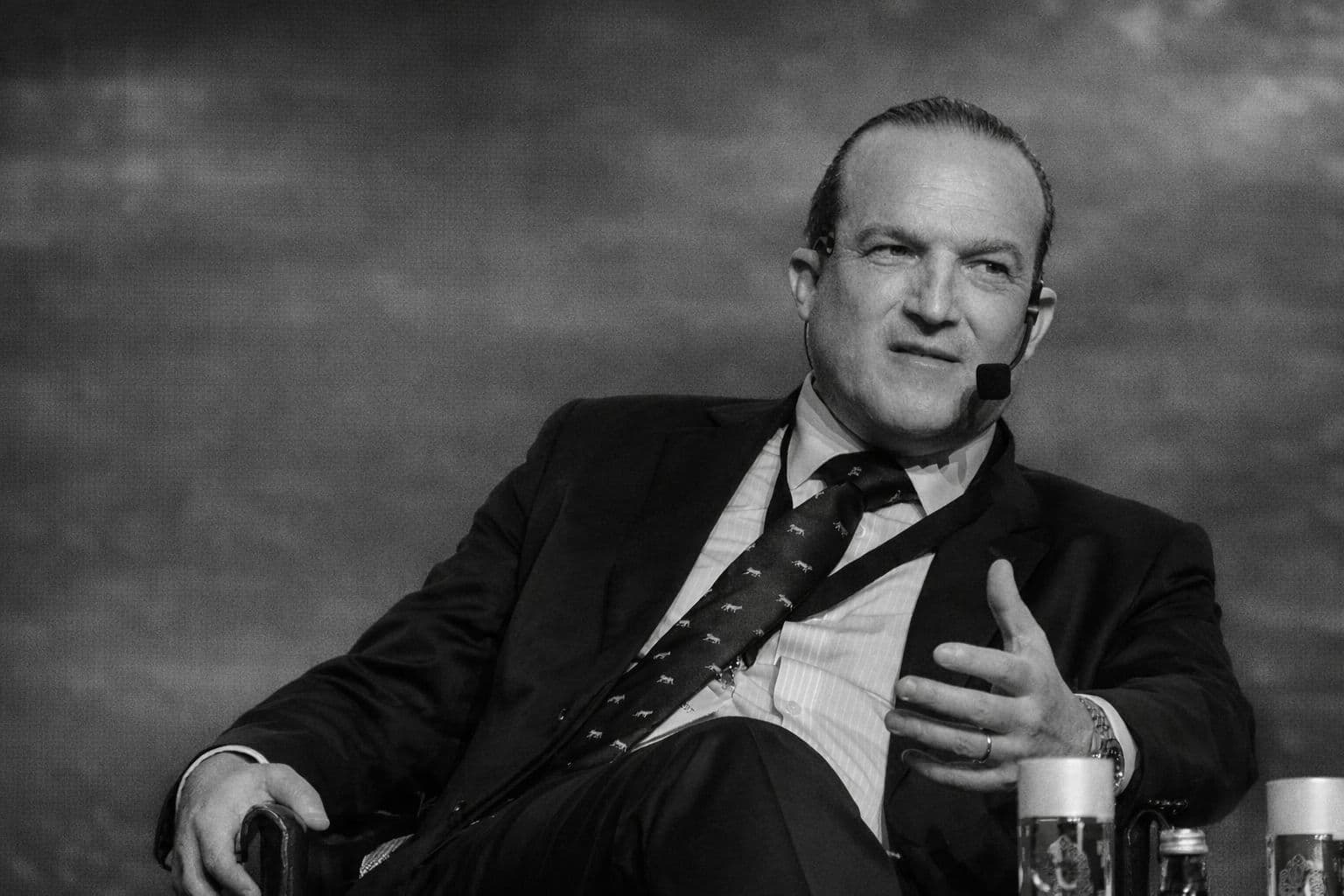
Dr. Raphael Nagel
July 28, 2025
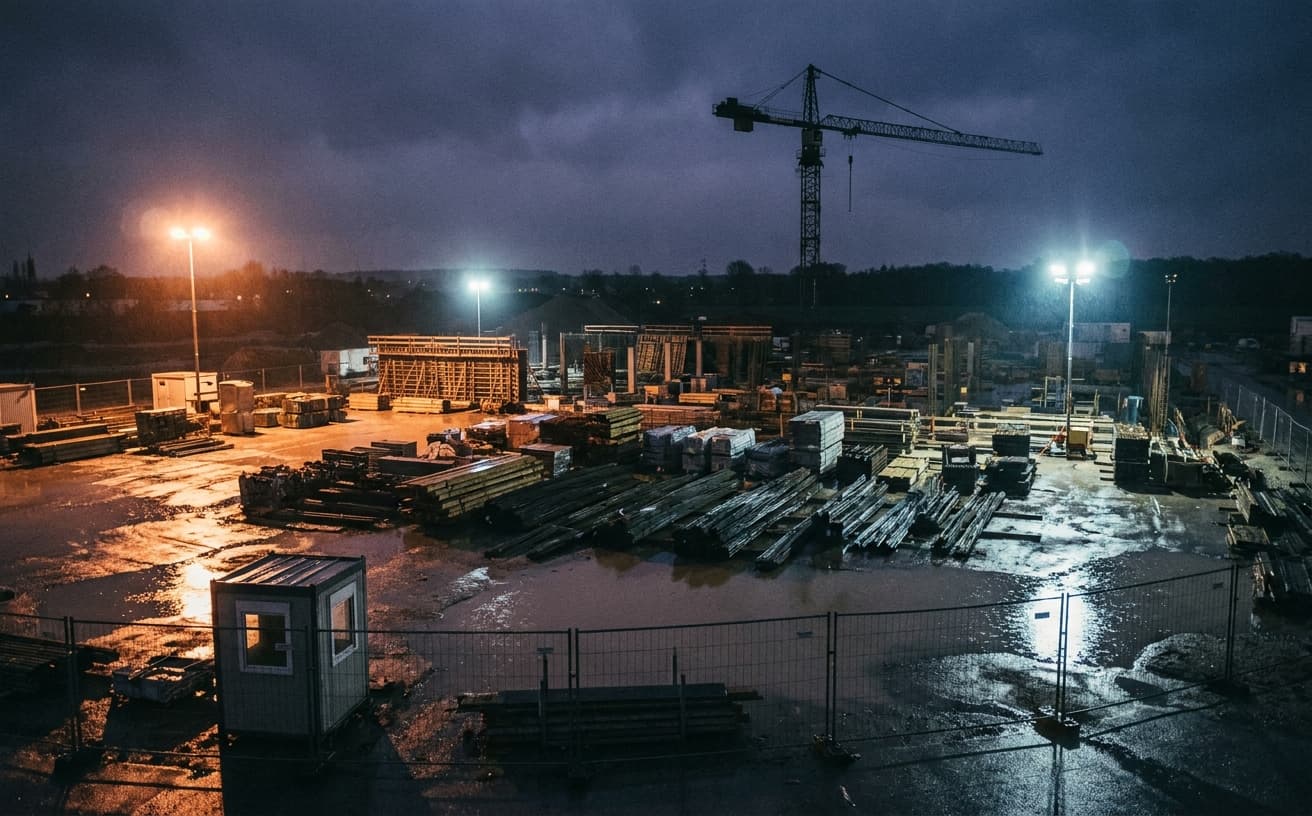
A watchman posted on a Gulf construction site between June and September is not a security measure. He is a liability waiting to be reclassified.
That sentence reads sharper than the operators in Dubai, Riyadh, Doha or Abu Dhabi would put it in writing, but it describes what their cost controllers already know. The classical model of overnight site security in the Gulf, one or two guards in a shed at the gate, a torch, a logbook and a thermos, was designed for a labour regime that no longer exists. Ministry inspections, heat-stress regulations and the rising material values stored on contemporary sites have moved the equation. The question is no longer whether the model holds. The question is which combination of technology and human presence replaces it without breaking the operator's compliance posture or the project's cost plan.
This article reads the problem from the manufacturer's side. Boswau + Knauer builds mobile video towers, security robots and AI-assisted video analytics for construction, industry and logistics. The Gulf is not its origin market, but the conditions there expose the design choices a serious manufacturer must defend. Heat, dust, autonomous power, regulatory exposure and the simple physiological fact that human attention degrades in a 45-degree night converge on the same answer.
The physiology of a 45-degree night
Construction security in the Gulf summer is, before anything else, a physiological problem. Ambient night temperatures in July and August in the inland zones of the UAE, Saudi Arabia, Qatar and Kuwait commonly sit between 38 and 45 degrees Celsius. Relative humidity in the coastal corridors of Jeddah, Dubai and Doha pushes the wet-bulb reading into territory that occupational health literature treats as a hard limit on sustained outdoor work. A guard expected to remain alert through a twelve-hour shift in those conditions is not performing security. He is surviving it.
The detached observation here is uncomfortable. A human posted under a metal-roofed cabin without effective cooling, drinking warm water, walking patrol arcs across uneven graded surface, will degrade cognitively long before he degrades physically. Reaction time slows. Pattern recognition narrows. The willingness to leave the cabin and verify an anomaly decreases as the shift lengthens. Insurers know this. So do the criminal economies that target Gulf construction sites in summer, where copper cable, generator fuel, mechanical fittings and high-value finishing materials sit exposed during a season when site activity slows and supervisory presence thins.
Authorities have responded with regulation. The UAE's Ministry of Human Resources and Emiratisation, MOHRE, imposes the midday work ban from June 15 to September 15 each year, prohibiting outdoor work between 12:30 and 15:00. Saudi Arabia and Qatar maintain comparable summer bans. These rules apply to construction labour rather than to private security per se, but the principle they encode, that human exposure to extreme heat must be managed and documented, has begun to bleed into how site security is assessed by insurers, by main contractors and by clients with international ESG obligations. The watchman who collapses on a Gulf site at three in the morning is no longer an isolated incident on a logbook. He is a regulatory exposure, a reputational exposure, and a question the project owner will be asked.
A security model that depends on placing low-paid labour in conditions that the same jurisdiction prohibits for the workers building the project is structurally fragile. It will hold until it is tested. The test, when it comes, comes from one of three directions: a medical incident, a successful intrusion that occurred while the guard was inside the cabin avoiding the heat, or an audit that asks for documented patrol coverage and receives a logbook full of identical entries.
What MOHRE and the wider Gulf framework actually require
Operators new to the Gulf often assume that private security falls outside the labour-protection regime. The assumption is partially correct and operationally misleading. MOHRE's midday ban targets outdoor construction labour. Security guards employed through licensed companies under the Security Industry Regulatory Agency framework in the UAE, the High Commission for Industrial Security in Saudi Arabia, or the comparable bodies in Qatar, Kuwait, Bahrain and Oman, operate under separate licensing regimes. Those regimes set training, vetting, uniform and reporting standards. They do not impose a midday ban as such.
What they do impose, increasingly, is a duty of care that mirrors the labour regime in substance if not in form. Heat-stress provisions in the UAE labour law, occupational health guidance from the Saudi Ministry of Human Resources and Social Development, and the Qatari Workers' Welfare Standards that emerged from the World Cup preparation period together establish a baseline. Employers must provide cooled rest areas, potable water, appropriate clothing and medical access. Guards working overnight at sites where daytime temperatures exceed forty degrees are not exempt from these obligations simply because they work at night. The thermal load on a body that has spent the daylight hours in barely cooled accommodation, sleeping through forty-six degree afternoons, is cumulative.
The compliance posture that follows is twofold. First, the main contractor or site owner remains exposed to scrutiny of the conditions under which any worker, including subcontracted security personnel, performs their duties on its site. Cases of guard fatalities in the region have prompted ministerial inquiries and, in several instances, project-level sanctions. Second, the security company itself, if it wishes to retain its licence and its access to government and quasi-government tenders, must demonstrate that it manages thermal exposure of its personnel. Documentation matters. A guard schedule that shows eight-hour outdoor shifts in August without rotation, without cooled rest cycles, without supervisory check-ins, is no longer defensible.
The implication is not that human security disappears from Gulf construction sites. It is that the share of work performed by humans in direct thermal exposure must shrink. Patrol arcs that previously required two or three guards walking a perimeter can be collapsed into a control room function, with one operator supervising sensors and cameras while a smaller field team responds only to verified events. The economics of this shift, examined in the next section, are no longer marginal. They have crossed into the range where the main contractor's quantity surveyor begins to ask why the security line is still budgeted on the old assumptions.
The economics of the mobile tower
A mobile video tower of the type Boswau + Knauer manufactures consists, in plain terms, of a transportable mast carrying a sensor head, autonomous power supply, communications module and local processing. The mast is stabilised on a trailer or skid base. Power is supplied by a combination of photovoltaic panels and a small backup generator or battery bank, sized for continuous operation in conditions where solar yield is high but cooling loads on the electronics are also high. The sensor head carries thermal and optical cameras, often a radar or lidar module, and is connected to a video analytics pipeline that filters events before they reach an operator.
The economic case begins with the comparison. A continuous overnight watch at a single Gulf construction site, assuming two guards per shift to cover breaks and patrol, two shifts overnight, and the loaded cost of licensed security personnel including accommodation, transport, insurance and supervision, lands in a range that in 2025 sits between fifteen and twenty-five thousand dirhams per month per site, depending on emirate, security tier and contract length. Comparable figures apply, with currency adjustment, across Saudi Arabia, Qatar and Kuwait. Across a twenty-four month project, the security line for a single mid-sized site reaches half a million dirhams or its equivalent.
A mobile video tower, deployed on the same site, replaces the patrolling function and most of the static observation function. The remaining human element, a control room operator who supervises multiple sites simultaneously and a small rapid-response team retained on call, scales differently. One operator can supervise five to ten towers across a portfolio of sites. The response team is dispatched on verified alarms only, not on speculative patrols. The cost per site, including amortisation of the tower hardware, the operator's share of cost, the response retainer and maintenance, typically lands at thirty to fifty percent of the classical model. On a portfolio of ten sites the saving runs into millions per year, before any account is taken of reduced shrinkage, lower insurance premiums or avoided incident-related delay.
The numbers vary by operator and by site type. The direction does not. The tower model is cheaper, and the gap widens as the portfolio grows. What the gap conceals, and what the procurement file should make explicit, is that the tower model is also more compliant. It removes the human from the thermal load. It generates a continuous, timestamped record of perimeter status that an insurer or auditor can interrogate. It does not call in sick. It does not retire to the cooled cabin at three in the morning and miss the cable theft. The cost saving is the visible benefit. The compliance posture is the structural one.
Heat, dust and the engineering reality
A manufacturer who sells mobile video towers into Gulf conditions without redesigning for them is selling a future warranty claim. The conditions are not merely warm. They combine sustained ambient heat with fine particulate dust that penetrates seals, with salt-laden air along the coastal corridors, with thermal cycling between forty-five degree afternoons and twenty-five degree pre-dawn hours, and with intermittent sandstorm events that abrade optical surfaces and overwhelm filtration systems.
The engineering responses are not exotic but they are deliberate. Sensor enclosures must be sealed to higher dust ingress ratings than European baselines. Cooling of the electronics inside the sensor head must be active rather than passive, because passive convection fails when the ambient sits above the upper operating limit of the processors. The photovoltaic surface must be sized with reference to soiling losses that in inland Gulf conditions degrade output by twenty to thirty percent between cleaning cycles, which means the cleaning schedule itself becomes a maintenance item. Battery chemistry must tolerate sustained high temperatures without thermal runaway, which excludes several commodity options that work adequately in temperate climates. Communications modules must hold link integrity through dust storms that scatter signal in the higher frequency bands.
Boswau + Knauer's design philosophy, set out at greater length in the book BOSWAU + KNAUER. From Building to Security Technology, treats robustness as the most expensive property of a system because it amortises over years rather than quarters. The Gulf application is where that philosophy is tested most directly. A tower deployed in Sharjah industrial backlots in August is not in a demonstration environment. It is in a stress test that does not pause. Components that survive eighteen months in central European conditions may survive six months in Gulf summer if the thermal envelope has not been reconsidered. Operators procuring towers should ask, in writing, what the manufacturer's mean time between failures looks like under fifty degree ambient with sustained dust load. A manufacturer that has not measured this number has not done the work.
The video analytics layer carries its own Gulf-specific demands. Thermal cameras that perform well against cool backgrounds lose contrast when the ground itself radiates heat through the night. Detection models trained on European datasets generalise poorly to Gulf site populations, vehicle types and clothing patterns. The reduction of false alarms, which is the central economic argument for AI-assisted analytics, depends on training data that reflects the deployment environment. This is solvable, but it is not solved by importing a European product unchanged. The reference framework here is the same one Boswau + Knauer applies elsewhere: multi-channel verification, where an alarm fires only when two independent sensors confirm an event, and contextual filtering, where expected movements within scheduled windows are excluded from the alarm logic.
Who supplies these systems in the GCC
The Gulf market for mobile video towers has matured over the past five years. Local manufacturers and integrators have emerged in the UAE and Saudi Arabia, often in partnership with European or Israeli technology providers. International manufacturers, including Boswau + Knauer, supply directly or through regional partners. The choice between local assembly and direct import is, for operators, less important than the question of who carries warranty and service obligation on the ground.
A tower deployed in Riyadh that requires a sensor replacement should not depend on a logistics chain that runs through a European warehouse. Operators evaluating suppliers should examine the service depth: spare parts held in-region, certified technicians available within forty-eight hours, software update cycles that account for the operating environment, and contractual response times that match the project's risk profile. The standards landscape is converging on familiar references. IEC 62443 for industrial control system security, ISO 27001 for information security management, and the NIST Cybersecurity Framework 2.0 for the broader risk architecture, all apply to mobile tower deployments because the towers themselves are networked devices generating data that flows into operator control rooms and, increasingly, into client dashboards. ASIS International guidance on physical security programmes provides the operational framing. CISA advisories on remote video and access control vulnerabilities are relevant to the procurement of the communications and processing modules.
Boswau + Knauer's position in this market is that of a manufacturer rather than a service provider. The distinction matters. The company supplies hardware, software and integration support to security companies and to direct end-clients. It does not compete with the security companies for the operator contract. This separation, examined at length in the book, allows the security partner to position the tower as part of its service offering while the manufacturer retains responsibility for the device's performance. For Gulf operators, this means that procurement does not force a choice between buying technology and buying a service. Both can be assembled, with clear lines of accountability between the hardware vendor, the software vendor, the integrator and the security operator.
What this means for the main contractor's site plan
The site plan for a Gulf construction project that begins in 2025 or 2026 should not budget overnight security on the assumptions of 2015. The labour cost has risen. The regulatory exposure has risen. The value of materials stored on site has risen, partly because of the post-pandemic adjustment in construction input prices and partly because contemporary projects carry more electronic and mechanical content per square metre than their predecessors. The probability that a guard-based model will perform to specification through a Gulf summer has fallen.
The recommended posture, drawn from Boswau + Knauer's deployments and from the wider operator experience in the region, is a layered model. Mobile video towers carry the perimeter observation function continuously. A reduced human presence, one or two personnel per site rather than four or six, handles physical access control at the gate and provides the first physical response to verified events. A central control room, either operated by the main contractor or contracted to a licensed security company, supervises the towers across the portfolio. A rapid-response team, retained on a call-out basis, attends verified incidents. The cost line falls. The coverage rises. The compliance posture improves on every axis: heat exposure, documentation, response time, audit trail.
The transition from the classical model to the layered model is not a single procurement decision. It is a phased shift, with a pilot on one site demonstrating the performance and economics before the wider rollout. This is where Boswau + Knauer's three engagement paths apply. Path I, a sixty-minute confidential conversation, is the first step for an operator who wants an outside view of the current model and its alternatives. Path II, a three to five day audit, examines the existing security architecture across the operator's Gulf portfolio and delivers a written report with a defined scope. Path III, a ninety-day pilot on a single site, demonstrates the layered model under operational conditions with a pre-agreed success metric. Each path stands alone. None obliges the operator to the next.
What holds
The economics have shifted. The regulation has shifted. The physiology has not, because human bodies have not changed and Gulf summers have, if anything, intensified. A security model that posts low-paid labour into 45-degree nights is a model that runs against three forces simultaneously: the cost of compliant labour, the cost of the regulatory exposure, and the cost of the incidents that occur when the guard is, predictably, not at the perimeter.
The mobile video tower, when designed for the conditions rather than imported unchanged, addresses all three forces. It removes the human from sustained thermal exposure. It generates the documentation that the compliance regime increasingly demands. It scales across a portfolio in a way that human patrol never could. The capital expense is real. The operating expense is lower than the classical model from the first month, and the gap widens over the project lifecycle.
Operators in the Gulf who treat security as a fixed cost to be minimised will continue to be surprised by the incidents and the inspections. Operators who treat security as an investment with a measurable return, applied through a layered model with clear lines of accountability, will find that the return is available now, in a market where the suppliers exist and the technology has been tested. The conversation that begins this shift takes sixty minutes. The audit that frames the shift takes three to five days. The pilot that proves the shift takes ninety days. None of these steps is irreversible. All of them are documented.
Frequently asked questions
Can watchmen work in 45C nights?
They can be physically present. They cannot reliably perform a security function. Sustained cognitive performance degrades sharply above wet-bulb thresholds that Gulf summer nights routinely exceed in coastal zones. Reaction time slows, willingness to patrol declines, and the rate of missed events rises across the shift. The regulatory framework, while not imposing a midday ban on private security in the same form as on construction labour, increasingly treats sustained thermal exposure of guards as a duty-of-care failure. A model that depends on watchmen maintaining alertness through twelve hour nights in 45 degree conditions is not defensible to an insurer or an auditor.
What does MOHRE require?
The UAE Ministry of Human Resources and Emiratisation prohibits outdoor work between 12:30 and 15:00 from June 15 to September 15 each year, with comparable bans in Saudi Arabia and Qatar. Private security operates under separate licensing regimes rather than directly under the midday ban, but the broader heat-stress provisions of UAE labour law, the Saudi occupational health guidance, and the Qatari Workers' Welfare Standards establish duty-of-care obligations that apply to security personnel. Cooled rest areas, potable water, documented rotation, and medical access are baseline requirements. Main contractors remain exposed to scrutiny of conditions for all workers on their sites, including subcontracted guards.
How do towers compare on cost?
A continuous two-guard overnight watch at a Gulf construction site, fully loaded, ranges between fifteen and twenty-five thousand dirhams per month per site in 2025 conditions, depending on emirate and security tier. A mobile video tower, including hardware amortisation, the operator's share of a multi-site control room, response retainer and maintenance, typically lands at thirty to fifty percent of that figure. The saving widens with portfolio size, because one operator supervises five to ten towers simultaneously. Beyond direct cost, the tower model reduces insurance premiums through documented coverage and eliminates the regulatory exposure of sustained guard thermal load.
Who supplies these towers?
The GCC market includes regional manufacturers and integrators, often in partnership with European or Israeli technology providers, alongside direct imports from international manufacturers including Boswau + Knauer. The procurement question is less about origin and more about service depth in-region: spare parts inventory, certified technicians available within forty-eight hours, software update cycles adapted to the operating environment, and contractual response times. Reference standards include IEC 62443 for industrial control security, ISO 27001 for information security, and ASIS International guidance for the operational framing. Operators should request documented mean time between failures under Gulf summer conditions before signing.
Take the next step: See prices & ROI · Explore the products · Send a no-obligation request. BOSWAU + KNAUER – direct from the factory in Filderstadt, reply within 5 working days.
About the author
Dr. Raphael Nagel (LL.M.) is founding partner of Tactical Management. He acquires and restructures industrial businesses in demanding market environments and writes on capital, geopolitics, and technological transformation. raphaelnagel.com
More reading
Since 1892.
The firm is reached at boswau-knauer.de or +49 177 2266267.