
Blog
Megaproject Perimeter Security Budget in the Gulf
Budget allocation patterns from real GCC megaprojects, security as a share of total CapEx, and the hidden line items that quietly eat a perimeter budget.

Dr. Raphael Nagel
June 30, 2025
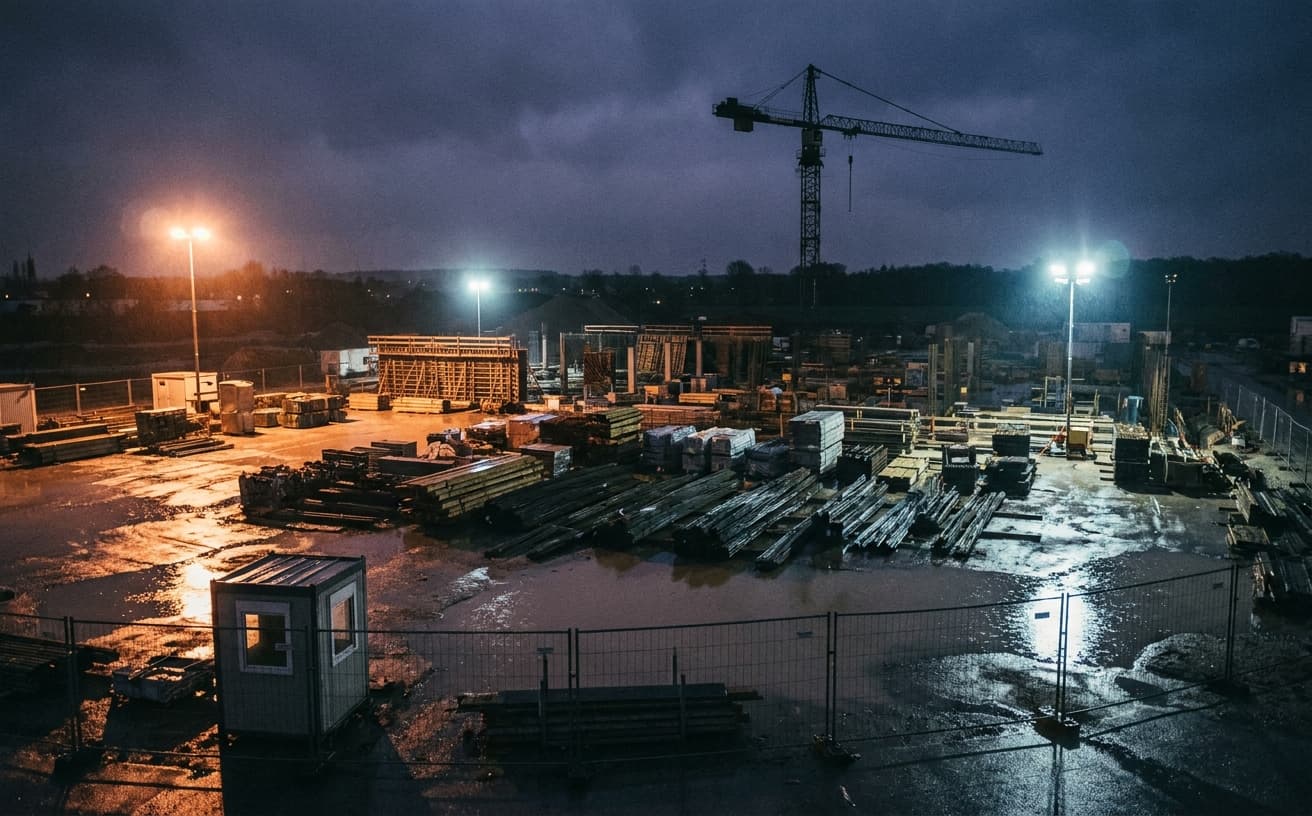
Security on a five-billion-dollar Gulf megaproject is not a line item. It is a portfolio of seventy to ninety line items, distributed across at least eleven cost centres, of which fewer than half carry the word "security" in their description.
The headline figure that circulates in industry conferences, "one to three percent of total capital expenditure," is therefore both correct and useless. Correct because it falls within the range that audited project closeouts confirm. Useless because that range hides everything that matters: which phases consume the budget, which line items are misclassified, which protections are absent because no one owned the scope, and which expenditures recur every twelve months on a project that runs for eight years. A general contractor reading the headline figure plans for one to three percent. A general contractor reading the structure underneath the figure plans for what the project actually consumes, which is closer to four to six percent if hidden items are surfaced, and closer to eight percent if losses, delays, and insurance loadings from unsecured early phases are honestly attributed.
This article reconstructs what five billion buys, based on patterns observed across GCC megaprojects in the past decade. The numbers are ranges, not single points, because every project is configured differently and because individual contract values are confidential. The structure of allocation, however, is stable. Operators who understand the structure are in a position to negotiate, contract, and audit. Operators who do not, pay twice: once at procurement and again at handover.
The visible budget and the invisible budget
The visible security budget on a Gulf megaproject sits in two places. The first is the dedicated security line inside the main contractor's bill of quantities, typically split between perimeter works (fencing, gates, lighting, guard accommodation), electronic security systems (CCTV, access control, intrusion detection, command centre), and manned guarding contracts. The second is the security scope embedded inside the facilities management contract for the operational phase. Together, these two visible budgets account for roughly forty to fifty percent of what the project will actually spend on protecting itself across its lifecycle.
The remainder is invisible because it is distributed. A non-exhaustive list of where the rest sits: the marine works package on a coastal development carries the cost of anti-intrusion barriers along the shoreline, classified under marine civils. The aviation package on a project with a private airstrip carries perimeter intrusion detection for the runway, classified under aviation safety. The IT package carries the cybersecurity provisions for the operational technology that will eventually run the building management systems, classified under IT infrastructure rather than security. The HR package carries the cost of vetting, badging, and onboarding tens of thousands of workers, often without a security cost centre attached. The insurance package carries premium loadings that reflect the project's risk profile, which is itself a function of the security architecture, but the premium is treated as a finance line, not a security line.
The consequence is structural. When the project director asks the security director "how much are we spending on security," the answer that comes back is the visible budget. The answer that should come back is the visible budget plus the embedded items plus the loss reserve plus the insurance loading. The first answer makes security look like a contained cost. The second makes security look like what it is, a cross-cutting function whose total expenditure rivals mechanical, electrical and plumbing on a complex asset. CISA and NIST CSF 2.0 both treat security as a function that must be governed across organisational boundaries precisely because of this distribution problem. The discipline applies as much to a Gulf megaproject as to a federal agency.
What one to three percent actually contains
The one to three percent figure, when broken down on projects of three to seven billion dollars in capital value, distributes approximately as follows. Perimeter physical works, including primary and secondary fencing, vehicle barriers, gate complexes, and guard infrastructure, consume roughly twenty to thirty percent of the visible security budget. Electronic security systems, including CCTV, access control, intrusion detection, intercom, and the integration platform that ties them together, consume thirty to forty percent. The command and control facility, including the building, the workstations, the video walls, the radio infrastructure, and the redundancy provisions, consumes ten to fifteen percent. Manned guarding during the construction phase, which on a multi-year project is the single largest recurring cost, consumes twenty to thirty percent. Specialised systems such as drone detection, screening equipment at vehicle and pedestrian portals, explosive detection, and underwater intrusion detection on marine sites, consume the remainder.
These percentages shift with the project type. A coastal mixed-use development with a marina, several hotels and residential towers tilts toward marine security and crowd management infrastructure. A new airport tilts toward screening, perimeter intrusion detection over very long fence runs, and airside access control. An industrial city tilts toward heavy vehicle screening, hazardous material handling perimeters, and operational technology security. A royal or governmental compound tilts toward layered perimeter, counter-surveillance, and command and control sophistication. The percentages above are starting points, not formulas.
Within each category, the dispersion between low-bid and high-bid configurations is substantial. A perimeter fence specified to repel opportunistic intrusion costs a fraction of a perimeter specified to delay a determined adversary for the time required for an armed response to arrive. The specification cascade, from threat assessment to delay-and-response calculation to physical specification to bill of quantities, is where the budget is set. Operators who shortcut the cascade and procure to a generic specification frequently discover, two years into operation, that they have purchased fence that delays an intruder for ninety seconds against a threat scenario that assumes a four-minute response. The cost of replacement is not the cost of the additional steel. It is the cost of cutting back roads, relaying conduits, and retesting integrated systems. ASIS International guidance on physical security design has been explicit on this point for years, and the lesson has been learned at the expense of more than one Gulf project.
How the phases consume the budget
Security expenditure does not flow evenly across the project timeline. The pattern, on projects with construction periods of four to eight years, follows a shape that is closer to a backloaded curve with a sharp pre-handover spike than to a straight line.
In the enabling works phase, which can last twelve to twenty-four months on a megaproject, security spending is dominated by site hoarding, temporary lighting, and contracted guarding for what is essentially a very large piece of cleared land with valuable plant and stockpiled material on it. This phase is consistently underbudgeted because the project leadership is focused on earthworks, utilities and logistics, and security is treated as a hoarding-and-watchmen problem. Losses in this phase are absorbed as construction overhead and rarely traced back to the security line. The German construction sector has a long-standing observation, captured in the GDV's loss statistics, that copper, fuel, and small plant are the bulk of recurring losses on extended construction sites. The same pattern, with regional variations in commodity targets, holds in the Gulf.
In the structural and main construction phase, security expenditure rises as the asset becomes more valuable and more attractive. Permanent perimeter works begin, although they are frequently installed in segments dictated by construction logistics rather than by security logic, leaving gaps that are filled by temporary measures. Manned guarding scales with the worker population, which on a megaproject can pass twenty thousand at peak. Access control begins to be installed at vehicle and pedestrian portals. Spending in this phase is significant but distributed and often invisible to a single owner.
In the systems integration and pre-handover phase, expenditure spikes. The electronic security systems are commissioned, integrated, and tested. The command and control facility is fitted out. The operational security organisation is mobilised, trained, and rehearsed. Drone detection, intrusion detection, and specialised systems are installed and certified. The pre-handover spike typically represents thirty to forty percent of the entire visible security capital budget compressed into the final twelve to eighteen months. Projects that have underspent in earlier phases discover here that the work cannot all be done in the time available, and the asset opens with an incomplete security architecture that takes another twelve to twenty-four months to mature.
In the operational phase, the capital budget gives way to the operating budget, dominated by manned services, system maintenance, technology refresh, and incident response. On a well-designed asset, the operating budget for security stabilises at a level that, over the asset's economic life, will exceed the capital budget by a factor of three to five. The implication is that decisions made at the capital stage have multiplier effects through the operating life. A perimeter that requires a high guard density to compensate for design weaknesses carries that cost for thirty years.
Who manages the budget, and why that question matters
On a five-billion-dollar megaproject, the security budget is not managed by a single person. It is managed by, at minimum, the project director's finance function, the main contractor's project controls, the security consultant who wrote the specification, the security subcontractor who delivers the works, the IT director who owns the integration platform, the FM director who will inherit the operation, the insurer's risk engineer who influences premium, and the owner's security director who is accountable for the result. Each of these has a different incentive structure. The project director wants the asset open on schedule. The main contractor wants the package closed and the retention released. The consultant wants the specification accepted. The subcontractor wants change orders. The IT director wants compatibility. The FM director wants serviceability. The insurer wants documented risk reduction. The owner's security director wants protection.
When these incentives align, the budget delivers protection. When they do not, the budget delivers compliance with a specification that no one is fully accountable for. ISO 27001 and IEC 62443 both insist on named accountability for security outcomes, the first in the information domain, the second in operational technology, and the same principle applies to integrated physical and electronic security on a megaproject. Without named accountability that spans the project lifecycle and reaches into operations, the budget produces line items rather than protection.
The structural fix, on the projects that have got this right, is the appointment of an owner-side security authority early in the design phase, with mandate across the visible and invisible budgets, with sign-off on specifications before they are released to tender, and with continuity into the operational phase. The cost of this function, typically a small team supported by independent technical advisors, is a fraction of the budget it governs and pays for itself many times over in avoided rework, avoided over-specification, and avoided under-specification. Dr. Nagel's book, BOSWAU + KNAUER. From Building to Security Technology, develops the underlying argument at length: security on a large asset is a function of governance before it is a function of hardware, and the operators who treat it as the latter without the former pay for both.
Hidden line items that decide outcomes
Several categories of expenditure consistently fall outside the visible security budget and consistently determine whether the visible budget produces protection. They deserve to be named.
The first is cabling and conduit infrastructure for the electronic security systems. On a large asset, the conduit network for CCTV, access control and intrusion detection is laid by the electrical contractor under the electrical package, not the security package. If the security specification arrives after the electrical package is set, the conduits are either undersized, mislocated, or absent, and the security subcontractor inherits a brownfield problem on a greenfield project. The cost of retrofitting conduit on a partially complete asset is several multiples of the cost of provisioning it correctly in sequence.
The second is the power infrastructure for security systems, including the redundancy provisions for the command and control facility. Security loads are frequently classified as non-essential during the early design, then reclassified as essential after the security director arrives and points out that a building management system without power is a building management system, but a security system without power is an open building. The reclassification triggers changes to the generator sizing, the UPS specification, and the distribution. The changes are expensive and visible in change orders.
The third is the integration cost between security systems and adjacent systems: the building management system, the fire and life safety system, the operational technology that runs critical building functions, and the IT infrastructure that carries the data. Integration is rarely scoped fully at tender. It is discovered in commissioning. The cost of late integration, including the systems integration engineering, the testing, the certification, and the inevitable rework, can equal the cost of the security systems themselves on a project where it was not properly scoped.
The fourth is the training, exercising, and rehearsal budget for the operational security organisation. On projects that open with a fully trained organisation, this line is funded and visible. On projects that do not, the line is implicit, absorbed by the operating budget in the first year of operations, and the asset opens with an organisation that learns on the job. NIST 800-53 control families on awareness, training and incident response apply to physical security organisations as much as to information security teams, and the same gap appears when the budget is not made explicit.
The fifth is technology refresh. Electronic security systems on a Gulf asset operate in conditions, heat, humidity, dust, salt, that shorten manufacturer-rated service lives. A system commissioned at handover will require partial replacement within seven to ten years on most components, and full replacement within twelve to fifteen on many. Projects that capitalise the systems and depreciate them over twenty-five years are mismatched against physical reality. The refresh cycle should be budgeted from day one of operations. BSI guidance on critical infrastructure protection and ISO 27001 lifecycle controls both recognise this principle. It is not yet universally applied in the region.
What holds
Five billion dollars buys a megaproject. Of that, the visible security budget will be fifty to a hundred and fifty million on the typical configuration, and the true lifetime security expenditure, including the invisible items, the operating costs over the asset's economic life, and the insurance loadings, will be several times that. Operators who treat the visible budget as the answer to "how much are we spending on security" plan for a fraction of what they will actually spend. Operators who structure the visible and invisible budgets together, with named accountability across the project lifecycle and into operations, spend the same money and receive protection. The difference is governance, not money.
The patterns described here are derived from observation across projects in the GCC and adjacent regions over the past decade. They are stable enough to be useful as a planning baseline and specific enough to be tested against any individual project's actuals. They are not a substitute for a project-specific threat assessment, a project-specific delay-and-response calculation, or a project-specific specification cascade. They are the structure within which those analyses become coherent.
Operators who want to test their own project against this structure have three paths available. The first is a sixty-minute confidential conversation with the author, in which the project's current configuration is mapped against the patterns described here and the largest mismatches are identified. The second is a three to five day audit, on site or against documentation, that produces a written report covering the visible budget, the embedded items, the phase profile, the governance structure, and the hidden line items, with a prioritised list of corrections. The third is a ninety-day pilot, on a defined scope, that demonstrates the operational and economic effect of a specific intervention. Which path is appropriate depends on the maturity of the project and the questions the operator most needs answered.
Frequently asked questions
How much do megaprojects spend on security?
The visible security budget on Gulf megaprojects of three to seven billion dollars in capital value typically lands between one and three percent of total capital expenditure, with the central tendency around one and a half to two percent. The true lifetime expenditure, including invisible items embedded in other packages, operating costs across the asset's economic life, insurance loadings, and technology refresh, runs materially higher, frequently between four and six percent of capital expenditure when honestly attributed. Projects with elevated threat profiles or specialised requirements, marine, aviation, governmental, can exceed these ranges.
Where does it go?
The visible budget distributes roughly as follows: perimeter physical works at twenty to thirty percent, electronic security systems at thirty to forty percent, command and control facility at ten to fifteen percent, manned guarding during construction at twenty to thirty percent, and specialised systems at the remainder. The invisible budget distributes across marine, aviation, IT, HR, insurance, and other packages, and frequently equals or exceeds the visible budget in total magnitude. The hidden line items, cabling, power, integration, training, refresh, decide whether the visible budget produces protection or only compliance.
How does it scale with phase?
Spending follows a backloaded curve with a sharp pre-handover spike. The enabling works phase is consistently underbudgeted relative to actual losses. The structural phase carries large but distributed expenditure, much of it embedded in other packages. The systems integration and pre-handover phase consumes thirty to forty percent of the entire visible security capital budget in the final twelve to eighteen months. The operational phase shifts to recurring operating expenditure that, over the asset's economic life, will exceed the capital budget by a factor of three to five. Capital decisions carry into operations as multiplier effects.
Who manages it?
On most megaprojects, no single person manages the full security budget end to end. Accountability is distributed across project finance, the main contractor, the security consultant, multiple subcontractors, IT, FM, the insurer, and the owner's security function, each with different incentives. The projects that produce protection rather than only line items appoint an owner-side security authority early in design, with mandate across visible and invisible budgets, sign-off on specifications before tender, and continuity into operations. ISO 27001, IEC 62443, and NIST CSF 2.0 all converge on the same principle: security outcomes require named accountability that spans the lifecycle.
Related topics
- Autonomous Security Robot: Patrols That Replace Guards
- Property Protection: Robots & Towers vs Guards 2026
- IP Rating for Outdoor Cameras: IP66, IP67 & IK10 Guide
- Construction Site Security Cost: Four Honest Tiers
- Security Robots in Qatar: MOI Standards & Legacy
Take the next step: See prices & ROI · Explore the products · Send a no-obligation request. BOSWAU + KNAUER – direct from the factory in Filderstadt, reply within 5 working days.
About the author
Dr. Raphael Nagel (LL.M.) is founding partner of Tactical Management. He acquires and restructures industrial businesses in demanding market environments and writes on capital, geopolitics, and technological transformation. raphaelnagel.com
More reading
Since 1892.
The firm is reached at boswau-knauer.de or +49 177 2266267.