
Blog
Industrial Perimeter Fencing in the Gulf: Failure Modes
Galvanized vs PVC-coated, sand-blasting corrosion, salt-air variants. What lasts and what fails in five years.

Dr. Raphael Nagel
August 2, 2025
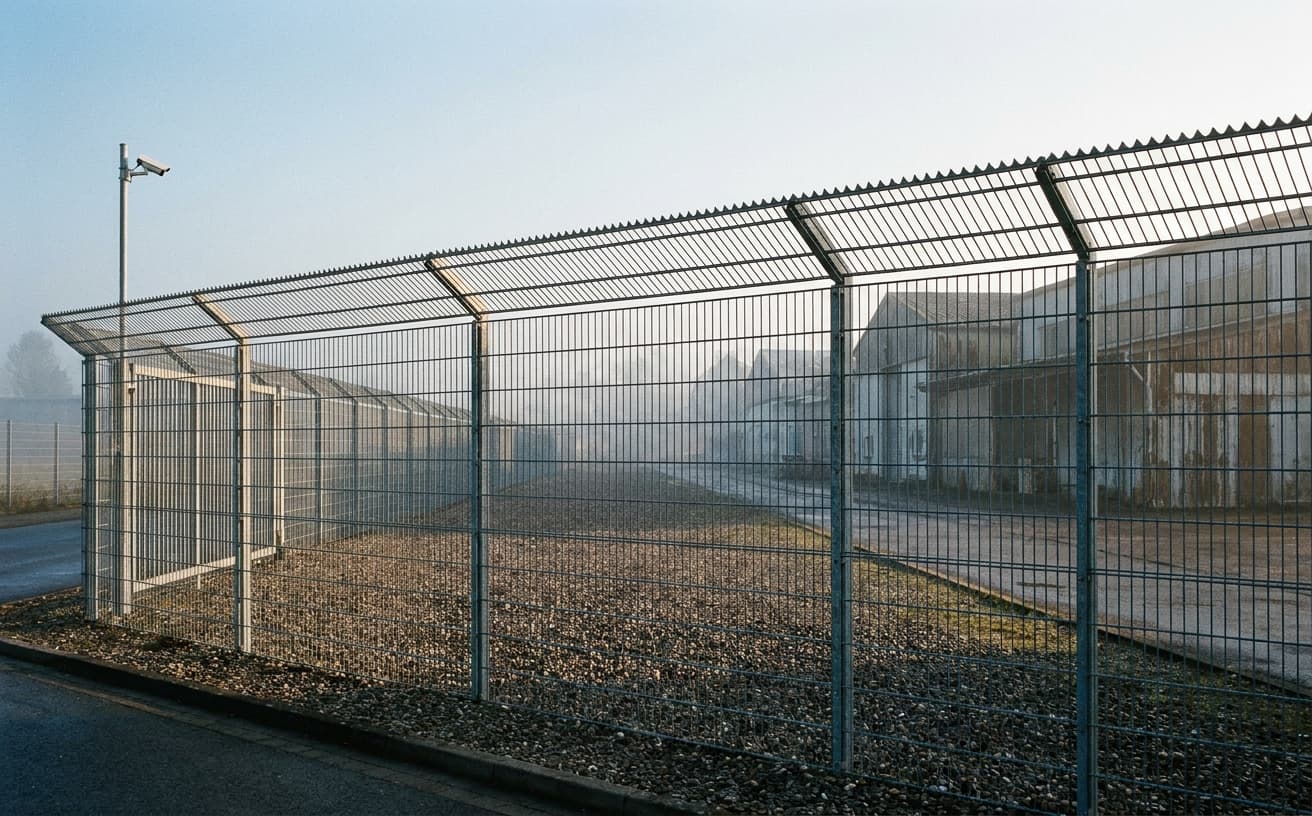
A perimeter fence in the Gulf is not a passive object. It is a wear part with a defined service life, and the service life is shorter than most procurement documents assume.
That sentence is the entire conversation, and it is rarely had at the level of seriousness it deserves. Specifications written in Frankfurt, Milan or Birmingham are imported into Jeddah, Sohar, Jubail or Dubai South without correction for the actual operating envelope. The fence is then installed, photographed, signed off, and forgotten until the third year, when the first sections begin to behave in ways the data sheet did not predict. By year five, the line that the auditor saw in the handover photographs has become a line that the security officer no longer trusts. The cost of replacing it falls outside the original capital file and lands inside operating expense, where it is harder to defend and harder to recover. Boswau and Knauer treats fencing as an industrial asset with a measurable service profile, not as a fixture, and the rest of this article follows from that distinction.
The angle here is operator to operator. The question is not which catalogue picture is more attractive. The question is which failure modes are inevitable in the Gulf climate, which are reducible, and which require a different category of product rather than a thicker coating of the same category. CISA, NIST and IEC 62443 all describe perimeter as the first delay layer in a defence in depth posture, and ASIS International has documented the cascading effect when that layer ceases to delay. A fence that has lost integrity does not fail visibly. It fails by reducing the time a responder has to reach the breach point, and that reduction is silent until it is tested.
The operating envelope that procurement documents underestimate
The Gulf is not one climate. It is at least three, and any fencing specification that treats it as one is already wrong. Inland sites near Riyadh, Al Ain or the Empty Quarter operate under thermal stress and abrasive dust loading, with relative humidity often below twenty percent and surface temperatures on exposed steel that exceed seventy degrees Celsius during summer afternoons. Coastal sites in the Eastern Province, around Dubai, Abu Dhabi, Doha, Manama and the Omani coast operate under chloride loading, with airborne salt deposits that vary by wind direction and proximity to the shoreline. Industrial estates around Jubail, Yanbu and Sohar add a third layer, where ambient salt combines with sulphur compounds, ammonia vapour, fluorides or hydrocarbon aerosols depending on the neighbour's process emissions. Each of these environments attacks fencing in a different way, and a coating system that performs adequately in one will fail prematurely in another.
The temperature cycle itself is a load that European procurement rarely models. A black-coated steel post in central Saudi Arabia can move through a sixty degree temperature swing in a single day, expanding and contracting at the welds, at the base plate, at the mesh attachment points. Over five years, that thermal cycling produces micro-cracks in coatings, opens hairline gaps at fasteners, and creates entry points for moisture and chloride that would never form in a temperate climate. The fence does not look damaged. It is damaged at a level that the eye does not see until corrosion blooms through, usually in the fourth or fifth summer.
Wind-driven sand is the second underestimated factor. In the open desert, abrasive particle loading during the shamal season removes coating thickness at a rate that has been measured between five and fifteen micrometres per year on windward faces, depending on exposure and elevation. A PVC coating specified at one hundred micrometres total thickness loses meaningful protection in the time horizon of a single contract cycle. The leeward face of the same post may retain its coating intact, which means the asset ages asymmetrically, and the inspection regime has to know which side to look at. Most inspection regimes do not.
Humidity at coastal locations completes the picture. The combination of chloride aerosol, condensation cycles at dawn, and direct solar loading during the day produces a corrosion environment that ISO 12944 classifies as C5-M or CX, the two most aggressive atmospheric categories in the standard. Specifying a fence to a lower category, which is the default in most commercial datasheets, is a procurement error that becomes visible only after the warranty has expired.
Galvanizing, the baseline that is not always baseline
Hot-dip galvanizing is the default treatment for industrial fencing globally, and it remains the correct baseline for Gulf installations, but the specification has to be tightened beyond European norms. EN ISO 1461 defines minimum zinc coating thicknesses by steel section thickness, and the typical commercial specification of seventy to eighty-five micrometres is sufficient for temperate, low-chloride atmospheres. It is not sufficient for coastal Gulf conditions, where chloride attack on zinc proceeds at rates that can consume the coating in five to seven years rather than the twenty to fifty years that the same coating delivers in central Europe.
The corrosion rate of zinc in C5-M environments is documented by ISO 9223 and ISO 9224 at values that, applied to a standard galvanized coating, produce service lives well below what asset owners assume. The mathematics is straightforward, and it is the mathematics that procurement files routinely fail to perform. A coating that loses six to eight micrometres per year in a coastal industrial setting will reach the point of red rust appearance within the first decade, and the appearance of red rust is not a cosmetic event. It signals that the steel substrate is now in direct contact with the corrosive environment and that section loss has begun.
The correct response is heavier galvanizing, often specified at one hundred and twenty to one hundred and forty micrometres for coastal Gulf use, combined with attention to the geometry that galvanizing alone cannot protect. Welds, cut edges, post tops and base plate junctions are where zinc thickness is naturally lower and where corrosion initiates first. A specification that names a single thickness value across the entire structure is a specification written by someone who has not walked a five-year-old fence line. Boswau and Knauer's approach, drawn from the discipline described in BOSWAU + KNAUER. From Building to Security Technology, is to specify zinc thickness by zone, with the most exposed elements treated as separate items in the bill of materials.
Galvanizing alone is rarely the right choice for the most aggressive coastal sites. It works as a primer beneath a secondary coating system, and that combination is where the durability extends to the fifteen to twenty year range that asset owners need.
PVC and polyester coatings under desert sun
PVC-coated and polyester-coated fencing is marketed in the region as the upgrade, and in many cases it is the right specification, but the performance envelope is narrower than the brochures imply. The two failure modes that dominate Gulf experience are ultraviolet degradation and abrasive removal, and they interact.
PVC under direct desert solar loading suffers chain scission and plasticizer migration. The coating becomes brittle, loses elasticity, and begins to crack at stress points, typically at mesh intersections or at the points where the coating bridges a sharp edge in the underlying steel. The cracks are initially hairline and invisible from operational distance. Moisture and chloride enter through the cracks and attack the steel substrate, often the zinc-coated steel substrate, from inside the coating. The visible failure is delamination, with sheets of PVC lifting away from the mesh, exposing rusted steel that has been corroding for months or years out of sight.
Polyester powder coatings, particularly architectural-grade polyesters certified to Qualicoat Class 2 or Class 3, perform better under ultraviolet load than standard PVC. The trade-off is mechanical robustness. A powder coating is thinner than a PVC sheath and offers less protection against impact and abrasion. On a site where sand-laden wind is a daily condition, the powder coating erodes from windward faces within three to four years, and the underlying galvanizing is then exposed to the same conditions that galvanizing alone would have faced from day one.
The honest specification for coastal Gulf installations is a duplex system. Heavy galvanizing as the corrosion barrier, polyester powder coating as the ultraviolet and aesthetic layer, and the explicit understanding that the powder coating is a sacrificial layer with a defined replacement cycle. Some operators recoat windward sections at year seven or year eight rather than replacing the fence. The economics of partial recoating are better than full replacement, but only if the substrate galvanizing is heavy enough to have survived the original installation period intact.
Color matters more than catalogues suggest. Dark colors absorb solar radiation, raise surface temperatures by ten to fifteen degrees above ambient, and accelerate coating degradation. Light grey, white and pale green coatings run cooler and last measurably longer in field measurements. The aesthetic preference for black or dark green fencing in the Gulf, driven by master planning documents written without climate engineering input, is a recurring source of premature failure.
Anti-climb geometry and the sand problem
Perimeter fencing in the Gulf is rarely just fencing. It is anti-climb fencing, often with welded mesh of the 358 type, with apertures of seventy-six by twelve point seven millimetres that defeat finger and toe holds. The geometry is effective against climbing, and it is also effective at accumulating wind-driven sand and dust at its base.
Sand accumulation along the line of a 358 fence builds a ramp. Over a single shamal season, a ramp can reach a height of three hundred to five hundred millimetres against the windward face. Against a three metre fence, that is the difference between a climbable obstacle and an unclimbable one. Operators who do not maintain the fence base on a regular cycle have built, without intending to, a launch platform for anyone willing to use it. NICB and ASIS guidance on perimeter delay times assumes the rated height of the fence is the actual height, and the actual height in the Gulf is a maintained value, not an installed value.
The same accumulation buries the bottom rail and creates a moisture trap, where dew condenses overnight and chloride concentrates at the steel-to-substrate interface. Corrosion at the base of the fence is the most common point of structural failure in five-year-old installations, and it is almost always traceable to sand and dust accumulation that was never cleared.
Anti-climb spike systems, rotating toppings and razor coil suffer their own degradation. Galvanized razor coil under coastal conditions corrodes faster than the supporting fence because the geometry concentrates surface area and the cutting edges are sharp, thin sections where any coating defect propagates rapidly. Three to four years is a realistic service life for unmaintained razor coil in coastal industrial settings. The visual deterrent remains, but the mechanical effect is reduced as the wire becomes brittle and breaks under sustained pressure.
The implication for design is that anti-climb performance has to be specified as a maintained performance, with cleaning intervals, inspection cycles and replacement budgets named in the original procurement file. Anti-climb geometry without a maintenance regime is theatre, and the operators who have walked a five-year-old line know which sections are theatre and which are still functional.
Detection integration and what fences cannot do alone
A fence is a delay device. NIST CSF 2.0 and IEC 62443, applied to physical perimeter, frame the function as part of a detect-delay-respond chain, where the fence buys time for sensors to alert and for a response to reach the breach point. The Gulf operating environment compresses every link in that chain.
Fence-mounted detection systems, whether vibration cable, taut wire, fibre optic or microphonic, behave differently in the Gulf than in their reference installations. Wind loading produces continuous low-level vibration that requires careful threshold calibration to distinguish from intrusion attempts. Sand impact on the mesh during shamals generates noise patterns that, without local tuning, produce false alarms at rates that cause operators to disable the system within months. Thermal expansion of the fence structure during daily temperature cycles induces strain on fibre optic systems that have not been compensated for the local thermal range.
The integration that works is one where the fence detection is one input among several, weighted by context, validated by video analytics, and tuned to the actual noise floor of the site. Boswau and Knauer's experience with mobile video towers and AI-driven analytics on Gulf installations has shown that the false alarm rate on fence-mounted detection drops by an order of magnitude when the alarm requires confirmation from a second sensor channel, typically thermal or radar, before it is escalated to a human operator. This is the multi-channel validation approach that ISO 27001 describes for information systems and that translates directly to physical perimeter design.
The fence itself contributes to detection in a way that procurement rarely captures. A well-maintained fence with intact coating and clear sight lines on both sides is also a fence where a breach is visually obvious to a patrolling robot or a fixed camera. A neglected fence, with sand build-up, climbing vegetation, accumulated debris and uneven horizon, is a fence where visual detection of breach attempts becomes ambiguous. The maintenance state of the perimeter is itself a security parameter, and the BSI and GDV guidance on perimeter integrity reflects this in their inspection protocols.
What holds
The Gulf perimeter that holds for fifteen years rather than five shares a small number of features. Heavy galvanizing as the corrosion baseline, named to the actual atmospheric category of the site rather than to a default value. A duplex coating system where the upper layer is recognized as sacrificial and budgeted for periodic renewal. Light colors that run cooler. Anti-climb geometry maintained as an actual height, with sand clearance cycles named in operating procedures. Detection integration that uses the fence as one input in a multi-channel validation chain rather than as a standalone alarm source.
None of this is new technology. All of it is discipline applied to specification, installation and operation. The reason it is rare in the field is that the discipline costs money at the procurement stage and saves money at the operating stage, and the two budgets are usually held by different people. Operators who have unified the capital and operating views on perimeter, often because they have lived through one full failure cycle and rebuilt the line, do not return to the cheaper specification. The lesson, once learned, holds.
For operators who suspect their current line will not hold the next five years, the relevant first step is a Path II audit. Three to five days on site, a documented condition survey of every segment, a coating thickness measurement programme, an integration review of any fence-mounted detection, and a written report that names the segments to replace, the segments to recoat, and the segments to leave alone. The audit is a fixed-scope, fixed-price engagement, and the report is the operator's property regardless of what follows. Where the audit identifies a high-value perimeter that justifies a different category of monitoring, the natural next step is a Path III ninety-day pilot with mobile video towers, AI analytics or autonomous patrol integrated into the existing line. The pilot produces ninety days of data against a pre-agreed success metric, and the data, not the brochure, makes the case for scale.
Frequently asked questions
What corrodes fastest?
The fastest-corroding elements on a Gulf perimeter are razor coil, fasteners and weld joints. Razor coil has high surface area and thin sections, so any coating defect leads to rapid section loss, and three to four years is a realistic service life in coastal industrial settings. Fasteners are often supplied with lighter coatings than the main structure and become the first point of red rust. Welds disturb the galvanized layer and concentrate corrosion at exactly the points that carry mechanical load. A serious specification names coating thickness for each of these elements separately and budgets for their replacement on a faster cycle than the main fabric.
Which coating lasts?
For coastal Gulf use, the longest-performing system is heavy hot-dip galvanizing of one hundred and twenty to one hundred and forty micrometres combined with a Qualicoat-certified polyester powder coating in a light color. The galvanizing carries the corrosion protection and the powder coating carries the ultraviolet and aesthetic load. PVC sheathing performs adequately in the first three to four years but suffers ultraviolet embrittlement and delamination in the fifth to seventh year. Galvanizing alone, at standard EN ISO 1461 thicknesses, is insufficient for C5-M atmospheres and is best treated as a primer rather than a finished system.
How does sand affect anti-climb?
Sand accumulation at the fence base creates a ramp that reduces the effective climbable height by three hundred to five hundred millimetres during a single shamal season. Against a three metre fence, that converts an unclimbable obstacle into a climbable one. The accumulated sand also traps moisture at the base, accelerating corrosion at the most structurally important section of the fence. Anti-climb performance is a maintained performance, not an installed performance, and any specification that does not name a sand clearance cycle is incomplete. Quarterly clearance is the minimum for inland sites, monthly for sites in the path of recurrent dust events.
What is the maintenance interval?
A defensible maintenance regime for Gulf perimeter has three layers. Visual inspection at monthly intervals, with attention to coating condition, sand accumulation, vegetation and fastener integrity. Coating thickness measurement at annual intervals on a sample basis, using ultrasonic or magnetic gauges, focused on windward faces and weld zones. Full condition survey at three to five year intervals, with documented decisions on recoating, partial replacement or full replacement. Detection systems mounted on the fence require their own calibration cycle, typically quarterly, to maintain signal-to-noise discrimination against the changing acoustic and thermal environment.
Related topics
- Industrial Fencing Standards: EN 1717, EN 1090 in Practice
- Perimeter Security Systems: The Seven-Layer Model
- Layered Perimeter Security on an Industrial Site
- Industrial Perimeter Security: Architecture Layered for Cost
- Extreme Heat & Security Robots in the Gulf: 55C
Take the next step: See prices & ROI · Explore the products · Send a no-obligation request. BOSWAU + KNAUER – direct from the factory in Filderstadt, reply within 5 working days.
About the author
Dr. Raphael Nagel (LL.M.) is founding partner of Tactical Management. He acquires and restructures industrial businesses in demanding market environments and writes on capital, geopolitics, and technological transformation. raphaelnagel.com
More reading
Since 1892.
The firm is reached at boswau-knauer.de or +49 177 2266267.