
Blog
GCC Water Security: Desalination Under Pressure
SWCC Saudi, EWEC UAE, KAHRAMAA Qatar. Why desalination is the single most concentrated piece of GCC critical infrastructure.

Dr. Raphael Nagel
May 14, 2025
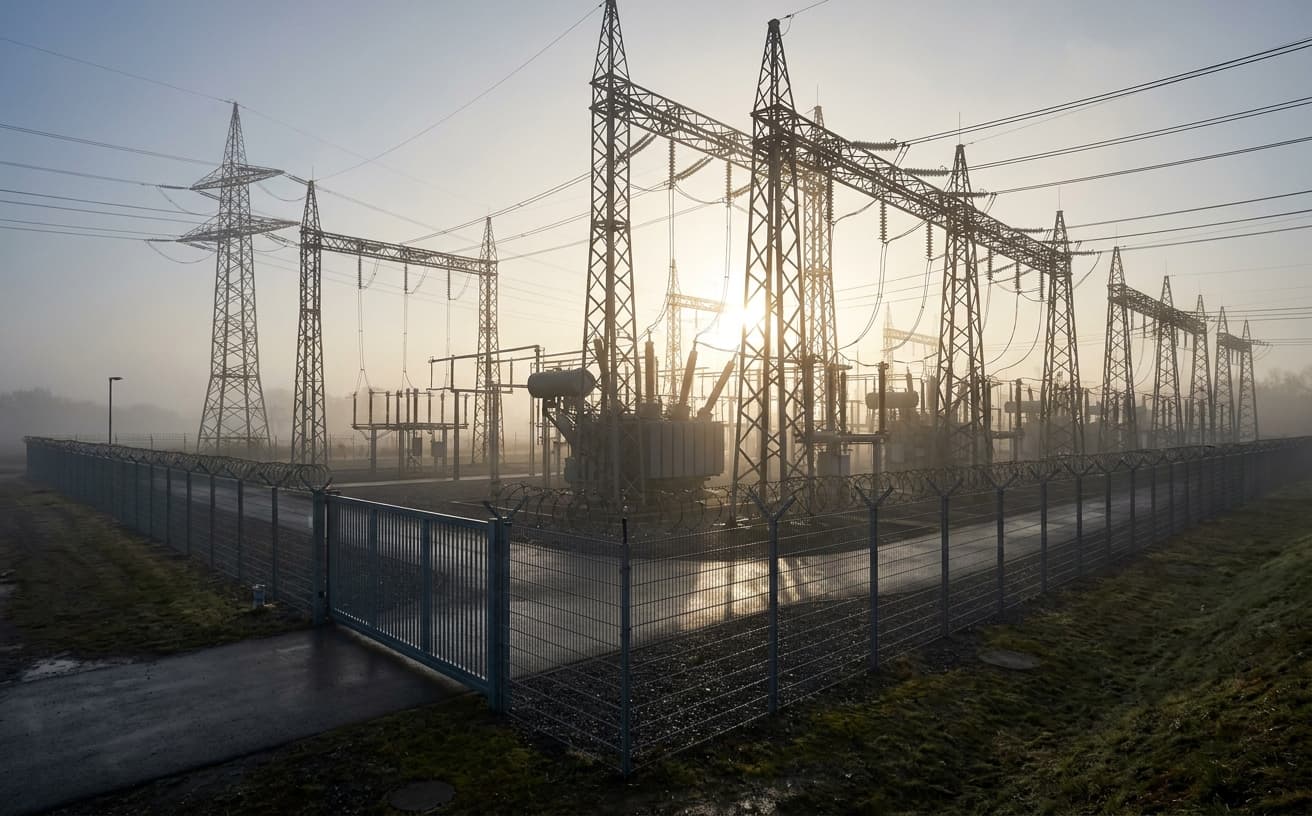
In the Gulf, water is not a utility. It is a manufactured commodity, produced day by day in industrial plants that consume electricity at the scale of small countries and run reverse osmosis trains and multi-effect distillation lines without meaningful pause. The phrase "water supply" hides what is actually happening: a continuous industrial process whose interruption empties storage tanks within seventy-two hours.
Critical infrastructure literature usually treats water and power as parallel sectors. In the Gulf Cooperation Council that distinction collapses. Desalination is a power-water co-production system, fed by gas turbines, controlled by SCADA layers that talk to grid dispatch, and tied to chemical storage, intake structures and outfall systems that no operator can move once built. The result is the most geographically concentrated piece of critical infrastructure on the planet, and one that no European or North American operator has a true equivalent for.
The Concentration That Has No Parallel
A European national grid can lose a power station and reroute load across interconnectors. A North American water utility can pull from reservoirs, aquifers, river abstraction and treated reuse, often within the same metropolitan footprint. The GCC has none of that redundancy. Saudi Arabia draws a majority of its municipal water from desalination, with SWCC operating plants along both the Red Sea and Arabian Gulf coasts. The United Arab Emirates, through EWEC and DEWA, runs Taweelah, Jebel Ali, Fujairah and Hassyan. Qatar's KAHRAMAA concentrates production around Ras Laffan and Ras Abu Fontas. Kuwait, Bahrain and Oman follow the same logic with different operators.
The Strait of Hormuz, the Arabian Gulf coastline and the Red Sea coast carry, between them, the entire freshwater future of around fifty million people. The intake structures are visible from satellite. The outfall plumes are mapped in open-source oceanographic data. The transmission corridors from plant to city follow the highway network because that is where the right-of-way exists. There is no covert version of this system. Concentration in space is matched by concentration in suppliers: a small number of EPC contractors built most of the membrane trains and most of the MED units, which means that a vulnerability discovered in one plant has a high probability of being present in others. ASIS International has, in its regional chapters, repeatedly flagged this monoculture effect, and the observation is correct.
The implication is hard. A disruption that a European water utility would treat as an incident becomes, in the Gulf, a sovereign-level event within days. Storage buffers in most GCC cities are measured in days, not weeks. Tankers cannot substitute for industrial production at this volume. Aquifers, where they exist, are already overdrawn and would not survive being treated as a primary source for more than a brief window. The system runs because the plants run. When the plants stop, the system stops.
Where the Attack Surface Actually Sits
Public discussion of desalination security gravitates toward the physical perimeter. Fences, marine exclusion zones, drone interception. These matter, but they are not where the modern attack surface concentrates. The IEC 62443 framework, which the more mature GCC operators have adopted in zones and conduits language, makes the point clearly: the control layer is the load-bearing element. A reverse osmosis train is governed by a distributed control system that regulates pressure, flow, chemical dosing and membrane cleaning cycles. Multi-effect distillation depends on precise thermal management. Both interact with the power side, because the same plant typically generates electricity for the grid and uses a fraction of that electricity for water production.
NIST CSF 2.0 categorises the relevant risks under Identify, Protect, Detect, Respond, Recover. In GCC desalination the Identify function is unusually difficult, because legacy plants commissioned in the 1990s and early 2000s carry control systems that were never inventoried against modern asset management practice. Engineering workstations sit on flat networks. Vendor remote access channels persist from commissioning years and were never properly closed. Historian databases, which store years of process data, are often accessible from the corporate IT side without the segmentation that IEC 62443 would require. CISA advisories on water sector intrusions in other jurisdictions, including those involving unauthorised access to human-machine interfaces, describe exactly the kind of weakness that an older Gulf plant is most likely to carry.
The chemical layer adds another dimension. Anti-scalants, biocides, coagulants and acid dosing are controlled by the same DCS. Manipulation of dosing setpoints does not need to be dramatic to cause harm. Excess chlorine damages membranes. Insufficient anti-scalant fouls them within days. Either path produces an outage measured in weeks, because membrane replacement is a logistics exercise that depends on a supplier base outside the country. The book BOSWAU + KNAUER. From Building to Security Technology develops the principle that a system which logs without deciding is an archive, and a system which decides without logging is a risk. Gulf desalination operators sit, more often than not, on the archive side: data abounds, action takes time.
Finally there is the intake. Marine intakes are large structures with limited protective options. Biofouling events, jellyfish blooms, oil spills and deliberate contamination have all caused intake shutdowns in the historical record. The 2017 jellyfish events at multiple Gulf plants were natural, but they demonstrated that intake denial works, and what nature can do, an adversary can attempt to replicate.
Governance, Standards and the Distance Between Them
The GCC operators have not been passive. SWCC has issued tenders explicitly referencing IEC 62443 and ISO 27001. EWEC has integrated cyber requirements into its independent water and power producer contracts, which forces the project finance side to budget for control system security from the design phase. KAHRAMAA participates in regional information sharing through the GCC Interconnection Authority for the power side and through bilateral arrangements on the water side. The National Cybersecurity Authority in Saudi Arabia, the Cybersecurity Council in the UAE and the National Cyber Security Agency in Qatar have all issued sector guidance that touches desalination, although the public versions are necessarily summaries of more detailed classified material.
The distance between standard and execution is, however, the issue. ISO 27001 certifies a management system, not the plant floor. NIST 800-53 controls, when mapped to operational technology, require interpretation that few EPC contractors carry as core competence. IEC 62443 zones and conduits demand a network architecture that legacy plants do not have and that retrofit projects cannot fully deliver without taking trains offline, which the operator cannot afford. The BSI in Germany has documented similar gaps in European water utilities, and the GDV in its risk publications on critical infrastructure makes comparable observations about the insurance industry's difficulty in pricing residual risk in OT environments.
The governance model also has an external dimension. GCC desalination plants are frequently built and operated under independent water and power producer structures, in which a consortium of international developers, often including French, Japanese, Korean and Chinese parties, takes a long-term concession. Security responsibility is divided between the offtaker, the project company, the operations and maintenance contractor and the EPC warranty holder. When a control system vulnerability is discovered, the question of who patches, who tests and who carries the liability is rarely answered cleanly in the contract. This is not a Gulf-specific failing, but it has Gulf-specific consequences, because the volume of water at stake leaves no room for the slow resolution that contract disputes normally take.
What a Credible Threat Actually Looks Like
The threat actors with both the capability and the intent to target GCC desalination divide into three rough categories. State and state-linked groups with operational technology expertise sit at the top. The public record on intrusions into industrial control environments in other regions, documented in CISA advisories and in mainstream reporting on incidents in Ukraine, the United States and Saudi Arabia itself, shows that such capability exists and has been used. The 2017 Triton incident at a Saudi petrochemical facility, widely attributed to a state-linked actor, demonstrated willingness to target safety instrumented systems. A desalination plant has comparable safety logic.
The second category is ideologically motivated groups operating from regional theatres. Their capability against hardened OT is lower, but they have access to commodity tooling and to insider knowledge through the regional labour market. Insider risk in the Gulf operates differently than in Europe or North America because of the expatriate workforce structure, the rotation patterns and the contractor density on site. NICB-style analyses of insider-enabled theft and sabotage in industrial settings translate imperfectly to this context but the underlying principle, that the person on the payroll is the most efficient vector, holds.
The third category is the operational disruption that does not require a sophisticated adversary at all. A misconfigured patch, a failed vendor remote session, a contractor who plugs an infected laptop into the engineering network, a power side incident that propagates to the water side through shared SCADA. These produce outages indistinguishable, from the customer's tap, from a deliberate attack. The recovery time is what matters, and the recovery time depends on whether the operator has rehearsed the scenario or is meeting it for the first time.
Designing for Recovery, Not Just Prevention
The mature posture for GCC desalination is to assume that prevention will sometimes fail and to invest accordingly in detection, response and recovery. NIST CSF 2.0 emphasises this rebalancing. Detection in OT means network monitoring tuned to industrial protocols, baseline behavioural analytics for control system traffic, and integration of physical security telemetry with logical event data. Several GCC operators have begun this work. The gap is the integration layer, where physical intrusion data, video analytics from perimeter and intake systems, and control system anomaly detection should feed a single operational picture.
Response means rehearsed playbooks that include the chemical side, the membrane side, the thermal side and the power side, with explicit decision rights at each step. It also means relationships with national authorities defined in advance, not improvised during an incident. The ninety-day pilot model that BOSWAU + KNAUER offers as Path III is built precisely for this kind of integration work, because the only way to know whether a response playbook holds is to run it under conditions that resemble the real event.
Recovery is the most underinvested area. The question of how long it takes to bring a fouled membrane train back online, how long it takes to replace a damaged high-pressure pump, how long it takes to restore a corrupted DCS from known-good backups, is one that operators rarely answer with confidence. The supply chain for the specialised components runs through a small number of European, Japanese and Korean manufacturers. Spare parts strategies that looked adequate in 2019 look thin after the supply chain disruptions of the early 2020s. The honest answer, for most Gulf plants, is that a serious incident affecting multiple trains would take weeks to fully resolve, and that the storage buffer in the downstream city is shorter than that.
What Holds
Desalination in the Gulf is not a utility sector. It is a sovereign function operated through industrial means, and its security profile should be treated accordingly. The concentration of plants along two coastlines, the dependence of fifty million people on industrial processes that cannot be paused, and the legacy control architectures that still govern significant portions of the installed base together produce a risk picture that has no European analogue.
The operators know this. The regulators know this. The gap is between the standards on paper and the engineering reality on the plant floor, and that gap is closed only by walking the floor, mapping the assets, testing the response and rehearsing the recovery. Standards do not close themselves.
For operators, insurers, project finance parties and government stakeholders who recognise a portion of their own position in this picture, the first useful step is a confidential conversation. Path I in our working model is exactly that: sixty minutes, in person, with someone authorised to speak frankly. Where the conversation leads to a defined audit scope, Path II provides a three to five day structured assessment with six named deliverables. Where the question is whether an integrated detection and response approach actually performs under load, Path III runs a ninety-day pilot at a defined site with success criteria fixed in advance. None of these paths commits the counterparty beyond the step itself.
Frequently asked questions
How much water comes from desalination?
Across the GCC the share varies by country, but desalination consistently provides the majority of municipal water. Saudi Arabia, through SWCC and affiliated producers, draws roughly half or more of its drinking water from desalination, with groundwater making up most of the remainder under increasing stress. The UAE, Qatar, Kuwait and Bahrain depend on desalination for the large majority of municipal supply, in some cases above ninety percent. Oman sits at a lower share but the trend is upward. The reliance is structural and increasing, because population growth and aquifer depletion leave no realistic alternative at scale.
What attacks are credible?
Three categories are credible. State-linked operational technology intrusions, demonstrated in the region's recent history against petrochemical and energy facilities, carry the capability to manipulate control systems and safety logic. Ideologically motivated groups with lower technical capability but better access to insider knowledge represent a second tier. Unintentional disruption from misconfiguration, vendor remote access failures and contractor-introduced malware represents a third tier that produces outcomes similar to deliberate attack. Physical threats to intakes, transmission corridors and chemical storage are also credible, though typically harder to execute at scale than the control system path.
Who governs the operators?
Each GCC state has a sectoral regulator and a cybersecurity authority that issue binding requirements. SWCC reports through Saudi Arabia's ministerial structure with oversight from the National Cybersecurity Authority. EWEC operates under UAE federal and emirate-level energy regulators with the Cybersecurity Council issuing sector guidance. KAHRAMAA reports within Qatar's energy and water ministry framework with the National Cyber Security Agency overseeing critical infrastructure protection. International standards including IEC 62443, ISO 27001 and NIST frameworks are referenced in tender documentation, but implementation depth varies between operators and between plants within the same operator.
What is the recovery time?
Recovery time depends entirely on the nature of the incident and on whether the operator has rehearsed it. A localised control system event with intact backups and a competent response team can be resolved in hours to days. A membrane fouling event affecting multiple reverse osmosis trains can take weeks because of spare parts logistics. A coordinated attack affecting power generation and water production simultaneously, which is plausible given their co-production at most plants, would test storage buffers that are typically measured in days. The honest answer for most operators is that they do not know with precision, because the scenarios have not been rehearsed end to end.
Related topics
- OT Security in the GCC: ISA-99 and IEC 62443 Reality
- Saudi Critical Infrastructure: NCA, ECC & OTCC
- IT/OT Convergence Inside Aramco: A Model for the GCC
- UK Energy CNI: ESO, National Grid & Substation Attacks
- UAE Incident Reporting: The 72-Hour Reality for Operators
- GCC Pharma Cold Chain: UAE Tatweer and Saudi NUPCO
- GCC Aviation Security: GCAA, GACA and ICAO Convergence
Take the next step: See prices & ROI · Explore the products · Send a no-obligation request. BOSWAU + KNAUER – direct from the factory in Filderstadt, reply within 5 working days.
About the author
Dr. Raphael Nagel (LL.M.) is founding partner of Tactical Management. He acquires and restructures industrial businesses in demanding market environments and writes on capital, geopolitics, and technological transformation. raphaelnagel.com
More reading
Since 1892.
The firm is reached at boswau-knauer.de or +49 177 2266267.