
Blog
False Alarm Reduction: How AI Cuts Alerts by 95%
False alarm reduction security explained: how AI-driven robots and video towers cut nuisance alerts by up to 95%, verifying threats in seconds, 24/7.
Dr. Raphael Nagel
August 5, 2026
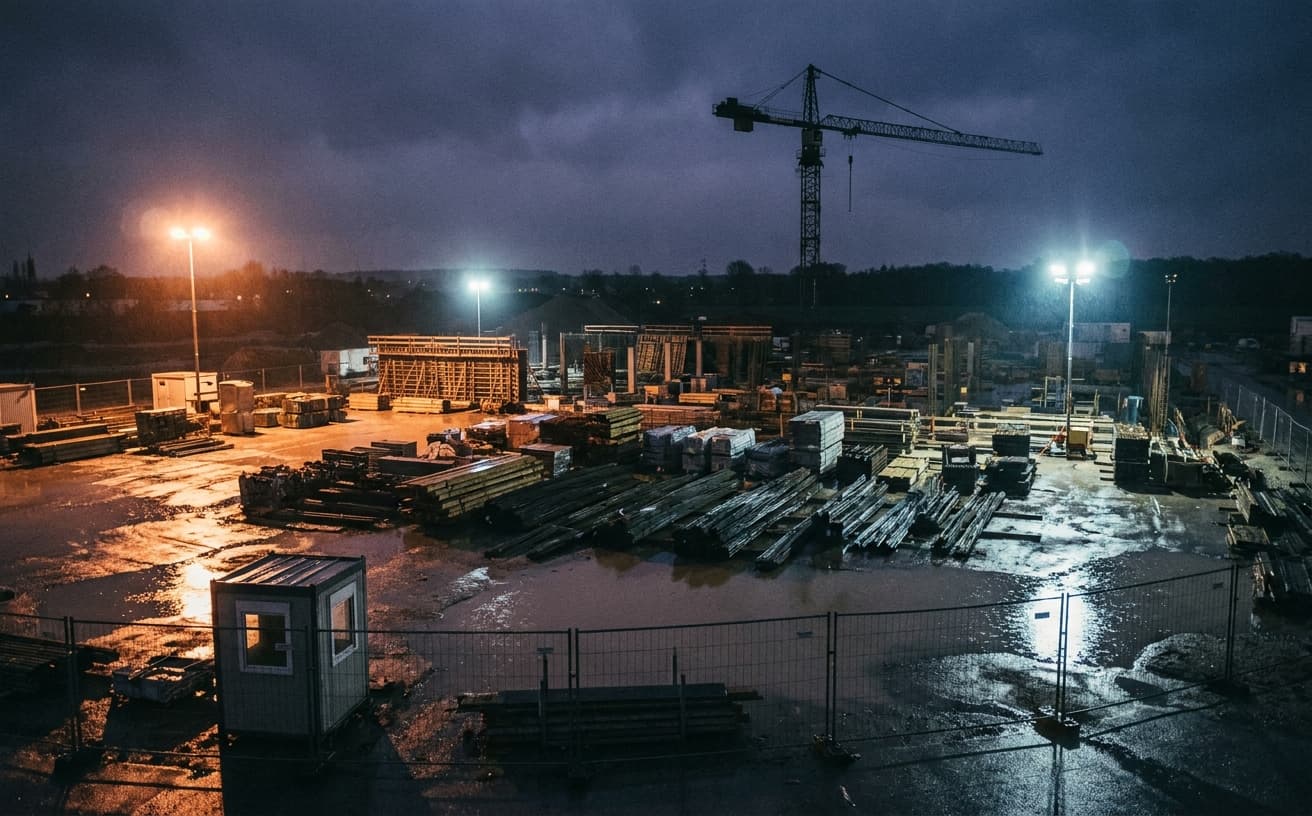
False alarm reduction security is the practice of using AI-based analytics to distinguish genuine intrusions from harmless movement, so that only verified threats trigger a response. Modern AI classifiers can cut nuisance alerts by up to 95% compared with legacy motion detection, because they recognise what an object actually is — a person, a vehicle, an animal — rather than simply reacting to pixels changing on a screen. For security managers, this means fewer wasted call-outs, lower monitoring costs, and faster reaction times when a real event occurs.
Why do traditional alarm systems generate so many false alarms?
Classic motion detectors and basic CCTV analytics react to any change in a scene. A branch swaying in the wind, a fox crossing a yard, rain, headlights, or a plastic bag blowing across a car park can all trip the sensor. Industry bodies estimate that between 90% and 98% of all intrusion alarms are false, and in many jurisdictions repeated false alarms lead to penalty charges or the withdrawal of police response altogether.
The cost is not only financial. Every unverified alert erodes trust. When operators are flooded with nuisance signals, genuine intrusions risk being dismissed as "just another false alarm" — the classic cry-wolf effect that undermines the entire security concept.
How does AI actually reduce false alarms?
AI-driven security replaces crude motion triggers with object classification. Instead of asking "did something move?", the system asks "what moved, where, and does it matter?"
- Object recognition: Neural networks trained on millions of images classify humans, vehicles and animals with high confidence, filtering out irrelevant movement.
- Behavioural analysis: The system flags loitering, perimeter crossing, or approach along a defined line rather than reacting to any motion at all.
- Contextual rules: Zones, time windows and direction-of-travel logic ensure that an authorised vehicle leaving at 06:00 does not create the same alert as an intruder scaling a fence at 02:00.
- Multi-sensor fusion: Combining thermal imaging, optical cameras and radar lets the system confirm a target across independent data sources before raising an alarm.
The result is video-verified alerting: every notification arrives with a live image or clip, so the control room sees the threat rather than guessing at it.
How do autonomous robots and video towers compare with a security guard?
BOSWAU + KNAUER — a German manufacturer engineering security technology since 1892 in Filderstadt — positions two AI platforms as the modern alternative to classic manned guarding: the autonomous security robot and the mobile video surveillance tower. Both apply the same false alarm reduction security logic, and both operate around the clock without fatigue.
| Criterion | Autonomous security robot | Mobile video tower | Classic security guard | |---|---|---|---| | Investment / cost | from €78,000 (one-off) | from €8,900 (one-off) | ~€4,000–6,000 per month | | Availability | 24/7, no breaks | 24/7, no breaks | shift-based, breaks, sick leave | | False alarm handling | AI classification + patrol verification | AI classification + fixed overview | human judgement, variable | | Coverage | mobile, patrols large sites | wide-area fixed vantage point | single point, limited reach | | Documentation | full video + data logs | full video logs | written report, subjective | | KRITIS suitability | yes, hardened for critical infrastructure | yes | depends on personnel |
Over a typical deployment, the arithmetic is straightforward. A single guard post can cost €48,000–72,000 per year and still covers only one location for one shift pattern. A mobile video tower from €8,900 pays for itself within months and never sleeps, while a robot from €78,000 patrols an entire perimeter with AI verification built in.
Where do robots and towers fit best?
Robots excel on large, complex sites — logistics yards, industrial estates, solar and energy assets — where mobile patrol adds real deterrence. Towers are ideal for construction sites, temporary compounds, car parks and events, where a rapidly deployable, high-vantage view of a wide area matters most. On many sites the two are combined: towers hold the perimeter while a robot patrols the interior.
What measurable benefits does false alarm reduction deliver?
- Up to 95% fewer nuisance alerts, according to analytics-industry benchmarks, freeing operators to focus on real events.
- Faster verified response, because each alert carries visual proof and can be actioned in seconds rather than minutes.
- Lower operating cost, replacing recurring monthly guarding fees with a one-off, depreciable asset.
- Complete, objective documentation — every event is recorded with time-stamped video, invaluable for insurance and compliance.
- KRITIS-capable resilience, suitable for critical infrastructure operators who cannot tolerate coverage gaps.
Frequently Asked Questions
How much can AI really reduce false alarms in security?
Well-configured AI video analytics typically eliminate 90–95% of the nuisance alerts produced by conventional motion detection. The exact figure depends on the site, camera placement and rule configuration, but the order of magnitude is consistent across independent analytics benchmarks: the vast majority of legacy false triggers simply disappear once object classification replaces raw motion sensing.
Is an autonomous robot or a video tower better for reducing false alarms?
Both use the same AI classification engine, so their false-alarm performance is comparable. The choice depends on the site. A mobile video tower (from €8,900) is best for wide-area, temporary or hard-to-wire locations such as construction sites. An autonomous security robot (from €78,000) adds mobile patrol and physical deterrence across large permanent sites. Many operators deploy both.
How does this compare in cost to hiring security guards?
A guard typically costs €4,000–6,000 per month, or roughly €48,000–72,000 per year, per single-shift post. A video tower recovers its cost within months and runs 24/7; a patrol robot replaces multiple shift patterns with one AI-verified asset. Over a two-to-three-year horizon, the one-off investment is usually well below the cumulative cost of manned guarding.
Do these systems work at night and in bad weather?
Yes. Thermal imaging, low-light optical sensors and radar allow reliable detection in darkness, fog and rain — conditions in which both traditional CCTV and human observation perform poorly. Multi-sensor fusion is precisely what keeps false alarms low when the weather turns difficult.
Ready to cut your false alarms?
If nuisance alerts, rising guarding costs or coverage gaps are undermining your security, BOSWAU + KNAUER can help you specify the right mix of AI robot and video tower for your site. Configure your solution in minutes with our online configurator, or contact our team for a tailored consultation and see how much false alarm reduction security can save you.
Related topics
- Drone Surveillance Security: Law, Limits & Alternative
- Property Protection Cost: Robots, Towers & Guards
- Perimeter Security Systems: The Complete 2026 Buyer's Guide
- Property Protection: Robots & Towers vs Guards 2026
- Industrial Site Security: The 2026 Protection Guide
Take the next step: See prices & ROI · Explore the products · Send a no-obligation request. BOSWAU + KNAUER – direct from the factory in Filderstadt, reply within 5 working days.
About the author
Dr. Raphael Nagel (LL.M.) is founding partner of Tactical Management. He acquires and restructures industrial businesses in demanding market environments and writes on capital, geopolitics, and technological transformation. raphaelnagel.com
More reading
Since 1892.
The firm is reached at boswau-knauer.de or +49 177 2266267.