
Blog
How to Secure a Construction Site Overnight
Lock down, sweep, monitor, respond. Four phases, each with a checklist, each with a cost line. A working protocol that survives the first wet weekend in March.

Dr. Raphael Nagel
February 6, 2026
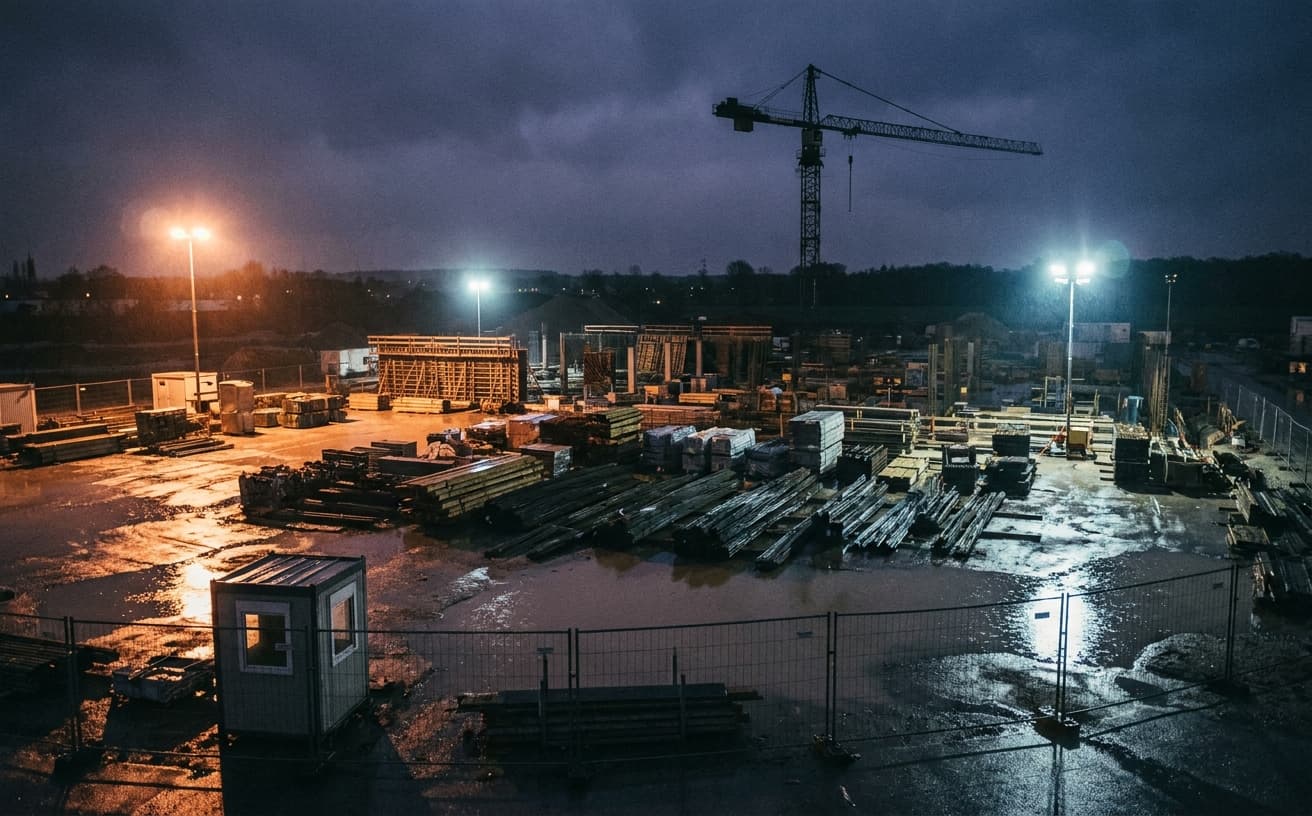
Overnight security on an active US construction site is not a service line item. It is an operating discipline with four phases, each measurable, each priced, each capable of failing in a specific way.
The phases are lock down, sweep, monitor, respond. They run in that order every working day, without exception. When a site treats them as a sequence with handoffs and timestamps, losses fall and the morning starts on time. When a site treats them as a vague aspiration delegated to whoever is still on the gate at six, losses are absorbed into the project cost, blamed on the market, and quietly priced into the next bid. The difference between the two outcomes is rarely a matter of equipment. It is a matter of protocol.
What follows is a working protocol. It assumes a mid-sized commercial or industrial site in the United States, a project value somewhere between five and two hundred million dollars, and the kind of weather that makes the first wet weekend in March a useful stress test. The protocol references the equipment categories addressed in BOSWAU + KNAUER. From Building to Security Technology, but the structure works whether the hardware on site is a mobile video tower, a security robot, fixed cameras, or a combination. The protocol is the point. The hardware serves the protocol.
Phase one: lock down
Lock down begins when the last subcontractor signs out and ends when the site is physically and electronically closed. On a well-run site, lock down takes between twenty and forty minutes. On a poorly run site, it takes whatever time is left before the foreman wants to go home, which is rarely enough.
The lock down checklist is short and unforgiving. Heavy equipment keys collected and stored in a locked container that is not the same container as the equipment. Fuel caps locked or removed. Hydraulic lines on excavators and loaders inspected for the soft cuts that signal a returning thief who has marked his targets for later. Copper and wire spools moved inside or into a hardened enclosure, never left in the open under a tarp. Power tools accounted for against the morning's sign-out list, with discrepancies flagged before the gate closes, not the next day. Generators fueled and locked. Container doors padlocked with shrouded shackle padlocks, because the unshrouded kind exists to be cut. Perimeter gates closed, chained, and verified by a second person, not the same person who closed them.
The cost line on lock down is mostly labor. Two people, thirty minutes each, every working day. On a five-day week over a twelve-month project that runs roughly two hundred sixty hours. At a fully loaded labor rate of forty-five to sixty dollars per hour for a competent foreman or site lead, the annual cost of disciplined lock down lands between twelve and sixteen thousand dollars. That number looks like overhead until it is compared to the average construction site theft loss reported by NICB and industry insurers, which runs in the tens of thousands per incident and into the hundreds of thousands when downstream delays are included.
The frequent objection is that lock down already happens. It usually does not, in the structured sense. It happens as a set of habits that vary by who is on shift, what the weather is doing, and whether the foreman has a personal commitment that evening. A protocol replaces habit with sequence. The sequence is written down, posted at the gate, and checked. When that does not exist, lock down is a story the site tells itself.
Phase two: sweep
The sweep is the bridge between lock down and monitoring. It is the last physical pass across the site after everyone is supposed to be gone, and it serves two purposes. The first is to confirm that everyone is actually gone. The second is to establish a known baseline that the monitoring phase can detect changes against. Without a sweep, the monitoring window starts in a state of ambiguity, and ambiguity is what false alarms feed on.
A proper sweep moves on a defined route, not a wandering loop. It begins at the gate, crosses the main work areas in a predictable pattern, checks the high-value zones (lay-down yards, tool cribs, fuel storage, electrical rooms), and ends at the monitoring point or the departing vehicle. The person performing the sweep carries a flashlight regardless of light conditions, a radio or phone with a documented contact for escalation, and a printed or digital checklist with the route's expected stops. Each stop is acknowledged. Anomalies are photographed and timestamped. A worker still on site at the end of the sweep is escorted out, not waved at.
The sweep also addresses what is rarely addressed in informal security routines: the presence of unauthorized persons who entered during the day and stayed past close. ASIS International and several insurer briefings have noted for years that a meaningful share of overnight construction losses involve persons who never crossed the perimeter at night because they were already inside when the perimeter closed. A sweep that lasts fifteen minutes catches most of them. A sweep that lasts ninety seconds catches none.
The cost line on the sweep is again labor, with a small allocation for the tools that make the route auditable. A fifteen to twenty minute sweep at the same labor rate adds roughly six to eight thousand dollars annually. Where the site uses a security robot or a mobile platform with thermal sensing, a portion of this cost shifts from labor to equipment depreciation, and the sweep coverage extends into areas a single person on foot does not reach in the same window. The economic case for technology in the sweep phase rests on coverage and consistency, not on replacing the person. The person is still walking. The platform extends what the person can verify.
Phase three: monitor
The monitoring window opens when the sweep closes and ends when the first authorized arrival reopens the site the next morning. On a typical commercial project in the continental US, that window runs ten to fourteen hours, with the longest stretch on weekends. The monitoring phase is where most of the security spend lands and where most of it is wasted.
Monitoring fails in two predictable ways. The first is the analog failure: a guard service that bills hours and provides presence, but whose attention degrades through the night and is statistically lowest in the two hours before sunrise, which is when industrial-grade thefts cluster. The second is the digital failure: cameras that record but do not detect, sensors that detect but do not classify, and alerts that fire so often for wildlife, weather, and lighting changes that the operator turns them off within the first month. Both failure modes end at the same place. The system is on, the bill is paid, and the loss happens anyway.
A working monitoring phase combines four elements. Visible deterrence, which means lighting and signage positioned so that an observer scouting the site before an attempt sees a serious operation. Continuous detection across multiple sensor channels, so that a single failure (a fogged lens, a sensor knocked off alignment, a network drop) does not blind the system. Centralized classification, which means the raw signals are interpreted by software or by a trained operator who can distinguish a fox from a person and a wind-loaded tarp from a forced entry. And documented escalation, which means every alarm has a defined response path with named contacts, expected response times, and a record of what actually happened.
The monitoring phase is where the equipment categories matter. Mobile video towers, deployed at the perimeter and at the high-value interior zones, provide the visible deterrent and the camera coverage. AI-assisted video analytics, running locally on the towers or at a central operations point, provide the classification that keeps the false alarm rate at a level an operator can sustain. A security robot, where deployed, provides the unpredictable movement that defeats observers who have learned the static camera angles. The combination, configured against a single platform, allows one operator to monitor multiple sites at the same time, which is the economic threshold at which technology-augmented security becomes cheaper than equivalent guard-only coverage at the same level of effectiveness.
The cost line on monitoring varies more than any other phase. A guard-only setup on a single site, twelve hours per night, seven nights per week, at twenty-eight to forty dollars per billed hour, runs between one hundred twenty and one hundred seventy thousand dollars per year. A platform-based setup with two mobile towers, integrated analytics, and a shared operator across multiple sites runs between forty and eighty thousand dollars per year on a per-site allocation, depending on contract structure. The platform setup also produces a documented incident record that supports insurance negotiations under standards like NIST CSF 2.0 and IEC 62443 for the operational technology component. The guard-only setup produces a logbook that nobody reads until something goes wrong.
Phase four: respond
Response is the phase that decides whether all the prior spending was an investment or an expense. A monitoring system that detects an intrusion at 02:47 and triggers a response that arrives at 04:15 has not prevented the loss. It has documented it. The difference between detection and prevention is measured in minutes, and the minutes are decided before the night begins, not during it.
A working response protocol has three layers. The first layer is automated and immediate: lights, sirens, voice-down systems that address the intruder by location and behavior. CISA and several DHS bulletins on critical infrastructure protection have made the point repeatedly that voice-down response, where an operator addresses an intruder in real time over a site speaker, terminates the majority of intrusions before any physical asset is touched. The second layer is local law enforcement, dispatched through a verified alarm protocol that does not depend on a single 911 call from a remote operator hoping the dispatcher takes it seriously. Verified alarms, supported by live video confirmation, receive faster response in most US jurisdictions than unverified ones. The third layer is the named on-call site representative, who arrives within a defined window to assess damage, secure breaches, and authorize any continued operation. This person is not optional. A site without a named on-call escalation is a site whose owner finds out about the incident from the morning crew.
The cost line on response is smaller than most owners expect, because the structural costs are absorbed in the monitoring phase. What response adds is the contractual framework: the agreement with the alarm verification provider, the registered alarm permit with the local jurisdiction (required in most US municipalities to avoid false alarm penalties), the documented on-call rotation, and the periodic drills that confirm the system works as designed. Annual cost typically runs three to seven thousand dollars per site, plus the time investment for the drills.
The drills are where most protocols quietly fail. A response protocol that has never been tested is an assumption. ISO 27001 and NIST 800-53 both treat untested response as equivalent to no response for audit purposes, and the same standard applies in practice. A site that runs a quarterly drill, documented and reviewed, knows what its response time is. A site that does not run drills knows what its response time was, after the fact, once.
What holds
The four phases of overnight construction security are not new. Every experienced site lead understands them in fragments. What the working protocol adds is the discipline of treating them as a single sequence, costed, measured, and auditable. The shift from informal security to protocol-based security is not a technology shift. It is a management shift. The technology follows the protocol, not the other way around.
The first wet weekend in March is the test most sites fail. Lock down is hurried because the crew wants out of the rain. The sweep is skipped because the foreman assumes the weather will do the deterrent work. Monitoring degrades because the cameras fog and the guard service is short-staffed for the holiday. Response is delayed because the on-call contact is two hundred miles away at a family event. The loss arrives between Saturday night and Sunday morning, and it is discovered on Monday. A site running the protocol described above has lock down completed in the same time regardless of weather, a sweep that uses thermal sensing where visibility fails, monitoring that flags the camera fogging as a sensor anomaly and routes around it, and a response chain with redundant contacts. The weekend passes without incident, and nobody notices, which is the correct outcome.
Sites that want to test their current protocol against the structure above have three options for engaging the work. A sixty-minute confidential conversation will produce an initial read on where the four phases are strongest and weakest on a given project. A three to five day audit will produce a written report with the standard deliverables: site description with vulnerability catalog, incident history reconstruction, economic analysis in three scenarios, prioritized recommendation matrix, implementation plan with milestones, and a documented assumptions review. A ninety-day pilot at a single site, with defined success metrics agreed before deployment, will produce the data required to decide whether to scale. None of the three options requires committing to the next. Each stands alone. The protocol holds regardless.
Frequently asked questions
What is the standard overnight security protocol on a US site?
There is no single regulated standard, but the working structure across competent operators is the four-phase sequence: lock down, sweep, monitor, respond. Lock down secures physical assets and access points. The sweep confirms the site is empty and establishes a baseline. Monitoring runs through the night with detection, classification, and visible deterrence. Response defines what happens when monitoring flags an event. Frameworks such as NIST CSF 2.0, IEC 62443 for operational technology, and ASIS International guidance all map onto this structure, though none mandate it in this exact form.
How is the site swept after work ends?
A proper sweep follows a defined route, not a wandering loop. It begins at the gate, crosses main work areas in a predictable pattern, checks high-value zones such as tool cribs, fuel storage, and electrical rooms, and ends at the monitoring point. Each stop is acknowledged on a checklist. Anomalies are photographed and timestamped. The sweep also identifies unauthorized persons who entered during the day and remained after close, which industry data identifies as a meaningful share of overnight loss vectors. Fifteen to twenty minutes is typical for a mid-sized commercial site.
What does the monitoring window look like?
The monitoring window runs from the end of the sweep to the first authorized arrival, typically ten to fourteen hours on weekdays and longer on weekends. Effective monitoring combines visible deterrence (lighting, signage, mobile towers), continuous multi-channel detection (video, thermal, motion, acoustic), centralized classification through AI analytics or a trained operator, and documented escalation paths. The objective is not to record incidents but to prevent them. Voice-down response, where an operator addresses an intruder in real time, terminates the majority of intrusions before assets are touched, according to CISA and DHS critical infrastructure bulletins.
How is the protocol audited?
A protocol that has not been audited is an assumption. Audit happens at two levels. Internal: quarterly drills that test response time, documented and reviewed against a written standard. External: a structured audit, typically three to five days on site, that examines the four phases against documented incident history, economic exposure, and applicable frameworks (NIST 800-53, ISO 27001, IEC 62443, GDV guidance where relevant). The external audit produces a written report the operator can use internally or with insurers. ISO 27001 and NIST 800-53 treat untested protocols as equivalent to none for compliance purposes, and the operating reality follows the same logic.
Related topics
- Construction Site Theft Statistics 2026: The Numbers
- Construction Site Theft Prevention: 23 Measures by ROI
- Construction Site Security Cost: Four Honest Tiers
- London Mayor Crime Strategy and the Construction Cordon
- UK Construction Theft 2026: The Data & Insurance Response
Take the next step: See prices & ROI · Explore the products · Send a no-obligation request. BOSWAU + KNAUER – direct from the factory in Filderstadt, reply within 5 working days.
About the author
Dr. Raphael Nagel (LL.M.) is founding partner of Tactical Management. He acquires and restructures industrial businesses in demanding market environments and writes on capital, geopolitics, and technological transformation. raphaelnagel.com
More reading
Since 1892.
The firm is reached at boswau-knauer.de or +49 177 2266267.