
Blog
Industrial Perimeter Security: Architecture Layered for Cost
Layered perimeter security as an architecture decision, not a shopping list. How to spend $200k vs $2M and not waste either.

Dr. Raphael Nagel
January 15, 2025
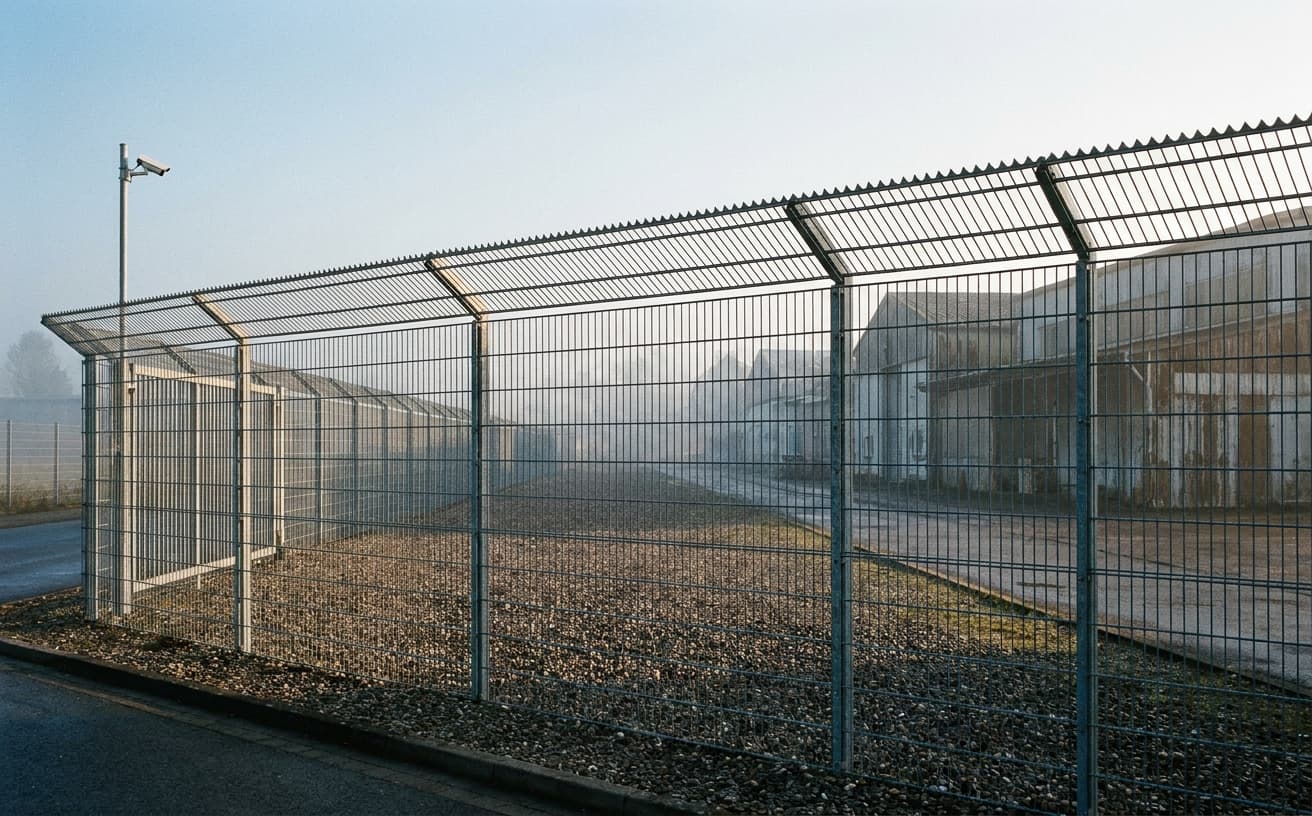
Perimeter is not a fence. Perimeter is the first decision in a sequence of decisions about where an intrusion is detected, where it is delayed, where it is assessed, and where it is answered, and the cost of the entire site flows from how that sequence is composed.
Most industrial operators discover this in reverse. They buy a fence because the previous fence was cut. They buy cameras because the insurer asked. They buy a guard tour because the cameras did not catch the last incident. Each purchase is rational in isolation and incoherent in aggregate. The result is a perimeter that costs more than it should and detects less than it must. The architecture, not the components, is what determines whether two hundred thousand dollars buys protection and two million dollars buys reassurance, or the other way around.
What perimeter actually means in industrial settings
The word perimeter carries the wrong picture. It suggests a line. In industrial practice perimeter is a zone, sometimes several hundred meters deep, in which detection, delay, assessment and response interlock. CISA writes about this in its physical security guidance and ASIS International codifies it in the protection in depth framework. The principle is older than both. A line can be crossed in a second. A zone takes time to traverse, and time is the only resource that gives a human responder a chance to arrive before the loss has been completed.
In a tank farm the perimeter starts at the access road and ends at the manifold. In a logistics hub it starts at the truck yard fence and ends at the loading dock. In a substation it starts at the cleared vegetation zone and ends at the control building. The depth of the zone is not aesthetic. It is the function of two variables: the response time of whoever will answer an alarm, and the time it takes an adversary to reach the asset of value. If the response time is twelve minutes and the adversary needs three minutes from fence to asset, the perimeter is too shallow regardless of how high the fence stands.
Operators who understand this stop asking what to buy and start asking how long they need. The conversation shifts from product to time budget. Detection must happen early enough that assessment, decision and dispatch consume less than the delay the physical layers can provide. IEC 62443 makes the analogous point for industrial control systems, where layered zones and conduits replace the idea of a single hardened boundary. The same logic applies to the physical environment. The boundary is not a wall. It is a budget of seconds.
When the time budget is the starting point, the architecture writes itself. Detection sensors go where they buy the most warning per dollar. Delay layers go where they buy the most seconds per meter. Assessment goes where it can confirm a real intrusion fast enough to authorize response. And response itself, whether internal, contracted or law enforcement, has to be honestly modeled, not assumed. Sites that assume a six minute police response when the actual response is twenty two minutes are not protected. They are documented.
The four functions, in the order they have to be designed
The standard taxonomy is detect, delay, assess, respond. The order matters because each function depends on the one before it. Detection without delay produces an alarm that confirms the loss has happened. Delay without detection produces a barrier that an adversary works through unobserved. Assessment without detection has nothing to assess. Response without assessment is dispatched on noise.
Detection is the layer where most budgets are wasted. Operators install perimeter intrusion detection systems, fiber along the fence, microwave, radar, video analytics, and discover within a quarter that the false alarm rate is unmanageable. The cause is rarely the technology. The cause is that the detection layer was specified without reference to the environment. Wind, wildlife, vehicle traffic on adjacent roads, lighting, seasonal vegetation, all of these turn a sensor that worked in the demonstration into a sensor that cries every fourteen minutes at the actual site. NIST 800-53 control PE-6 names the requirement clearly, monitor physical access, but it does not absolve the operator of the duty to engineer the monitoring against the environment in which it will run.
Delay is the layer where most budgets are underspent. A chain link fence delays a determined intruder by less than ten seconds. A welded mesh panel with anti climb geometry and a buried lower edge delays the same intruder by closer to a minute. A second line of bollards or vehicle barriers behind the fence adds another tier. The cost of upgrading from the first to the second is a fraction of what most operators spend on cameras that watch the fence being cut. Delay is unglamorous. It does not generate data. It does not appear in a dashboard. It buys the only thing that matters when the alarm fires, which is the time for the next function to operate.
Assessment is the layer that the last decade of technology has changed most. AI assisted video analytics, when trained on the actual site rather than a generic dataset, can classify an intrusion against background motion in under a second. The author's manuscript BOSWAU + KNAUER. From Building to Security Technology develops this in detail, distinguishing between general intelligence claims and the kind of narrow, site trained classification that operators can actually deploy. The distinction is operationally decisive. A model that calls everything an intrusion is worse than a human watching nothing, because it teaches the watcher to ignore the screen.
Response closes the loop. It is the function operators control least and assume most. The honest planning question is what happens in the first ninety seconds after a confirmed intrusion. Who is dispatched, how, with what authority, to which point. If that sequence is not written down and rehearsed, the preceding three layers are an expensive way of producing a report.
Why two hundred thousand and two million both work, and both fail
The cost range of industrial perimeter security is not a function of site size alone. It is a function of risk concentration and replacement time. A two hectare distribution yard with palletized consumer goods and a sixty minute average loss timeline can be defended for under two hundred thousand dollars using standardized detection, robust fencing, video assessment from a remote operations center, and a contracted response. The architecture is simple because the asset is replaceable, the loss curve is shallow, and the insurer accepts a tolerable level of residual risk.
A substation supplying a regional grid, a chemical storage installation, or a data center sit at the other end of the curve. The asset cannot be replaced in days. The loss is not the equipment, it is the downstream interruption. The same architecture that protects the distribution yard would be a negligent under investment here. These sites require redundant detection, certified delay barriers, on site response, and integration with the SCADA layer under IEC 62443, so that a physical breach triggers a logical response in the control network. Two million dollars is not a luxury here. It is the floor.
The failure modes are symmetric. The distribution yard that spends two million on a perimeter is throwing capital at a problem the insurer was already pricing in. The substation that spends two hundred thousand has built a perimeter that satisfies the audit and fails the threat. In both cases the underlying error is the same. The operator did not design the architecture against the time budget, the asset profile and the response reality. They bought components.
This is where the GDV, the BSI in its KRITIS guidance, and the NICB in its loss reporting all converge on the same observation. Losses cluster at sites where the perimeter was specified by procurement rather than designed by engineering. The component lists look similar. The architectures behind them are not.
The cost levers operators actually control
Five levers determine where on the cost curve a perimeter sits, and each one can be tuned independently. The first is the depth of the zone. Adding fifteen meters of cleared ground between fence and asset is among the cheapest delay measures in industrial security, because it costs only landscaping and lighting, and it converts a stealth approach into a visible one. Operators who own the land and refuse to clear it are spending elsewhere to compensate for a free improvement they declined.
The second lever is the detection technology mix. A single technology perimeter, whether fence sensor, radar or video, will produce more false alarms than the operator can sustain. A two technology perimeter, where an alarm requires confirmation from a second independent channel before it escalates, can reduce false alarms by an order of magnitude. This is not a product question. It is an integration question, and it sits in the system design phase, not the procurement phase.
The third lever is assessment automation. A human operator watching twelve screens will miss intrusions. The same operator supported by classification that pre filters routine motion and elevates only candidate events can supervise five times the camera count without loss of accuracy. The savings appear in the operations budget, not the capex line, which is why they are often invisible to the procurement decision. Over a five year horizon they typically exceed the capex of the analytics layer itself.
The fourth lever is response model. Contracted response, on site response, hybrid models, and integration with law enforcement all carry different price points and different reliability profiles. Operators who model their response time honestly, with actual data from drills rather than vendor promises, often find that the cheapest reliable response is a hybrid, with a small on site presence handling first contact and a contracted force handling escalation.
The fifth lever is lifecycle. A perimeter designed for ten years of service with planned refresh cycles costs less per year than a perimeter that is rebuilt every three years because components were chosen on initial price. ISO 27001 frames this for information assets, NIST CSF 2.0 frames it across the cyber physical estate, and the principle holds in pure physical security. Total cost of ownership, not unit cost, is the right denominator.
What the architecture looks like when it is right
A correctly designed industrial perimeter has a recognizable shape. The outer detection ring sits beyond the physical barrier, often as radar, thermal imaging or buried sensor, with enough range to detect approach before contact with the fence. The fence itself is engineered for delay, not just for legal demarcation, with anti climb geometry, anti cut mesh and ground anchoring that resists lifting. Behind the fence the cleared zone provides visibility and additional delay, and within that zone a second detection layer, typically video analytics with site trained classification, confirms the alarm from the outer ring.
Lighting is integrated with the detection layer, not specified separately. Cameras have the illumination they need without producing the glare that aids approach from outside. Access points are choke points by design, with vehicle barriers, identity verification and logging that integrates with the broader access management system. The control room, whether on site or remote, has assessment tools that present the operator with a single confirmed event rather than a wall of raw feeds, and the response dispatch protocol is written, rehearsed and timed.
This is what an audit under IEC 62443 or ISO 27001 will look for when it asks for layered physical security. It is also what an insurer will price favorably when underwriting the site. And it is what allows the operator to scale the same architecture across multiple sites without rebuilding the design for each one. The author's manuscript on the transition from building to security technology argues this point in the industrial chapters, that perimeter is a platform decision, not a project decision, and that operators who design once and deploy many times reach a cost per site that single site procurement cannot match.
What holds
Industrial perimeter security is an architecture problem, not a shopping problem. The components are commoditized. The integration is not. The operators who succeed in the two hundred thousand range and the operators who succeed in the two million range share the same discipline. They begin with the time budget, they design the four functions to fit within it, and they tune the five cost levers to the asset profile they are protecting. The operators who fail in either range share the opposite discipline. They begin with the catalog.
The distinction between an architecture and a shopping list is invisible at procurement and obvious at the first real incident. By then the choice has been made. The work of choosing well happens before there is anything to defend against, in the quiet phase when the budget is still abstract and the threat is still hypothetical.
For operators who want to test where their current perimeter sits on this spectrum, Path II, the three to five day audit, is the format that produces a usable answer. It documents the existing architecture against the time budget, identifies the layers that are over or under invested, and delivers a written report the operator can act on with or without further engagement. For operators who already know the architecture is wrong and want to test a corrected version before committing to a full rollout, Path III, the ninety day pilot, runs the proposed design at one site under operational conditions and produces the data on which the scaling decision can rest.
Frequently asked questions
How is industrial perimeter security designed?
It is designed against a time budget. The starting question is how many seconds elapse between the earliest possible detection of an intrusion and the moment the asset of value is reached, and whether that interval is long enough for assessment, decision and response. Detection sensors, physical delay layers, assessment tools and response protocols are then specified to fit within that budget. The reference frameworks are NIST 800-53 control family PE, IEC 62443 for sites with industrial control systems, ISO 27001 for the broader management context, and ASIS International protection in depth guidance.
What is the layered model?
The layered model organizes physical security into four functions performed in sequence: detect, delay, assess, respond. Detection identifies that an intrusion is occurring. Delay slows the adversary's progress toward the asset. Assessment confirms whether the detection is real and what it represents. Response is the human or automated action that interrupts the intrusion. The model fails when any layer is missing or when the layers are not engineered to interlock in time. CISA and ASIS both use this taxonomy, and it underlies the physical security controls in NIST CSF 2.0 and NIST 800-53.
How does cost scale with risk?
Cost scales with two variables, asset replacement time and downstream impact. Sites with replaceable inventory and shallow loss curves can be protected at the lower end of the range, often under two hundred thousand dollars, because the architecture can rely on standardized detection, basic delay and contracted response. Sites with irreplaceable assets or critical downstream dependencies, such as substations, chemical storage or data centers, require redundant detection, certified delay, on site response and integration with the control system layer, which puts them well above one million dollars. The variable that breaks the pattern is response time. Where reliable response is slow, delay must compensate, which raises cost regardless of asset profile.
Who designs the architecture?
The architecture is designed by an engineering function, not a procurement function. The competent role combines knowledge of physical security, industrial control systems where relevant, insurance and risk transfer, and operational reality at the site. In practice this is either an internal security engineering team in large operators, or an external specialist engaged through a structured audit. The author's manuscript BOSWAU + KNAUER. From Building to Security Technology argues, from the manufacturer's perspective, that the design competence and the supply competence have to be separated, so that the architecture serves the site rather than the catalog. Operators who confuse the two end up with perimeters that are coherent on paper and incoherent in operation.
Related topics
- Perimeter Security Systems: The Seven-Layer Model
- Layered Perimeter Security on an Industrial Site
- Building a UK Industrial SOC: TUPE, SIA & Living Wage Math
- Industrial Perimeter Fencing in the Gulf: Failure Modes
- Access Control with Emirates ID: Federal Biometrics
Take the next step: See prices & ROI · Explore the products · Send a no-obligation request. BOSWAU + KNAUER – direct from the factory in Filderstadt, reply within 5 working days.
About the author
Dr. Raphael Nagel (LL.M.) is founding partner of Tactical Management. He acquires and restructures industrial businesses in demanding market environments and writes on capital, geopolitics, and technological transformation. raphaelnagel.com
More reading
Since 1892.
The firm is reached at boswau-knauer.de or +49 177 2266267.