
Blog
Is a Security Robot ROI Positive in Under Two Years?
A line-by-line payback model. In which deployments the robot pays back inside twenty-four months and in which it does not. No vendor magic, just the math.

Dr. Raphael Nagel
January 31, 2026

A security robot is not a savings device. It is a labour-displacement instrument whose return depends on how many human guard hours it removes, at what loaded cost, against what capital and service charge.
That sentence sets the frame for everything that follows. The question of whether a security robot pays back inside twenty-four months has a definite answer, but the answer is conditional. It depends on four variables that are knowable before purchase and one that is not. The four knowable variables are: the loaded hourly cost of the guard hours being displaced, the number of those hours displaced per week, the all-in capital and service cost of the robot, and the residual value at month twenty-four. The unknowable variable is the loss-event frequency that the robot, by its presence, prevents. The first four are arithmetic. The fifth is statistical, and statistics over a single site in a single year are noise. The honest model therefore separates the deterministic case from the probabilistic case and asks payback to be defended on the deterministic case alone. Anything the loss-event frequency contributes is upside, not justification.
The model below is built operator to operator, on the assumption that the reader has already negotiated guard rates, already knows the seasonal swings of their site, and already has at least one set of insurance correspondence in their drawer.
The deterministic payback model
The deterministic model has five lines. Line one is the loaded cost of guard hours displaced. Loaded means the rate the operator pays the security contractor, not the wage the guard receives. In most European jurisdictions, the loaded rate for night and weekend coverage at industrial sites ranges from twenty-eight to forty-five euros per hour, depending on collective agreement, region and risk class. Loaded means inclusive of contract margin, training overhead, vehicle allocation and supervisor share. A site that runs a single night guard from twenty-two hundred to oh-six-hundred displaces eight hours per night. Over a thirty-day month that is two hundred forty hours. At a loaded rate of thirty-five euros, that is eight thousand four hundred euros of monthly guard spend potentially in play.
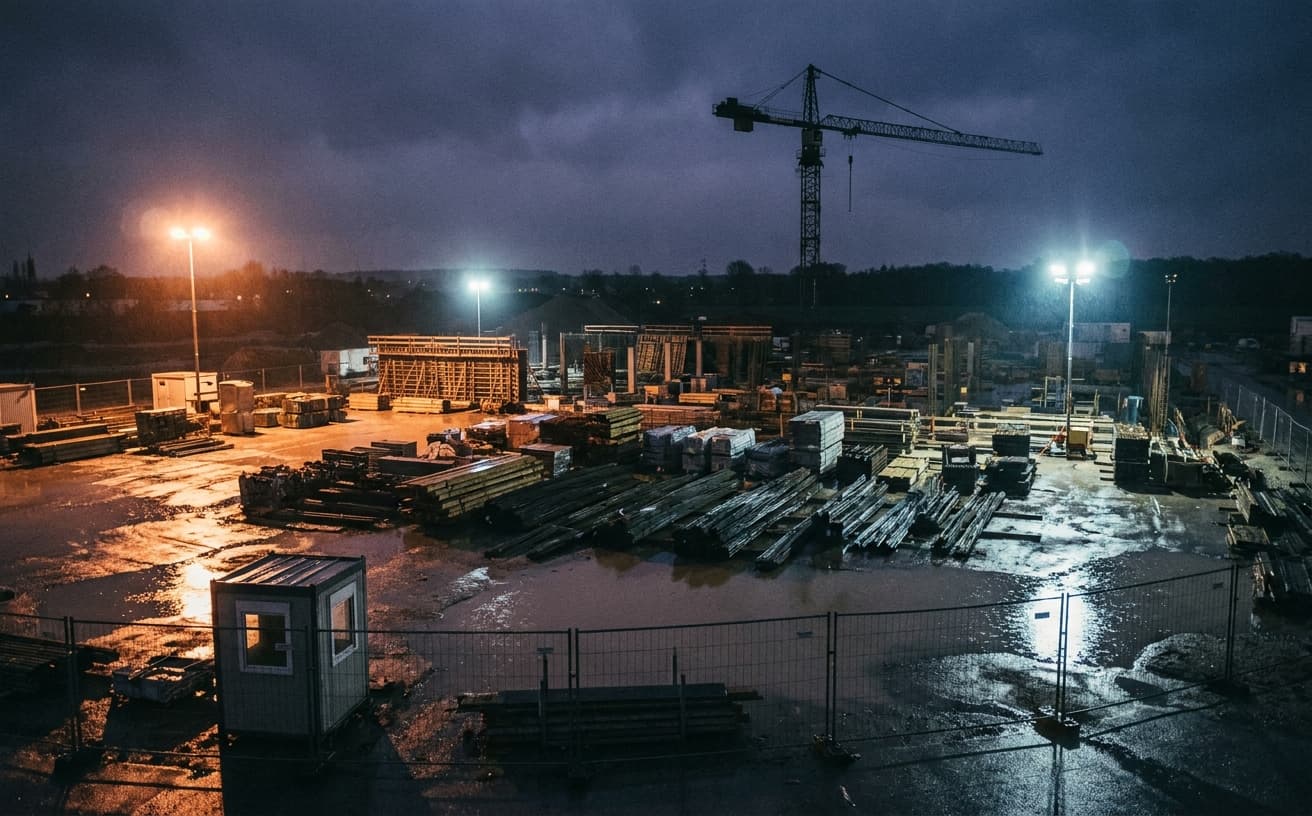
Line two is the fraction of those hours the robot actually displaces. A robot does not displace a guard fully. It displaces the patrol portion of the guard's work, not the access-control portion, not the incident-response portion, not the key-holding portion. Realistic displacement on a fenced industrial site ranges from forty to seventy percent of guard hours. On a construction site with no access control function during the night, displacement can reach eighty to ninety percent, because there is no human task that the robot's presence does not address, except physical intervention against intruders, which is in any case not the guard's role but the responding patrol's.
Line three is the all-in cost of the robot. This is where vendor quotes diverge from reality. The all-in cost includes the capital cost or lease rate, the software subscription, the connectivity, the monitoring centre fee if applicable, the maintenance contract, the charging and docking infrastructure, the site survey and commissioning, and the cost of the human operator who reviews the robot's alerts. Honest all-in monthly cost for a mid-tier outdoor security robot, fully serviced, in a European market, sits between three thousand five hundred and six thousand euros per month. Anyone quoting less has externalised a line item the operator will later pay.
Line four is residual value or contract-end position. For a purchased robot at month twenty-four, residual value depends on the secondary market for that model, which in this segment is shallow. A conservative residual at twenty-four months is twenty to thirty percent of the original capital cost. For a leased or service-model robot, residual is zero by construction, and the monthly cost in line three already reflects that.
Line five is the financing or opportunity cost of the capital deployed. For most operators this is between five and nine percent, depending on balance sheet and tax position.
Set those five lines against each other and the question of payback becomes arithmetic. A site displacing two hundred forty guard hours per month at thirty-five euros loaded, with a sixty percent displacement factor, recovers roughly five thousand euros per month in guard spend. Against an all-in robot cost of four thousand five hundred euros per month, the net positive is five hundred euros per month. Cumulative net positive over twenty-four months is twelve thousand euros. That is positive but thin. It does not yet count any avoided losses, any insurance benefit, or any productivity contribution. It is positive on labour displacement alone, and that is the threshold the deterministic model requires.
Where the robot does not pay back
A robot does not pay back on a site that has no existing guard spend to displace. This is the most common error in the ROI conversation. An operator who has never paid for night patrol cannot recover what was never spent. The robot in that scenario is not a substitution, it is a net new line item. It may be justified by other arguments, by risk reduction, by insurance access, by deterrence, by documentation for the bauherr, but it is not justified by payback in the labour-displacement sense. The model collapses to zero in line one.
A robot does not pay back on a site whose patrol path is shorter than the robot's economic minimum route. Robots have a fixed cost regardless of how much ground they cover. A site that requires forty minutes of guard time per shift cannot displace enough hours to recover the robot's monthly all-in cost. The break-even point on most current European deployments sits at roughly four to six guard hours displaced per night, every night, for the deterministic model to clear. Below that, the robot is uneconomic on labour grounds alone.
A robot does not pay back on a site with terrain or weather conditions that exceed its operating envelope. Snow loads above the manufacturer's spec, gradients above fifteen percent on unimproved surfaces, ambient temperatures outside the certified band, and fog densities that defeat the optical sensor suite all reduce effective uptime. A robot with seventy percent uptime is paying for thirty percent of its monthly cost while delivering nothing. Operators in alpine, coastal-fog or arctic environments need to model effective uptime, not nameplate uptime, and reduce line two accordingly.
A robot does not pay back on a site where the human operator function has not been organised. The robot generates alerts. Alerts must be triaged. If the triage function sits with a person who is already overloaded, the robot's value collapses, because alerts are ignored, suppressed or escalated to the wrong responder. The cost of a properly staffed monitoring function, whether internal or contracted to a regional control centre, must be in line three of the model. Operators who omit this line are not modelling, they are dreaming.
A robot does not pay back on a site whose loss profile is dominated by event types the robot cannot detect. A robot patrol is good against intrusion, loitering, opportunistic theft, fire ignition in early stages, and certain vandalism patterns. It is poor against insider theft during working hours, against credentialed contractor misappropriation, against cyber-physical attacks on the systems the robot itself depends on, and against organised crews that have studied the patrol pattern. A site whose loss history is concentrated in the categories the robot cannot address should not expect the robot to bend the loss curve, and the deterministic model is the only honest case.
What insurance contributes, and what it does not
Insurance economics shift the model, but rarely as much as vendors suggest. The structural reality, supported by GDV positioning in the German market and by reinsurer commentary across Europe, is that property insurance pricing responds to documented, sustained risk-reduction measures with a lag of one renewal cycle, sometimes two. A robot installed in March may not show in the premium until the renewal in January, and the premium reduction in that first cycle is typically modest, in the range of five to fifteen percent on the affected coverage lines, conditional on documentation that the underwriter accepts.
The larger insurance benefit, in practice, is not premium reduction but coverage access. Sites that struggle to obtain or maintain coverage at industrial limits, or that face exclusions on theft, vandalism or specific risk categories, can sometimes use a documented robot deployment to restore coverage or remove an exclusion. The economic value of an exclusion removed is not visible in the premium line. It is visible only when a loss occurs and the coverage holds. Operators should ask their broker to quantify the exclusion exposure before deciding whether the robot's insurance contribution is material.
A second insurance contribution is deductible structure. Insurers will sometimes accept a higher deductible in exchange for documented risk-reduction measures, transferring frequent small losses to the operator while preserving catastrophic protection. This shifts the cash-flow profile in the operator's favour over a full cycle, because the operator captures the no-loss months and only pays in the loss months. Whether this is economically positive depends on the operator's loss frequency, and most operators do not have clean enough loss data to model it confidently. NICB data on theft patterns in the United States and BSI guidance on critical infrastructure resilience in Germany both support the structural argument that documented technical measures shift insurer behaviour, but the magnitude is site-specific and broker-dependent.
A robot's insurance contribution to ROI is therefore real but secondary. It should appear in the model as a sensitivity case, not as a base case. If the deterministic case does not clear on labour displacement alone, insurance benefit is unlikely to rescue it. If the deterministic case clears thinly, insurance benefit is the cushion that turns a marginal yes into a confident yes.
Deployment patterns that shorten payback
Certain deployment patterns shorten payback below twenty-four months reliably. The first is multi-shift coverage on a single site. A robot that displaces guard hours across the full overnight shift, rather than only the deepest hours, captures more displaced cost against the same fixed monthly. A robot running from twenty hundred to oh-six-hundred displaces ten hours per night, against the eight in the earlier example. The arithmetic improves linearly.
The second pattern is shared deployment across adjacent sites. An operator with two industrial plots within transit distance, or a logistics campus with multiple yards, can rotate the robot between locations across the week, displacing guard hours at each. The capital and service cost remains fixed. The displaced labour cost multiplies. Operators who own portfolios of similar sites should model the robot at the portfolio level, not the site level. This is the most common path to payback well inside twenty-four months in industrial security practice.
The third pattern is integration with existing CCTV and access control. A robot that operates as a mobile sensor inside an already-instrumented site, contributing to a unified picture, reduces the marginal cost of monitoring because the operator function is already in place. The robot becomes one more input to a desk that already exists, rather than requiring a desk of its own. This pattern aligns with the integration principles in IEC 62443 for industrial systems and with the asset-management practices in NIST CSF 2.0. It is also the pattern that BOSWAU + KNAUER. From Building to Security Technology develops in the chapters on platform architecture, because the platform logic is what allows the robot to contribute without imposing a new fixed cost layer.
The fourth pattern is construction-site deployment with mobile relocation. A robot that follows the operator across projects, rather than being tied to a single permanent site, amortises across project lifecycles. The project-by-project return is high because each project would otherwise carry a full guard contract for its construction phase. The accounting question becomes which project carries the depreciation, but the economic question is settled: the asset is producing across a portfolio.
The fifth pattern is high-loss-rate environments where the robot's deterrence contribution is documentable. Operators with a baseline loss history above one percent of project value, or above a defined euro threshold per quarter, can attribute a portion of the loss reduction to the robot and shorten the payback materially. This requires before-and-after data discipline that most operators do not maintain. Operators who do maintain it have the strongest ROI case in the market.
Where the model breaks honestly
The model breaks when the operator cannot agree with themselves on what the displaced guard would have done. If the guard's value was access control rather than patrol, the robot does not displace the guard, it sits beside the guard. If the guard's value was incident response, the robot raises alerts that still require the guard or a contracted response unit, and the cost is additive. Operators who cannot decompose the guard's function into patrol, access control, response and presence will struggle to model the robot, because they cannot identify which portion is in play.
The model also breaks when the operator overstates uptime. A robot that the vendor specifies at ninety-five percent uptime, in practice, often runs at seventy-five to eighty-five percent across a full year, after weather, maintenance, software updates, sensor cleaning and operator error. The operator who models at nameplate is modelling the demo, not the deployment.
The model breaks when the operator omits the operator function. There is no robot deployment in serious industrial or construction practice that runs without a human reviewing the alerts. ASIS International guidance on physical security operations, and CISA guidance on layered defence, both presume a human in the loop. The cost of that human is not optional. Operators who treat the robot as an unattended device are building a system that will be disabled within six months of the first false alarm cascade.
The model breaks, finally, when the operator confuses ROI with risk transfer. A robot does not transfer risk. It reduces certain risks and documents the reduction. Risk transfer remains the work of insurance and contract. Operators who buy a robot expecting it to make the bauherr or the insurer go away will be disappointed. The robot is a working device, not a legal instrument.
What holds
A security robot is ROI positive inside twenty-four months when it displaces enough loaded guard hours, on a site or portfolio configured to accept it, with a monitoring function already organised and a maintenance contract that holds. It is not ROI positive when any one of those conditions fails. Insurance benefit is a real cushion but rarely the rescue. Loss prevention is real upside but should not appear in the base case.
The honest path for an operator who wants to know the answer for their specific site is not to read more articles. It is to run the five-line model with their own loaded guard rate, their own displacement fraction, an all-in robot cost from a vendor willing to quote in writing, and a conservative residual. If the deterministic case clears, the deployment is defensible. If it does not, the operator needs either a different deployment pattern, a different site profile, or a different security architecture.
Operators who want that calculation done with discipline, against their actual site data and their actual guard contracts, should begin with Path II, the three to five day audit. The audit produces the numbers in a form that the operator can defend internally, with annotations on the assumptions, and an annexed comparison against the operator's existing arrangement. The audit does not pre-commit the operator to any procurement decision. It only ensures that the next decision is made on arithmetic rather than on impression.
Frequently asked questions
When does a security robot reach ROI under two years?
A security robot reaches ROI inside twenty-four months when it displaces between five and eight loaded guard hours per night, every night, on a site whose loaded guard rate sits at the higher end of the regional range, with an all-in robot cost contained below the displaced labour cost by a margin sufficient to absorb uptime losses and operator function costs. The arithmetic clears most reliably on industrial sites with continuous overnight guard contracts and on portfolios where the robot rotates across adjacent locations. Single-shift, short-route, low-rate sites rarely clear inside two years on labour displacement alone.
What deployment patterns shorten payback?
Five patterns shorten payback materially. Multi-shift coverage extends the displaced hours against fixed cost. Portfolio rotation across adjacent sites multiplies displaced labour without adding capital. Integration with existing CCTV and monitoring desks avoids a new fixed cost layer. Construction-site deployment with mobile relocation amortises across project lifecycles. High-loss-rate environments allow documented loss reduction to enter the case. Operators who combine two or more of these patterns can reach payback inside twelve to eighteen months. Operators who match none of them should not expect twenty-four-month payback on labour displacement alone, and should look to other justifications.
What insurance benefits accelerate ROI?
Insurance benefits enter the model in three forms. Premium reduction, typically five to fifteen percent on affected lines, arriving one to two renewal cycles after deployment, conditional on documentation the underwriter accepts. Coverage access, where a documented robot deployment restores coverage or removes an exclusion, whose value appears only when a loss occurs but whose structural importance is significant for sites at the edge of insurability. Deductible restructuring, where the operator accepts a higher deductible in exchange for documented measures, shifting cash flow favourably across a full cycle. None of these should be modelled as base case. All should appear as sensitivity layers above the deterministic labour-displacement model.
When does a robot never pay back?
A robot never pays back on a site with no existing guard spend to displace, because there is nothing to recover. It does not pay back on sites whose patrol need is below four to six guard hours displaced per night, because the fixed monthly cost exceeds the available labour saving. It does not pay back where terrain, weather or site geometry push effective uptime below seventy percent. It does not pay back where the monitoring function is not staffed, because alerts collapse into noise. And it does not pay back on sites whose loss profile is dominated by event types the robot cannot detect, where the operator was hoping for risk reduction the technology does not deliver.
Related topics
- Building a UK Industrial SOC: TUPE, SIA & Living Wage Math
- Security Robots in Saudi Arabia: Vision 2030 & NEOM
- Rolling Out a Security Robot in a Warehouse
- Who Is Liable When a Security Robot Misses an Incident
- Security Robots For Sale vs Rental: When CapEx Actually Wins
Take the next step: See prices & ROI · Explore the products · Send a no-obligation request. BOSWAU + KNAUER – direct from the factory in Filderstadt, reply within 5 working days.
About the author
Dr. Raphael Nagel (LL.M.) is founding partner of Tactical Management. He acquires and restructures industrial businesses in demanding market environments and writes on capital, geopolitics, and technological transformation. raphaelnagel.com
More reading
Since 1892.
The firm is reached at boswau-knauer.de or +49 177 2266267.