
Blog
Italian Construction Night Security: The Real Cost
Costo orario vigilanza, ANCE statistics, Mezzogiorno theft patterns. The South-North divide in Italian site security.

Dr. Raphael Nagel
October 19, 2025
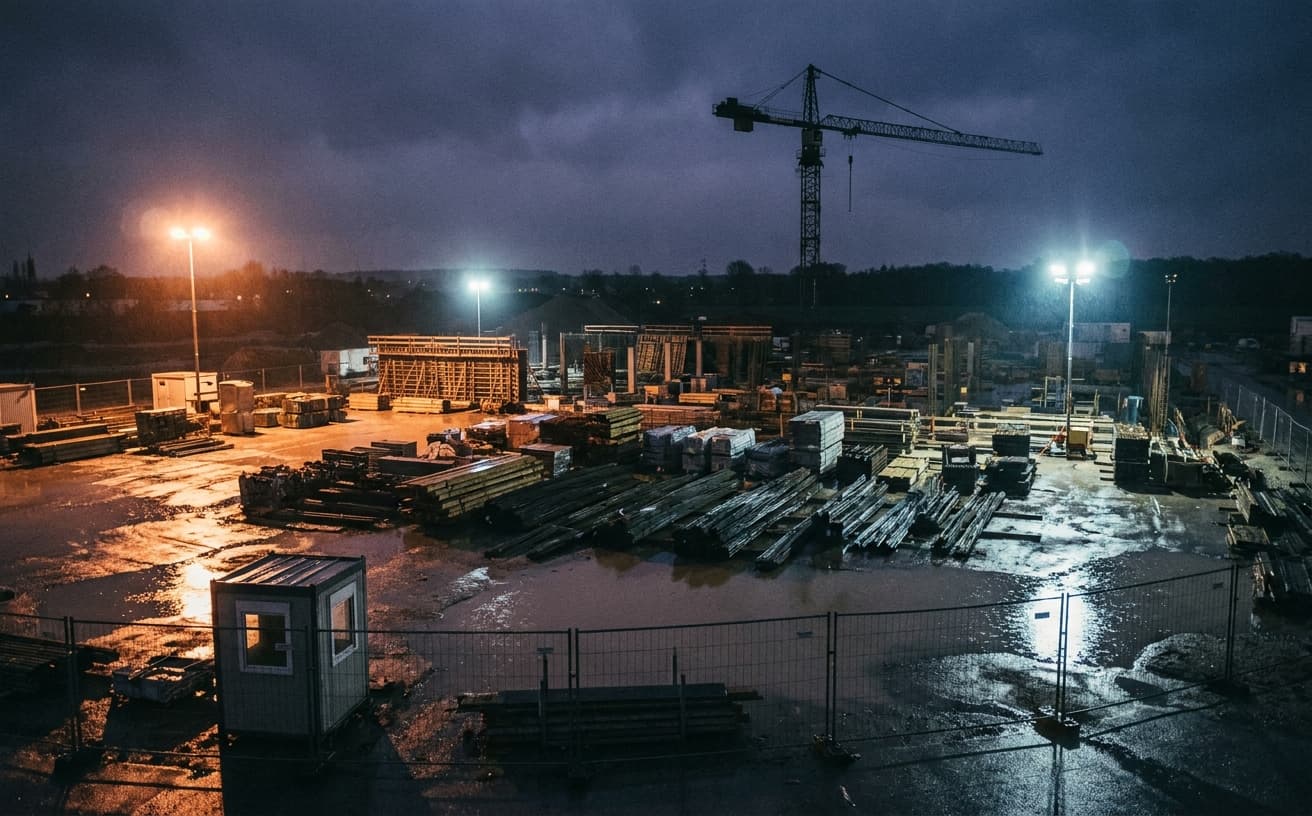
The Italian word vigilanza has been stretched beyond what it can carry. On most sites between Bolzano and Reggio Calabria, it now describes a man in a car who arrives once or twice a night, signs a sheet, and drives on. That is presence, not security, and the distinction is no longer academic when the materials behind the fence are worth more than the man and his car combined.
Italian construction operators have spent the last decade absorbing two pressures at once. Material values inside the perimeter have climbed, driven by copper, structural steel, lithium in tool batteries, and increasingly expensive site electronics. At the same time, the hourly cost of a licensed guardia particolare giurata has risen, while the supply of trained personnel has thinned, especially in the South. The arithmetic that held in 2015 no longer holds in 2025, and the operators who continue to apply it are quietly losing margin they cannot recover at handover.
What follows is a working description of the Italian night-watch market for construction sites, with the per-hour numbers as they are observed on actual quotes, the regional split that ANCE and ANIA data make visible, and the mathematical case for the mobile video tower as the substitution instrument. The figures are presented as ranges where ranges are honest. The argument is built for the operator who reads a consuntivo and a preventivo in the same week and knows which one tells the truth.
What the Italian night watch actually costs per hour
The headline number, the one that appears on most invoices issued to construction clients in Italy, sits between 22 and 32 euros per hour for a licensed armed guard from a registered istituto di vigilanza. That range covers the contract minimum under the CCNL Vigilanza Privata, the employer's social charges, vehicle costs, central station overhead, and the institute's margin. Below 22 euros, the work is either irregular or compressed in ways that will not survive a labour inspection. Above 32 euros, the buyer is paying for a brand, a specific contract clause, or a rapid response commitment that goes beyond the basic patrol service.
The hour itself is not a unit of security. It is a unit of presence with a defined content. On a construction site, the typical contract specifies between three and six ispezioni per night, each lasting roughly fifteen to twenty minutes, with the guard moving between client sites across the rest of the shift. Total in-site time is therefore between forty-five minutes and two hours across a twelve-hour darkness window. The remaining ten hours are covered by the deterrent value of a sticker on the gate and by the theoretical promise of a pronto intervento, which in practice means a second car dispatched from the central station once an alarm has been confirmed, with arrival times in Italian urban contexts averaging twelve to twenty minutes and stretching considerably further in peripheral or rural areas.
Operators who price security by the per-hour line item are therefore paying for a fraction of the night and receiving a fraction of the protection. The honest reading of the invoice is that 26 euros per hour, multiplied by twelve hours of darkness, produces a nightly cost of around 312 euros for a service that physically occupies the site for less than two of those hours. The remaining ten hours are unmanned in the literal sense. Whether they are unmanaged is a separate question, and it depends on what else has been installed.
The contract structure compounds the issue. Vigilanza contracts in Italy are typically annual, with cancellation windows that punish early termination. An operator who signs a twelve-month contract for a six-month site is paying for coverage on a finished building, or is paying twice when the next site begins on a different schedule. The mismatch between contract duration and project duration is a structural inefficiency that the istituti have no incentive to solve, because they are paid by the month regardless of whether the perimeter still contains anything worth stealing.
The North-South divide in site theft patterns
ANCE has documented, across multiple regional reports, that construction site theft in Italy does not distribute evenly. The Mezzogiorno, and within it specifically the provinces of Naples, Caserta, Foggia, Bari, Catania, and Palermo, shows incident rates that run between two and four times the national average. The NICB-equivalent function in Italy is split between ANIA on the insurance side and the Ministero dell'Interno on the criminal statistics side, and the two sources, read together, confirm what site managers in the South already know: organised, repeat-pattern theft is a feature of the operating environment, not an exception within it.
The Northern pattern is different in kind, not only in frequency. In Lombardy, Veneto, Emilia-Romagna, and Piedmont, the dominant theft profile is opportunistic, often involving non-resident actors moving between sites within a corridor, and concentrated on copper, fuel from generators, and unattended power tools. The Southern pattern includes all of the above and adds two further layers: organised removal of structural materials in volume, including rebar, scaffolding components, and machinery, and a parallel layer of extortive pressure that does not appear in any insurance statistic because it is not reported to insurers. ASIS International chapters operating in Italy have addressed the second layer in closed sessions for years. It is not a secret. It is a fact that does not enter the actuarial data.
The consequence for security planning is direct. A Northern site can often be adequately protected with a perimeter system, video coverage, and an alarm contract with a local istituto. A Southern site of comparable value cannot. The threat model is denser, the response time of public force is longer in many provinces, and the deterrent value of a single guard arriving twice a night is, in honest terms, close to zero against an organised crew with a flatbed truck and a forty-minute work window. ANCE Campania and ANCE Sicilia have both, in published positions, called for site security standards that go beyond the vigilanza model. The published positions do not, however, translate automatically into contractual practice, because the buyer is the impresa and the impresa is calculating against the next gara.
The pricing reflects the divide only weakly. Per-hour rates in Naples or Bari are not meaningfully higher than per-hour rates in Milan or Bologna, despite the higher operating risk for the guard and the lower deterrent value of the service. This is partly a function of CCNL standardisation and partly a function of competitive pressure among Southern istituti. The buyer who reads only the per-hour line will conclude that Southern security is no more expensive than Northern security. The buyer who reads the sinistri line of the closing balance will conclude otherwise.
What ANCE and the trade data actually report
ANCE, the Associazione Nazionale Costruttori Edili, publishes periodic Osservatorio reports on the conditions of the construction sector, and within these the security and theft component is covered with varying depth. The picture that emerges, when the ANCE data is read alongside ANIA's insurance statistics and the Ministero dell'Interno's Rapporto sulla criminalità, is consistent across several years.
Direct material losses from site theft in Italy are conservatively estimated in the hundreds of millions of euros annually, with ANCE-affiliated sources placing the figure for the broader construction sector, including ancillary thefts of tools, fuel, and copper, well above that floor. The indirect losses, meaning project delays, contractual penalties, idle equipment hire, and the cascade effects through subsequent trades, are not captured in any single dataset, but every site manager who has lost a transformer or a switchgear cabinet to theft can produce the internal calculation. The ratio between direct loss and indirect loss on a delayed structural phase frequently runs between one to four and one to ten. Stealing a distribution panel worth eight thousand euros can produce sixty to eighty thousand euros of downstream cost, and ANCE has documented case studies that confirm this multiplier in the public record.
The insurance angle adds a second layer of pressure. Polizza CAR, the construction all-risk policy that covers most Italian sites of meaningful size, has tightened materially in recent years. Premiums have risen, deductibles have grown, and the exclusions for repeat-pattern theft on sites without documented active protection have multiplied. ANIA's published guidance to underwriters explicitly favours sites with electronic surveillance, remote video verification, and intervention contracts over sites that rely on patrol-only vigilanza. The insurance market is, in this sense, ahead of the procurement market. Underwriters are pricing the new threat model. Buyers are still pricing the old one.
The ANCE position, taken across multiple regional chapters, can be summarised without distortion: the construction sector in Italy needs to move from a vigilanza-centric model to a technology-centric model, because the vigilanza-centric model no longer scales with the values inside the fence. This is not a marketing position from a security vendor. It is the trade association's own reading of its members' losses. The reading is in the public record. The implementation is uneven.
When the mobile video tower replaces the guard hour
The mathematics of the mobile video tower against the patrol contract are direct, and they do not depend on assumptions that cannot be checked. A mobile tower with autonomous power, multi-sensor video coverage, thermal imaging, and a connection to a remote video verification centre, deployed under the framework described in BOSWAU + KNAUER. From Building to Security Technology, occupies the perimeter for the full darkness window, not for ninety minutes within it. The cost per night, including the central station verification contract and the amortised hardware, sits in a range that for most site profiles undercuts the patrol contract by a meaningful margin from the second month onward.
The arithmetic that matters is the following. A vigilanza contract at 26 euros per hour, with three inspections per night and a basic alarm verification clause, produces a monthly cost in the range of 2,400 to 3,600 euros for a single site, depending on the inspection frequency and contract terms. A mobile tower deployment, including installation, removal, monthly service, remote verification, and the proportional hardware cost across a typical six-to-eighteen-month project, lands in a range of 1,800 to 3,200 euros per month for equivalent or stronger coverage. The savings are not the headline. The coverage differential is the headline. The tower watches the perimeter for twelve hours. The patrol watches it for ninety minutes. The intervention that follows a tower-generated alarm is faster, because the verification has already happened in real time at the central station, and the responding unit, whether vigilanza or public force, is dispatched against a confirmed event rather than a hypothesis.
The payback question, for sites that consider purchasing rather than renting, is more sensitive to project pipeline than to single-site economics. A tower deployed on a single eighteen-month project does not pay back within that project against the rental alternative. A tower deployed across three to five sequential projects, with the standard mobility and reconfiguration that the platform supports, pays back somewhere between the second and the third deployment, depending on the site profile and the vigilanza baseline being displaced. Italian operators with project pipelines extending beyond two years should be running this calculation against their own data. The IEC 62443 framework for industrial system security and the ISO 27001 controls for operational data handling provide the reference architecture for the data layer. The economics are a separate calculation, and the economics are what move the procurement decision.
Three further considerations complete the picture. First, the tower does not tire, does not negotiate, and does not need a second car as backup. Its failure modes are technical and predictable, not human and variable. Second, the recorded video stream produces evidence that survives in procedimenti penali and in richieste di indennizzo in a way that a guard's written report frequently does not. The GDV equivalent in Italy, ANIA, has been clear with underwriters that verified video evidence accelerates settlement and reduces dispute. Third, the tower is visible. Italian site thieves, North and South, conduct reconnaissance. A visible tower with active illumination and a cartello indicating remote monitoring changes the reconnaissance calculation in ways that a patrol sticker on the gate does not.
What holds
The Italian construction security market is in a transition that the regulatory environment, the insurance market, and the trade association have already acknowledged. The procurement practice in most imprese has not yet caught up, partly because the vigilanza relationship is old and embedded, partly because the per-hour line on the invoice is easier to compare than the total-cost-of-protection line that the modernised model requires. Operators who continue to procure on per-hour pricing alone will continue to lose margin to theft, to delay, and to insurance friction that the underwriters are no longer willing to absorb.
The South is not the same problem as the North, and the same solution cannot be sold into both with the same configuration. Mezzogiorno sites need denser coverage, faster verification, and a higher tolerance for false-positive review at the central station, because the cost of a missed true positive is materially higher. Northern sites can often operate with a leaner configuration, with the tower or robot system handling the perimeter and a reduced vigilanza contract handling the legal-procedural requirements that some municipalities and clients still expect on paper. Both configurations are buildable. Neither is a generic product.
The decision in front of the Italian operator is whether to make the calculation or to inherit it from the next event. Path II, the three to five day audit described in the closing section of the book, is the format that produces the calculation in a form that can be presented internally and to insurers. It does not require a contract beyond the audit itself. What it produces is the data on which the next procurement cycle should rest.
Frequently asked questions
What does a watchman cost in Italy?
A licensed guardia particolare giurata from a registered istituto di vigilanza costs between 22 and 32 euros per hour invoiced to a construction client, with most contracts settling between 24 and 28 euros. The rate covers the CCNL Vigilanza Privata minimums, social charges, vehicle and central station overhead, and institute margin. Below 22 euros the service is either irregular or compressed in ways that will not survive labour inspection. The hourly rate, however, buys presence for roughly ninety minutes of a twelve-hour night, not continuous coverage.
How does North differ from South?
The Northern pattern is opportunistic and corridor-based, dominated by copper, fuel, and tool theft, and is broadly addressable with perimeter systems, video coverage, and standard alarm contracts. The Southern pattern, concentrated in Campania, Puglia, Sicily, and Calabria, includes organised volume removal of structural materials and machinery, with response times from public force that are structurally longer. ANCE regional reports and Ministero dell'Interno statistics confirm incident rates in the South running two to four times the national average. The same security configuration will not perform equivalently across the divide.
What does ANCE report?
ANCE, across its national and regional Osservatorio publications, documents that construction site theft losses in Italy run into the hundreds of millions of euros annually in direct material terms, with indirect losses through delay and contractual penalty running several multiples higher. The association's published position favours a shift from patrol-centric vigilanza to technology-centric protection, citing both the per-incident cost trajectory and the tightening of polizza CAR terms under ANIA underwriting guidance. The reading is consistent across recent reporting cycles.
When does a tower pay back?
A purchased mobile video tower, against a comparable vigilanza patrol contract, does not pay back within a single eighteen-month project. Across three to five sequential projects, with the standard mobility the platform supports, payback typically falls between the second and the third deployment. Operators with multi-year pipelines should run the calculation against their own vigilanza baseline, including the avoided indirect-loss component that ANCE case studies place at four to ten times the direct material figure. A ninety-day Path III pilot produces the project-specific numbers needed to confirm the case.
Related topics
- Poland Construction Boom and Site Security
- Construction Site Theft Patterns in the GCC: The Data
- Construction Site Theft Statistics 2026: The Numbers
- London Mayor Crime Strategy and the Construction Cordon
- How to Secure a Construction Site Overnight
Take the next step: See prices & ROI · Explore the products · Send a no-obligation request. BOSWAU + KNAUER – direct from the factory in Filderstadt, reply within 5 working days.
About the author
Dr. Raphael Nagel (LL.M.) is founding partner of Tactical Management. He acquires and restructures industrial businesses in demanding market environments and writes on capital, geopolitics, and technological transformation. raphaelnagel.com
More reading
Since 1892.
The firm is reached at boswau-knauer.de or +49 177 2266267.