
Blog
Jobsite Security Cost per Night: A Frank Calculation
Per-night quotes are easy to find. The components those quotes hide are the ones that decide whether the number is fair. A frank walkthrough.

Dr. Raphael Nagel
January 27, 2026
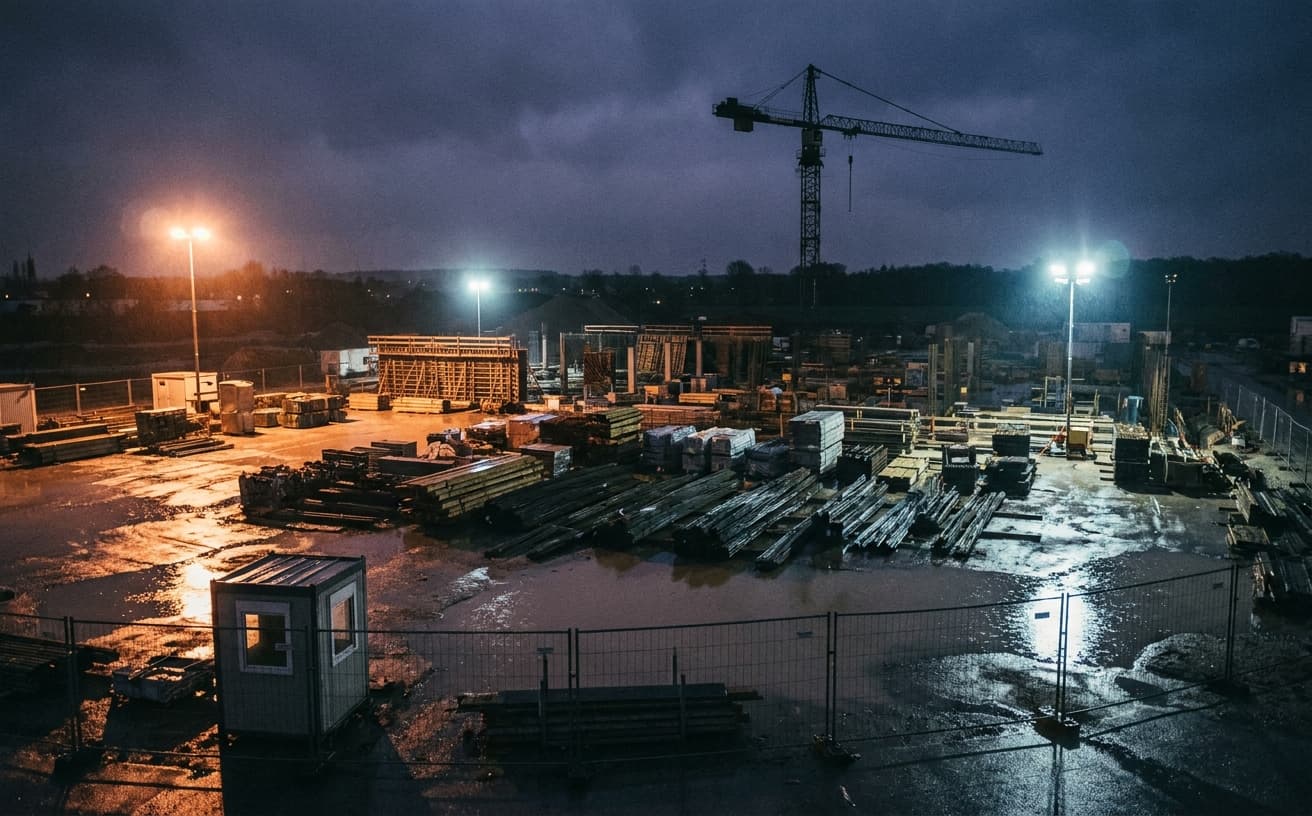
A per-night number is not a price. It is a placeholder that hides three other numbers, and the buyer who signs without seeing all four pays for the difference.
Search results for "jobsite security cost per night" return ranges that look reassuring. Three hundred dollars for a single guard shift in a low-cost market. Four hundred and fifty in a metro. Seven hundred for armed coverage at a high-risk site. Video tower rentals between sixty and one hundred and twenty dollars per night, depending on length of deployment. Mobile patrol drive-bys at thirty to fifty dollars per visit. These numbers are not wrong. They are incomplete in ways that matter to the operator who has to defend a budget after the project closes.
The completion problem is the subject of this article. What follows is a frank walk through the components a serious quote contains, the components a cheap quote omits, and the conditions under which one solution structurally beats another. The argument draws on the manufacturer perspective developed in BOSWAU + KNAUER. From Building to Security Technology, and on figures published by industry references such as the National Insurance Crime Bureau, ASIS International, and the construction insurance underwriters who quietly set the real benchmarks.
The four numbers behind one number
Every per-night quote contains four numbers, whether the seller breaks them out or not. The first is labor. For a guarded site, this is the hourly wage plus the burden, multiplied by the shift length. A twelve-hour shift at twenty-eight dollars loaded comes in at three hundred and thirty-six dollars before the contractor adds anything else. The second is overhead. Insurance, payroll administration, training, uniforms, vehicle costs for relief and supervision, dispatch, and licensing. In the United States, a guard firm operating at industry-typical margins carries overhead between thirty and forty-five percent of direct labor. The third is margin. A reputable firm prices margin between ten and eighteen percent. A firm pricing below this band is either subsidizing the contract from another line of business or is about to fail to deliver. The fourth is risk premium, which most quotes do not name but every honest pricing model contains. Risk premium covers the cost of incidents that will occur on the site during the contract: medical exposure to the guard, vehicle damage on patrol, claims arising from incident handling, and the cost of replacing personnel who do not return after a difficult shift.
When the four numbers are aggregated honestly, a single twelve-hour guard shift in a major American metro lands between three hundred and ninety and five hundred and forty dollars. A two-guard configuration on a larger site doubles the labor line but does not double the overhead, which is why per-guard cost decreases slightly with scale. A twenty-four-hour configuration with two shifts of twelve hours lands between seven hundred and eighty and one thousand and eighty dollars per night, before any technology layer. These are not negotiated prices. They are the cost floor below which the service cannot be delivered without quality compromise. Quotes substantially below this floor exist, and they have a structure: they assume the guard will work alone, without relief, without supervision, without functioning vehicle, and often without the training the local jurisdiction requires. The operator who accepts such a quote is not buying security. The operator is buying the appearance of security, and the appearance carries no deterrent value once it is tested.
The number that gets quoted is usually one of these four numbers presented as the total. That is the structural deception in the market, and it is the reason buyers find themselves discussing claims with insurers six months into the project, wondering why the coverage they thought they purchased did not behave as expected.
What "per night" actually covers and what it does not
The phrase "per night" suggests that the buyer is purchasing a defined window of protection. The reality is more granular. A guard shift covers the hours during which the guard is physically present at the location specified in the contract. It does not cover the periods during which the guard is on break, attending to a personal emergency, walking to or from the vehicle, or performing administrative tasks such as logging incidents into a system. These periods are not deceptive. They are inherent to human deployment. On a twelve-hour shift, the effective coverage time is closer to ten and a half hours of active observation, distributed unevenly across the shift in patterns that competent intruders can learn.
A per-night quote also typically does not include the response time required if an incident occurs. The guard observes, reports, and waits. The response is provided by local law enforcement, whose arrival on a non-violent property crime in most American jurisdictions is measured in tens of minutes during normal conditions and in hours during high-demand periods. The quote does not include the cost of those minutes. The construction site does. A copper theft that takes nine minutes to execute happens between the moment the guard reports and the moment any external response arrives. The guard has done the job. The site has lost the copper.
Video tower quotes carry their own omissions. A typical rental price covers the unit, the solar panel array, the cellular connection, and a baseline monitoring service. It does not always cover the cost of monitored response, which is the only feature that converts a tower from a recording device into a deterrent. Monitored response means a live operator watching the feed, calling out over the on-board speaker when activity is detected, and dispatching guards or police if the verbal challenge does not clear the scene. Without monitored response, the tower records evidence after the loss. With monitored response, the tower prevents the loss in the majority of attempted incidents. The cost difference between the two configurations is the difference between a hundred dollars per night and two hundred dollars per night for a single tower. The cost difference between the two outcomes, measured over the course of a project, is several orders of magnitude larger.
CISA guidance on physical security and the IEC 62443 framework both emphasize that detection without response is a documentation function, not a protection function. The buyer who pays only for detection has paid for a witness, not a deterrent. NIST CSF 2.0 makes the same distinction between identify, detect, protect, and respond. A jobsite security quote that bundles only detect should be read as a quote for evidence collection.
How site size and value change the math
The per-night cost question becomes more useful when it is replaced with cost per protected dollar and cost per protected square foot. A guarded site at four hundred dollars per night, sustained for ninety nights, costs thirty-six thousand dollars for the period. On a project with two million dollars of exposed material and equipment, that is one point eight percent of exposed value. On a project with twenty million dollars of exposed value, the same coverage represents zero point one eight percent. The same dollar buys ten times more protection density on the larger site, but the smaller site is the one that fails most often, because the operator looks at the absolute number and decides that thirty-six thousand dollars is too much to spend on a two-million-dollar project. The decision is rational at the level of the line item and incorrect at the level of the portfolio. NICB data on construction theft suggests loss rates between one and two percent of project value on unprotected sites in higher-risk metros, with peaks substantially above that range on copper-intensive and mechanical-intensive trades.
Site size also changes the configuration that makes sense. A site under fifty thousand square feet of fenced area can typically be covered by a single video tower with monitored response, supplemented by motion-triggered lighting at the access point. The all-in cost lands between one hundred and twenty and one hundred and eighty dollars per night for the tower plus monitoring, with one-time setup and removal fees that amortize across the project duration. Compared to a single guarded shift at four hundred dollars per night, the tower configuration is sixty to seventy percent less expensive and provides continuous attention rather than the human shift pattern, which has known weak points in the hours before dawn.
Sites between fifty thousand and two hundred thousand square feet benefit from two or three towers positioned to eliminate blind spots, combined with periodic mobile patrol passes during high-risk windows. The all-in cost lands between three hundred and four hundred and fifty dollars per night, equivalent to a single guard but with broader spatial coverage and verifiable performance data. Sites above two hundred thousand square feet, or sites with high-value mobile equipment, justify a hybrid configuration: towers for perimeter and storage zones, one guard for access control and incident response, and a robotic patrol unit for the interior loops that towers cannot cover from a fixed position. The all-in cost lands between six hundred and eight hundred and fifty dollars per night and replaces a configuration that would otherwise require three guards across two shifts, costing twelve to fifteen hundred dollars per night without delivering equivalent coverage. The math is in favor of the technology-led hybrid at every scale above the smallest jobsite, and the gap widens as site complexity grows.
What a serious quote actually itemizes
A quote that an operator can defend in front of a finance committee or a project owner separates the components rather than aggregating them. The base service line shows the equipment or personnel deployed, with explicit hours and explicit square footage. The monitoring line shows whether response is included, what the dispatch protocol is, and what the contractual response time is. The communication line shows the technology stack: cellular backup, on-site connectivity, recording retention period, and access for the client to review footage independently. The insurance line shows the contractor's general liability and workers' compensation coverage and the additional insured endorsement that names the client. The escalation line shows what happens when an incident is detected, who is called in what order, and what authority the responding party has. The exclusions line shows what the quote does not cover, including weather suspensions, force majeure, and any site conditions that void the service guarantee.
A quote that lacks any of these lines is not a security quote. It is a labor quote. The labor quote may be appropriate for a low-risk site or a short-duration deployment, but it should be priced and evaluated as labor. ISO 27001 and NIST 800-53 both make the distinction between a service and a control. A service is something delivered. A control is something that produces a measurable reduction in risk. The buyer who confuses the two ends up paying for services and explaining the absence of controls when a loss occurs. ASIS International guidance on construction security explicitly recommends that operators specify outcomes rather than activities in their procurement documents, because activities do not predict outcomes and outcomes are the only thing that matters in a claims discussion.
The BSI in Germany and the GDV, the German insurance association, publish framework recommendations that the American market would benefit from adopting. They specify, for example, that a serious site security configuration includes detection, verification, and response within a defined cycle time, and that the cycle time, not the presence of equipment, determines the insurance treatment. American insurers are moving in the same direction. Operators who run their projects to this standard are finding that premium negotiations open more constructively than operators who present a labor invoice as evidence of risk management.
When the video tower beats the guard structurally
The video tower beats the guard on cost in any deployment longer than four weeks on a site of fifty thousand square feet or more, with two specific conditions. First, the tower must be configured with monitored response, not just recording. Second, the site must have a defined response pathway that the monitoring operator can activate within minutes, whether that pathway is a contracted mobile patrol, a local police partnership, or an internal escalation to project supervision. Without these two conditions, the tower is cheaper because it does less. With these two conditions, the tower delivers more protection per dollar than any guard configuration, and it does so with documentation that survives the project close and supports any insurance discussion that follows.
The guard beats the tower in two specific scenarios. The first is access control on an active site with high vehicle and pedestrian throughput during defined hours. A guard at a gate verifying credentials, directing deliveries, and managing trade contractor entry performs a function that no current technology replaces cost-effectively. The second is incident response itself. When an event has begun, a human who can intervene physically is worth more than a camera that can watch the event unfold. The serious operator does not choose between technology and personnel. The serious operator places each where it produces the highest return and accepts that the answer will be a hybrid for any site of meaningful scale.
The transition point at which the hybrid becomes superior to either pure model is reached at lower site values today than five years ago, because the cost of monitored video has fallen while the cost of qualified guard labor has risen. The trend is structural. Personnel costs in the American security market have grown six to nine percent annually over the past three years, driven by labor scarcity and minimum wage pressure. Technology costs have decreased by three to five percent annually over the same period, driven by hardware maturity and software efficiency. The crossover point at which technology becomes the dominant cost-effective layer on smaller sites is moving toward project values that previously did not justify any structured security at all. The implication is that operators who have not revisited their security model in the past two years are almost certainly over-spending on labor and under-spending on detection.
What holds
A per-night quote is a starting point for a conversation, not the conclusion of one. The buyer who treats the number as final pays in two ways: once at invoice, and a second time in the gap between the protection the quote suggested and the protection the quote delivered. The four numbers behind every quote are labor, overhead, margin, and risk premium. The buyer who can name all four reads quotes differently than the buyer who can name only the total.
On any site of meaningful scale and duration, a technology-led hybrid configuration delivers more protection per dollar than a personnel-only configuration. The hybrid requires that detection be paired with response, that the response pathway be contractually defined, and that the entire arrangement be documented in a form that insurers and project owners recognize. Operators who run their projects to this standard find that cost per protected dollar falls year over year, while operators who repeat last year's configuration find that the same dollar buys less protection each cycle.
The starting point for a serious review is a sixty-minute confidential conversation, Path I in the framework described in BOSWAU + KNAUER. From Building to Security Technology. The operator describes the current configuration and the recent loss history. The manufacturer describes what a structurally sound configuration would look like at the same budget. The conversation has no follow-up obligation. For operators who want a deeper assessment, the three to five day audit produces a written report with the six deliverables that turn vague concern into structured action. For operators ready to test a configuration against their actual conditions, the ninety-day pilot delivers data that supports the scaling decision. The number on the quote is the beginning of the analysis, not the answer to it.
Frequently asked questions
What does a security guard cost per night in the US?
A single twelve-hour unarmed guard shift in most American metros costs between three hundred and ninety and five hundred and forty dollars when priced honestly, with labor, overhead, margin, and risk premium included. Armed coverage adds twenty to forty percent. Twenty-four-hour coverage with two shifts runs between seven hundred and eighty and one thousand and eighty dollars per night. Quotes below the lower bound exist but typically reflect missing components: no relief, no supervision, no functioning vehicle, or compressed training. The lower bound is the cost floor for deliverable service, not the price of negotiation.
How does cost change with site size?
Absolute cost rises with site size, but cost per protected square foot and cost per protected dollar of exposure both fall. A small site at fifty thousand square feet is most efficiently covered by a single video tower with monitored response at one hundred and twenty to one hundred and eighty dollars per night. A medium site between fifty thousand and two hundred thousand square feet justifies two or three towers plus patrol passes at three hundred to four hundred and fifty dollars per night. A large site above two hundred thousand square feet justifies a hybrid of towers, one guard, and robotic patrol at six hundred to eight hundred and fifty dollars per night, replacing configurations that would otherwise cost double.
What is included in a typical per-night quote?
A serious quote itemizes six components. The base service line specifies equipment or personnel with hours and coverage area. The monitoring line specifies whether response is included and what the dispatch protocol is. The communication line specifies the technology stack and recording retention. The insurance line specifies the contractor's coverage and additional insured endorsements. The escalation line specifies the incident response sequence. The exclusions line specifies what the quote does not cover. A quote missing any of these lines is a labor quote, not a security quote, and should be evaluated accordingly.
When does a video tower beat a guard on cost?
A monitored video tower beats a guard on cost in any deployment longer than four weeks on a site of fifty thousand square feet or more, provided two conditions are met. First, the tower must be configured with monitored response, not just recording. Second, the site must have a defined response pathway that the monitoring operator can activate within minutes. Under these conditions, the tower delivers continuous attention rather than shift-based coverage, eliminates the pre-dawn weak window inherent to human deployment, and produces documentation that supports insurance discussions. The cost advantage typically ranges from forty to seventy percent compared to equivalent guarded coverage.
Related topics
- When Insurers Will Mandate AI Surveillance: A Real Calendar
- Surveillance Trailer Rental: The US Market by Zip-Code-Tier
- Mobile Surveillance Towers on UAE Megaprojects
- Mobile Surveillance Towers in the Gulf: Solar Truth
- Insurance Premium Reduction Through AI Surveillance
Take the next step: See prices & ROI · Explore the products · Send a no-obligation request. BOSWAU + KNAUER – direct from the factory in Filderstadt, reply within 5 working days.
About the author
Dr. Raphael Nagel (LL.M.) is founding partner of Tactical Management. He acquires and restructures industrial businesses in demanding market environments and writes on capital, geopolitics, and technological transformation. raphaelnagel.com
More reading
Since 1892.
The firm is reached at boswau-knauer.de or +49 177 2266267.