
Blog
Knightscope's K5 Was a UX Miracle and an ROI Tragedy
Public filings tell the whole story. A close reading of the K5 commercial arc, what it got right about adoption, and what it got wrong about unit economics.

Dr. Raphael Nagel
February 16, 2026
Adoption is not the same as economics, and the K5 is the cleanest public proof of that distinction in the security robotics market.
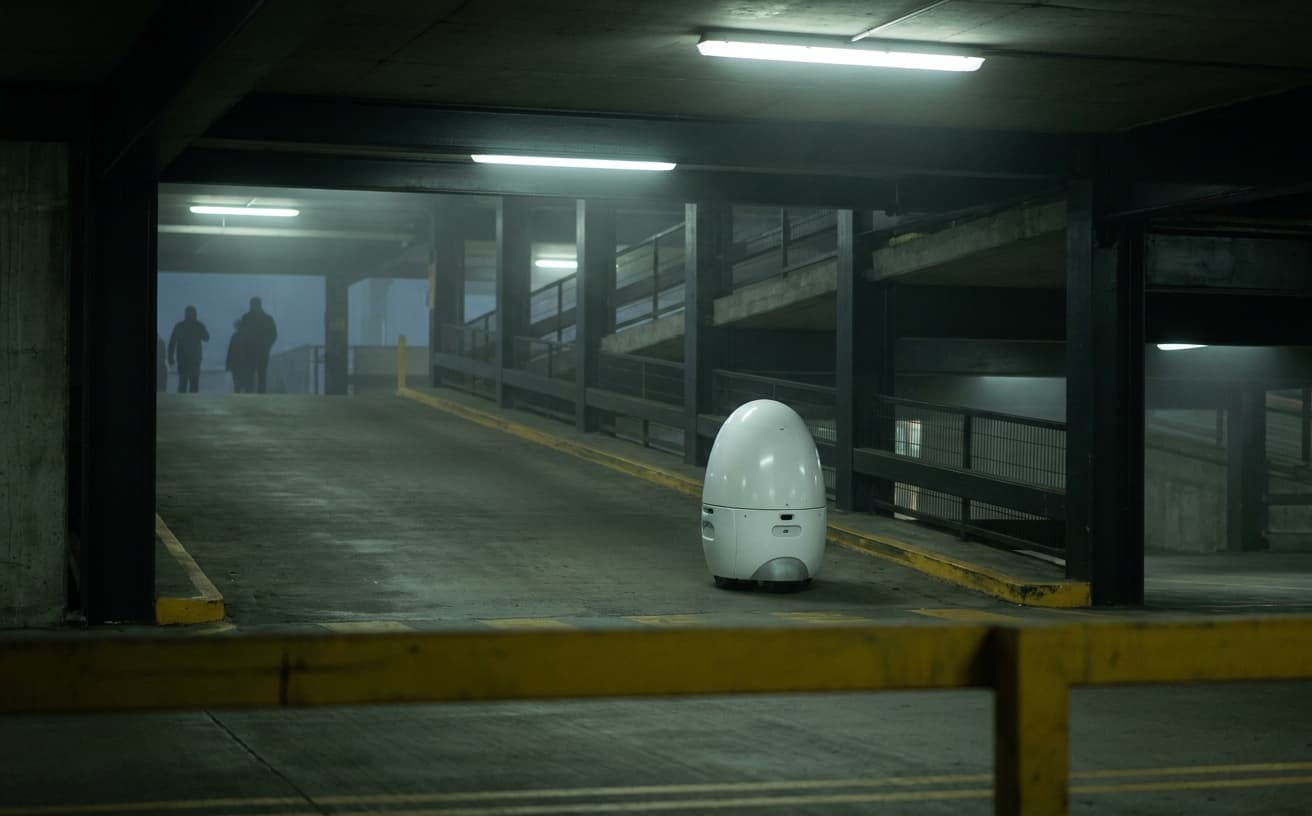
The K5 from Knightscope is the most photographed object in the recent history of physical security. Shopping mall operators have posed next to it. Police chiefs have been quoted near it. Television crews have followed it through parking garages. Its egg-shaped silhouette has done more for the public idea of an autonomous guard than any white paper produced in the last decade. And yet the company that builds it has, across more than a decade of operation, never delivered the kind of unit economics that a manufacturer of capital goods is expected to deliver. The reading offered here is not hostile. It is structural. The K5 deserves the credit it gets for user experience, in a precise sense of that term, and the criticism it gets for return on capital, in a precise sense of that one.
The point is that these two judgments belong to the same machine, and that operators who confuse them will buy the wrong thing for the wrong reason, or, worse, refuse to buy any robot at all because one company's filings have created a mood. A serious manufacturer reads the K5 the way a serious civil engineer reads a collapsed bridge. Not as a verdict on bridges. As a lesson on load.
What the K5 got right about user experience
The K5 was designed for a non-technical audience. That is the first thing that has to be said, and it has to be said before anything about cost, margin or churn. The form factor is approachable in a way that almost no industrial sensor platform manages. It is roughly the height of a person, it has rounded surfaces, it carries no visible weapon mount, and it moves at a speed that does not threaten the people around it. Children take pictures with it. Shoppers walk around it without instruction. Security officers who have never seen a robot in their lives can describe what it does after watching it for thirty seconds. This is not a small achievement, and it is the part of the Knightscope story that competitors quietly copy.
The interaction model is similarly deliberate. The K5 communicates through light, sound, a small screen and a clearly marked call button. An operator at a remote console can speak through it. A passerby can press to be connected. The relationship between the machine and the surrounding humans is legible without a manual, and legibility is the first economic property of any security tool that has to function in front of the public. CISA guidance on physical security and ASIS International benchmarks both, in different language, point to the same idea. A control that is not understood is not a control. The K5, whatever else may be said about it, is understood.
The siting decisions are sound as well. Knightscope correctly identified parking structures, hospital campuses, retail centers and public-facing corporate lobbies as the environments where a slow-moving, highly visible patrol unit would do real psychological work. NICB data on opportunistic vehicle crime and the documented behavior patterns around exposed parking show that deterrence in those environments is largely a function of perceived observation. A K5 rolling through a garage at three in the morning, lit, audible, recording, does the thing that a static camera on a pole does not do. It moves, which means that an offender has to model it. Modeling is friction. Friction is deterrence. The user experience design, from form to siting to interface, is the part of the K5 that any manufacturer entering this market should study without embarrassment.
What the K5 got wrong about unit economics
The economic structure of the K5 program, as disclosed in Knightscope's public filings since its direct listing, tells a less generous story. The company sells the machine as a service, under the term Machine-as-a-Service, at annual subscription rates that have moved over time but have generally sat in the range of seventy to one hundred and twenty thousand US dollars per unit per year, depending on configuration and contract length. That figure, taken alone, looks competitive against a twenty-four hour guard post in a high cost metropolitan market, where fully loaded guard hours in the United States run between thirty and sixty dollars and a single round-the-clock post can clear a quarter of a million dollars annually. The pitch writes itself. One robot, one third the cost, no sick days.
The pitch does not survive contact with the cost stack. Knightscope's filings have repeatedly shown gross margins that are thin or negative on the service line, with cost of revenue at or above subscription revenue in several reporting periods. The reasons are not mysterious. The K5 carries non-trivial hardware cost. It requires charging infrastructure, which is also hardware. It requires a network operations center staffed around the clock, because the machine is not autonomous in the strong sense of that word and depends on remote human operators to handle exceptions, edge cases, calls and incidents. It requires field service, because devices in the wild get bumped, vandalized, soaked, and stuck. It requires deployment engineering, because each site has its own map, its own no-go zones, its own elevator interactions, and its own integration with the client's existing security operations. None of this scales the way a software business scales. All of it accumulates per unit, every year, for the life of the contract.
The result is a company that has, across multiple fiscal years, reported operating losses larger than its revenue. That is not a temporary distortion of an early stage business. It is a structural signal that the unit economics, at the price points and cost stack disclosed, do not close. A manufacturer reading the filings sees three problems. First, the service model puts capital expense on the manufacturer's balance sheet without giving the manufacturer pricing power to recover it. Second, the human-in-the-loop requirement converts what was sold as automation into a hybrid labor model whose savings against a guard post are smaller than the marketing suggests. Third, churn and downtime, which are not always cleanly disclosed but which can be inferred from the gap between cumulative deployments and active units, erode the lifetime value of each contract in ways that compound. The K5 is, in this reading, an excellent product attached to a difficult business model. The two should not be conflated.
The honest comparison against a human guard
The question that operators actually ask, security robot versus guard ROI, deserves a sober answer rather than a marketing one. A single unarmed guard post in the United States, staffed twenty-four hours a day, seven days a week, costs an operator somewhere between one hundred and eighty thousand and three hundred thousand dollars per year, depending on geography, contract structure, overtime exposure and the licensing regime of the state in question. That figure is rising, not falling, because the labor market for guards is tight and because turnover in the industry, documented for years by trade associations and by GDV-equivalent insurance bodies in Europe, runs well above one hundred percent annually in many segments. The guard you train this quarter is not the guard you have next quarter. The replacement cost is real, and it is rarely booked against the line item that pays for it.
Against that, a security robot, whether a K5 or a competitor's platform, has to clear three hurdles to be the better economic choice. It has to cost less, on a fully loaded basis, than the guard post it displaces or supplements. It has to deliver equivalent or better detection and deterrence, measured against incident counts and not against feelings. And it has to do both of those things for long enough that the capital cost, financed or amortized, is recovered before the platform is retired or refreshed. NIST CSF 2.0 and IEC 62443, applied to the cyber-physical layer of these systems, add a further constraint. The platform must remain securable across its operational life, which is not a free assumption when firmware support windows in this category have historically been short.
The honest answer is that a robot replaces a fraction of a guard post, not a whole one, in most environments. It extends the reach of an operator who can monitor several sites at once. It absorbs the routine patrol that the guard would otherwise perform unevenly. It does not handle the access control exception, the medical call, the verbal de-escalation, the physical intervention. The economics close when the robot is priced to reflect that fractional substitution, and when the surrounding human layer is reorganized to take advantage of the reach it provides. The K5 has often been sold, implicitly, as more than that fraction, and the gap between the implicit promise and the delivered reality is where customer disappointment, and the company's revenue volatility, has lived.
The lessons a manufacturer should take
A manufacturer reading the K5 arc has, by the author's reckoning, four lessons to extract and one trap to avoid. The first lesson is that interface design matters more than feature lists. The K5 won shelf space, mind share and pilot contracts because operators and the public could read it. Any platform that requires a training day before a site supervisor can describe what it does has already lost the deployment that the K5 won. BOSWAU + KNAUER. From Building to Security Technology, develops this point at length in the chapters on the shift from executor to manufacturer. A device that is not legible to the foreman at the gate is not a product. It is a prototype.
The second lesson is that the service model is not a free lunch. Selling hardware as a subscription transfers capital risk from the customer to the manufacturer, which is attractive in a presentation and punishing on a balance sheet if the cost stack is not engineered for it. A manufacturer that takes this path has to price for the field service, the network operations center, the firmware lifecycle, the insurance, and the cost of money, and has to do so without losing the price advantage that justified the model in the first place. Knightscope's filings suggest that this engineering was incomplete. Anyone copying the model should complete it before signing the first contract.
The third lesson is that autonomy is a regulated and bounded claim. The K5 is not autonomous in the strong sense, and no commercially viable security robot today is. The honest architecture is a controlled autonomy in which the machine handles routine, escalates exceptions, and documents both in a structure that is auditable under NIST 800-53 and ISO 27001 control families. Marketing that overstates the autonomy invites both customer disappointment and regulatory attention, and BSI guidance on operator responsibility in cyber-physical systems is becoming sharper on this point, not softer.
The fourth lesson is that deterrence is real and measurable. The K5 has produced documented reductions in vehicle crime, loitering and after-hours incidents in specific deployments. Operators should not abandon the category because one company's economics have struggled. They should buy with sharper questions and at honest prices.
The trap to avoid is the assumption that because the K5 is famous, it is the benchmark. It is not. It is the first widely visible attempt at a category that will mature past it. Treating it as the ceiling is a category error.
What the filings actually say, read carefully
Public filings are an underused resource in this discussion. Knightscope's prospectus materials and subsequent quarterly disclosures contain, between them, most of what an operator needs to assess the program without relying on either the company's marketing or the press coverage that surrounds it. The disclosures show revenue growth that has been uneven, gross margins that have struggled to turn meaningfully positive on the service line, accumulated deficits that have grown across the period of public reporting, and a pattern of capital raises that have been progressively more dilutive. None of this is a moral failing. All of it is a description of a company that priced an offer ahead of the cost base required to deliver it.
The deployment figures, read alongside the revenue figures, suggest an average revenue per active unit that has not consistently covered the cost of operating that unit. The company has, at various points, restructured its sales motion, adjusted its pricing, and pursued government and law enforcement contracts as a route to larger anchor deployments. These are reasonable responses to a hard situation, and the company's persistence over more than a decade is itself a data point about the difficulty of the category. A more capitalized entrant with a cleaner cost stack could read these filings as a map of what not to repeat. The map is free. It is in the public record. Operators evaluating the category should read it before they read any vendor's slide deck, including this manufacturer's.
The further point, which operators sometimes miss, is that the filings also tell a story about customer behavior. Renewals, expansions and the silent attrition of pilots that did not convert are visible, if indirectly, in the gap between cumulative contract announcements and current active fleet. That gap is the most important number in the document, and it is the one the press has covered least.
What holds
The K5 is a UX miracle because it solved the problem of public legibility in a category that had previously failed at it. The K5 is an ROI tragedy because the business model attached to that product did not engineer the cost stack required to deliver it profitably at the prices the market would pay. Both statements are true at the same time, and operators who hold them together will make better decisions than operators who pick one and ignore the other.
For the operator in a parking structure, a hospital campus, a logistics yard or an industrial site, the practical conclusion is that security robots belong in the toolkit, that they substitute for a fraction of a guard post rather than the whole, and that the right way to price the substitution is against honest local guard costs, honest incident data, and an honest assessment of the surrounding human layer required to make the deployment work. The wrong way is to take the marketing at face value, on either side, and to either over-buy or refuse to buy on the basis of someone else's story.
For the manufacturer, the conclusion is harder. The category will mature. The companies that mature with it will be the ones that priced for the cost stack, designed for legibility, were honest about autonomy, and built a service organization that could carry the weight that the subscription model placed on it. BOSWAU + KNAUER builds in that direction, and the three formats through which operators engage with this work, a sixty-minute confidential conversation, a structured three-to-five-day audit, or a ninety-day pilot at a single defined site, exist precisely so that the economic questions can be answered before the hardware is bought. The audit, in particular, is where the comparison between a robot, a guard post, a video tower and a hybrid configuration is settled on the operator's numbers, not on anyone's slide.
Frequently asked questions
What is the actual ROI of a security robot in the United States?
The honest range, based on documented deployments and public filings across the category, is that a security robot at typical subscription pricing of seventy to one hundred and twenty thousand US dollars per year displaces between one third and two thirds of a twenty-four hour unarmed guard post in a high cost metropolitan market. Payback against the displaced labor cost is realistic within twelve to twenty-four months if the surrounding operator layer is reorganized to use the robot's reach. Payback does not occur if the robot is added on top of unchanged guard staffing without operational redesign.
How does the K5 compare to a human security guard on cost?
A K5 subscription has historically priced below a twenty-four hour guard post in expensive labor markets and at parity or above in inexpensive ones. The comparison is misleading without two adjustments. The robot does not perform the full scope of a guard's duties, particularly verbal de-escalation and physical intervention, so the substitution is fractional. The guard cost should be loaded with turnover, training, insurance and overtime exposure, which often raises the true figure thirty to fifty percent above the headline hourly rate. Once both adjustments are made, the comparison is closer than either side typically claims.
Why has Knightscope struggled with profitability?
Public filings show three structural reasons. The Machine-as-a-Service model places hardware capital on the manufacturer's balance sheet without commensurate pricing power. The requirement for a twenty-four hour network operations center and field service organization converts the offer into a hybrid labor business with costs that do not scale like software. And gross margins on the subscription line have remained thin or negative across multiple reporting periods, which combined with growth investment has produced sustained operating losses and dilutive capital raises. The product is not the problem. The business model attached to it is.
What does the K5 do well that competitors copy?
Three things, consistently. The form factor, which is approachable to the public and legible to non-technical staff without training. The interface model, built around light, sound, a screen and a clear call button, which makes the interaction understandable in seconds. And the siting strategy, which targeted parking structures, hospital campuses and retail environments where slow, visible, recording patrol does measurable deterrence work. Competitors entering the category have, in different combinations, copied all three. The parts of the K5 worth copying are the parts that the filings do not capture, because they are design decisions rather than line items.
Related topics
- Security Robots in the UAE: SIRA Licensing
- Security Robots in Smart Districts: Msheireb Doha
- Security Robots in Kuwait, Bahrain & Oman
- Security Robots in the Aramco Supply Chain
- All-Weather Security Robots: What Outdoor Rated Means
Take the next step: See prices & ROI · Explore the products · Send a no-obligation request. BOSWAU + KNAUER – direct from the factory in Filderstadt, reply within 5 working days.
About the author
Dr. Raphael Nagel (LL.M.) is founding partner of Tactical Management. He acquires and restructures industrial businesses in demanding market environments and writes on capital, geopolitics, and technological transformation. raphaelnagel.com
More reading

Since 1892.
The firm is reached at boswau-knauer.de or +49 177 2266267.