
Blog
Layered Perimeter Security on an Industrial Site
Four layers, four jobs, one logic. We describe a perimeter architecture you can actually buy, deploy, and verify.

Dr. Raphael Nagel
December 17, 2025
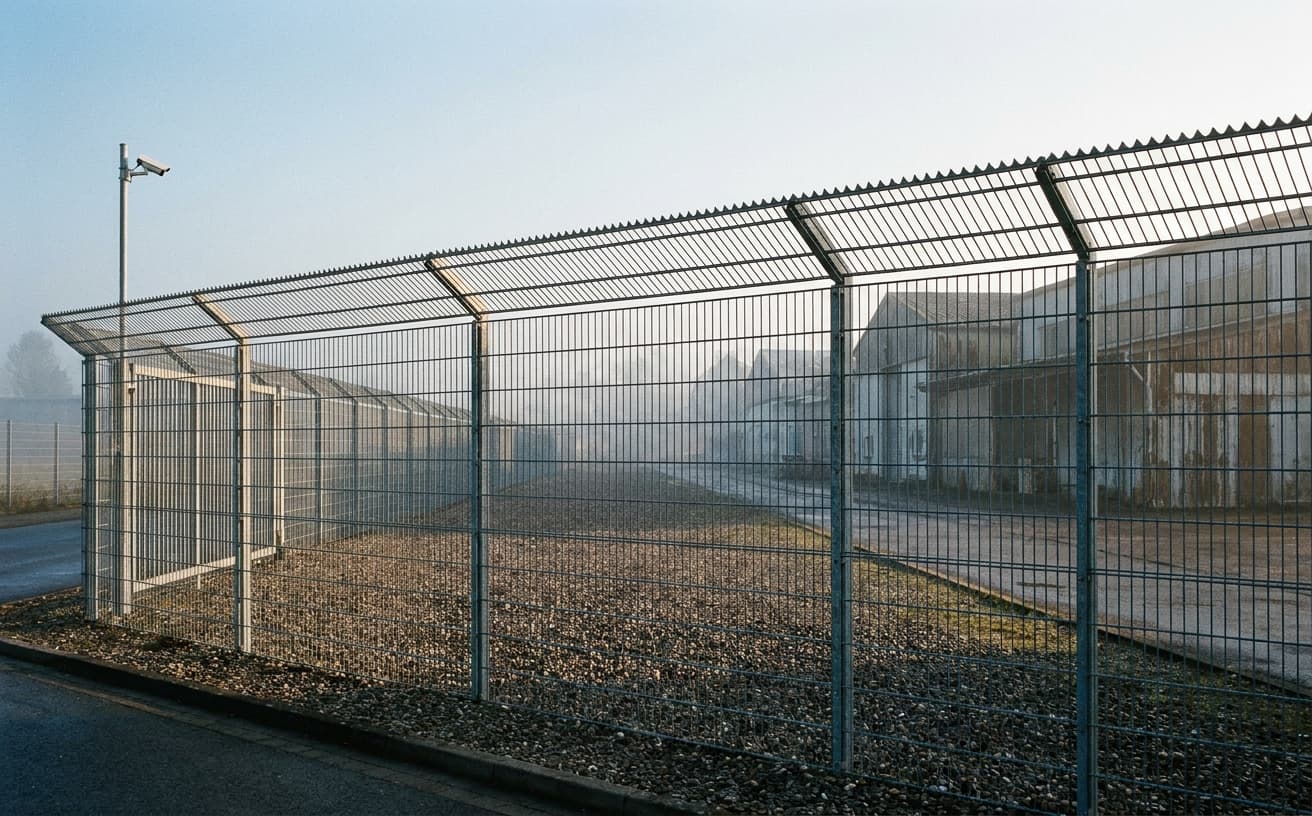
Perimeter security on an industrial site is not a fence with cameras attached. It is an architecture of four layers, each with a defined job, each dependent on the next, each verifiable on its own terms.
The word "perimeter" has been diluted to the point of uselessness. Vendors apply it to anything that sits at the edge of a property line, from a chain-link fence to a thermal camera bracketed onto a light pole. That usage obscures the only question that matters in planning: what is each component supposed to detect, deter, delay, or deny, and how does it hand over to the next layer when its own job is done. A perimeter without that hand-over logic is a collection of devices billed as a system. The distinction matters because procurement budgets in this segment routinely run into seven figures, and the operators who sign the orders rarely receive a document that explains how the parts depend on one another.
The architecture set out below has four layers. It is the same architecture Boswau + Knauer deploys on construction sites that mature into industrial sites, and on industrial sites that were never anything else. The reference frame is NIST CSF 2.0 for governance and detection, IEC 62443 for any layer that touches operational technology, and ISO 27001 for the data side. Where these standards are silent on physical work, ASIS International guidance and the practical experience documented in BOSWAU + KNAUER. From Building to Security Technology fill the gap.
Layer one: deterrence and the outer envelope
The outermost layer does one job. It signals to anyone approaching the site that the property is observed, that entry will be detected, and that the cost of attempting unauthorized access is higher than the expected gain. This is the layer that prevents the vast majority of incidents, because the vast majority of incidents are opportunistic rather than planned. CISA's guidance on physical security baselines repeats this point in different language: visible deterrence shifts the population of potential intruders from casual to determined, and the determined group is small enough to handle with the inner layers.
The components at this layer are a properly specified fence, lighting tuned to eliminate shadow corridors rather than to flood the entire site, signage that names the operator and the fact of monitoring without revealing the monitoring architecture, and a clean sight line maintained through vegetation management. A fence that is not maintained tells a story. A fence that is maintained, lit, and signed tells a different story. The choice of which story to tell is the first design decision.
The mistake operators make at this layer is to treat it as cosmetic. A fence specified at the wrong height, with the wrong mesh pattern, or with anchoring that allows lift-and-crawl access, does not deter. It merely documents that the operator considered deterrence and stopped before completing it. The German insurance association GDV publishes statistics that correlate fence specification to claim frequency on industrial sites, and the correlation is not subtle. A fence that meets a recognised resistance class reduces opportunistic loss by a margin that pays for the difference in specification within a single year on most sites.
The dependency from layer one to layer two is straightforward. Deterrence must be visible enough to discourage casual entry and quiet enough not to broadcast where the next layer of detection sits. Lighting must illuminate the approach without blinding the cameras that watch it. Signage must warn without naming the sensor types. The outer envelope sets up the inner work without exposing it.
Layer two: detection and classification
The second layer detects entry and classifies what entered. Detection without classification is a nuisance alarm generator. Classification without detection is a dashboard. The two functions belong together, and they must execute in the seconds between a perimeter breach and the moment a human operator can be expected to respond.
This is the layer where sensor diversity earns its cost. A single technology produces predictable false positives. A fence-mounted vibration sensor reacts to wind and to wildlife. A thermal camera reacts to small mammals at close range. A radar reacts to vegetation movement in storms. None of these technologies is wrong. Each is incomplete. The detection layer must combine at least two independent sensing modalities and confirm an event on both channels before it escalates. This multi-channel rule is the single largest contributor to a workable false-alarm rate, and it is the rule most often violated by integrators who buy on unit price.
Classification sits on top of detection. A trained model distinguishes a person from a deer, a service vehicle from an unknown vehicle, a maintenance crew on the schedule from an arrival outside the schedule. The models that do this work are not general intelligence. They are specialised classifiers trained on data that resembles the site in question. Generic models trained on retail or traffic data perform poorly on industrial perimeters because the background distribution is wrong. Operators who buy classification as a feature without asking what data the model was trained on are buying a promise rather than a function.
The standard reference for the cyber side of this layer is IEC 62443, particularly the requirements around zone and conduit separation. Detection devices that share a network segment with production control systems create attack paths that did not exist before the perimeter was upgraded. The architecture must place detection on its own segment, with defined conduits to the monitoring layer above, and with no routing into the operational technology environment. This separation is not optional. NIST 800-53 control families AC and SC describe the same principle in different language.
The dependency from layer two to layer three is the alarm itself. A classified detection produces an event with enough metadata for the next layer to act on it. The metadata includes location, time, sensor confidence, classification, and a reference to the video and sensor records that support the classification. Without this packet, the response layer is reacting to a beep.
Layer three: response and the operator loop
The third layer is the human and the tools the human uses. This is the layer most often under-specified because it is the layer that operators believe they already have. They have a guard service, or a control room, or a contracted monitoring centre, and they treat that as the response layer. In most cases it is not. It is a receiver of alarms, not a response capability.
Response begins with verification. An operator receives the event packet from layer two and verifies the classification against the supporting video and sensor data within seconds. Verification produces one of three outcomes: false positive, low-priority event, or actionable event. Each outcome triggers a different workflow. False positives are logged for model retraining. Low-priority events are recorded and reviewed in batch. Actionable events trigger the response chain, which includes dispatch of mobile units, notification of named personnel, escalation to police where the threshold is met, and activation of any layer-four delay measures that are appropriate to the threat.
The operator loop has timing requirements that operators rarely measure. From event detection to verification, ten seconds is achievable with current technology and a properly staffed control room. From verification to dispatch, sixty seconds is achievable. From dispatch to on-site response, the time depends on geography and on whether the dispatched unit is a mobile patrol, a robotic platform, or a contracted response service. These three intervals together determine whether the perimeter actually works as a system or only as a record-keeping function. An operator who cannot state these three numbers for the current installation does not have a measured perimeter.
Robotics enters this layer as a force multiplier rather than a replacement. A robotic platform on patrol can verify a layer-two alarm in seconds by moving to the location and providing a second optical and thermal channel under operator control. The robot does not decide. It extends the operator's reach. This distinction matters legally and operationally. Decision authority remains with the human, while the human's effective perimeter coverage grows by a factor that depends on site geometry and on the number of platforms deployed. On a typical industrial site of fifty to one hundred hectares, two platforms allow one operator to maintain coverage that previously required four to six guards on rotation.
The dependency from layer three to layer four is the delay request. When an actionable event is confirmed and response is in motion, the operator triggers the measures at layer four that buy time for response to arrive. The trigger is a command, not an assumption.
Layer four: delay and denial at the asset
The innermost layer protects the assets that matter, on the assumption that all the outer layers have already failed or have been bypassed. This is the layer most often described as physical security in the narrow sense: hardened doors, reinforced enclosures, locked cages around high-value equipment, safes for documents and data carriers, and access controls that distinguish between zones inside the site.
The job of this layer is to delay an intruder for long enough that the response from layer three arrives before the asset is removed or damaged. The delay specification is therefore a function of the response time. If response arrives in four minutes, the delay measures must hold for at least six. If response arrives in fifteen minutes, the delay measures must hold for at least twenty. Operators who specify layer four without measuring layer three produce installations that either over-invest in hardening or under-invest in it, and both errors cost.
The BSI publishes resistance class definitions for doors, windows, and enclosures that translate directly into delay times under defined attack profiles. Class RC3 holds against a casual attacker with hand tools for approximately five minutes. Class RC4 holds for approximately ten. Class RC6 holds for approximately twenty against a determined attacker with power tools. These are not marketing numbers. They are tested intervals from accredited laboratories, and they form the basis on which insurance pricing for industrial property is calculated. The GDV references these classes directly in its underwriting guidance.
Access control inside the site is the second half of this layer. Zones are defined by what they contain, not by where they sit on the floor plan. A document storage room and a server room may be in different buildings but in the same zone if they hold equivalent classes of asset. Access to each zone is logged, time-bounded, and tied to identity rather than to a generic credential. The NIST 800-53 controls in the AC family describe this principle in detail. The implementation on an industrial site uses card or biometric systems, depending on the threat model and on the workforce constitution. Card systems are easier to manage and easier to defeat. Biometric systems are harder to defeat and harder to manage. The choice is a function of the asset value and the operator's appetite for administrative overhead.
Sizing each layer to the actual risk
The four layers are not equal in cost or in attention. Sizing is the design decision that determines whether the budget produces a system or a collection. Sizing is driven by an honest assessment of what the site contains, what an intruder would want, what the attacker profile looks like, and what the operator can absorb in loss without consequence.
A site that stores commodity raw materials has a different threat profile than a site that holds intellectual property in physical form, and both differ from a site that contains process control systems whose disruption would halt production. The first site can tolerate a strong layer one and a moderate layer four. The second requires a strong layer four regardless of the other layers. The third requires strong layers two and three because the threat is disruption rather than theft, and disruption is fast.
The sizing exercise produces a risk-adjusted budget allocation across the four layers. A typical allocation on a medium-complexity industrial site, in the experience documented across the relevant chapters of the work referenced above, runs approximately twenty percent of capital expenditure to layer one, thirty-five percent to layer two, fifteen percent to layer three in technology terms with the operating cost separate, and thirty percent to layer four. These ratios shift substantially based on the asset profile and on what the operator already has in place. They are not a formula. They are an anchor against which proposals can be tested.
The audit that produces these ratios is the work of three to five days on site, with access to incident history, insurance documentation, existing system documentation, and the asset register. Without those inputs the sizing exercise is guesswork. With them it is a defensible engineering decision.
What holds
Four layers, four jobs, one logic. Deterrence reduces the population of intruders. Detection identifies and classifies those who enter despite the deterrence. Response verifies and acts on the classified events. Delay holds the asset until response arrives. Each layer depends on the next. Each can be specified, deployed, and tested on its own. None of them substitutes for the others.
The architecture is buildable. The components exist, the standards are published, and the integration patterns are documented. What is rarely present in the field is the discipline to size each layer to the actual risk rather than to vendor catalogues, and the willingness to measure response times honestly rather than to assume them. The architecture works when it is sized, deployed, and verified. It fails when it is bought.
For operators who suspect their current installation is a collection rather than a system, the next step is a sixty-minute confidential conversation that maps the four layers against the current state and identifies the largest gap. For those who already know where the gap sits, the three to five day audit produces a sized, costed, and scheduled remediation plan. Both paths are described in the closing sections of BOSWAU + KNAUER. From Building to Security Technology, alongside the ninety-day pilot that demonstrates the architecture on a single defined standort before any decision on scaling.
Frequently asked questions
What are the four layers of an industrial perimeter?
The four layers are deterrence, detection and classification, response, and delay and denial. Deterrence is the outer envelope of fence, lighting, signage, and sight lines that discourages casual entry. Detection identifies and classifies entries that occur despite deterrence, using at least two independent sensor modalities and a trained classifier. Response is the operator loop that verifies alarms and dispatches the appropriate intervention. Delay protects the assets themselves through hardened enclosures and zone-based access control. Each layer hands over to the next through defined data and command flows, not through assumptions.
How do you size each layer for risk?
Sizing begins with the asset profile. What does the site contain, what would an intruder want, what is the realistic attacker capability, and what is the operator's tolerance for loss and disruption. Those four inputs produce a risk-adjusted allocation across the layers. A site that holds commodity materials weights layer one heavily. A site that holds intellectual property or process control systems weights layers two, three, and four. The sizing exercise requires incident history, insurance documentation, and the asset register. Without those inputs it is guesswork, and guesswork in this segment is expensive.
What is the role of robotics in a layered model?
Robotics sits in layer three as a force multiplier for the response operator. A robotic platform on patrol verifies layer-two alarms by moving to the location and providing a second sensor channel under operator control. The robot extends the operator's effective coverage without replacing the operator's decision authority. On a typical industrial site of fifty to one hundred hectares, two platforms allow one operator to maintain coverage that previously required four to six guards. The robot does not decide. It carries the operator's attention to where it is needed.
How is the model audited?
The audit is a three to five day engagement on site that examines each layer against its job and against the dependencies to the adjacent layers. The deliverables are a standort description with a documented gap catalogue, an incident history of the previous twenty-four months where reconstructable, a cost-benefit analysis in three scenarios, a prioritised recommendation matrix, an implementation plan with milestones, and a transparent record of the assumptions on which the conclusions rest. The audit references NIST CSF 2.0, IEC 62443 where operational technology is in scope, ISO 27001 for the data side, and BSI resistance classes for layer four.
Related topics
- Security as Code: Platform Thinking for Physical Defense
- Perimeter Security Systems: The Seven-Layer Model
- Industrial Perimeter Security: Architecture Layered for Cost
- Industrial Fencing Standards: EN 1717, EN 1090 in Practice
- Building a UK Industrial SOC: TUPE, SIA & Living Wage Math
Take the next step: See prices & ROI · Explore the products · Send a no-obligation request. BOSWAU + KNAUER – direct from the factory in Filderstadt, reply within 5 working days.
About the author
Dr. Raphael Nagel (LL.M.) is founding partner of Tactical Management. He acquires and restructures industrial businesses in demanding market environments and writes on capital, geopolitics, and technological transformation. raphaelnagel.com
More reading
Since 1892.
The firm is reached at boswau-knauer.de or +49 177 2266267.