
Blog
Mobile CCTV Towers: What 70% of Buyers Regret
A buyer-side autopsy of mobile CCTV tower procurement. The four buying mistakes that show up after six months, and how to avoid them.

Dr. Raphael Nagel
January 21, 2025
Most regret around mobile CCTV towers is not technical. It is contractual.
The hardware on the market is, with a few exceptions, broadly comparable. Sensors come from the same handful of suppliers. Masts come from a smaller handful. Solar panels and batteries are commodities. What distinguishes the buyer who is satisfied after six months from the buyer who is not, is rarely the chassis on site. It is what was signed before the chassis arrived, what was understood about the alarm chain behind it, and what was assumed about who would actually look at the images at three in the morning.
A survey of post-installation conversations across construction sites, logistics yards and industrial perimeters shows the same pattern repeating. The buyer chose a tower based on its specification sheet. Six months later, the tower is still standing, the specification sheet is still accurate, and the buyer is still dissatisfied. The fault line lies somewhere else, and the purpose of this article is to draw it precisely.
What a mobile CCTV tower actually is
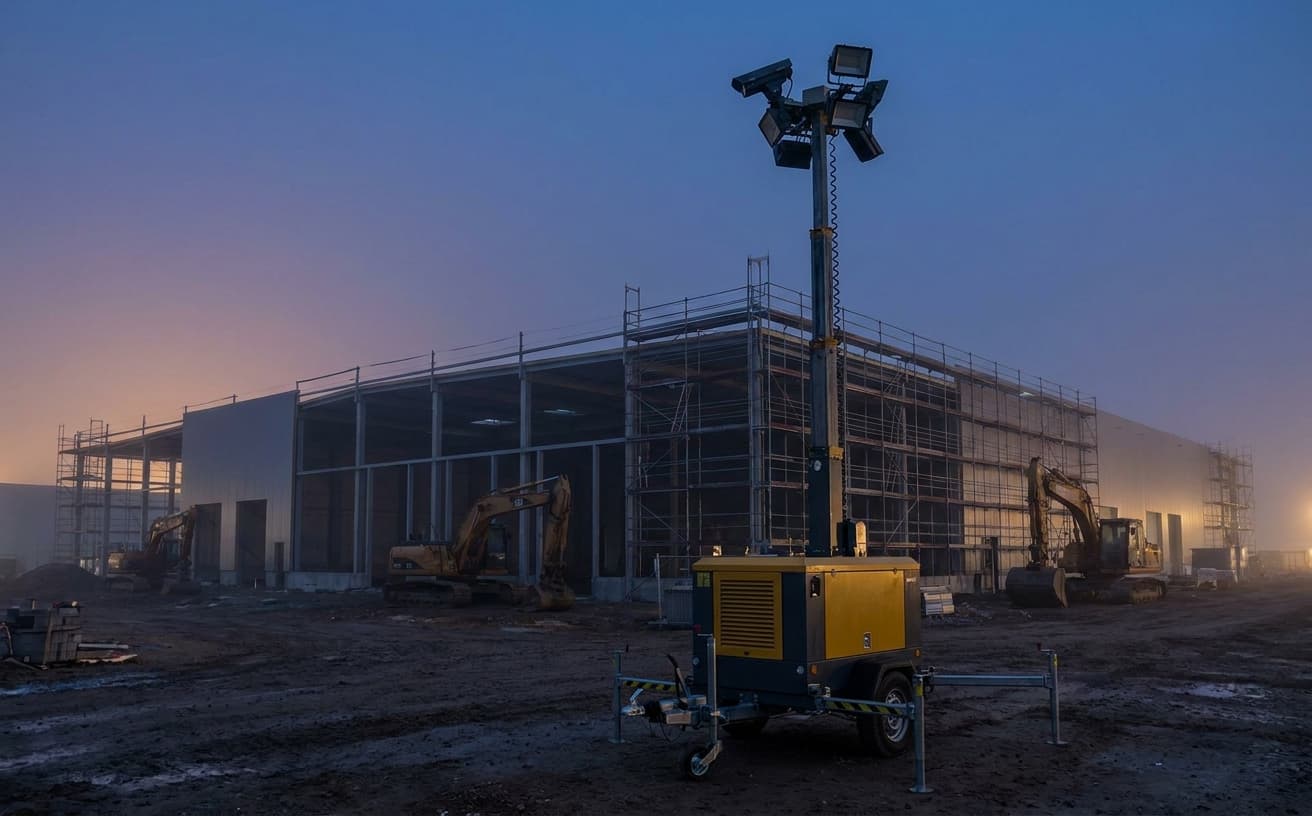
A mobile CCTV tower is a self-contained, relocatable surveillance unit combining a telescopic mast, multiple cameras, edge processing capability, autonomous power supply and a communication channel to a monitoring centre or alerting infrastructure. The device is designed to be deployed in hours rather than weeks, to operate without mains connection, and to provide overlapping fields of view that compensate for the absence of fixed installation. That is the definition. Almost everything sold under the label complies with it. Almost nothing sold under the label delivers what buyers expect from it.
The expectation gap begins with the word surveillance. In conventional usage, surveillance implies that someone watches. A mobile tower in standalone configuration does not generate watching. It generates footage. Whether that footage triggers a response, and how quickly, is a function of the alarm chain, not of the tower itself. Buyers who do not separate these two layers in their procurement specification end up with a tower that records the incident faithfully and arrives at no consequence. The footage is then submitted to the insurer, the deductible is paid, and the buyer concludes that mobile CCTV does not work. The conclusion is wrong. What did not work was the chain in which the tower was the smallest, and probably the least important, component.
Standards exist that frame this distinction. IEC 62443 treats the surveillance system as part of an industrial control environment with defined roles, zones and conduits. NIST CSF 2.0 in its detect and respond functions makes clear that detection without a binding response procedure is incomplete. ISO 27001 anchors monitoring within a management system, not within a device. ASIS International publications on physical security have for years separated deterrence, detection, delay and response into distinct layers. A mobile tower, however well specified, sits in the detection layer. It does not, on its own, occupy the other three. Procurement that pretends otherwise is procurement that will be regretted.
The first regret. Buying the chassis instead of the service
The most common procurement mistake is to evaluate mobile CCTV towers as if they were vehicles. Buyers compare mast height, camera resolution, battery autonomy, panel capacity, ingress protection rating, thermal optics and analytics packages. They build a matrix. They award to the highest column total or the lowest price within an acceptable range. Six months later, the matrix is forgotten and the question is whether the device generates outcomes.
Outcomes do not come from the chassis. They come from the service that surrounds it. A tower with mid-range cameras, mid-range optics and a well-designed alarm chain outperforms a flagship tower with no monitoring contract behind it, in every measurable dimension. Time to first verified detection, time to dispatch, time to intervention, number of confirmed incidents, percentage of incidents leading to apprehension or prevention. The chassis contributes to these metrics at the margin. The service constructs them.
The asymmetry is explained by how the operator at the receiving end works. A mobile tower in a monitored configuration sends alerts to a control room operating to defined service levels. The operator verifies the alert visually, classifies it, escalates if necessary, dispatches a patrol or contacts law enforcement. Every minute of this chain is either contracted or not contracted. If the chain is not contracted, no specification on the tower can compensate. If the chain is well contracted, even a modest tower delivers. Buyers who internalise this rebalance their procurement weight from hardware to service, and discover that the cost of the service is far lower than the cost of the next hardware upgrade they were about to make.
There is a related error. Buyers ask for the tower to include AI analytics, presuming that the analytics will replace the human operator. They will not. The published false alarm rates of edge analytics under realistic conditions, with shadows, weather, fauna and partial occlusion, are not low enough to act unmediated. Analytics filter, they do not decide. The decision belongs to the operator, the procedure and the contract. A buyer who pays a premium for analytics and saves on monitoring has compounded both errors.
The second regret. Contract length and what it hides
The second pattern of regret concerns the duration of the contract. Buyers on construction sites tend to negotiate short, project-bound terms, often three to six months, sometimes extended ad hoc. Buyers in industry and logistics tend to sign long terms, twenty-four or thirty-six months, on the assumption that long means cheap. Both extremes contain a trap.
The short term trap is rotation cost. Each redeployment carries fixed labour, transport, configuration and commissioning costs that, on a project basis, swallow the apparent discount. A tower contracted for four months and redeployed twice within that period to follow phasing of the site has, on average, a cost per protected day twenty to forty percent higher than a tower on a steady twelve-month engagement. Construction buyers who insist on project-bound contracts are often paying for a flexibility they do not use, because the sites do in fact require continuous protection through the construction sequence.
The long term trap is technological lock-in. A twenty-four month contract signed in the current generation of analytics will, by month eighteen, be running on a model that the provider considers legacy. Updates may or may not be included, depending on the wording. Replacement of the hardware may or may not be included. Migration to a successor platform may or may not be priced. Buyers who treat the contract as a fixed price for a fixed service discover that the service quietly degrades while the price stays fixed. The provider has not breached anything. The contract simply did not anticipate the rate of change.
A defensible contract length sits between these extremes and contains explicit clauses on technology refresh, false alarm tolerance, monitoring service levels, redeployment rates within the contract, and termination conditions for performance shortfall. The German insurance industry's general guidance, as reflected in publications associated with the GDV, points repeatedly to the relationship between contracted service levels and actual claims experience. The contracts that produce the lowest claims are not the longest or the shortest. They are the ones that bind the provider to outcomes, not to the presence of a tower.
The third regret. The monitoring question
The third pattern of regret is the most expensive, because it shows up in incident reports rather than in invoices. Buyers assume that someone is watching. In a meaningful percentage of installations, no one is. The cameras record, the system stores, the analytics process, and the alerts, if generated, arrive at an address that is not staffed at the relevant hours. The buyer discovers this only when an incident occurs and the footage is reviewed retrospectively.
Monitoring is not implicit in the supply of a mobile CCTV tower. It is a separate service, typically provided either by the tower vendor through an affiliated control room, or by an independent security company contracted in parallel, or, in some configurations, by the buyer's own internal security organisation. Each model has consequences. The vendor-affiliated control room offers tight integration and a single point of accountability, at the cost of bundling that can obscure pricing. The independent contractor offers competitive pricing and clean separation, at the cost of integration friction. The internal organisation offers the highest control, at the cost of staffing levels that few non-security companies can sustain economically.
What matters is that the buyer states the model explicitly, contracts to defined service levels, and audits compliance. Service levels worth contracting include time from alert to verification, time from verification to dispatch decision, time from dispatch decision to arrival on site, percentage of alerts verified within target time, percentage of alerts escalated correctly, monthly false alarm rate per camera, and quarterly reporting cadence. CISA's guidance on physical security monitoring, while framed for critical infrastructure, applies in substance to any continuously monitored perimeter. The principle is the same. If it is not measured, it is not happening reliably.
The NICB has documented, in the context of equipment theft from construction sites, that recovery rates correlate strongly with intervention speed in the first hour after the incident. A mobile tower contributes to that hour only if the chain behind it functions. Buyers who allocate procurement attention proportionally to incident-relevant time discover that the monitoring contract deserves more scrutiny than the tower specification.
The fourth regret. Cybersecurity and data governance
The fourth regret arrives later than the others, often only when an audit is conducted or a security incident triggers an inquiry. The mobile CCTV tower, in modern configuration, is a connected device. It transmits video, receives commands, accepts firmware updates, and exchanges metadata with a backend. Each of these channels is an attack surface. Each of these channels is also a data flow that must be governed under applicable regulation.
Buyers in Germany and the broader European Union operate under data protection requirements that constrain how surveillance data may be collected, stored, accessed and deleted. The BSI's published guidance on networked video systems, the relevant parts of the IT-Grundschutz catalogue, and the principles encoded in NIST 800-53 for access control, audit and configuration management all converge on a set of expectations that most off-the-shelf mobile towers do not natively meet. Default passwords on cameras, unencrypted streams, firmware that has not been updated since deployment, no logging of operator access to footage, no documented process for evidence handling. The buyer accepts the device, the device is plugged in, and the buyer assumes that the vendor has handled the rest. The vendor has not, because the contract did not require it.
The regret is structural. When an incident occurs and the footage is needed in legal proceedings, chain of custody questions arise. Who had access to the recordings, when, and through which authentication mechanism. If these questions cannot be answered, the evidentiary value of the footage is reduced or eliminated. When a data subject exercises a right of access or deletion, the system must be able to respond. If it cannot, the buyer is liable, not the vendor. When the supervisory authority requests documentation of the data processing, the buyer must produce it. If the vendor's documentation is generic or absent, the buyer fills the gap or pays.
A procurement specification that addresses these dimensions does not need to be elaborate. It needs to be present. The contract should reference the applicable standards, name the responsible parties for each control, define retention periods explicitly, specify the encryption posture for data at rest and in transit, and provide for periodic security testing of the deployed system. Buyers who add these clauses at procurement spend marginally more. Buyers who add them after an incident spend disproportionately more, often in legal fees that exceed the entire surveillance budget.
What holds
A mobile CCTV tower is a useful device. It is not a security strategy. The seventy percent of buyers who, in informal surveys, report regret about their procurement decisions are reporting, with rare exception, the absence of one or more layers around the device. Service, contract structure, monitoring, governance. The device itself is, in most cases, what the specification sheet said it would be.
The remedy is not better hardware. The remedy is better procurement. The mobile tower belongs inside a system that has been thought through end to end, from the initial site assessment to the response procedure to the data lifecycle. The system can be built. It is built routinely, by buyers who have done it before, and it can be built for buyers who have not, with the assistance of a partner who has seen the failure modes in enough installations to know which ones to avoid.
For a buyer who suspects that the current installation, or the next planned one, sits on the wrong side of one or more of the regrets described above, the appropriate first step is a sixty-minute confidential conversation. No commitment, no follow-on cost. A second possibility is a three to five day audit of the existing perimeter, which produces a written report that the buyer can use with or without further engagement. The methodology underlying these formats is set out in the book BOSWAU + KNAUER. From Building to Security Technology, which describes how a manufacturer that grew out of construction approaches the procurement question from the operator's side. The book is a working document, not a brochure, and it is meant to be used.
Frequently asked questions
What is a mobile CCTV tower?
A mobile CCTV tower is a self-contained, relocatable surveillance unit. It combines a telescopic mast typically between four and seven metres in height, multiple cameras with optical and thermal capability, edge processing for analytics, autonomous power from solar panels and batteries, and a cellular or radio uplink to a backend. It is designed for deployment in hours, operation without mains power, and protection of perimeters that change over time, such as construction sites, laydown yards, logistics zones and event grounds. The chassis is the visible part. The contract and the monitoring behind it determine the actual security outcome.
What do most buyers regret?
Most buyers regret four things, in roughly this order. They regret evaluating the tower as a product rather than a service, and underspending on the monitoring chain. They regret choosing a contract length that either rotates too often and accrues redeployment costs, or locks in too long and freezes the technology. They regret assuming that someone was watching when in fact the alerts were arriving at an understaffed address. They regret skipping the cybersecurity and data governance specification at procurement, and discovering the gap during an audit or after an incident. The hardware itself is rarely the source of regret.
How long should a contract be?
Contract length should match the operational reality of the site, not the procurement calendar. For continuous-protection contexts in industry and logistics, twelve months is a reasonable baseline, with explicit clauses on technology refresh, service level review and termination for performance. For construction sites with phased works, contracts should follow the construction sequence rather than fragmenting into short redeployments, and should include redeployment economics within the agreed term. Short contracts hide rotation costs. Long contracts hide technology drift. The defensible structure is medium term with explicit refresh and performance clauses.
Who is responsible for monitoring?
Responsibility for monitoring must be named in the contract. Three models exist. The tower vendor provides monitoring through an affiliated control room, which offers integration at the cost of pricing transparency. An independent security company provides monitoring in parallel, which offers competitive pricing at the cost of integration effort. The buyer's internal security organisation provides monitoring, which offers maximum control at the cost of staffing. Whichever model is chosen, the contract must specify service levels in measurable terms, including verification time, dispatch time, false alarm tolerance and reporting cadence. Absent these, no one is responsible in practice.
Related topics
- Solar Surveillance Trailers on a Construction Site
- Mobile Video Tower vs Security Guard: Cost Showdown
- Mobile Surveillance Tower Rental: What's in the Price
- Mobile Surveillance Trailer 2026: Six Criteria That Matter
- Mobile Video Surveillance 2026: Rentals vs CapEx
- Construction Security Companies: Where the Markups Hide
Take the next step: See prices & ROI · Explore the products · Send a no-obligation request. BOSWAU + KNAUER – direct from the factory in Filderstadt, reply within 5 working days.
About the author
Dr. Raphael Nagel (LL.M.) is founding partner of Tactical Management. He acquires and restructures industrial businesses in demanding market environments and writes on capital, geopolitics, and technological transformation. raphaelnagel.com
More reading
Since 1892.
The firm is reached at boswau-knauer.de or +49 177 2266267.