
Blog
Mobile Surveillance Tower Rental: What's in the Price
Setup, takedown, monitoring, footage retention, and weather availability are the components that should appear on the contract.

Dr. Raphael Nagel
January 2, 2026
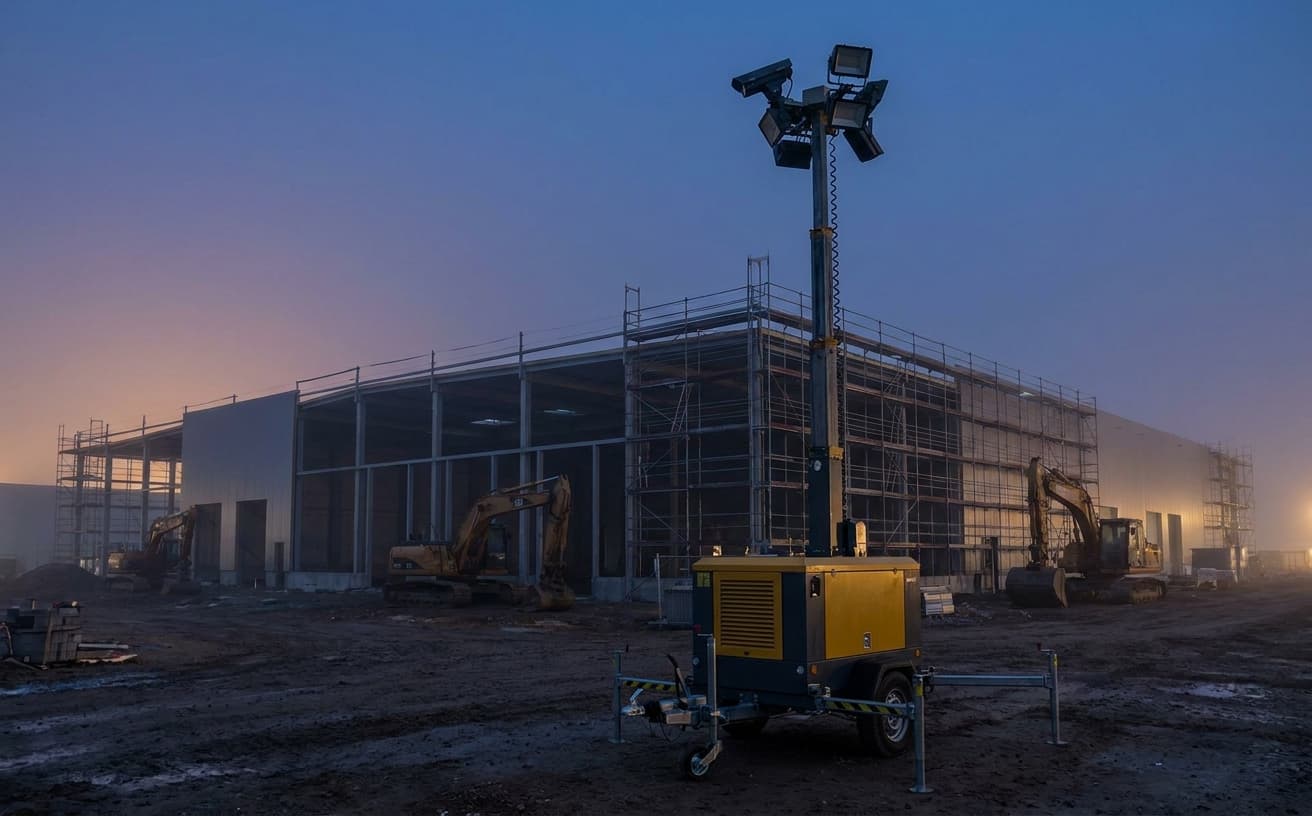
A monthly rate quoted in isolation is not a price. It is a hook.
What buyers ask for, when they search for the cost of a mobile surveillance tower rental, is rarely what they actually need. They ask for a number. What they need is a contract that names every component of the service and assigns a cost to each. The number alone, lifted out of context, will hide most of what determines whether the system protects the site or sits on it as a decorative pole with a blinking light.
The discipline that follows is buyer-side. It is written from the perspective of an operator who has paid for surveillance towers across construction sites, logistics yards and industrial perimeters, and who has learned which line items belong in the contract and which line items are missing when the invoice arrives. The manufacturer's perspective is honest about this: a tower that performs is more expensive than a tower that does not, and the difference is visible long before the first incident.
What a Tower Actually Is, and Why That Matters for the Price
A mobile surveillance tower is not a camera on a mast. It is a small, self-contained security installation that includes a structure, a power source, a sensor package, a transmission path, a recording layer, an analytics layer and a response protocol. Each of these elements has a cost, and each can be left out of a quote without the buyer noticing until the system is tested by an incident.
The structure is the trailer or pole, the hydraulic mast, the wind rating and the anti-tamper enclosure. A tower rated for storm conditions costs more to manufacture and more to maintain than a tower rated only for fair weather. Buyers in northern Europe who accept a fair-weather rating discover the difference in November.
The power source is autonomous solar with battery backup, hybrid solar with a small generator, or grid connection where available. Autonomous systems require a battery bank sized to the worst week of the year at the latitude of the site, not the average week. A tower that runs nine months and goes dark in December is not a security system. It is a seasonal decoration.
The sensor package is the cameras, the resolution per camera, the field of view, the thermal channel if present, and the audio if present. A four-camera tower with 4K resolution and a thermal channel is a different product from a two-camera tower with HD resolution. The price difference is rational and should be visible on the quote.
The transmission path is 4G or 5G modem, the SIM data plan, and the fallback. A tower without a fallback transmission path will lose contact during the same weather event that justifies its presence. The recording layer is local storage on the tower, cloud storage off the tower, or both. Retention period is a contractual term, not a marketing claim. The analytics layer is the on-device classification, the alarm filtering, and the integration with the monitoring centre. The response protocol is what happens when an alarm fires.
Each of these layers has a cost. A quote that lists only a monthly rental price hides at least four of them. The buyer's first move is to ask for the line items.
Setup and Takedown Are Not Free
The most common omission in mobile surveillance tower quotes is the cost of getting the tower onto the site and off it again. Vendors quote a clean monthly rate and then add transport, positioning, commissioning, decommissioning and removal as separate invoices that arrive after the contract is signed. The buyer is then in a weak position to negotiate, because the alternative is to leave the tower in place at the original rate.
Honest pricing names these items at the outset. Transport to site is a function of distance from the depot, the size of the vehicle required and the access conditions on site. A tower delivered to a city-centre construction site through a narrow gate at 6 a.m. costs more to position than a tower delivered to an open logistics yard at midday. The vendor knows this. The contract should reflect it.
Positioning is the work of placing the tower in the correct location, levelling it, deploying outriggers if present, raising the mast and aligning the cameras. A two-person crew with the right equipment does this in thirty to sixty minutes for a standard tower. A crew that arrives without the right equipment, or that has to wait for site access, charges by the hour. Commissioning is the configuration of the cameras, the analytics zones, the alarm rules and the connection to the monitoring centre. This work is often billed as a flat fee, and it should be visible on the quote.
Decommissioning and removal mirror the setup process in reverse. They are typically billed at the same rate as setup, although some vendors discount the removal because the tower returns to the depot rather than to a new site. The buyer should ask. Storage between deployments, if the buyer wants to retain the tower without paying the full active rate, is a separate negotiation. Some vendors offer a reduced standby rate; others insist on full rental until the contract ends.
Weather damage, vandalism and theft of the tower itself are insurance questions that belong in the contract. The vendor's standard contract will assign these risks to the buyer unless explicitly negotiated otherwise. Buyers who rent towers for sites where vandalism is a real risk, which is to say most construction sites, should price the insurance line carefully. The premium is not nothing, but the deductible on a totalled tower is several thousand euros. NICB data on equipment theft, while focused on the United States, gives a sense of the recovery rates for stolen construction equipment, which are low. The European picture is comparable.
Monitoring Is Where the Real Money Lives
A tower that records footage and does nothing else is a forensic tool, not a security system. It tells the owner, after the fact, who took the copper. It does not prevent the copper from being taken. The component that turns a recording device into a security system is monitoring, and monitoring is where the real money lives.
Three monitoring models exist in the market. Self-monitoring means the buyer or the buyer's staff receives alarms and decides whether to act. This is the cheapest option on the quote and the most expensive option in practice, because human attention does not scale and night shifts on construction projects are not staffed for alarm response. Self-monitoring is appropriate for low-risk sites where the tower's role is deterrent and documentation, not response.
Vendor-monitored service means the vendor's monitoring centre receives the alarms, applies a first filter, and contacts the buyer's designated response or a third-party guard service when a real incident is identified. This is the standard model for serious surveillance tower deployments. The cost is meaningful, typically a significant fraction of the tower's rental rate, and it varies with the alarm volume the site generates. A site with twenty alarms a night costs more to monitor than a site with two. Vendors who quote a flat monitoring fee regardless of alarm volume are either overcharging quiet sites or undercharging noisy ones, and the model will not hold.
The third model is integrated monitoring with guaranteed response, where the vendor's monitoring centre is contractually linked to a guard or police dispatch with a defined arrival time. This is the most expensive option and the only one that closes the loop from detection to response. It is appropriate for high-value sites and for sites where the cost of an unanswered incident exceeds the cost of the response standby. Buyers should examine the response time guarantee carefully. A response time of fifteen minutes in a rural area is operationally meaningless if the nearest guard patrol is thirty kilometres away.
Analytics quality determines monitoring cost in a way that is rarely visible on the quote. A tower with poor classification will generate a false alarm every time a fox crosses the yard or a tarpaulin moves in the wind. Each false alarm consumes operator time. CISA's guidance on physical security monitoring, and the IEC 62443 framework for industrial security, both emphasise that alert fatigue is the operational failure mode of monitoring systems. The vendor who quotes a low monitoring rate on a tower with weak analytics is selling the buyer a contract that will be renegotiated within six months when the operator cost becomes unsustainable.
Retention, Evidence, and What the Footage Is Worth
Footage retention is a contractual term that has consequences far beyond the cost of storage. The retention period determines whether the footage is available when an insurance claim is filed, when a police investigation is opened, or when a contractor dispute reaches arbitration. A retention period of seven days, which is the default on many low-cost rentals, is too short for most of these purposes. A retention period of thirty days covers most insurance and contractor disputes. Ninety days covers most criminal investigations that start late.
The retention period is a function of storage capacity and storage cost. Local storage on the tower is cheap but vulnerable to the same theft or sabotage that the tower is meant to detect. Cloud storage is more expensive but resilient. A serious system uses both, with cloud storage as the authoritative record and local storage as a buffer for transmission outages.
The format of the footage matters for evidentiary use. Footage that cannot be exported in a standard format with an unbroken chain of custody is of limited value in court. ASIS International guidance on video evidence, and the relevant national procedural rules, are consistent on this point. The buyer should ask whether the vendor's system produces export packages with timestamp integrity, hash verification and a documented chain of custody. If the answer is vague, the footage is unlikely to survive a serious challenge.
GDPR considerations belong in the retention discussion. A tower that records a public street, or that captures employees and contractors as part of normal operations, must be deployed under a documented legal basis, with retention limited to what is necessary, and with appropriate signage. The vendor's standard configuration may not be compliant with the buyer's specific legal context. The buyer remains the data controller in most rental arrangements and bears the regulatory risk. The contract should clarify the vendor's role as processor and should include the data processing terms that GDPR requires.
The cost of retention is not large in absolute terms, but the cost of an inadequate retention policy can be large. A construction site that experiences a theft on day fifteen of a project, with a seven-day retention contract, has no footage. The tower was there, the cameras worked, the alarm fired, and the recording was overwritten. This is not a hypothetical. It is the most common reason that surveillance tower investments fail to deliver on insurance claims.
Weather, Availability and the Honest Question of Uptime
Availability is the contractual term that separates serious vendors from casual ones. A tower that is operational ninety-five percent of the time is offline for eighteen days a year. A tower that is operational ninety-nine percent of the time is offline for three and a half days a year. The difference matters when the offline period coincides with an incident.
Weather availability is the subset of this question that buyers most often miss. A solar-powered tower deployed in a northern European winter, on a site shadowed by a building, will produce far less energy than the specification sheet suggests. The battery bank will drain. The cameras will go dark. The monitoring centre will register the loss of signal and will notify the buyer, but by then the site is unmonitored.
The vendor's obligation in this scenario should be defined in the contract. Some vendors guarantee availability with service-level penalties for downtime. Others disclaim weather-related downtime entirely. The honest middle ground is a contract that names the expected availability, the measurement method, the exclusions, and the remedies. NIST 800-53 control families that address physical and environmental protection, and ISO 27001 annex A controls on operations security, both treat availability as a measurable property, not a marketing claim.
Wind ratings are the second weather variable that buyers should examine. A tower rated for wind speeds typical of summer in central Europe will be lowered or evacuated during storms, which means it is offline precisely when intrusion attempts spike. Towers rated for higher wind speeds cost more to manufacture and rent. The buyer's decision is a trade-off between cost and continuity, and the trade-off should be made explicitly rather than discovered during a storm.
Cold weather affects battery performance, sensor performance and mast hydraulics. Vendors operating in regions where temperatures drop below freezing should specify the operational temperature range of the tower, the heating provisions for sensitive components, and the impact on uptime. BSI guidance on physical security technology in cold climates is a useful reference, although most national standards bodies provide equivalent material. The buyer should ask, and the answer should be in writing.
Maintenance windows are a planned form of downtime. A serious vendor schedules maintenance, communicates the schedule, and minimises the impact on availability. A vendor who treats maintenance as an unplanned event, performed when something breaks, is selling a tower whose effective availability is lower than the specification suggests. The contract should name the maintenance schedule and the response time for unplanned interventions.
A Buyer-Side Checklist for Honest Pricing
The checklist that follows is the operational summary of the components above. It is the list the buyer should bring to the negotiation, and it is the list the vendor should be able to answer line by line. A vendor who declines to itemise these elements is offering a price, not a contract.
Hardware specification, including camera count, resolution, thermal channel, audio capability, mast height, wind rating, temperature range, and tamper protection. Power architecture, including solar panel area, battery capacity, generator backup if any, and the worst-case duty cycle the system can sustain. Transmission, including primary and fallback connectivity, data plan, and the behaviour of the system when transmission fails. Local storage capacity and cloud storage capacity, with the resulting effective retention period at the configured recording quality.
Setup cost, broken into transport, positioning, commissioning and any site-specific work. Takedown cost, with the same breakdown. Standby cost between deployments if applicable. Insurance and liability allocation for theft, vandalism and weather damage to the tower itself.
Monitoring model, with the alarm volume assumption that underlies the price, the false alarm filtering process, the operator-to-tower ratio in the monitoring centre, and the escalation protocol. Response protocol, with the named guard service or police interface, the response time guarantee, and the geographical scope of the guarantee. Analytics specification, including the object classes the system recognises, the on-device versus cloud processing split, and the update cadence for the models.
Retention period, storage redundancy, export format, evidentiary integrity provisions, and GDPR data processing terms. Availability commitment, measurement method, exclusions, maintenance schedule, and remedies for breach. Contract length, notice period, price adjustment mechanism for extensions, and the conditions under which the vendor can terminate.
A quote that addresses each of these items, with a number or a defined commitment against it, is a quote that can be evaluated. A quote that lists a monthly rental and leaves the rest implicit is a starting point for negotiation, not an offer.
The manufacturer's book BOSWAU + KNAUER. From Building to Security Technology describes the platform logic that underlies these distinctions. A surveillance tower is a node in a security system, not a product in isolation, and the contract that rents it should reflect the system properties it delivers.
What Holds
A mobile surveillance tower is rented to perform work. The work is detection, deterrence, recording, and the triggering of a response. Every component of the price corresponds to a component of the work. A buyer who reads the quote against the work understands what they are buying. A buyer who reads only the monthly rate buys a number.
Honest pricing is itemised pricing. It is more uncomfortable to read than a single figure, because it forces both vendor and buyer to take positions on questions they would prefer to leave implicit. It is also the only basis for a contract that survives the first incident. The vendors who price honestly tend to retain the customers who learn this. The vendors who price loosely tend to acquire customers who replace them within two contract cycles.
For operators considering whether their current surveillance arrangements would survive the kind of itemisation described above, Path II of the manufacturer's three engagement models is the appropriate next step. A three to five day audit, against a defined fee and defined deliverables, produces a written assessment of the existing security posture and a comparison against what a properly structured deployment would deliver. The audit report is the buyer's property, usable with the manufacturer or without.
Frequently Asked Questions
What does a mobile surveillance tower cost per month?
Monthly rates for mobile surveillance towers in Europe typically range from the low hundreds of euros for a basic, self-monitored tower with limited retention, to several thousand euros per month for a high-specification tower with thermal imaging, 4K cameras, vendor monitoring with guaranteed response, and ninety-day cloud retention. The wide range reflects genuine differences in capability, not arbitrary pricing. A buyer comparing quotes should ensure that the towers being compared are configured to the same specification before drawing conclusions about which vendor offers better value. Setup, transport and monitoring are often separate line items.
How long does setup and takedown take?
A standard mobile surveillance tower, delivered by a two-person crew with the appropriate vehicle, is positioned and commissioned in thirty to sixty minutes under normal site conditions. Takedown takes a similar amount of time. Site conditions that extend the timeline include restricted access, the need for a crane or specialised positioning equipment, ground conditions that require additional levelling, and integration work with an existing monitoring infrastructure. Vendors should quote setup and takedown as defined line items with a stated time allowance, and any work beyond that allowance should be billed transparently against an agreed hourly rate.
Is monitoring included in the rental?
Monitoring is not automatically included. Three models exist. Self-monitoring, where alarms route to the buyer's staff, is usually included at no additional cost but places the response burden on the buyer. Vendor monitoring, where a monitoring centre filters alarms and escalates real incidents, is a separate line item priced according to expected alarm volume and the operator's involvement. Integrated monitoring with guaranteed guard or police response is the most expensive option and is typically priced as a service contract layered over the tower rental. The buyer should confirm which model is in the quote and what response protocol applies.
What retention period is standard for footage?
Retention periods in the market range from seven days at the low end to ninety days or more at the high end, with thirty days being a common middle ground. Seven days is generally insufficient for insurance claims and contractor disputes, which often emerge later than the recording window. Thirty days covers most operational needs. Ninety days is appropriate for sites where criminal investigations or regulatory inquiries may begin weeks after an incident. The retention period should be specified in the contract, along with the storage redundancy, the export format, and the GDPR-compliant deletion process at the end of the retention window.
Related topics
- Mobile Video Tower vs Security Guard: Cost Showdown
- Mobile CCTV Towers: What 70% of Buyers Regret
- UK Construction Mobile Surveillance: Why Operators Switch
- Surveillance Trailer Rental: The US Market by Zip-Code-Tier
- Solar Surveillance Trailers on a Construction Site
Take the next step: See prices & ROI · Explore the products · Send a no-obligation request. BOSWAU + KNAUER – direct from the factory in Filderstadt, reply within 5 working days.
About the author
Dr. Raphael Nagel (LL.M.) is founding partner of Tactical Management. He acquires and restructures industrial businesses in demanding market environments and writes on capital, geopolitics, and technological transformation. raphaelnagel.com
More reading
Since 1892.
The firm is reached at boswau-knauer.de or +49 177 2266267.