
Blog
Mobile Surveillance Towers at Jebel Ali Port
DP World, Dubai Customs interaction, container dwell time. How a port at this scale layers mobile and fixed surveillance.

Dr. Raphael Nagel
June 29, 2025
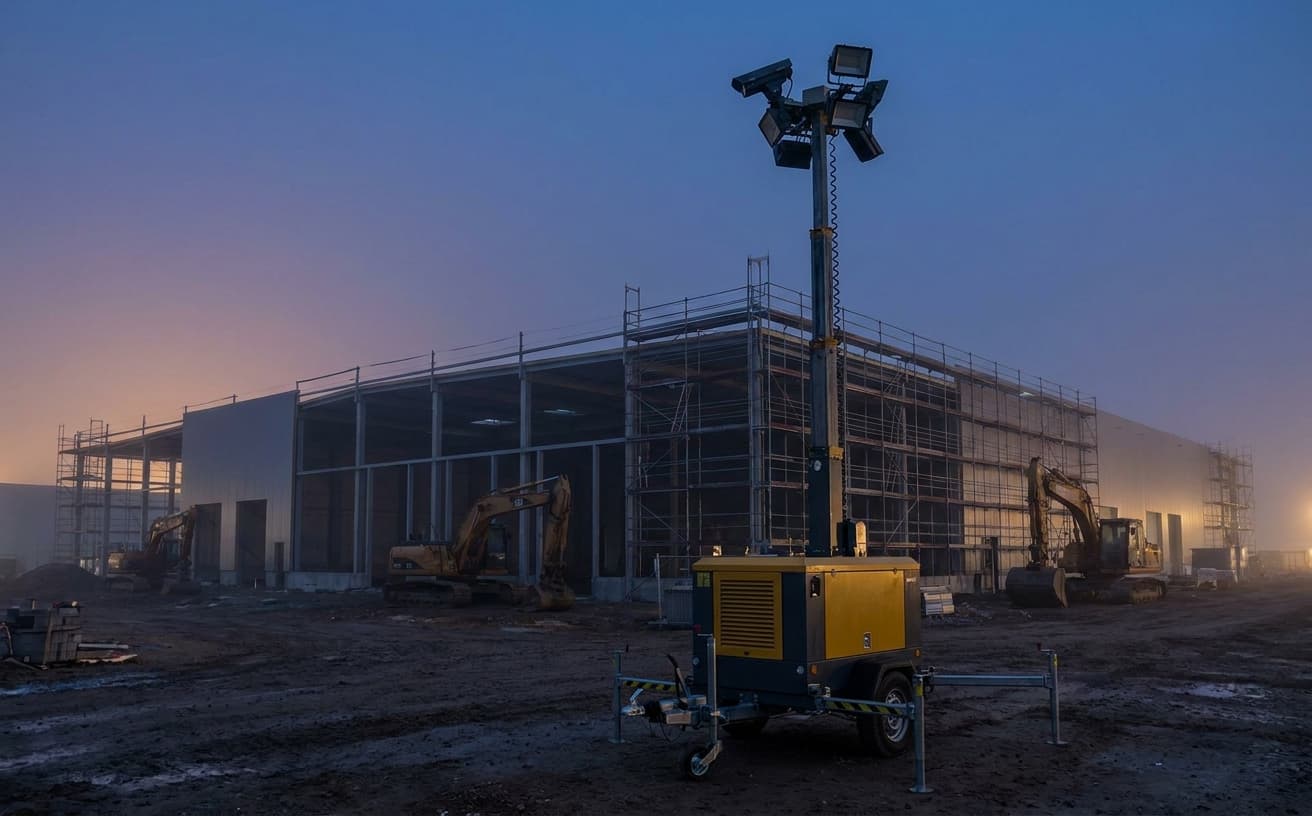
A port at the scale of Jebel Ali does not have a perimeter. It has a coastline, a fenceline, a rail edge, a road edge and a water edge, and each of these is permeable in a different way at a different hour. Anyone who calls that a perimeter has not stood at gate four in July at three in the morning.
Jebel Ali is the largest container port between Rotterdam and Singapore. DP World runs it, Dubai Customs operates inside it, and a layered architecture of state, terminal, tenant and carrier security operates around it. The thesis of this article is straightforward. Fixed cameras and fixed fencing are necessary at a port of this scale, but they are not sufficient. The shape of risk inside a container terminal moves with vessel schedule, with customs dwell time, with weather and with shift change. Sufficiency comes from a mobile layer that can be redeployed in hours, that runs autonomously for weeks, and that records to a standard a customs authority and an insurer will accept after the fact. That is the operating reality BOSWAU + KNAUER builds for.
The geometry of Jebel Ali
The site covers a footprint that no single fixed installation can cover from a single viewpoint. DP World operates three container terminals along Jebel Ali, with quays measured in kilometres and a stack yard that holds tens of thousands of containers at any given moment. Throughput sits in the range of fifteen million TEU per year, which means that every hour of every day, several hundred containers move between vessel, yard, rail, road and customs inspection lane. The Jebel Ali Free Zone wraps the landside of the port and adds warehousing, light industry and bonded storage to the equation. The port and the free zone together form a single security problem with multiple legal layers.
Fixed CCTV at a port this size sits on masts, on quay cranes, on gate gantries and on the corners of administrative buildings. It works as long as the geometry of the yard remains stable. The geometry does not remain stable. Stacks rise and fall by twenty feet in a shift. A reefer block that was clear at noon is solid at six. A line of empties shifts position because a vessel is rerouted. The camera that had clean sight of bay forty-seven on Tuesday has a wall of forty foot high cubes between it and the same bay on Thursday. Fixed infrastructure delivers excellent baseline coverage of the gates, the quays and the perimeter road, and it produces blind volumes inside the stack the moment operations move. The mobile layer exists to close those volumes for the days they exist and to move when they move.
A second geometry sits underneath. Dubai Customs operates inspection lanes, scanning facilities and bonded zones where dwell times stretch from hours to weeks depending on cargo type, manifest accuracy and risk profile. The longer a container sits, the more value accumulates in a known location, and the more the security calculation shifts from flow to storage. ASIS International guidance on supply chain security treats dwell as the single most important variable in cargo theft exposure. The longer the dwell, the deeper the layered control has to go.
The DP World security stack
DP World operates its own integrated security function across the terminals it runs, and Jebel Ali is the reference site. The stack begins with access control at the truck gates, where Optical Character Recognition reads container numbers and licence plates, where biometric verification ties drivers to pre-cleared appointments, and where weigh-in-motion data flows into the terminal operating system. This layer is mature, heavily instrumented and well documented in DP World's public communications. It is also the layer that gets most of the analyst attention, because it sits at the boundary between the public and the controlled.
Behind the gate, the security model changes. Inside the yard, the dominant control is operational rather than perimetral. Reach stackers, straddle carriers, rubber-tyred gantries and ship-to-shore cranes are tracked through the terminal operating system, and the movement of every container is logged to a six digit position. Theft inside a yard of this kind rarely takes the form of a container disappearing. It takes the form of cargo being removed from a container during a planned stop, of seals being switched, of paperwork being reissued against a different consignee, or of containers being misdelivered through manipulated release codes. CISA and the United States Customs Trade Partnership Against Terrorism, which DP World participates in through its global footprint, treat these as the dominant theft vectors in modern container logistics.
The third layer is federal. Dubai Police, the Federal Authority for Identity, Citizenship, Customs and Port Security and the Coast Guard operate inside and around the port with full statutory authority. They are not contractors. They are sovereign. The operational consequence for any private operator inside Jebel Ali is that surveillance technology has to be deployable under conditions where the data, the chain of custody and the recording standards will be reviewed by a federal authority if an incident occurs. ISO 27001 controls on data integrity and IEC 62443 controls on the underlying industrial control systems are not optional reading. They are the floor.
Mobile surveillance towers fit into this stack as a tenant layer. The terminal operator runs the gate, the customs authority runs the inspection, and the freight forwarder or the consignee runs the container while it sits in bonded storage. Each of those parties has an interest in additional, time-bounded visibility over a specific zone. That is the slot the mobile tower occupies.
The mobile tower as a tenant instrument
A mobile surveillance tower is not a substitute for the DP World fixed network. It is a complement to it, owned by a different party, focused on a different volume, deployed for a different duration. The operator of a high value reefer consignment that is held in customs for fourteen days does not have access to the fixed camera feeds of the terminal. The operator has a contractual interest in knowing what happened around that consignment during those fourteen days. A mobile tower, positioned with the consent of the terminal and within the regulatory frame of the free zone, gives that operator a defensible answer.
The technical requirement is specific. The tower has to be self-powered, because trailing cable across a working yard is not acceptable. It has to run for several weeks without a refuel or a battery swap, because access to deployed positions inside an active terminal is restricted. It has to record at a resolution and frame rate that survives forensic review, which in practice means four megapixel minimum on the primary sensors, with thermal overlay for the night shift and infrared illumination tuned to the eight to forty metre range that dominates yard work. It has to encrypt at rest and in transit, because the data may be requested by customs, by police, by insurers, or by the consignee, and it has to be defensible in all four hands. NIST 800-53 controls on media protection and audit logging are the relevant reference. BSI guidance on video surveillance under GDPR adapted local data protection logic is the second reference, since many of the cargoes that move through Jebel Ali are bound for or originating in European markets.
Deployment time matters at a port. A vessel that arrives with a high value consignment that requires extended customs inspection generates a security requirement that did not exist a week earlier and will not exist a week later. A tower that takes three days to deploy is useless against that requirement. A tower that deploys in under two hours, that powers up on hybrid solar and fuel cell, and that streams to a remote operations centre from the moment it is upright, is the instrument that fits. Chapter 8 of BOSWAU + KNAUER. From Building to Security Technology describes this deployment envelope as the defining commercial property of the mobile tower category. It is not a CCTV pole on a trailer. It is a complete sensor platform with its own power, its own connectivity and its own redundancy.
The theft profile that matters
Container theft at Jebel Ali does not look like container theft at a small regional port. The National Insurance Crime Bureau in the United States and the equivalent industry data from the GDV in Germany show that at major ports, the dominant pattern is not the disappearance of whole containers. It is the controlled extraction of high value cargo from containers during legitimate stops, combined with documentary manipulation that delays detection until the consignment has cleared the chain of custody. Electronics, pharmaceuticals, luxury goods, copper and certain categories of automotive parts dominate the loss tables.
The window of exposure is the customs hold. A container that arrives at Jebel Ali on a Wednesday and clears customs on a Friday spends roughly forty-eight hours in a known position with a known content. If that content is worth six or seven figures, the economic logic of organised theft makes that window the target. Internal collusion is the dominant access vector. A driver, a yard worker, a customs broker, a clerk in the terminal operating system, any one of these has more access to the container than any external intruder ever will. The security model that addresses this is not perimeter intrusion detection. It is presence assurance, behavioural anomaly detection and continuous audit of every approach to the container during its hold.
Mobile towers contribute to this model in three ways. First, they document approach. Every person and every vehicle that enters a defined zone around the consignment is recorded, time stamped and matched against the expected work order. Second, they detect anomaly. Modern AI analytics, trained on yard operations, distinguish between a yard worker walking past and a yard worker stopping at the door of a specific container. Third, they deter. A visible, identifiable, hardened tower with active lighting tells the opportunistic actor that the consignment is observed by an instrument that the actor does not control. NIST CSF 2.0 categorises this as a combination of Identify, Protect and Detect functions running on a single platform.
The towers do not replace the terminal's own monitoring. They sit on top of it, focused on a specific tenant interest, for the specific window in which that interest exists. When the consignment clears, the tower moves to the next assignment. That mobility is not a feature. It is the entire commercial proposition.
Integration with customs and terminal systems
The instinct of a technology vendor at this point in an argument is to promise deep API integration with the terminal operating system and the customs platform. The reality at Jebel Ali, and at any port operated to international standard, is that such integration is heavily controlled and is granted sparingly. DP World's terminal operating system is not an open platform. Dubai Customs operates under federal data sovereignty rules that limit what private surveillance data can be cross-referenced with manifest data. The honest position for an external surveillance provider is that the integration runs through the tenant, not directly with the authority.
What this means in practice is that the mobile tower's data is owned by the tenant who deployed it, the data is held in a defined retention envelope that complies with UAE data protection law and with the customs and terminal access agreements, and the data is made available to the authority or to the insurer on request and under documented chain of custody. ISO 27001 governs the information security management. IEC 62443 governs the security of any operational technology element that touches the tower's control plane. The chain of custody documentation is the artefact that matters when a claim is filed or when a criminal investigation opens.
The interface to the tenant is straightforward. A web based operations console, a mobile alerting channel for the duty officer, an automated daily report against defined events and a weekly summary report against the deployment objective. The interface to the terminal is procedural. The deployment is registered with the terminal operator, the position is agreed against the yard plan, the cabling and the lighting are checked against the terminal's safety rules, and the demobilisation is recorded against the same procedure. The interface to customs is by exception. If an event occurs that customs needs to review, the recording is provided through the proper channel, with the metadata that establishes time, position and integrity.
This procedural discipline is what separates a serious port surveillance operator from a vendor pushing equipment. Chapter 14 of BOSWAU + KNAUER. From Building to Security Technology argues that in industrial and logistics environments, the technology is the easier half. The harder half is the integration with the operational and regulatory environment in which the technology will live. Ports are the cleanest case of this rule.
What holds
A port the size of Jebel Ali does not have a single security model. It has a layered model in which the state secures the perimeter and the strategic infrastructure, the terminal operator secures the gates, the quays and the operational systems, and the tenants secure the specific assets they own or are responsible for during their dwell in the terminal. Mobile surveillance towers occupy a defined slot in that layered model. They are not a substitute for the DP World stack. They are the tenant's instrument for the volumes and the windows that the fixed stack does not, and should not, cover.
The argument for the mobile layer rests on three operating realities. The geometry of a working container terminal changes faster than fixed infrastructure can follow. The economic value at risk concentrates during customs dwell, not during flow. The dominant theft vector at major ports is internal collusion at the point of access, not external intrusion at the perimeter. A mobile, autonomous, hardened tower with the right sensor stack, the right power autonomy and the right data integrity discipline addresses all three.
Operators who want to test this argument against their own consignments and their own dwell profile at Jebel Ali or any comparable port have three ways to engage with BOSWAU + KNAUER. The first is a sixty minute confidential conversation with a member of the leadership, which produces an assessment without any commitment. The second is a three to five day audit at a defined site, which produces a written report with a vulnerability catalogue, an economic case in three scenarios, and an implementation plan. The third is a ninety day pilot at a defined location with a defined success metric agreed before deployment. Each of the three stands on its own.
Frequently asked questions
How big is Jebel Ali?
Jebel Ali is the largest container port in the Middle East and one of the ten largest in the world. DP World operates three container terminals along the site, with combined throughput in the range of fifteen million TEU per year. The quays stretch for several kilometres, and the stack yard holds tens of thousands of containers at any given moment. The Jebel Ali Free Zone wraps the landside of the port and adds several square kilometres of warehousing, light industry and bonded storage. The port and the free zone together form a single integrated logistics and security environment.
Who supplies port security?
Port security at Jebel Ali is layered. The Federal Authority for Identity, Citizenship, Customs and Port Security, Dubai Police and the UAE Coast Guard exercise sovereign authority across the site. DP World operates its own integrated security function across gates, quays and yards, with terminal operating system controls, biometric access at gates and a substantial fixed CCTV network. Tenants, freight forwarders and consignees engage private security and surveillance providers for the specific consignments and zones they are responsible for. Mobile surveillance towers fit into the tenant layer of this stack, deployed under the operational and regulatory frame of the terminal and the free zone.
What is the theft profile?
Theft at major container ports rarely takes the form of whole containers disappearing. The dominant pattern, documented by ASIS International, NICB and GDV equivalent data, is the controlled extraction of high value cargo from containers during legitimate stops, combined with documentary manipulation that delays detection. Internal collusion is the leading access vector. Electronics, pharmaceuticals, luxury goods, copper and certain automotive parts dominate the loss tables. The window of exposure is the customs hold, when high value consignments sit in a known position with known content for hours to days. That window is the focus of any serious mobile surveillance deployment.
How does customs integrate?
Dubai Customs operates inspection lanes, scanning facilities and bonded zones inside Jebel Ali under federal authority. Private surveillance data does not integrate directly with customs systems. Integration runs through the tenant, who owns the surveillance data and provides it to customs or to police on documented request when an event requires review. The discipline that matters is chain of custody. Data must be recorded to forensic standard, encrypted at rest and in transit, retained under the relevant UAE data protection rules and ISO 27001 controls, and produced with metadata that establishes time, position and integrity. That is what makes the recording usable when it is needed.
Related topics
- Mobile Surveillance at the Port of Rotterdam
- Mobile Surveillance Towers on UAE Megaprojects
- Mobile Surveillance Towers at Saudi Giga Projects
- EU Procurement of Mobile Surveillance Towers: TED Guide
- UK Port Security: Felixstowe, Southampton & Brexit Reality
Take the next step: See prices & ROI · Explore the products · Send a no-obligation request. BOSWAU + KNAUER – direct from the factory in Filderstadt, reply within 5 working days.
About the author
Dr. Raphael Nagel (LL.M.) is founding partner of Tactical Management. He acquires and restructures industrial businesses in demanding market environments and writes on capital, geopolitics, and technological transformation. raphaelnagel.com
More reading
Since 1892.
The firm is reached at boswau-knauer.de or +49 177 2266267.