
Blog
Mobile Surveillance at GCC Events: Expo, COP & F1
Expo 2020 Dubai legacy, COP28 logistics, F1 Yas Marina, post-event venue patterns. The events that taught the region how to do perimeter.

Dr. Raphael Nagel
August 17, 2025
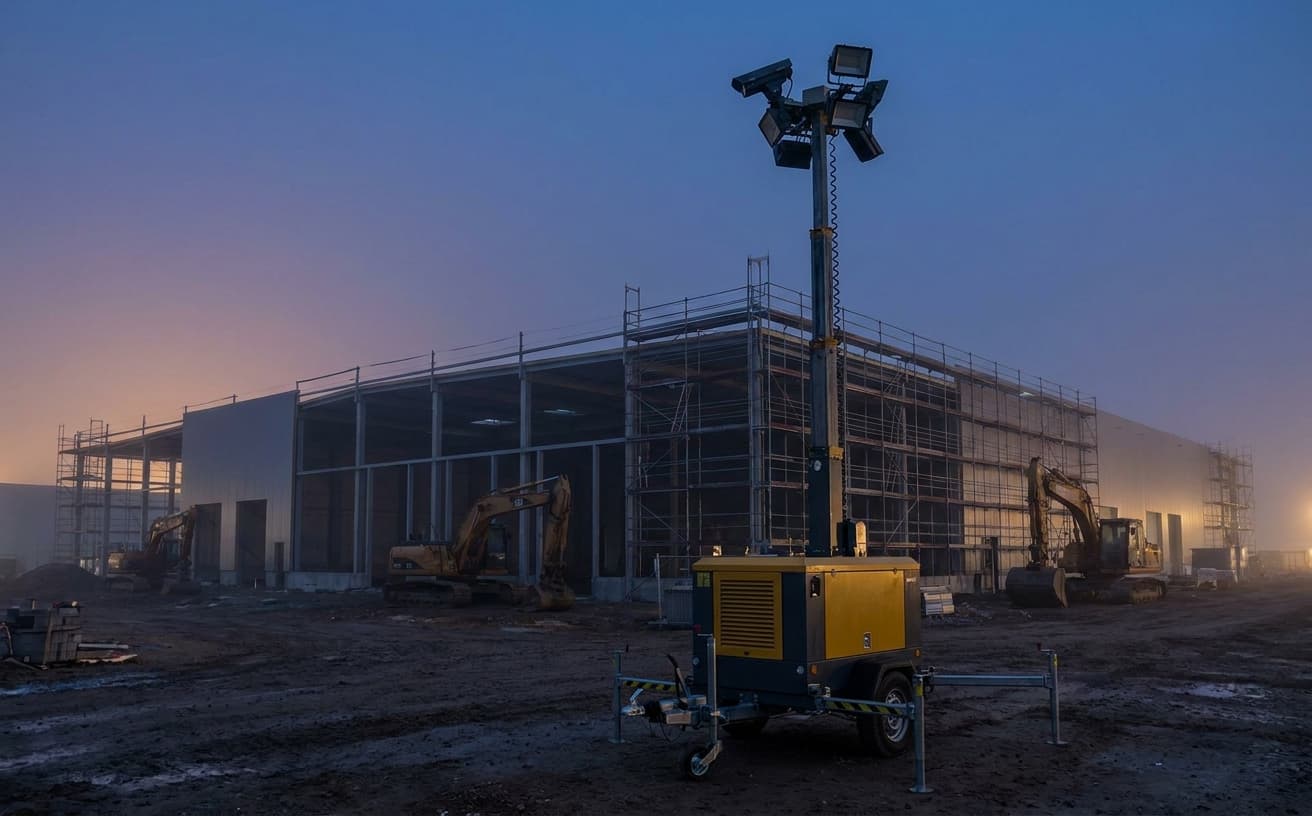
Event security in the Gulf is not a temporary discipline borrowed from venue managers. It is an industrial competence, built site by site, mast by mast, since the moment Expo 2020 Dubai forced the region to operate perimeter at a scale that no single national security service had previously rehearsed.
What looks from the outside like a series of headline occasions, the world fair, a climate summit, a Formula 1 weekend, is in operational terms a continuous training programme for the operators, integrators and manufacturers who supply mobile surveillance to the region. Each event has rewritten parts of the playbook. Each event has also exposed weaknesses that the next event was forced to address. The argument that follows is not nostalgic. It is a structured account of what changed, what held, and what now defines competent perimeter delivery in the GCC.
The Expo Inheritance and Why It Still Defines the Region
Expo 2020 Dubai, delivered in 2021 and 2022 after pandemic delay, ran for 182 days across roughly 4.38 square kilometres in Dubai South. Visitor figures published by the organisers crossed twenty-four million. Those two numbers, area and duration, are the reason Expo became the inflection point for mobile surveillance in the region. Permanent CCTV infrastructure on a site of that scale is a fixed cost only justified by a fixed future. Expo had a known end date, and a known transition into District 2020. The procurement logic therefore favoured systems that could be deployed in days, repositioned in hours, removed cleanly, and reused on the next assignment.
What operators learned at Expo, and carried forward, sits in three observations. The first is that mast-based mobile platforms with autonomous power, typically a combination of solar, hybrid generator and lithium storage, can hold continuous duty for the full event cycle when designed for industrial use rather than for short construction stints. The second is that camera count matters less than analytics quality. Expo perimeters were not policed by armies of staring eyes. They were policed by a smaller number of trained operators supported by video analytics that filtered routine movement from genuine anomaly. The third is that the integration layer, the part that nobody photographs, decides whether the operation works under load. A platform that does not speak to the command centre, to the access control system, to the traffic management feed and to the pavilion-level incident workflow becomes a parallel system, and parallel systems are abandoned within weeks.
Expo also taught the region that crowd behaviour is data. Heat maps, dwell times, queue formation at pinch points, these are not marketing curiosities. They are operational inputs that change deployment patterns by the hour. Operators who treated analytics as an afterthought were forced to retrofit. Those who designed analytics into the perimeter from day one, ASIS International guidance on integrated event security points in the same direction, set the standard that COP28 and successive Yas Marina seasons inherited. The Expo footprint did not disappear when the gates closed. It became the reference architecture for everything that followed.
COP28 and the Logistics of a Diplomatic Perimeter
COP28, hosted at Expo City Dubai in late 2023, looked from the outside like a continuation of the Expo legacy on the same ground. Operationally it was a different exercise. A climate conference under UNFCCC rules is a diplomatic event. It carries a Blue Zone managed under United Nations security protocols, a Green Zone managed by the host, and a wider envelope of accommodation, transport corridors and protest accommodation that the host state secures end to end. The perimeter is layered, the rules of engagement differ between layers, and the credentialing volume is significant. Public reporting put accredited participants above eighty thousand, which is large by COP standards.
The mobile surveillance lesson from COP28 is that flexibility under protocol constraint is harder than flexibility on an open commercial site. At Expo, an operator could reposition a tower in response to a new pedestrian pattern. At COP, the same reposition required coordination with UN security, with the host command centre, and with the diplomatic protection details responsible for specific delegations. Manufacturers who supplied COP28 reported that the technical capability of the equipment was rarely the constraint. The constraint was governance. Devices needed clean audit trails, hardened against tamper, with chain-of-custody documentation for footage that might later enter a formal incident review. NIST CSF 2.0 and ISO 27001 framing of evidence handling, transposed into a temporary deployment, became the operational baseline.
Two further patterns from COP28 deserve attention. The first is the integration of mobile surveillance with crowd flow management around the protest accommodation zones. Hosts of high-profile climate events have to provide space for legitimate expression while protecting delegates and infrastructure. This is a sensor-and-analytics problem before it is a manpower problem. Operators learned that mobile towers configured with thermal, acoustic and optical channels, feeding a multi-channel verification logic rather than a single-camera alarm, reduced false alarms during peak protest hours by a margin that mattered for command centre workload. The second is the cyber posture of the mobile fleet itself. A surveillance tower is a networked device. IEC 62443 expectations for industrial control environments apply with full force to mobile estates that traverse multiple sites in a single year. COP28 forced suppliers to demonstrate, not assert, segmentation between operational technology and corporate networks. Those who could, won the work. Those who could not, were quietly excluded from the shortlist.
F1 Yas Marina and the Discipline of an Annual Event
Formula 1 at Yas Marina is the GCC's most regular high-stakes event security commitment, run every season since 2009 with the Abu Dhabi Grand Prix typically closing the calendar in late November or December. Unlike Expo and COP, which are episodic, the F1 weekend is recurrent, and recurrence creates a different kind of operational maturity. The same site, the same approach roads, the same hotels and the same fan zones are secured year after year. The perimeter design is not invented each season. It is iterated.
This recurrence has consequences for who supplies the mobile surveillance capability. The Abu Dhabi Police Critical Infrastructure and Coastal Patrol Authority retains operational command. Integration is run through a small set of accredited security integrators with established track records on Yas Island. The mobile surveillance fleet is drawn from a combination of in-region inventory held by these integrators and specialist deployments brought in for the weekend. What an outside observer reads as a generic event security operation is, in practice, a tightly defined supplier set with multi-year relationships, scrutinised credentialing, and detailed pre-event walkthroughs that begin months in advance.
The technical signature of an F1 perimeter at Yas Marina is the layering of fixed CCTV on the permanent circuit infrastructure with mobile towers deployed across temporary fan zones, hotel approaches, marina-facing zones and the yacht moorings that flank the harbour section of the track. Mobile towers carry pan-tilt-zoom optics, thermal sensors for low-light and over-water coverage, and analytics tuned for crowd density estimation as well as for unauthorised approach. Drone detection has become part of the standard configuration. So has integration with the traffic management systems that handle the inbound flow on race days. None of this is improvised on the Friday. It is configured weeks ahead, tested in dry runs, and audited against the prior year's incident log.
What operators have learned from F1 is the value of post-event review. The weekend ends, the trophies are presented, and the integrators do not pack up and disappear. They write the report. That report becomes the input to the next year's design. NICB data on event-time vehicle and asset theft, ASIS event security guidance, and the integrators' own incident records combine into an annual revision of the perimeter. This discipline, the closed loop between deployment and learning, is the single most underestimated reason the GCC has reached the level of competence it now displays.
Crowd Analytics as the Connective Tissue
The phrase crowd analytics is used loosely in marketing material. In serious deployments it covers a specific set of functions: density estimation in defined zones, flow direction and rate, dwell time at points of interest, anomaly detection in movement patterns, and integration with access control and incident workflow. CISA guidance on mass gathering security treats these as operational inputs, not display metrics. The same view holds in the GCC.
At Expo, crowd analytics fed pavilion-level queue management and informed the dispatch of stewards before pinch points became safety incidents. At COP28, the same class of analytics fed delegation movement coordination and informed the placement of additional mobile resources when delegate schedules shifted. At Yas Marina, analytics inform stewarding and traffic management across a weekend whose peak hours are predictable but whose minute-by-minute variability is not. In each case the analytics layer connects mobile surveillance assets to the wider operation. Without that connection, mobile towers are isolated sensors. With it, they become part of a decision system.
The integration question matters because most of the value of mobile surveillance at events is realised in the seconds before an incident, not the minutes after. A tower that records a fight in a fan zone is useful for evidence. A tower that flags rising density in a fan zone at a rate consistent with crowd compression, and routes that flag to the steward supervisor with location and recommended response, prevents the incident. The technical difference between the two is modest. The operational difference is decisive. Operators who internalised this difference during Expo carried the advantage into every event that followed.
A note on the data discipline that this connective tissue requires. Footage retention, access controls, evidentiary chain of custody, lawful basis for processing, retention beyond the event window. These are governance questions that BSI guidance and the relevant UAE federal data protection framework both address, and that a competent integrator handles before deployment, not after. NIST 800-53 control families translate directly into the controls that should be in place around a mobile fleet's data flows. Operators who treat governance as a separate workstream from the technical deployment introduce risk that is invisible until the moment it becomes a regulatory problem.
What Holds
Mobile surveillance at GCC events has matured to the point where the architecture is no longer in question. Mast-based mobile platforms with autonomous power, multi-sensor configurations, analytics tuned for the venue type, integration into a command centre that speaks to access control, traffic management and incident workflow. This is the baseline. The differentiation now lies in the disciplines around the architecture: cyber posture of the mobile estate, governance of the data, post-event review, multi-year supplier relationships, and the integrators' capacity to learn from one season to the next.
The post-Expo venue pattern in the region, including District 2020, Yas Marina, the upcoming infrastructure around Riyadh's event programme, and the recurring conference and exhibition calendar across Doha, Abu Dhabi and Dubai, has converged on the same operational logic. Permanent fixed CCTV where the use case is permanent. Mobile surveillance where the use case is temporary or variable. Analytics that connect the two into a single operational picture. The economics favour suppliers who build for lifecycle rather than for the single deployment, a logic that the book BOSWAU + KNAUER. From Building to Security Technology develops at length in its chapters on mobile video towers and scalability.
For operators outside the region who want to understand how the GCC reached this position, the practical entry point is not a site visit. It is a sixty-minute confidential conversation about the standard you are currently operating against, and the standard your next event will require. That conversation is Path I in the structured engagement model. For operators who already know the gap and want it characterised in writing, the three-to-five-day audit is Path II. For those ready to test a configuration against a defined success measure on a single site, the ninety-day pilot is Path III. Each path stands on its own.
Frequently asked questions
What did Expo deploy?
Expo 2020 Dubai deployed an integrated perimeter combining fixed CCTV on permanent pavilion and infrastructure assets with a substantial fleet of mobile video towers across the 4.38 square kilometre site. The configuration emphasised multi-sensor towers with optical, thermal and acoustic channels, video analytics for filtering routine movement from genuine anomaly, autonomous power through solar-hybrid systems, and integration with the central command centre. The operational lesson was that camera count matters less than analytics quality and integration depth. That lesson became the reference architecture for subsequent GCC events.
How does COP differ?
A COP is a diplomatic event run under UNFCCC protocols, with a UN-managed Blue Zone, a host-managed Green Zone and a wider security envelope that includes accommodation, transport and protest accommodation. The mobile surveillance challenge is not primarily technical capability but governance. Devices require hardened audit trails, evidentiary chain of custody and demonstrable network segmentation aligned with IEC 62443 and ISO 27001 expectations. Repositioning decisions require coordination across multiple command authorities. Suppliers who can demonstrate compliance rather than assert it are the ones who win COP work.
Who supplies F1 venues?
Formula 1 at Yas Marina is operated under Abu Dhabi Police command, with integration delivered through a small set of accredited security integrators holding multi-year relationships on Yas Island. The mobile surveillance fleet combines in-region inventory held by these integrators with specialist deployments brought in for the weekend. The supplier set is tightly defined, credentialing is scrutinised, and pre-event walkthroughs begin months ahead. Recurrence creates maturity: the same perimeter is iterated annually against a closed loop of incident review, which is the discipline that distinguishes serious event security operations.
How does crowd analytics integrate?
Crowd analytics integrate by feeding outputs from the mobile surveillance fleet into the operational decision systems that run the event. Specifically: density estimation, flow direction and rate, dwell times and movement anomalies are routed to stewarding supervisors, traffic management, access control and incident workflow. The technical integration relies on open interfaces and a platform layer that connects sensors to command. The operational value is realised in the seconds before an incident, not in the recording afterwards. Without integration, mobile towers are isolated sensors. With it, they become part of a decision system.
Related topics
- UK Construction Mobile Surveillance: Why Operators Switch
- Mobile Surveillance at the Port of Rotterdam
- Mobile Video Surveillance 2026: Rentals vs CapEx
- Mobile Surveillance at Aramco Field Sites: Uptime
- Mobile Surveillance Towers in the Gulf: Solar Truth
Take the next step: See prices & ROI · Explore the products · Send a no-obligation request. BOSWAU + KNAUER – direct from the factory in Filderstadt, reply within 5 working days.
About the author
Dr. Raphael Nagel (LL.M.) is founding partner of Tactical Management. He acquires and restructures industrial businesses in demanding market environments and writes on capital, geopolitics, and technological transformation. raphaelnagel.com
More reading
Since 1892.
The firm is reached at boswau-knauer.de or +49 177 2266267.