
Blog
Mobile Surveillance Towers in the Gulf: Solar Truth
Solar irradiance maps, summer dust derating, panel-clean intervals. The Gulf is the one place the solar marketing is not a lie.

Dr. Raphael Nagel
August 27, 2025
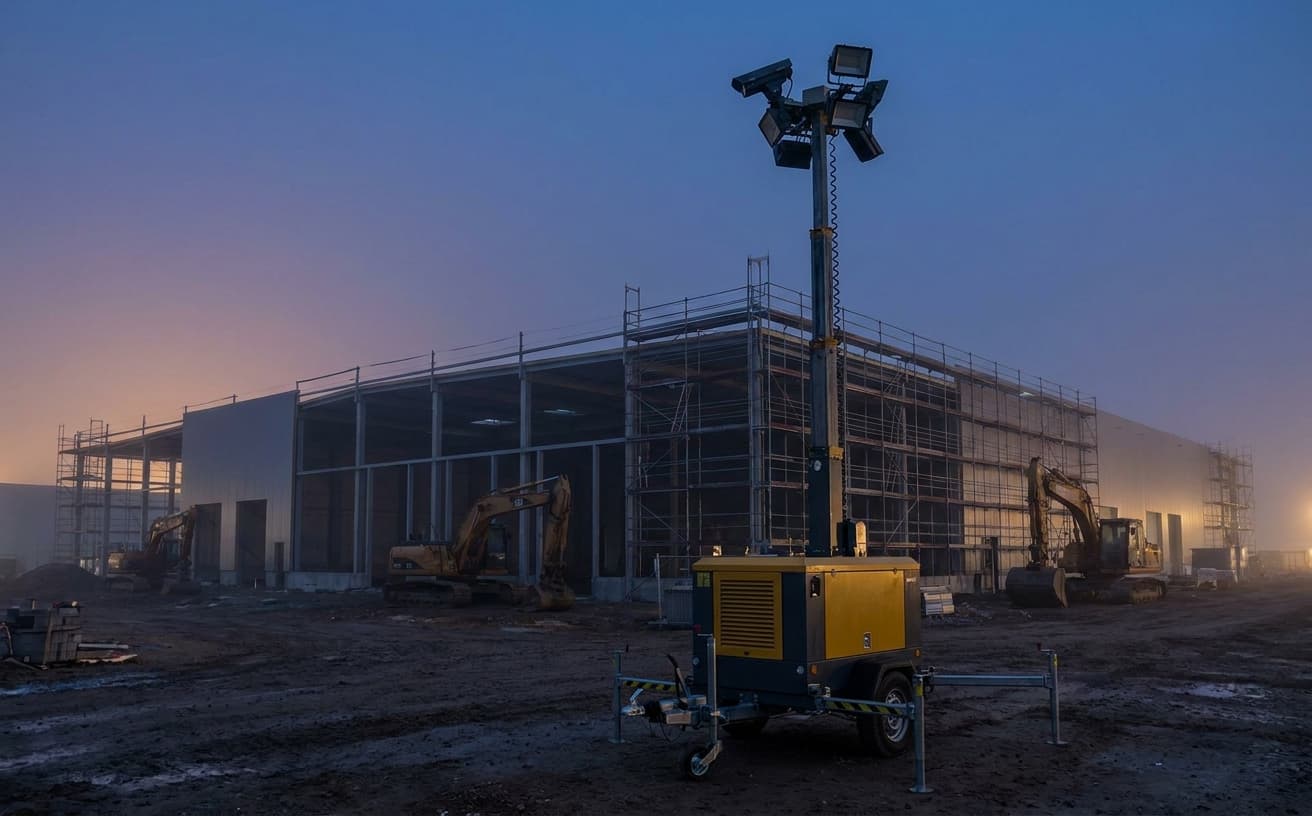
Solar marketing on mobile surveillance towers is, in most climates of the world, a half-truth. In the Gulf, it is not.
The honest version reads like this. Across most of Europe, a tower advertised as solar-autonomous will run autonomous for three months of the year, hybrid for six, and on the diesel generator or shore power for the remaining three. The brochure shows a panel array in the sun. The site logbook shows a fuel delivery schedule. This gap between the marketed system and the operated system is the source of most disappointment in this product category. It is also the reason serious procurement departments quietly assume that any mobile tower sold as solar will, in practice, need a fuel line.
The Gulf inverts the calculation. Between the irradiance profile, the cooling load reality, and the local logistics of fuel and labor, the Gulf Cooperation Council region is the one geography where a properly engineered solar tower delivers what its datasheet promises, over the full year, with margin to spare. The qualifications are real and they matter, summer dust being the most consequential. But the underlying physics work in a way they simply do not work in Hamburg, Lyon, or Birmingham. What follows is the technical case, written from the position of a manufacturer that builds these towers and operates them across both climate zones.
The irradiance baseline that changes the math
Global horizontal irradiance across the Gulf sits in a range that most temperate operators have never personally encountered as a working number. Annual GHI across Saudi Arabia, the United Arab Emirates, Qatar, Kuwait, Bahrain, and Oman runs broadly between 2,100 and 2,400 kilowatt hours per square meter per year, with interior desert sites at the upper end of that band and coastal sites somewhat lower due to humidity haze. The closest European comparison, southern Spain, peaks around 1,900. Germany averages near 1,100. The United Kingdom hovers below 1,000. The relevant figure for a mobile tower is not the annual total but the daily minimum during the worst month, because a solar system that cannot ride through its worst week is not autonomous, it is seasonal.
In the Gulf, the worst solar month is typically December or January, depending on the site. Daily GHI in that window still ranges between 4.0 and 4.8 kilowatt hours per square meter per day. The summer maximum exceeds 7.5. The ratio of best to worst month is roughly 1.6 to 1. In central Germany, the same ratio is closer to 7 to 1, with December delivering daily values below 0.8. This is the single most important number in the autonomy calculation, because battery sizing and panel sizing are dictated by the worst case, not the average. A tower designed for German winter must carry panel and storage capacity that sits idle most of the year. A tower designed for Gulf winter sizes close to its working load and runs that way through every season.
The practical consequence at the equipment level is that a four-panel configuration of approximately 1.6 kilowatts of installed photovoltaic capacity, paired with a lithium iron phosphate battery bank in the 10 to 15 kilowatt hour range, supports a continuous load of roughly 100 to 140 watts across the full Gulf year. That load envelope covers a pan-tilt-zoom camera, a thermal sensor, edge analytics, an LTE or 5G backhaul, and a low-current LED deterrent strip, with margin for two consecutive overcast days. The same configuration in a German winter would drop the operator into the generator after seventy-two hours. The Gulf operator does not own the generator. That is the difference the irradiance baseline creates.
What summer dust actually does to the panels
The most important qualifier in any honest Gulf solar specification is dust. The marketing departments tend to skip it. The engineering reality is that fine particulate deposition on photovoltaic glass reduces output, and the reduction is measurable, predictable, and seasonal. Across Gulf sites that have published soiling data, daily output loss from dust accumulation runs in the range of 0.4 to 1.2 percent per day during the dry season, with the higher end of that range during summer dust storm activity and the lower end during the cleaner winter months. Cumulative loss between cleaning intervals follows a roughly linear curve for the first two to three weeks, after which the deposition behavior shifts and additional loss tapers as larger particles begin to slough off under wind load.
In numerical terms, a panel array left uncleaned for four weeks during a Gulf summer can deliver between 15 and 25 percent below its rated output. This is not a marginal effect. It is the difference between an autonomous tower and a hybrid tower. The good news is that the effect is fully reversible with cleaning, and the cleaning itself is a low-skill, low-cost operation. The serious news is that any manufacturer or operator who designs a Gulf solar system without a defined cleaning protocol is designing a system that will fail predictably in its second month.
Soiling behavior also varies by site. Coastal humidity creates a cementing effect where overnight dew binds particulate to the glass, which increases the adhesion strength and makes simple wind clearance ineffective. Interior desert sites with dry nights see less binding but more total deposition. Industrial sites near aggregate plants, cement works, or active earthworks see particulate loads that exceed natural background by an order of magnitude. The tower specification must address the site, not the country. A solar tower on a clean coastal logistics yard in Abu Dhabi is a different machine, operationally, from the same tower on an active construction site in Riyadh ten kilometers from a quarry.
A realistic cleaning interval and how it gets resourced
The honest cleaning interval for Gulf solar surveillance panels, across most site profiles, sits between fourteen and twenty-one days. Some clean coastal sites stretch to thirty days without meaningful loss. Some industrial-adjacent sites require seven days. The operator who plans for monthly cleaning and discovers, after two months, that output has dropped below the autonomy threshold, did not do the engineering. The operator who plans for biweekly cleaning, builds it into the patrol schedule, and assigns it to existing site staff or to the security service provider, holds autonomy through the year.
The cleaning operation itself is simple. Deionized water, a soft microfiber tool on a telescoping pole, no detergent, no abrasive, conducted in the early morning before panel temperatures rise. Three minutes per panel, twelve minutes per tower. A two-person team can service ten towers in a working morning, with travel. The cost is labor, water, and vehicle time, and it sits in a range that does not move the operating economics. What moves the operating economics is forgetting to schedule it.
Two design choices materially reduce the cleaning burden without eliminating it. The first is panel tilt. A steeper tilt, in the 25 to 30 degree range, sheds particulate better than the shallow 10 to 15 degree tilt that optimizes summer output. The trade is a small annual energy loss against a meaningful reduction in soiling rate. For Gulf towers, the steeper tilt typically wins. The second is anti-soiling glass coatings, which are now mature enough to deliver a 20 to 30 percent reduction in deposition rate over uncoated glass. The coatings degrade over two to three years and need refresh. They are worth the cost on long-deployment towers. They are not worth the cost on towers that rotate sites every ninety days, because the coating life is consumed before its full benefit is realized.
Temperature derating and why it matters less than expected
The other technical concern operators raise about Gulf solar is temperature. Photovoltaic cells lose efficiency as their operating temperature rises, with a coefficient typically between 0.35 and 0.45 percent per degree Celsius above the standard test condition of 25 degrees. A panel sitting in 50 degree ambient air, with a cell temperature near 75 degrees, runs at roughly 80 to 82 percent of its nameplate output. This is real, and any engineer who ignores it produces optimistic numbers.
It is also less consequential than the irradiance gain that drives it. The same summer day that pushes cell temperature to its annual peak also delivers the highest solar resource of the year. Net output, after thermal derating, still exceeds winter peak by a comfortable margin. The summer problem in the Gulf is not energy supply, it is energy supply versus dust accumulation, because the dust season and the heat season overlap. A well-engineered Gulf tower handles thermal derating by oversizing the panel array by roughly 25 percent against the nominal load, which costs little at the bill of materials level and absorbs both the thermal loss and a portion of the soiling loss between cleaning intervals.
Battery thermal management is the harder problem. Lithium iron phosphate chemistry is more tolerant of high temperatures than older lithium chemistries, but sustained operation above 45 degrees still accelerates capacity fade, and battery enclosures sitting in direct sun on a Gulf summer afternoon will exceed that without intervention. The serious manufacturers address this with insulated enclosures, passive ventilation, and in some configurations a small active cooling loop powered from the panel array during daylight. The cost is modest. The omission of it produces battery replacements every two years instead of every six, which destroys the operating economics regardless of how clean the panels are.
When the hybrid configuration is still the honest answer
Even in the Gulf, there are sites where pure solar is not the right answer. The case for hybrid configuration, where a small diesel or LPG generator sits as backup behind the solar array, rests on three site conditions, and where two or more apply, the hybrid is the responsible specification.
The first condition is sustained high-load surveillance. A tower carrying a thermal camera, two PTZ optical cameras, edge analytics, active illumination, and a continuous video uplink can draw 250 to 350 watts continuously. The solar configuration that supports this load through Gulf winter, with two days of autonomy margin, becomes physically large. At some point the panel area required exceeds what a mobile tower can carry without compromising stability or transport. The hybrid configuration solves this with a smaller solar array and a generator that runs perhaps two hours per week to top the battery during the worst weeks.
The second condition is dust storm exposure. Sites in the interior of Saudi Arabia, parts of Kuwait, and the Empty Quarter periphery experience multi-day dust events where panel output collapses to 30 or 40 percent of normal for periods that exceed any reasonable battery reserve. A pure solar tower in this environment is gambling against the weather log. The hybrid configuration carries the site through the event and resumes solar operation afterward.
The third condition is critical infrastructure surveillance where any autonomy failure is unacceptable. A construction site can tolerate a six-hour gap in coverage during an unusual weather event. A pipeline monitoring station, an energy substation, or a sovereign infrastructure perimeter cannot. The reliability standard here is not 99 percent uptime, it is 99.95 or higher, and reaching that figure requires redundancy that pure solar does not naturally provide. The hybrid is not a failure of the solar concept, it is the appropriate engineering for the criticality level. The detail and the trade-offs of this hardware logic are developed at length in BOSWAU + KNAUER. From Building to Security Technology, particularly in the chapters that address mobile video towers and the hardware platform underneath them.
What holds
The Gulf is the one operating environment where the solar mobile surveillance tower delivers the autonomy it advertises, across the full year, without quiet dependence on a fuel line. The reason is not marketing but irradiance. The worst Gulf solar month delivers more daily energy than the best Northern European month, and the ratio of best to worst across the Gulf year sits inside the design envelope of a properly engineered photovoltaic and storage configuration. The honest qualifications are dust and heat, and both are manageable with disciplined design and a defined cleaning protocol. The dishonest qualifications, the ones the brochures skip, are what separate a tower that works from a tower that gets replaced after one summer.
The operating reality is that a Gulf solar tower is not a maintenance-free product. It is a low-maintenance product with a predictable service rhythm, where a fourteen to twenty-one day cleaning cycle, an annual battery check, and a quarterly panel inspection are the operating commitments. Operators who accept this rhythm hold autonomy. Operators who expect set-and-forget discover the gap between physics and marketing in their second month.
For operators evaluating mobile surveillance for Gulf sites, the appropriate first step is a sixty-minute confidential conversation about site profile, deployment duration, and surveillance load. That conversation distinguishes the sites where pure solar is the right answer from the sites where the hybrid is the responsible engineering. Path I exists for exactly this conversation, and it is the lowest-cost way to avoid the higher cost of specifying the wrong configuration.
Frequently asked questions
How much solar does the Gulf get?
Annual global horizontal irradiance across the GCC ranges from approximately 2,100 to 2,400 kilowatt hours per square meter per year, with interior desert sites at the upper end and coastal sites somewhat lower due to humidity. The worst solar month, typically December or January, still delivers daily values between 4.0 and 4.8 kilowatt hours per square meter per day. For comparison, this winter floor exceeds the summer peak of most of Northern Europe. The ratio of best to worst month sits near 1.6 to 1, which keeps panel and battery sizing inside a configuration that fits on a mobile platform without compromising transport or stability.
How does dust derate panels?
Dust deposition reduces photovoltaic output linearly during the first two to three weeks after cleaning, at a rate of roughly 0.4 to 1.2 percent per day depending on site conditions. Coastal sites with overnight dew see binding effects that increase adhesion. Industrial-adjacent sites near earthworks or aggregate operations see particulate loads an order of magnitude above natural background. Cumulative loss over four uncleaned weeks during summer can reach 15 to 25 percent. This is the single largest variable in Gulf solar autonomy, and it is fully reversible with disciplined cleaning. Steeper panel tilt and anti-soiling coatings reduce the rate but do not eliminate it.
What clean interval is realistic?
For most Gulf sites, the realistic cleaning interval is fourteen to twenty-one days. Clean coastal logistics yards may stretch to thirty days without meaningful loss. Industrial-adjacent construction sites with active earthworks may require seven-day intervals during dry season peaks. The cleaning operation itself requires deionized water, a soft microfiber tool on a telescoping pole, and approximately twelve minutes per tower with a two-person team. The cost sits in labor and vehicle time and does not materially affect operating economics. What affects operating economics is failure to schedule the cleaning, which produces autonomy failures by the second month of deployment.
When is hybrid still needed?
Three conditions justify a hybrid configuration with backup generator capacity. First, sustained high-load surveillance above approximately 250 watts continuous, where the required solar array becomes too large for a stable mobile platform. Second, sites with sustained dust storm exposure, particularly in interior Saudi Arabia and the Empty Quarter periphery, where multi-day output collapse exceeds any reasonable battery reserve. Third, critical infrastructure surveillance requiring uptime above 99.95 percent, where pure solar redundancy is insufficient. The hybrid is not a failure of the solar concept, it is the appropriate engineering for the criticality and exposure profile of the specific site.
Related topics
- Mobile Surveillance Towers in France: The Olympic Legacy
- Mobile Surveillance Trailer 2026: Six Criteria That Matter
- UK Construction Mobile Surveillance: Why Operators Switch
- Mobile Surveillance at the Port of Rotterdam
- Mobile Surveillance Towers on UAE Megaprojects
Take the next step: See prices & ROI · Explore the products · Send a no-obligation request. BOSWAU + KNAUER – direct from the factory in Filderstadt, reply within 5 working days.
About the author
Dr. Raphael Nagel (LL.M.) is founding partner of Tactical Management. He acquires and restructures industrial businesses in demanding market environments and writes on capital, geopolitics, and technological transformation. raphaelnagel.com
More reading
Since 1892.
The firm is reached at boswau-knauer.de or +49 177 2266267.