
Blog
Mobile Surveillance Towers at Saudi Giga Projects
Saudi giga-project logistics, contractor proliferation, theft patterns. What towers really do in the largest construction sites on earth.

Dr. Raphael Nagel
August 29, 2025
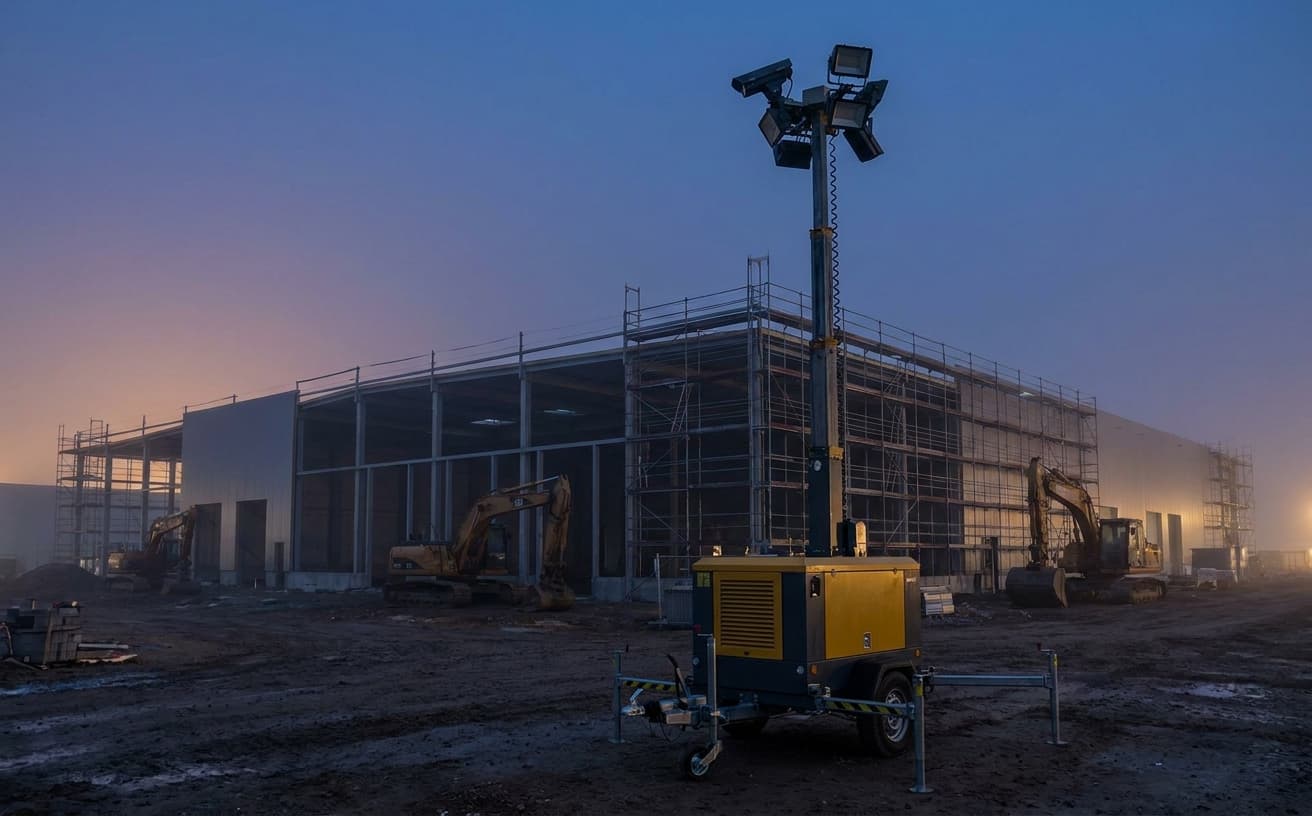
A giga-project is not a large construction site. It is a temporary city whose population, perimeter and logistics graph change weekly, and whose security cannot be conceived in the categories of conventional site protection.
That distinction is not academic. It dictates which sensors fail, which contractor structures generate theft, and which surveillance assets actually survive twelve months in the field. The Saudi developments at NEOM, Qiddiya and Red Sea Global have made this visible at a scale the industry had not previously been forced to confront. Towers, robots and video analytics that are perfectly adequate on a European logistics yard collapse, sometimes literally, against the combination of dust, heat, contractor proliferation and distances measured not in meters but in kilometers. The manufacturer's perspective on these projects has therefore had to change. Boswau + Knauer has spent several deployment cycles adapting platforms originally conceived for German and Central European construction environments to a context in which the conventional vocabulary of perimeter security loses most of its meaning.
The giga-project as a security category of its own
A conventional construction site, even a large one, can be described by a closed perimeter, a manageable number of access points, a finite contractor list and a logistics pattern that stabilizes within the first weeks of mobilization. None of those properties hold at NEOM, Qiddiya or Red Sea Global in any meaningful sense. NEOM alone covers an area larger than several European states. The Trojena mountain sub-project, the Oxagon industrial harbor and The Line linear development each carry their own perimeter logic, their own contractor ecosystem and their own logistics rhythm. Treating any of them as a single site is a category error that produces the wrong security architecture from the first deployment plan.
The first consequence is that perimeter, in the classical sense, ceases to exist as the primary unit of protection. What replaces it is a layered topology of nodes: laydown yards, fuel depots, accommodation camps, batching plants, prefab assembly areas, equipment parking, fiber and power corridors. Each node has its own value profile, its own exposure window and its own logical neighbors. A mobile tower at a giga-project does not guard a fence. It guards a node in a graph, and its position must be reconsidered every time the graph mutates, which on these projects happens in cycles of weeks, not quarters.
The second consequence is that the operator function moves to the center of the architecture. NIST CSF 2.0 in its Detect and Respond functions makes the point in general terms: detection without orchestrated response is documentation, not security. At giga-project scale, an operator in a centralized control room may be responsible for fifty or eighty mobile towers spread across hundreds of square kilometers, with response times that are physically constrained by distance to the next available patrol vehicle or guard force. This changes what a tower must do. It must not only see. It must classify, prioritize and reduce false positives to a level that allows a remote operator to retain situational awareness across an inventory that no single human could otherwise hold in mind. The reference architecture moves closer to what IEC 62443 calls a zone-and-conduit model than to anything resembling traditional CCTV.
The third consequence concerns the contractor ecosystem. A typical mid-sized German project might involve thirty to fifty subcontractors over its lifetime. At a giga-project, that number reaches into the hundreds, sometimes the low thousands, with personnel rotations counted in tens of thousands per month. ASIS International guidance on construction security identifies insider involvement as a leading factor in losses on large sites. At giga-project scale, the insider category is not a fraction of the workforce, it is a population. The architecture of surveillance has to assume that the perimeter is permeable by definition and that internal nodes are the actual battleground.
What towers really do at this scale
The mobile surveillance tower, in the Saudi giga-project context, is misunderstood when it is described primarily as a camera on a mast. Its function is operational, not optical. It is a deployable security node that delivers four things simultaneously: persistent observation of a defined area, visible deterrence, autonomous power and communications, and a known reference point in the response graph that operators and patrol forces can name and reach.
Persistent observation is the function most often discussed and the easiest to overstate. A tower with four cameras and a thermal imager covers a defined arc and depth, no more. Without overlapping coverage from adjacent towers, the gaps between assets at giga-project distances are large enough to accommodate any organized intrusion. The serious deployment question is therefore not the specification of the individual tower but the density of the tower network across the node graph. Boswau + Knauer plans these networks backward from the desired probability of detection within a defined intrusion path, not forward from a unit count per hectare. The difference matters in the bid stage, where unit counts are easy to negotiate and probabilities are not.
Visible deterrence is the function most underestimated. The tower works before the event in a way that no concealed camera ever can. CISA's guidance on physical security for critical infrastructure treats visible deterrence as a first-line control precisely because it shifts the cost calculus of the would-be intruder. On a giga-project, where opportunistic and organized actors operate in parallel, deterrence is the layer that reduces the volume of incidents the operator and patrol forces would otherwise have to absorb. A tower that is invisible from the access roads to a laydown yard is a tower that has been incorrectly positioned, regardless of how well its sensors perform.
Autonomous power and communications determine whether the tower exists as a real asset or as a paper one. Solar with battery buffer, sized for the actual irradiation pattern of the AlUla, Tabuk or Riyadh regions, is the baseline. Diesel hybrid is the fallback for tower positions adjacent to active concrete pours or earthworks where dust degrades panel output below the design assumption. Communications run on a combination of cellular, where coverage exists, and private LTE or mesh radio where it does not. The redundancy is not an aesthetic preference. It is the condition under which the tower remains a node in the graph rather than a dark spot that the operator has to assume compromised.
The fourth function, being a named reference point, is the one most often left out of technical specifications and most often decisive in practice. When an incident occurs, the patrol force does not respond to coordinates. It responds to a tower designation. The naming convention, the visual marking, the operator's ability to direct a guard vehicle to "Tower 47, north-west camera, vehicle approaching from access road three" is what turns detection into intervention. This is logistics, not optics.
Theft patterns specific to giga-project logistics
Theft on giga-projects follows patterns that diverge from the European baseline in three respects. The first is target selection. The second is timing relative to the logistics cycle. The third is the involvement of the contractor structure itself.
Target selection at NEOM, Qiddiya and Red Sea Global concentrates on three categories. High-value portable equipment, particularly survey instruments, specialist power tools and tablet-class electronics, remains the most frequent loss category by incident count. Copper and non-ferrous metals, despite the well-publicized regional crackdowns, continue to be removed from cable spools, transformer stations and unattended electrical works. Fuel, both diesel and gasoline, is taken from equipment tanks and storage bowsers at a rate that the operators of large fleets are reluctant to discuss publicly but which appears in the post-calculation of every project that performs the analysis honestly. The National Insurance Crime Bureau has documented equivalent patterns in large North American projects and the structural similarity is high enough to justify the comparison.
Timing patterns cluster around the logistics cycle in ways that mass-deployed analytics learn to recognize. The interval between delivery and installation is the highest-risk window. Material that has been received but not yet incorporated into the works is unaccounted for in both directions: the supplier has handed over, the installer has not yet taken on. Inventories at this stage are reconciled weekly at best, often monthly, and a competent insider knows the reconciliation calendar. Towers positioned at laydown yards, with analytics tuned to recognize loading activity outside scheduled shift windows, address this window directly. The GDV statistics for German construction losses show the same pattern at smaller scale, and the underlying logistic logic is universal.
Contractor proliferation is the variable that distinguishes giga-projects from anything in the European baseline. A mid-tier package on NEOM may carry six layers of subcontracting between the main contractor and the laborer who actually handles the material. Each layer reduces accountability and increases the population of personnel with legitimate access who are unknown to each other. The classical insider threat model, which assumes an identifiable group of employees with traceable relationships to assets, breaks down. What replaces it is a probabilistic model: at any given moment, a defined percentage of personnel on site are within their first thirty days, a further percentage are within their last thirty days, and the security architecture must assume that both populations carry elevated risk. Towers, in this model, are not primarily there to catch the determined criminal. They are there to make the routine opportunistic theft uneconomical, to compress the window of unobserved access, and to generate the recorded evidence that allows the post-incident process to function at all.
Supply, integration and the politics of who builds the network
The question of who supplies mobile surveillance towers to Saudi giga-projects is operationally less interesting than the question of who integrates them. The hardware market is not monopolistic. Several European manufacturers, including Boswau + Knauer, supply units that meet the durability and autonomy specifications. Regional assemblers, often working under license or with imported sub-assemblies, supply additional volume. The hardware, in itself, is not where the projects succeed or fail.
Integration is where the architecture is decided. A mobile tower is useful to the operator only to the extent that its video stream, sensor data and alarm events appear in the same workspace as the rest of the security stack: fixed cameras, access control, guard tour systems, vehicle telematics, drone feeds, and increasingly autonomous ground patrol units. The dominant practice on the Saudi giga-projects has been to specify integration platforms at the master developer level and to require all subcontracted security providers to feed into them. The standards referenced in these specifications draw on ISO 27001 for information security management, NIST 800-53 for control families, and IEC 62443 for the operational technology zones. The manufacturer who arrives without an integration story arrives without an order.
The manufacturer's monograph BOSWAU + KNAUER. From Building to Security Technology develops this point in the context of European projects, where the integration question is increasingly the determinant of supplier selection even at conventional site scale. On giga-projects, the question is no longer optional. A tower that cannot be integrated into the master security operations center is a tower that the operator cannot orchestrate, and an unorchestrated tower is a sunk cost in the post-mortem of any serious incident.
A second integration dimension concerns the patrol and response layer. Towers detect, but they do not intervene. The response time from detection to patrol arrival, at the distances involved on these projects, is rarely under several minutes and frequently longer. This makes the design of the patrol layer, in vehicle inventory, route planning and shift coverage, a security architecture question rather than a guarding question. Towers and patrols must be designed together. Boswau + Knauer has, on several engagements, taken the position that delivering towers without participating in the patrol design produces an inferior outcome for the client, even where the contractual scope would have permitted a narrower delivery.
Data routing, sovereignty and the regulatory frame
The data generated by mobile surveillance towers on Saudi giga-projects is subject to a regulatory frame that has matured substantially over the past several years. The Personal Data Protection Law issued by the Saudi Data and AI Authority establishes obligations for the processing of personal data, including video that identifies individuals, that are broadly comparable in structure, though not in every detail, to the European GDPR baseline. Operators are required to maintain processing records, implement appropriate security controls, and observe constraints on cross-border transfer. The BSI's guidance on video surveillance, and the European Data Protection Board's positions on construction site monitoring, provide useful comparators for European manufacturers operating in the Saudi context, with the understanding that the local law governs in case of conflict.
The practical consequence for tower deployment is that data routing has to be designed, not assumed. Storage in-country is the default for most master developers. Edge processing on the tower itself, with only metadata and alarm events transmitted to the central control room, has emerged as the preferred architecture for both bandwidth and compliance reasons. Full video is retained locally for a defined retention period and accessed on demand. This shifts processing load to the edge device and raises the specification requirements for the on-board compute, which in turn affects power budget, thermal management and ultimately the autonomy of the unit in field conditions.
A second consequence concerns the analytics models themselves. Models trained on European datasets do not transfer cleanly to Saudi field conditions. The lighting environment, the dust profile, the vehicle and equipment population, and the clothing of the workforce all differ enough that classification accuracy degrades unless the models are retrained on local data. The manufacturer who claims a single global model is, in practice, claiming a model that will produce elevated false positive rates in at least one of the deployment environments. Boswau + Knauer's position has been that model adaptation is part of the deployment, not a post-sale service, and that the operator's tolerance for false positives is the binding constraint on what the analytics layer is permitted to claim.
What holds
The mobile surveillance tower at a Saudi giga-project is not a product. It is a node in an architecture whose other components, the operator, the patrols, the integration platform, the contractor structure, the regulatory frame, determine whether the tower delivers security or merely generates footage. The manufacturer who understands this designs differently, sells differently, and survives the second deployment cycle.
The structural points carry beyond the Saudi context. Perimeter logic gives way to node logic at any project scale where the contractor population exceeds the operator's capacity to know it. Visible deterrence outperforms concealed observation at any site where the cost of an incident exceeds the cost of preventing one. Integration determines whether towers are assets or sunk costs. These observations are not specific to NEOM, Qiddiya or Red Sea Global. They are specific to the class of project these developments have made visible.
For operators considering how to position their own security architecture in light of these observations, three paths are available. A sixty-minute confidential conversation with the manufacturer establishes whether the questions raised here have analogues in the operator's own portfolio. A three-to-five-day audit converts the conversation into a written assessment with a defined deliverable. A ninety-day pilot at a single site converts the assessment into operational evidence. Each path stands alone. None of them requires the others.
Frequently asked questions
How many towers at NEOM?
A precise figure is not publicly disclosed by the master developer and would, in any case, be a moving target given the rolling mobilization of sub-projects. Public statements from contractors and security providers suggest deployments in the high hundreds across the NEOM footprint as a whole, with concentrations at Trojena, Oxagon, The Line construction corridor and the regional logistics hubs. The operationally relevant figure is not the absolute count but the tower density per node and the response time from detection to patrol arrival, both of which are project-internal metrics.
Who supplies them?
The supplier landscape is mixed. European manufacturers, including Boswau + Knauer, supply units that meet the durability and autonomy specifications. Regional assemblers in the Gulf supply additional volume under license arrangements or with imported sub-assemblies. North American and East Asian suppliers are present in smaller numbers. The determining factor in supplier selection has shifted over the past several deployment cycles from hardware specification to integration capability, particularly the ability to feed into the master developer's specified security operations platform under ISO 27001 and IEC 62443 reference architectures.
What are the theft patterns?
Three patterns dominate. First, high-value portable equipment, including survey instruments, specialist tools and tablet-class electronics, taken in the interval between delivery and installation. Second, copper and non-ferrous metals from cable runs, transformer stations and unattended electrical works. Third, fuel from equipment tanks and storage bowsers. The contractor proliferation typical of giga-projects, with six or more layers of subcontracting in some packages, elevates insider involvement to a structural variable rather than an exceptional one. ASIS International and NICB pattern analyses provide useful comparators.
How is the data routed?
The dominant architecture is edge processing on the tower itself, with full video retained locally for a defined period and only metadata, alarm events and operator-requested footage transmitted to the central security operations center. In-country storage is the default under the Saudi Personal Data Protection Law administered by the Saudi Data and AI Authority. Cross-border transfer is permitted under defined conditions but is rarely the operational baseline. Bandwidth and compliance considerations point in the same direction, which is why edge-heavy architectures have become the practical standard.
Related topics
- Solar Surveillance Trailers on a Construction Site
- Mobile Video Tower vs Security Guard: Cost Showdown
- Mobile Video Surveillance 2026: Rentals vs CapEx
- Mobile Surveillance Towers on UAE Megaprojects
- Mobile Surveillance Towers at Jebel Ali Port
Take the next step: See prices & ROI · Explore the products · Send a no-obligation request. BOSWAU + KNAUER – direct from the factory in Filderstadt, reply within 5 working days.
About the author
Dr. Raphael Nagel (LL.M.) is founding partner of Tactical Management. He acquires and restructures industrial businesses in demanding market environments and writes on capital, geopolitics, and technological transformation. raphaelnagel.com
More reading
Since 1892.
The firm is reached at boswau-knauer.de or +49 177 2266267.