
Blog
Mobile Surveillance Towers on UAE Megaprojects
Etihad Rail corridors, NEOM Line earthworks, Saadiyat museum cluster. Where towers actually deploy on Gulf megaprojects.

Dr. Raphael Nagel
October 17, 2025
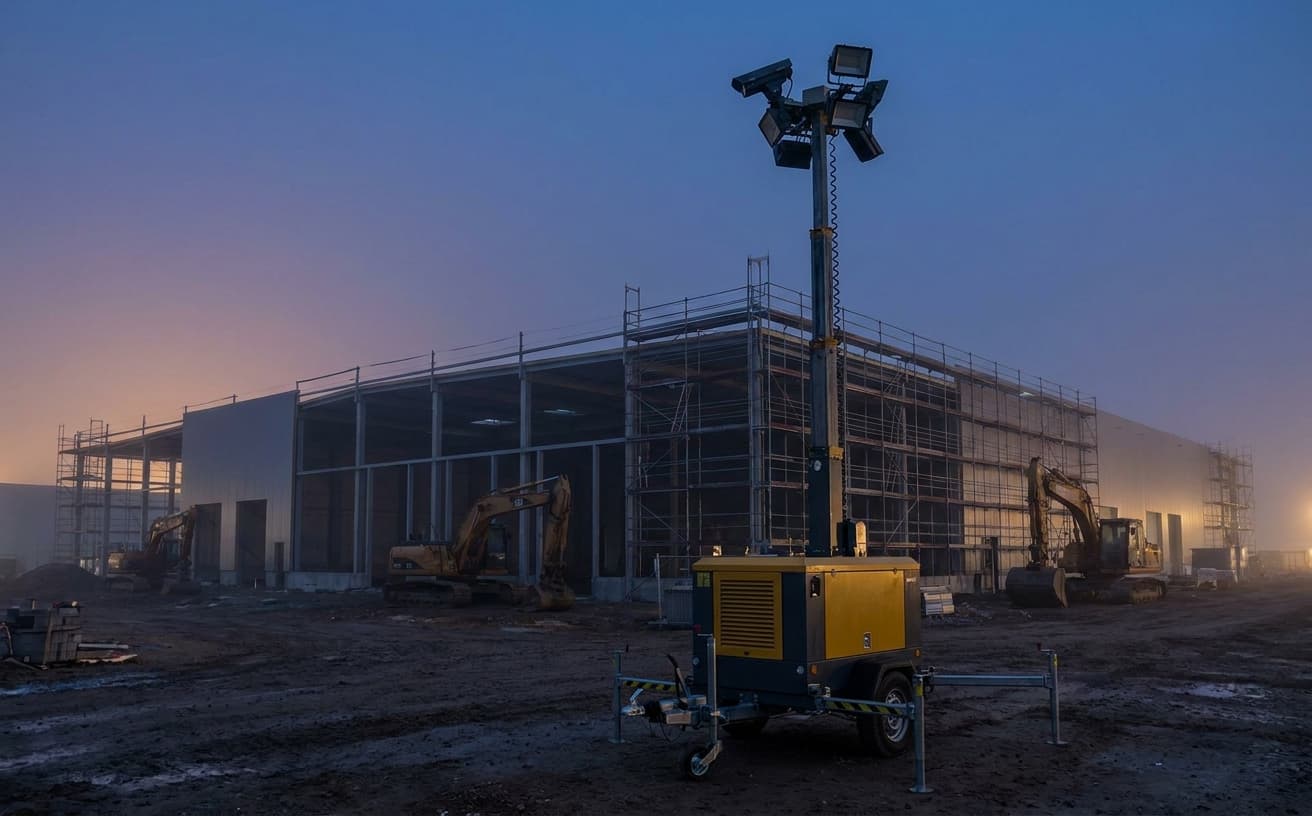
A megaproject is not a large project. It is a project whose perimeter changes faster than any fixed installation can be re-trenched, re-wired, or re-cabled to follow it.
That single property, the moving perimeter, is what decides whether surveillance technology earns its place on a Gulf site or sits as decoration on a budget line. On the Etihad Rail corridors, on the earthworks adjacent to The Line, on the museum cluster of Saadiyat, and on the staging yards that feed Expo City Dubai legacy works, the fence line that exists on Monday morning is a different fence line by Thursday. Trenched cameras, hardwired light masts, and permanent control rooms cannot keep pace. Mobile surveillance towers can, when they are specified correctly, deployed correctly, and connected to a monitoring discipline that does not collapse after the first month.
What follows is a manufacturer's account of where these towers actually deploy on Gulf megaprojects, how they are configured for desert conditions, what the cost structure looks like once it is examined honestly, and where the failure modes hide. The argument draws on chapters eight and thirteen of BOSWAU + KNAUER. From Building to Security Technology, and on field experience accumulated through pilots and deployments where the heat, the dust, and the project clock leave no room for vendor theatre.
The Etihad Rail corridor and the geometry of linear sites
Etihad Rail, in its operational and ongoing stages, is the clearest example in the region of a security problem that defeats fixed infrastructure. The corridor runs over a thousand kilometres when the full network is counted. Material lay-down areas shift weekly. Track laying machines, ballast trains, sleeper depots, signalling cabinets, and copper return conductors create a continuous procession of high-value targets, each of them present at a given coordinate for a defined number of days and then gone. A trenched camera installation that takes three weeks to commission has no time to amortise before the asset it was meant to watch has moved sixty kilometres down the alignment.
Mobile towers, by contrast, follow the work. A typical deployment pattern on a rail corridor places one tower at each active staging yard, one at each material transfer point, and floating towers at the live track-laying head and at the rear protection point where finished works are not yet handed over to operations. Towers are repositioned in line with the construction schedule, not in line with a separate security plan. The integration between project planning and surveillance positioning is what distinguishes a functioning corridor security architecture from a collection of expensive masts.
The exposure profile on a rail corridor is also specific. Copper theft is the headline risk and the one that drives insurance discussion, but it is rarely the largest financial loss in a calendar year. Diesel theft from rail-bound plant, sabotage or accidental damage to signalling cabinets during third-party works, and undocumented incursions by adjacent contractors who treat the corridor as a shortcut produce a continuous baseline of incidents that no static system catches. Mobile towers with thermal imaging, radar-assisted perimeter detection, and verified video analytics reduce this baseline by an order of magnitude when the configuration matches the corridor's actual geometry. The relevant standards here are IEC 62443 for the integration with operational technology on the rail side, and the structural logic of NIST CSF 2.0 for organising the detect, respond, and recover functions across the corridor as a single estate rather than as a sequence of isolated camps.
NEOM, The Line, and the earthworks adjacency problem
The earthworks supporting The Line and the broader NEOM development sit in a category of their own. Public attention focuses on the architectural rendering, but the security work concerns the staging yards, the haul roads, the concrete batching plants, the labour accommodation perimeters, and the materials corridors that feed the spine. These are sites where the construction estate adjoins desert in every direction, where the nearest formal settlement may be tens of kilometres away, and where the response time of any external security force is measured in hours rather than minutes.
Towers deployed in this environment serve three functions simultaneously. They provide deterrent visibility across a perimeter that cannot be physically fenced to any meaningful standard. They generate the recorded evidence that insurers, contracting authorities, and royal commission oversight require for incident documentation. And they extend a single operator's reach across a footprint that would otherwise require a guard force whose accommodation and rotation alone would consume the security budget twice over.
The desert adjacency problem is not only about distance. It is about the difficulty of distinguishing legitimate movement from intrusion when the background is empty. A camel, a Bedouin vehicle taking a traditional route, a survey team from a different contractor, and an actual material thief all produce thermal signatures that a poorly configured analytics model will treat identically. The work of tuning the detection envelope to local conditions is not a setup cost paid once. It is a continuous adjustment that runs for the life of the deployment, and any vendor who claims otherwise has not operated towers in the Empty Quarter or its margins for any meaningful length of time.
The accommodation cluster at the worker camps is a related but distinct application. Here the question is not intrusion from outside but the management of a population in the thousands, with shift movements, contractor handovers, and welfare considerations that turn the perimeter into a controlled-flow problem rather than a denial problem. Towers configured for camp surveillance carry different optics, different lighting, and a different analytics profile from towers on the open haul road. The same hardware platform serves both, but the configuration is unrecognisable between them.
Saadiyat, cultural cluster security, and the public-facing site
The museum cluster on Saadiyat Island presents a third profile, and one that is often misunderstood by operators who arrive from corridor or earthworks experience. The Zayed National Museum, the Guggenheim Abu Dhabi, the Natural History Museum, and the adjacencies to the Louvre and the existing performing arts venues create a construction zone that is simultaneously a public-facing destination. Tourists walk past the site hoardings. Diplomatic visits arrive without the kind of pre-notification that other site types receive. Media coverage is continuous, and any visible security incident becomes an international news item within hours.
The towers deployed on the Saadiyat cluster carry a configuration that prioritises discretion over visible deterrence in some sectors, and visible deterrence over discretion in others. The hoarding line facing the Corniche cannot host the same equipment profile as the lay-down area behind the construction office. Architectural sensitivity, in a context where ASIS International guidance on cultural property protection meets local heritage authority requirements, requires towers that can be moved into less visible positions, lowered, or substituted with lower-profile equivalents at short notice. The same towers, on the rear perimeter, run in full deterrent configuration because the threat profile there is conventional theft and unauthorised access by adjacent contractors.
The cultural cluster also drives the strictest documentation requirements of any UAE megaproject category. The insurance underwriters, often a syndicated international group rather than a single regional carrier, demand evidence trails that comply with ISO 27001 information security management for the recorded footage itself, not only for the IT infrastructure that handles it. Footage retention, access control, chain of custody, and the demonstration that the analytics decisions did not improperly capture identifiable individuals outside the site perimeter are matters that finished projects have failed on. The tower itself is a small part of that compliance picture, but it is the part that captures the data, and the configuration choices made at deployment determine whether the evidence is admissible or merely interesting.
Desert deployment, thermal load, and the failure modes nobody publishes
Manufacturers' data sheets describe operating temperature ranges that bear an optimistic relationship to summer conditions in Al Ain, Liwa, or the Tabuk region of NEOM. Ambient air temperatures of fifty degrees Celsius in shade translate to enclosure surface temperatures considerably higher, and the actual operating environment inside a tower head can exceed the specifications that European laboratory testing produced. A tower that runs continuously in Munich for five years may degrade in eighteen months on a Gulf site if the thermal management is not redesigned for the actual heat load.
The failure modes are predictable. Image sensors lose sensitivity in the upper part of the temperature range, producing washed-out images during the brightest hours of the day, which is also the time when haul roads are most active. Solar charge controllers, which are critical because most desert deployments are off-grid, derate aggressively above ambient thresholds, with the result that battery banks designed for twelve hours of overnight operation deliver eight. Cable insulation hardens and cracks under combined UV and thermal stress. Connector contact resistance rises, which produces intermittent faults that are hard to diagnose because they appear only at peak temperature and disappear at night when service teams arrive.
The redesigns required for serious Gulf deployment are not glamorous. Larger heat sinks. Active cooling on the camera head, not only on the electronics cabinet. Cable specifications above what European norms require. Solar array sizing that assumes a forty percent derating factor rather than a published twenty. Enclosure paint selected for thermal reflectance rather than corporate branding. Battery chemistry chosen for cycle life under elevated temperature, accepting the trade-off against initial energy density. Dust ingress protection at IP66 or higher with serviceable filtration, because the fine sand of the interior penetrates seals that perform faultlessly in coastal European conditions.
A tower built without these adjustments will function on day one. It will perform acceptably for one summer. The second summer reveals which manufacturers built for the climate and which built for the brochure. Procurement decisions that treat Gulf deployment as a European deployment with stronger sunscreen tend to be regretted in the fourteenth month.
What the per-night cost actually contains
Conversations about mobile tower pricing in the region often collapse into a single number expressed in dirhams per tower per night. The number is useful for budget pages and useless for actual decision-making, because what it includes varies by an order of magnitude between providers. A tower at the low end of the regional market may cost less than half of a tower at the upper end, and the cost difference between the two reflects real and measurable differences in capability that translate directly into incident reduction.
The components that determine the honest per-night cost on a UAE megaproject include the hardware platform itself, financed or rented over a defined contract period; the energy system, which is almost always solar with battery backup and which sizes differently depending on uptime requirements; the connectivity, which on remote corridors and earthworks adjacencies often requires satellite backhaul rather than cellular; the monitoring service, which is rarely included at the headline rate and is the largest variable cost above the hardware; the analytics licence, where it is licensed separately rather than bundled; the deployment and repositioning labour, which on a moving rail corridor or earthworks site can equal the hardware cost over a year; and the maintenance regime, including the spare parts inventory held locally, the response time commitment, and the replacement provisions when a tower fails or is damaged.
A reputable Gulf operator pricing a tower at a per-night figure that seems low against the market is either subsidising the early period to win the contract, omitting one or more of the above components, or operating equipment whose total cost of ownership is being silently transferred to the client through downtime, missed incidents, or end-of-contract recovery disputes. The right comparison is not per-tower per-night but cost per detected incident, cost per documented hour of coverage, and cost per square kilometre of perimeter monitored to a defined standard. These figures take longer to calculate and reveal more.
Across the active megaproject categories in the UAE and the wider Gulf, the credible range for a fully serviced mobile surveillance tower, including monitoring, analytics, and reasonable response provisions, sits well above what an unbundled hardware-only rental implies. The figure that operators with multiple Gulf deployments quote in private varies by site type and by contract length, but it is consistent enough that anyone receiving a quotation significantly below the band should examine what has been removed from the specification.
Who watches the feed, and why this is the question that matters
A tower without a monitoring discipline behind it is a recording device, not a security system. It produces footage that is reviewed after an incident, by which point the incident has already occurred and the loss has already been booked. The transition from recording to security happens at the monitoring centre, and the choices made there determine whether the tower has any preventive function at all.
Three monitoring models are in active use across UAE megaprojects. The first is in-country, in-house, where the project operator runs its own control room with its own staff. This model is rare outside the largest operators because the labour cost is significant, the training burden is continuous, and the difficulty of maintaining alertness through low-activity overnight shifts defeats most internal teams within a year. The second is in-country outsourced, where a regional security firm provides monitoring as a service from a local centre. This model dominates the market and produces acceptable results when the contract specifies response time commitments, false-alarm rates, and escalation procedures with enough rigour. The third is international monitoring with local response, where the video feeds are reviewed from a centre outside the region, often in Europe, and verified incidents are escalated to a local response team. This model exists for clients who require continuity through Gulf weekends, public holidays, and the periods when in-country resources are stretched, and it is more common on the higher-end deployments than the procurement literature suggests.
The analytics layer above the human operators is what makes any of these models economic. A single operator watching a single feed sees less than four hours of useful attention in an eight-hour shift, a figure consistent across decades of guidance from CISA, BSI, and the underlying human factors literature. An operator supported by analytics that filter the feed, surface only events that have passed a verification threshold, and present a prioritised queue can sustain attention across many more feeds and many more hours. The combination of NIST 800-53 controls applied to the monitoring infrastructure and IEC 62443 segmentation between the tower fleet and the operator network is what makes this model defensible to insurers and regulators. The towers are part of the system. They are not the system.
What holds
Mobile surveillance towers on UAE megaprojects work when three conditions are met simultaneously. The hardware is built for the climate, not retrofitted to it. The deployment follows the project's actual geometry, repositioning as the work moves, rather than sitting where the first plan placed it. And the monitoring discipline behind the feed combines verified analytics with operators who are organised, supported, and held to measurable response commitments. Where any one of these conditions fails, the towers become props, and the security budget pays for the appearance of protection rather than for protection itself.
Etihad Rail corridors, NEOM earthworks adjacencies, and the Saadiyat cluster are the three site types where the economics of mobile towers are most obviously favourable against any alternative, but the same logic extends to logistics yards at Khalifa Industrial Zone, to the construction perimeters around Al Maktoum airport expansion, to the data centre clusters under construction across Abu Dhabi and Dubai, and to the power and water infrastructure that supports all of them. Each site type carries its own configuration profile. The platform is the same. The configuration is unrecognisable between them, and the operators who deliver consistently are the operators who treat that configuration work as the actual product, with the hardware as the substrate that carries it.
Operators evaluating their current position on a Gulf megaproject have three paths forward with the manufacturer. A sixty-minute confidential conversation establishes whether the questions raised here apply to a specific site. A three to five day audit produces a written report on the existing configuration, with a defined deliverable set that the operator owns and can use with or without the manufacturer. A ninety-day pilot installs a configured platform on one defined location with measured success criteria agreed before deployment begins. The choice between them depends on how much certainty the operator already has about its current position, and how soon the next incident is expected to deliver that certainty in a less voluntary form.
Frequently asked questions
Which megaprojects use towers?
Active deployments across the UAE include the Etihad Rail corridors at both staging yards and live track-laying heads, the earthworks and worker accommodation perimeters supporting NEOM and The Line development on the Saudi side, the Saadiyat cultural cluster museum sites, the construction perimeters at Al Maktoum airport expansion, Khalifa Industrial Zone Abu Dhabi logistics yards, and the data centre clusters under construction across both emirates. Each site type drives a different configuration profile, but the underlying platform logic is consistent. The towers are not specialised by project. They are specialised by deployment context.
How are they deployed in desert?
Desert deployment requires hardware specified for sustained operation above the temperature ranges typical of European testing, with thermal management redesigned at the camera head and electronics cabinet, oversized solar arrays to compensate for derating, dust ingress protection at IP66 or higher with serviceable filtration, and cable specifications that account for combined UV and thermal stress. Repositioning is coordinated with the construction schedule rather than treated as a separate logistics task. Monitoring analytics are tuned to local background conditions to avoid the false-alarm rate that defeats poorly configured systems in the first three months.
What is the per-night cost?
The honest per-night cost varies substantially by what is included. A fully serviced tower with monitoring, analytics licensing, off-grid energy systems, satellite backhaul where required, and contracted response provisions sits in a range significantly above hardware-only rental quotations. Procurement decisions based on the headline number alone miss the components that determine actual security outcome. The relevant comparison is cost per detected incident, cost per documented hour of coverage, and cost per square kilometre monitored to a defined standard, calculated across the full contract period rather than the first month.
Who monitors the feed?
Three models dominate. In-house monitoring by the project operator is rare and expensive to sustain. In-country outsourced monitoring through a regional security firm is the most common arrangement and produces acceptable results when contracts specify response times, false-alarm rates, and escalation procedures rigorously. International monitoring with local response is more common on higher-end deployments than is generally recognised, providing continuity through Gulf weekends and holidays. The analytics layer above the human operators determines whether any model is economic. The towers are part of the system. They are not the system.
Related topics
- Mobile Surveillance Towers at Saudi Giga Projects
- Mobile Surveillance Towers in the Gulf: Solar Truth
- Mobile Surveillance Towers at Jebel Ali Port
- Mobile Surveillance Towers in France: The Olympic Legacy
- EU Procurement of Mobile Surveillance Towers: TED Guide
Take the next step: See prices & ROI · Explore the products · Send a no-obligation request. BOSWAU + KNAUER – direct from the factory in Filderstadt, reply within 5 working days.
About the author
Dr. Raphael Nagel (LL.M.) is founding partner of Tactical Management. He acquires and restructures industrial businesses in demanding market environments and writes on capital, geopolitics, and technological transformation. raphaelnagel.com
More reading
Since 1892.
The firm is reached at boswau-knauer.de or +49 177 2266267.