
Blog
Mobile Video Surveillance 2026: Rentals vs CapEx
Mobile surveillance as a finance decision. Lease, rent, capex, hybrid. Four models, twelve break-even scenarios, one honest answer.

Dr. Raphael Nagel
March 18, 2025
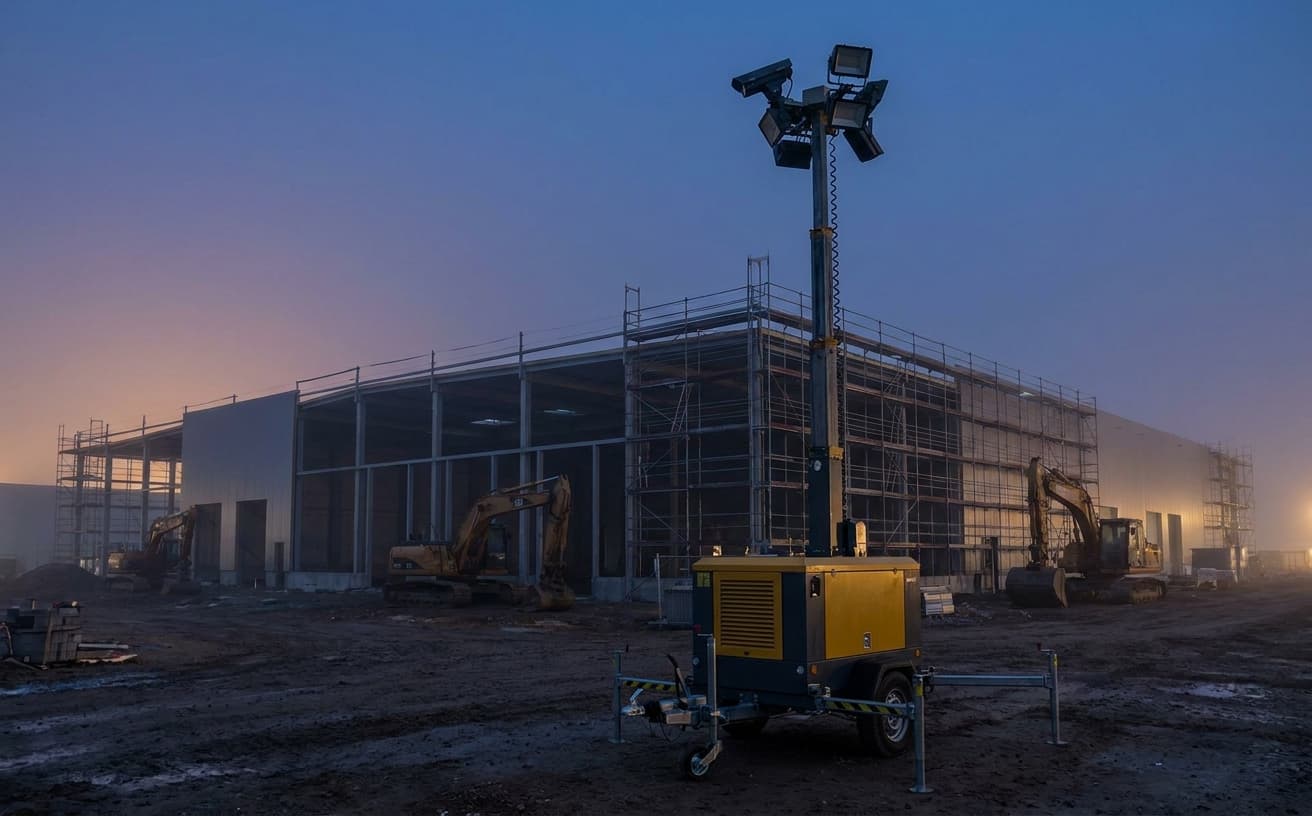
Mobile video surveillance is a finance decision dressed up as a technology purchase.
The hardware question is settled. A modern video tower combines four to six cameras, thermal optics, a video analytics stack trained on construction and yard environments, autonomous power through solar with battery buffer or hybrid generator, and a cellular uplink that holds through weather and load. The technical differences between credible suppliers have narrowed to the point where the operator cannot lose much by choosing among the top five. What the operator can lose, and frequently does lose, is the framing of the procurement itself. The question is not which tower. The question is on which balance sheet the tower belongs, for how long, and against which expected loss profile.
This article reorders the procurement around that question. It looks at four financing models, runs twelve break-even scenarios in qualitative form, and arrives at a position that BOSWAU + KNAUER has defended in field projects for several years. The position is uncomfortable for vendors who sell hardware and for buyers who like to own things. Rental wins more often than capex, and the inflection point sits at eighteen months.
The four models, named honestly
There are four ways to put a mobile video tower on a site. Each carries a distinct cash profile, a distinct risk allocation, and a distinct exit. Operators who confuse them confuse their own controllers, and the controllers eventually push back.
The first model is capital purchase. The operator buys the tower outright, depreciates it over five to seven years depending on jurisdiction, and carries the residual risk. Maintenance, firmware, SIM management, vandalism repair, and end-of-life disposal all belong to the operator. The cash hit is immediate, the asset shows on the balance sheet, and the depreciation runs whether the tower is on a site or in storage. Storage cost is the line nobody calculates at purchase and everybody pays after the second project ends.
The second model is finance lease. The operator pays a structured monthly amount over a fixed term, typically thirty-six to sixty months, with a residual buyout at the end. The lease sits on the balance sheet under IFRS 16. The accounting benefit that older operators remember from operating leases has been gone since 2019. What remains is the cash smoothing and a partial transfer of obsolescence risk. The lessor still expects the asset to come back in serviceable condition.
The third model is operational rental. The operator pays a daily or monthly fee for the tower while it is on a site, and returns it when the project ends or the threat profile changes. Maintenance, replacement, firmware, connectivity, and monitoring are bundled in or contracted separately. The tower never enters the balance sheet as an asset. The line item is an operating expense, planned per project, charged to the project budget, and recovered in the project's contingency or in the client's security clause.
The fourth model is hybrid, and it is the model BOSWAU + KNAUER builds most of its larger frameworks around. A small core fleet on capex, sized to baseline demand across a multi-year horizon, is supplemented by rental units that flex with project peaks. The core covers permanent yards, depots, and recurring industrial sites. The rental layer covers construction projects with defined timelines. This model survives audits because each unit is on the balance sheet that fits its actual use pattern.
Why eighteen months is the inflection
The number is not arbitrary. It comes from running the same arithmetic across hundreds of projects, in three industries, in four pricing regimes. The structure is simple. A video tower in the German and continental European market today carries a purchase price in a band that depends on configuration but tends to cluster between twenty and forty-five thousand euro for a serious unit. Rental rates run between forty and ninety euro per day depending on monitoring, analytics tier, and contract length. Maintenance, connectivity, and software updates add somewhere between fifteen and thirty percent of purchase price annually if the operator carries them itself.
Run those numbers across deployment durations. At three months, capex is absurd because the operator has paid the full price for ten percent of the useful life. At six months, capex is still losing badly because the residual value of a used tower is below sixty percent of purchase even in a healthy secondary market. At twelve months, capex starts to look competitive on the headline number but loses on the carry, because the tower will sit in storage for two to four months between deployments and the storage is not free. At eighteen months, the lines cross. Beyond eighteen months of continuous deployment, capex wins on direct cost, provided the operator has the internal capability to maintain, monitor, and redeploy the asset without paying a third party to do it.
The operator who does not have that capability never reaches the cross, regardless of duration. This is the second variable that the headline arithmetic hides. Capex is not cheaper than rental simply because the math says so. Capex is cheaper than rental if and only if the operator owns the operational infrastructure that makes ownership work. Most operators do not. Most operators who think they do, when audited honestly under the diagnostic in BOSWAU + KNAUER. From Building to Security Technology, find that they have purchase capacity without operational capacity. They own towers and pay someone else to run them, which is the worst of both worlds.
Twelve scenarios, qualitatively scored
A real procurement decision is never about a single tower on a single site. It is about a portfolio of deployments over a planning horizon. Twelve scenarios capture the realistic range.
Scenario one, a single construction project of four months on a residential site with moderate material values, falls clearly to rental. Scenario two, the same project extended to eight months due to permit delays, still falls to rental. Scenario three, a commercial project of fourteen months with significant copper and equipment exposure, sits at the border, and the answer depends on whether the operator has a follow-on project that absorbs the tower at month fifteen. Scenario four, a continuous industrial yard with no defined end date, falls to capex if the operational capacity exists, to managed service otherwise.
Scenario five, a logistics depot expansion of nine months, falls to rental. Scenario six, a critical infrastructure perimeter under a multi-year mandate from a public client, falls to capex with a structured maintenance contract, because the contract horizon justifies the depreciation curve. Scenario seven, an event venue with seasonal peaks, falls to rental for the peaks and capex for the off-season baseline if the venue runs year-round operations. Scenario eight, a renewable energy construction site in a remote location, falls to rental because logistics dominate the math and the rental provider absorbs the redeployment cost.
Scenario nine, a security services provider building a fleet for client deployments, falls to capex on a core fleet sized to seventy percent utilization, with rental for surge. Scenario ten, a developer running three to five concurrent projects with rolling timelines, falls to the hybrid model. Scenario eleven, an industrial operator replacing a guard service across multiple plants, falls to capex if the plants are owned and to managed service if leased, because lease-end clauses constrain installation. Scenario twelve, a public-sector body procuring under standard tender rules, almost always falls to operational rental, because the rules favor opex categorization and exit flexibility.
The pattern across the twelve scenarios is consistent. Short duration favors rental. Long duration with operational capacity favors capex. Long duration without operational capacity favors managed service. Mixed portfolios favor hybrid. The eighteen-month threshold is where the curves cross under typical European pricing, and it shifts by three to six months in either direction depending on local maintenance labor costs and secondary market liquidity.
What the standards expect
Procurement decisions made on cost alone fail audits made on compliance. Mobile video surveillance is not a regulatory blank space. ISO 27001 covers the information security management around the data the towers generate and transmit. The IEC 62443 family applies where the towers integrate with industrial control environments, which they increasingly do on logistics and energy sites. NIST CSF 2.0, in the Detect and Respond functions, frames the operational expectations around the analytics layer and the incident workflow that follows an alert. NIST 800-53 provides specific control families for the surveillance data, including AC for access, AU for audit logging, and SI for system integrity.
CISA guidance on physical security convergence, and ASIS International's professional standards on protective operations, both treat mobile surveillance as a component of a broader detection and response architecture, not as a standalone deterrent. The BSI, in its IT-Grundschutz catalog, addresses the connectivity and data-handling dimensions explicitly. The GDV's positioning on insurance discounts for monitored construction sites is qualitative rather than schedule-based, but underwriters consistently apply credits where towers are paired with documented response protocols and where the data retention meets the policy's evidentiary requirements. The NICB tracks the equipment-theft patterns that the towers are deployed to interrupt, and its statistics inform the threat-modeling that should sit upstream of the procurement.
The point is that the financing model does not change the compliance obligation. Whether the tower is owned, leased, rented, or consumed as a service, the data it produces, the analytics it runs, and the response it triggers all sit inside the same regulatory envelope. Operators who choose rental partly to push compliance onto the provider need to verify that the provider's compliance posture actually meets the operator's regulatory exposure. Often it does not. The provider's ISO 27001 certification covers its own operations, not the operator's chain of custody for evidence retrieved from the tower.
The hidden cost of ownership
The capex case looks strong on the spreadsheet that compares purchase price against multi-year rental sums. The case weakens when the spreadsheet is honest about what ownership requires.
Maintenance is the first line. A tower that runs continuously needs camera cleaning, battery checks, solar panel cleaning where applicable, generator service where applicable, and periodic firmware updates that frequently require on-site work because the cellular link is too slow to push the full image reliably. A reasonable maintenance schedule consumes between two and four field visits per tower per year. At loaded technician rates of seventy to one hundred twenty euro per hour, plus vehicle and travel, this is a four-figure annual cost per tower that owners systematically underestimate.
Connectivity is the second line. SIM cards, data plans, failover routing, and the soft cost of dealing with carrier outages add up. Most owners buy the tower and then realize they have signed up for a small telecommunications operation alongside their core business. The rental providers run this operation at scale, which is why their effective per-tower connectivity cost is materially below what an owner pays.
Software is the third line. The analytics layer requires periodic retraining, particularly when site conditions change or when the threat pattern shifts. An owner who buys a tower with analytics baked in is buying a snapshot of capability. The capability ages. Updates that the rental provider rolls out across its fleet do not automatically reach the standalone owner, who either pays for the update separately or watches the system drift behind the threat.
Storage and redeployment is the fourth line. A tower that is not on a site is a depreciating asset in a yard. Each redeployment involves transport, installation, configuration, and a test cycle. The cost runs between five hundred and two thousand euro per redeployment depending on distance and complexity. Owners with three deployments per year per tower are absorbing this cost three times. Rental providers absorb it once per deployment as part of the daily rate, and they amortize the transport across denser geographic clusters.
End-of-life is the fifth line. After five to seven years, the tower's components no longer support the current analytics, the batteries have degraded, and the secondary market value sits below disposal cost in many regions. Owners who did not budget for end-of-life write down the asset abruptly. Rental providers manage end-of-life as an internal flow, refurbishing where possible and disposing through scaled relationships that owners cannot match.
These five lines together typically add forty to sixty percent to the headline purchase price across the useful life. The capex case that looked decisive at the headline narrows considerably once these lines are included. This is the arithmetic that pushes the inflection toward eighteen months rather than the six or nine months that vendors quote when they want to sell hardware.
What holds
Mobile video surveillance procurement should start with deployment duration and operational capacity, not with hardware specification. Operators with deployments under eighteen months, or without the internal capacity to maintain a fleet, should default to rental and treat it as a project expense. Operators with longer-horizon commitments and genuine operational depth should build a core capex fleet sized to baseline and a rental layer that flexes with peaks. Operators in between, which is most operators, should run the hybrid model and stop pretending that ownership is a virtue.
The vendor conversation that produces the right answer is the conversation that begins with the operator's project pipeline and threat profile, not with the vendor's catalog. BOSWAU + KNAUER runs that conversation in Path I, a sixty-minute confidential discussion that arrives at a financing recommendation grounded in the operator's actual portfolio rather than in a generic comparison. Operators who want the recommendation tested against their own sites move to Path II, the three to five day audit that produces a written report with scenario costing, deployment plan, and a model recommendation that the operator can implement with BOSWAU + KNAUER or without it. Operators who want to validate the model against operational reality before committing the portfolio go to Path III, the ninety-day pilot that runs the recommended configuration at one site under defined success metrics and delivers the data on which the wider rollout is decided.
The hardware is settled. The arithmetic is knowable. What remains is the decision, and the decision belongs on the operator's desk, not the vendor's.
Frequently asked questions
What is mobile video surveillance?
Mobile video surveillance describes a self-contained, redeployable observation unit, typically a mast or tower, that combines multiple cameras, often thermal optics, on-board video analytics, autonomous power through solar with battery buffer or a hybrid generator, and a cellular uplink to a monitoring center. The unit installs in under an hour, operates without site infrastructure, and moves between sites as project needs shift. It is the operational successor to fixed CCTV on construction sites, industrial yards, logistics depots, and temporary perimeters where wiring is impractical and where the surveillance horizon is measured in months rather than decades.
When does rental beat capex?
Rental beats capex when the operator's deployment duration sits below approximately eighteen months of continuous use, when the operator lacks the internal maintenance and connectivity infrastructure to run owned assets at scale, when the project pipeline is uncertain enough that ownership creates storage risk between deployments, or when the procurement framework favors operating expenses for accounting or tender reasons. Above eighteen months of continuous use and with genuine operational capacity, capex begins to win on direct cost. Below that threshold, rental wins on total cost of ownership across maintenance, connectivity, storage, redeployment, and end-of-life.
How long is a typical rental?
Typical rental durations cluster in three bands. Short-term rentals run one to four months for events, peak-season logistics, or short construction phases. Medium-term rentals run four to twelve months and cover the majority of residential and commercial construction projects. Long-term rentals run twelve to thirty-six months for industrial expansions, infrastructure projects, and public-sector contracts under multi-year mandates. Beyond thirty-six months, the conversation typically shifts to either capex with a maintenance contract or a managed-service arrangement. The eighteen-month inflection point sits inside the medium-to-long band and marks the threshold where the model choice becomes consequential.
Who supplies the monitoring?
Monitoring can sit with the operator's internal security organization, with a contracted security services provider, with the tower supplier's own monitoring center, or in a split model where alerts are triaged by one party and response is dispatched by another. The choice depends on regulatory requirements around evidence handling, on the response infrastructure available locally, and on the operator's preference for control versus convenience. BOSWAU + KNAUER works with security services providers as partners rather than as competitors, supplying the technology layer that makes their monitoring more effective, and integrating with the operator's existing arrangements rather than displacing them.
Related topics
- UK Construction Mobile Surveillance: Why Operators Switch
- Solar Surveillance Trailers on a Construction Site
- Mobile Video Tower vs Security Guard: Cost Showdown
- Mobile Surveillance Towers at Saudi Giga Projects
- Mobile Surveillance at GCC Events: Expo, COP & F1
Take the next step: See prices & ROI · Explore the products · Send a no-obligation request. BOSWAU + KNAUER – direct from the factory in Filderstadt, reply within 5 working days.
About the author
Dr. Raphael Nagel (LL.M.) is founding partner of Tactical Management. He acquires and restructures industrial businesses in demanding market environments and writes on capital, geopolitics, and technological transformation. raphaelnagel.com
More reading
Since 1892.
The firm is reached at boswau-knauer.de or +49 177 2266267.