
Blog
Mobile Video Tower vs Security Guard: Cost Showdown
A two-column comparison. Cost per hour, coverage radius, response time, and the cases where a guard is still the right answer.

Dr. Raphael Nagel
February 4, 2026
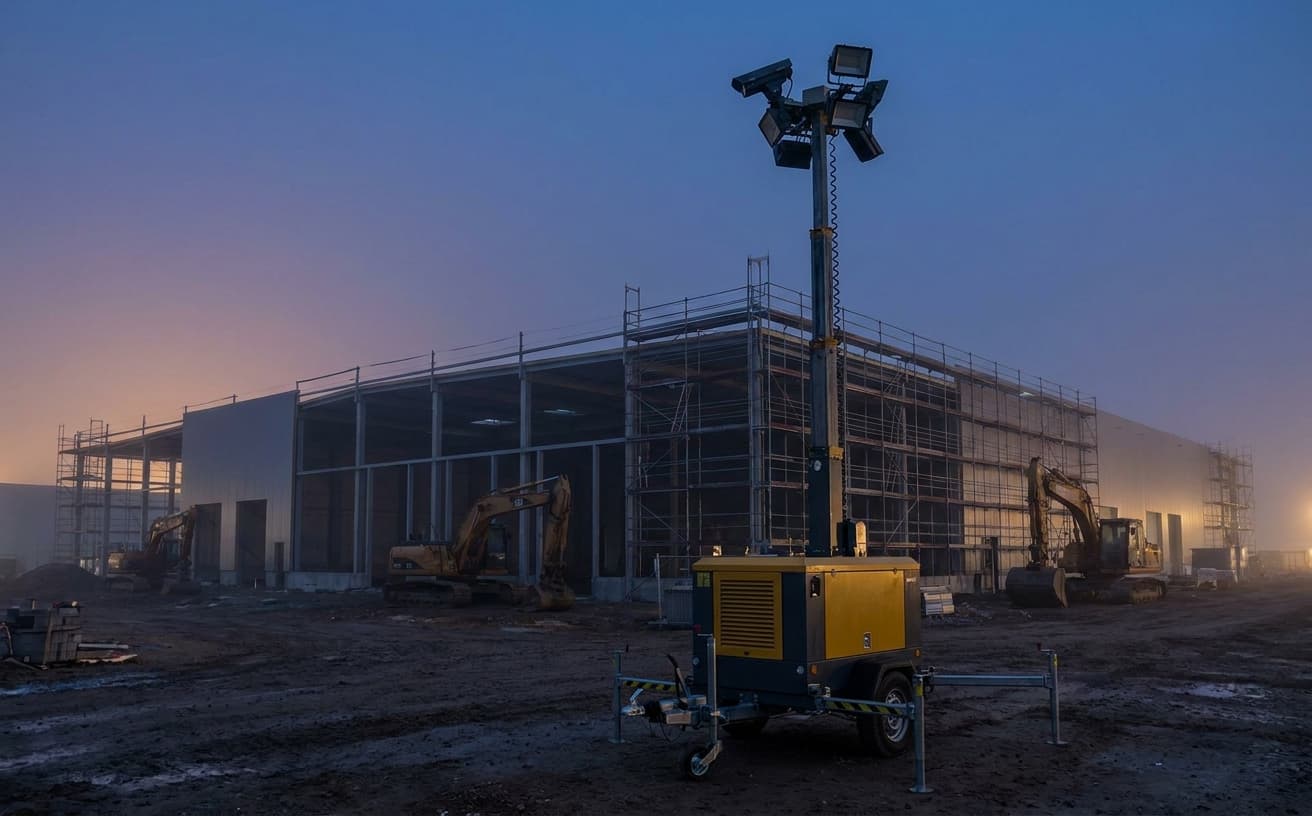
A guard does not patrol a site. A guard patrols a route, on a schedule, with intervals between passes during which the site is not under observation.
This distinction is the starting point of any honest comparison between mobile video towers and manned guarding. The guard is a person walking a beat, and between two passes there is a gap. That gap is where the loss occurs. The video tower, by contrast, does not walk. It sits, watches, and records, and the gap collapses to the time it takes a model to classify a frame. The two systems are not opposites. They are different tools, with different cost structures, different failure modes, and different evidentiary value. The decision between them, or between a combination of them, is a calculation, not a preference.
What follows is a comparison built from operator experience on construction sites, industrial perimeters, and logistics yards. It avoids the marketing register on both sides. The video tower is not a miracle, and the guard is not obsolete. Both have a domain in which they are the correct answer, and a domain in which they are the wrong one.
What each system actually delivers
A mobile video tower is a self-contained surveillance platform, typically four to seven meters tall, with multiple cameras, illumination, a recording unit, autonomous power from battery, solar, or a small fuel cell, and a data link by cellular or radio. The better units carry thermal imaging, audio deterrence, and an analytic layer that classifies events at the edge. Coverage radius depends on optics and lighting but ranges from forty to one hundred and twenty meters of useful detection, with longer ranges for vehicle-scale detection and shorter ranges for person-scale classification. The tower is installed in under an hour by two people and operates unattended for weeks before a service visit.
A security guard, in the sense relevant to most operators, is a contracted officer provided by a licensed firm under an hourly rate, often with a minimum shift length and surcharges for nights, weekends, and holidays. A single guard on a typical industrial site covers a patrol route that takes between twenty and forty minutes to walk. During that walk the guard is in one location and not in twenty others. Reaction to an event depends on whether the guard happens to be near the event when it occurs. A guard is also a witness, an interlocutor, and a person who can intervene physically within the legal limits of the jurisdiction. The video tower cannot do any of those things.
The two systems are therefore not substitutes in the strict sense. They overlap in deterrence and observation, and they diverge in intervention. ASIS International and CISA both treat physical presence and electronic surveillance as complementary layers in a defense-in-depth model, and that framing is closer to the operational reality than any direct head-to-head. The honest comparison is not whether one replaces the other, but where each delivers the marginal unit of security at the lower cost per protected hour.
Cost per hour, computed honestly
The hourly cost of a security guard varies by region, but the structure is consistent. In central and western Europe, a fully loaded guard hour, including wage, social charges, supervision, insurance, and the contractor's margin, falls in a range from approximately twenty-eight to forty-five euros for standard shifts. Night, weekend, and holiday premiums push the upper end well past fifty euros. A continuous twenty-four-hour, seven-day guard presence therefore costs between roughly two hundred and forty thousand and four hundred thousand euros per year per single officer. Most sites that use guards use more than one shift overlap, more than one officer for a large perimeter, or supervisory layers, and the annual figure rises accordingly.
The hourly cost of a mobile video tower is computed differently. The capital cost of a competitive unit ranges between fifteen thousand and forty thousand euros, depending on optics, analytics, and energy autonomy. Amortized over a service life of five to seven years and adjusted for maintenance, connectivity, monitoring, and an analytics subscription, the fully loaded operating cost per tower falls in a range of three to six euros per hour for continuous coverage. A monitored tower with a remote operator who responds to verified alarms adds between two and four euros per hour for the operator share, depending on how many towers that operator handles in parallel. The total comes to between five and ten euros per hour for a tower under active human supervision, a fraction of the guard hour.
This calculation is not the end of the discussion. It is the beginning. The tower hour buys observation, deterrence, and recording. It does not buy physical intervention. The guard hour buys observation during the minutes the guard is in the relevant location, plus the capacity to act. The correct comparison is therefore not euro per hour, but euro per protected event. On a site where the relevant events are theft of materials and vandalism after hours, the tower hour wins by a wide margin because it covers the whole perimeter continuously. On a site where the relevant events require an officer to stop, identify, and escalate to authorities in person, the tower hour does not buy the decisive capability.
Coverage, response, and the geometry of risk
Coverage is the property that exposes the difference most clearly. A tower covers its field of view at all times. A guard covers the entire site, but only in the moments the guard is at the relevant point. Translated into protected hours per euro, the tower delivers continuous observation of a defined zone for a small fraction of the cost of intermittent observation of the same zone by an officer.
The geometry matters. On a linear site, such as a pipeline corridor or a long perimeter fence, a single guard covers the route by movement, and a single tower covers only what it sees. On an enclosed site of moderate area, such as a construction lot of one to three hectares, two to four towers can deliver continuous coverage of all critical zones, while a single guard covers the same zones intermittently. On a site of ten hectares with multiple sensitive areas, the tower configuration becomes cost-competitive against any reasonable guarding rotation, and the cost gap widens at scale.
Response time is the second variable. A tower with edge analytics detects an intrusion in milliseconds, sends an alarm to a monitoring center within seconds, and triggers an audio challenge or a verified police dispatch within a minute. A guard, depending on position, reaches the event in anywhere from thirty seconds to ten minutes. NICB data on commercial burglary and recovered loss suggests that the first three to five minutes of an incident determine most of the outcome, and the question is therefore which system reliably acts inside that window. The tower with a competent monitoring center is faster than a single roving guard on a site larger than a few hectares, simply because the guard cannot be everywhere.
The third variable is evidentiary quality. A tower produces a continuous, time-stamped video record that is admissible in most jurisdictions and accepted by insurers under GDV-aligned policies in Germany. A guard produces an incident report based on what the guard saw, plus, in better-equipped contracts, body-worn camera footage during the intervention. The video tower's record is broader. The guard's record is narrower but contains the human observations a camera cannot supply, such as the conversation at the gate, the smell of fuel near a generator, the unidentified tool found behind a container.
Where a guard remains the right answer
The video tower does not win every category. There are operational contexts in which a guard is not optional, and the operator who replaces a guard with a camera in those contexts is taking on a risk that does not show in the savings line until it shows in a claim.
The first context is access control with verification. A guard at a gate verifies identity, checks credentials, signs in visitors, holds keys, and turns away unauthorized arrivals. A video tower can record the arrival, but it cannot stop a vehicle, ask a driver to open a trunk, or refuse entry to a contractor without proper paperwork. Sites with active access requirements, such as live construction phases with mixed trades or industrial yards with frequent deliveries, need a human at the gate during operating hours regardless of how dense the camera coverage is elsewhere.
The second context is intervention. A guard licensed under the relevant national framework, in Germany under the trade regulation provisions for security services and the framework documented by BSI for critical infrastructure protection, can detain, escort, and physically address a person on site within defined legal limits. A camera cannot. On sites where the threat model includes hostile entry by persons who will not respond to deterrence, the guard is the layer that closes the loop. Verified police dispatch from a monitoring center is the alternative, but in many jurisdictions the response time is in tens of minutes for non-emergency commercial calls, which is too long for some scenarios.
The third context is presence as policy. Some clients, insurers, or regulators require a documented human presence on site. This requirement is sometimes implicit, written into a construction contract or a lease, and sometimes explicit, written into a security plan accepted by an authority. In those cases the question is not whether the guard adds protection beyond the tower, but whether the contract permits the substitution. ISO 27001 and IEC 62443 do not directly mandate guards, but ISO-aligned policies for high-value sites often do, and an operator must read the contract before optimizing the line item.
The fourth context is the human function the camera cannot perform. A guard interacts with the workforce, builds informal intelligence about who comes and goes at unusual hours, defuses small disputes, and is the first responder to a fire, a medical incident, or a flood. These functions are not security in the narrow sense, but they are part of the operational continuity that a manned post delivers and a camera does not.
The hybrid configuration that usually wins
The most defensible configuration on most mid- to large-sized sites is neither pure technology nor pure manning. It is a hybrid in which the video tower handles continuous perimeter observation, the analytics layer filters events and escalates only verified ones, a remote monitoring center provides the cognitive layer at a cost a fraction of an on-site operator, and a reduced guard presence covers access control, intervention, and the human functions above. This configuration is consistent with NIST CSF 2.0 principles of layered controls and identifies the function each layer actually performs, rather than duplicating capabilities at high cost.
In a typical hybrid, four to six towers cover a ten-hectare site continuously, one to two guards cover the gate and active intervention during operating hours, and the night shift is reduced to a single guard or eliminated entirely in favor of monitored towers and on-call response. The cost reduction relative to a fully manned twenty-four-hour configuration is in the range of forty to seventy percent, with protection that is in most measurable dimensions equivalent or better. The argument for this configuration is developed at length in the chapter on mobile video towers in BOSWAU + KNAUER. From Building to Security Technology, and it is the configuration that has emerged as the operating standard on the sites we know best.
The hybrid is not free. It requires a discipline of integration that some operators find harder than purchasing either pure manning or pure technology. Towers must be positioned to deliver overlapping fields of view at the relevant elevations. Analytics must be tuned to the specific environment to suppress false alarms from wildlife, weather, and authorized movement. The monitoring center must have authority to dispatch and a documented escalation path. The on-site guards must understand which events the towers will catch and which they must catch personally. A configuration assembled without these disciplines delivers neither the cost reduction nor the protection. Assembled with them, it delivers both.
What the numbers do not capture
Two effects of the comparison sit outside the cost-per-hour calculation but matter to the operator who has to defend the decision in front of a board, an insurer, or a court.
The first effect is on insurance and claims. Insurers in the German market, working under GDV-aligned tariff structures, are increasingly willing to recognize continuous video surveillance with verified alarm response as an equivalent or superior risk control compared to intermittent manned guarding. The premium effect is measurable on policies for sites with high theft exposure, and the deductible structure often improves as well. Operators who run hybrid configurations with documented evidence of analytics performance and verified response times are in a stronger position at renewal than operators who rely on guard logs alone. Conversely, removing all manned presence in a context where the policy assumes it will result in claim disputes that erase any saving.
The second effect is on workforce relations and project culture. The presence of a guard at the gate of a construction site changes the behavior of everyone who passes through it, including the workforce. Removing the guard entirely shifts that culture. On sites where small-scale internal pilferage is a measurable share of loss, the cultural effect of an unmanned site is not negligible. Cameras deter strangers; a guard at the gate deters everyone, including those who hold a key. The right answer is not always to maximize either effect, but to know which one matters on the specific site.
What holds
The video tower wins on cost per hour of continuous observation by a wide margin, and on most sites with primary exposure to theft and vandalism it wins the overall calculation against a fully manned guard configuration. The guard wins, and remains necessary, where the protection function requires access control, physical intervention, contractual or regulatory presence, or the human operational layer that a camera does not deliver. The hybrid configuration, in which technology handles continuous observation and reduced manning handles the human functions, is on most mid- to large-sized sites the configuration with the best ratio of cost to protected outcome.
The decision is not ideological. It is operational. An operator who replaces a guard with a tower without understanding what the guard was actually doing will save money in year one and pay it back in claims in year two. An operator who refuses to consider towers because the security plan has always specified guards is paying a premium for a configuration that the underlying threat model no longer justifies. The way out of both errors is the same: a documented threat model, a measured baseline of incidents and response times, and a configuration designed against both.
For operators who want to test this on a single site before committing to a fleet, the appropriate path is a ninety-day pilot at one location with defined success criteria agreed before installation. The pilot produces the data on which a scaled decision can rest, and the data is the operator's regardless of whether the pilot extends into a contract. The alternative for operators who already know the answer in principle and need a structured audit of their existing configuration is a three-to-five-day on-site assessment that ends with a written report and a cost model the operator owns.
Frequently asked questions
When does a video tower beat a guard on cost?
A video tower beats a guard on cost when the protection requirement is continuous observation of a defined perimeter without a hard requirement for on-site intervention or access control. On a typical construction site of one to ten hectares with primary exposure to theft and vandalism outside working hours, a configuration of two to four towers with monitored response delivers protected hours at roughly one fifth to one tenth the cost of an equivalent manned night watch. The cost advantage grows with site size and shrinks with the frequency of events that require a physical response.
How many guards does a tower replace?
A single tower with edge analytics and monitored response replaces, in observation terms, the continuous coverage that a roving guard would deliver for the area in its field of view. In practical staffing terms, a configuration of four to six towers across a medium site typically replaces one full guard position on the night shift, including the supervisory overhead. The replacement is not one-for-one because the functions overlap only partially. The tower covers more ground continuously; the guard covers everything intermittently and can intervene. The right metric is protected zones per euro, not guards per tower.
What does a tower not do that a guard does?
A tower does not verify identity at a gate, refuse entry to an unauthorized person, detain an intruder under the legal authority of a licensed officer, respond to a medical incident, suppress a small fire, or build the informal intelligence that comes from being on site daily. A tower also does not provide the contractual or regulatory presence that some agreements require explicitly. These functions belong to the human layer of a security configuration, and an operator who treats them as optional will discover the cost of their absence under conditions chosen by someone else.
Can a tower and a guard work together effectively?
The hybrid configuration is the configuration we recommend on most mid- to large-sized sites. Towers handle continuous perimeter observation and event detection. A reduced guard presence handles access control during operating hours and intervention when towers verify an event that requires a physical response. A remote monitoring center provides the cognitive layer between detection and dispatch. The combined cost is typically forty to seventy percent below fully manned coverage with protection that is equivalent or better. The combination requires disciplined integration, but the result is the operating standard on the sites we know best.
Related topics
- Mobile Surveillance Tower Rental: What's in the Price
- Solar Surveillance Trailers on a Construction Site
- Mobile CCTV Towers: What 70% of Buyers Regret
- UK Construction Mobile Surveillance: Why Operators Switch
- Surveillance Trailer Rental: The US Market by Zip-Code-Tier
Take the next step: See prices & ROI · Explore the products · Send a no-obligation request. BOSWAU + KNAUER – direct from the factory in Filderstadt, reply within 5 working days.
About the author
Dr. Raphael Nagel (LL.M.) is founding partner of Tactical Management. He acquires and restructures industrial businesses in demanding market environments and writes on capital, geopolitics, and technological transformation. raphaelnagel.com
More reading
Since 1892.
The firm is reached at boswau-knauer.de or +49 177 2266267.