
Blog
Mobile Surveillance at the Port of Rotterdam
Containerised theft, drug interception, port-police coordination. How Europe biggest gateway runs mobile and fixed surveillance.

Dr. Raphael Nagel
June 13, 2025
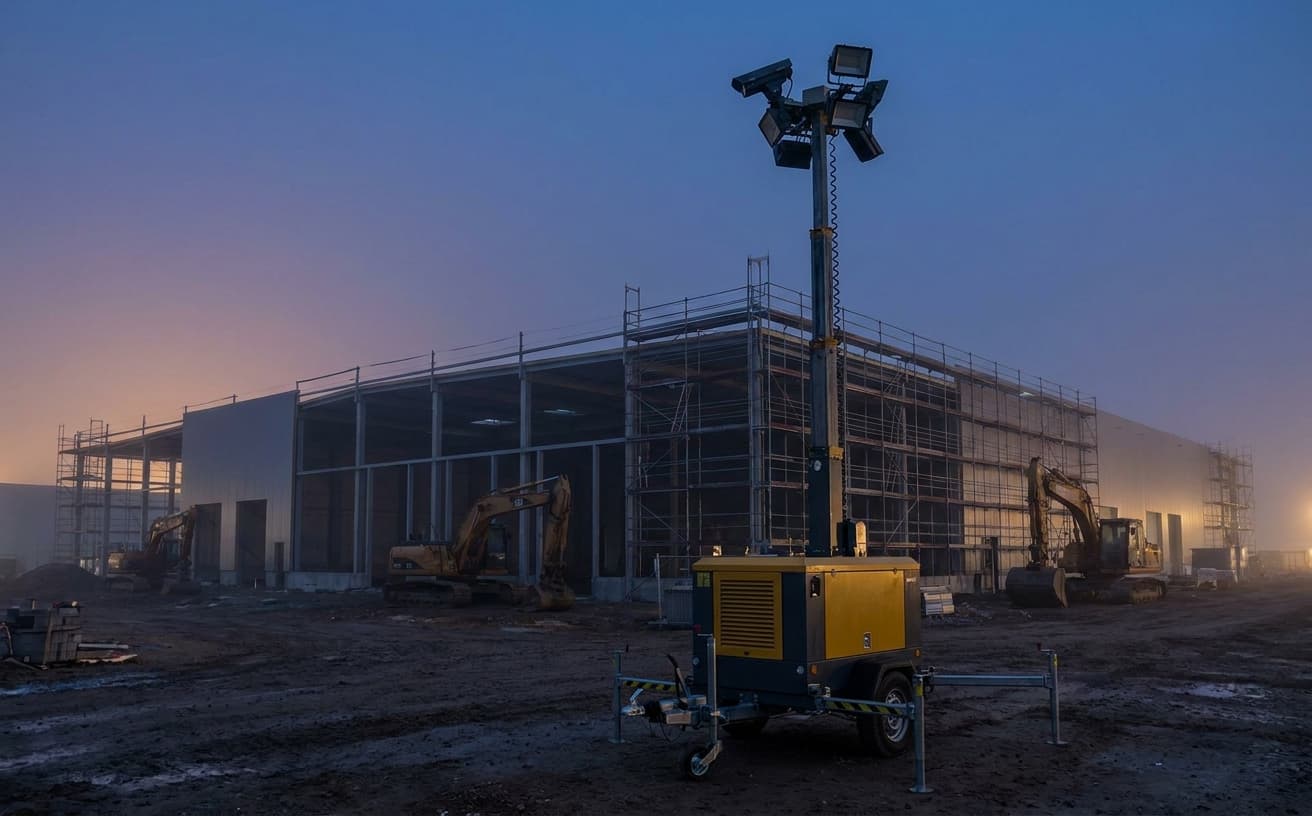
A port is not a perimeter. It is a moving system of containers, vehicles, vessels and people in which the boundary between inside and outside is dissolved several thousand times per day, by design.
That observation is the starting point for any honest discussion of surveillance at the Port of Rotterdam. The site covers more than forty kilometres of waterfront, handles roughly fourteen million standard containers a year, and processes a volume of cargo that places it ahead of every other deep-sea hub on the European mainland. Fences and gates matter, but they describe perhaps five percent of the security problem. The other ninety-five percent is movement: which box went where, who touched it, when, under what authorisation, and whether the seal that was on it at Singapore is still the seal on it at Maasvlakte II.
Surveillance at Rotterdam is therefore not a question of cameras on poles. It is a question of how mobile and fixed sensing, port police presence, customs analytics and terminal operator data are tied into a layered architecture that can act on a container before the container leaves the yard. The lessons translate to any logistics operator running a high-value, high-throughput site.
Why the port perimeter stopped being the answer
The traditional Dutch port security model rested on a fenced terminal, lit yard, manned gate and a CCTV grid wired back to a control room. That model dates from a period when the principal threat was opportunistic theft, when container volumes were a fraction of current levels, and when narcotics interception was a customs problem rather than a daily contest with organised crime networks embedded in the supply chain.
Three pressures broke that model. The first is volume. A terminal that moves more than ten thousand boxes a day cannot be policed by perimeter staff alone, because the perimeter is permeable by definition: every truck, every reach stacker, every vessel crew change is an authorised crossing of the line that, in another context, would be the line a security system is meant to defend. The second is the rise of the so-called extractor: a person, often coerced or recruited inside the terminal workforce, who collects narcotics from a designated container during normal yard operations. The Dutch customs service has reported cocaine interceptions at Rotterdam in the range of forty to fifty tonnes per year over recent reporting periods, and the unintercepted volume is by competent assumption higher. Extractor cases bypass the perimeter entirely. The third pressure is cyber-physical: terminal operating systems, gate automation and crane control are now part of the attack surface, which means a USB stick in a terminal office can do what a bolt cutter on a fence cannot.
The response, developed jointly by terminal operators, the Seaport Police (Zeehavenpolitie), Dutch Customs and private security providers, is layered surveillance. Fixed cameras with analytics cover quay walls, gate complexes, reefer stacks and container blocks. Mobile video towers move with the operational picture, deployed to a stack where a high-risk container is dwelling, to a perimeter section under construction, or to a temporary lay-down area outside the fenced terminal. Patrol vehicles, marine units and increasingly drones provide the kinetic response. The architecture is consistent with IEC 62443 zoning principles applied to physical assets, and with the layered defence logic that NIST CSF 2.0 and ISO 27001 describe for information systems. The vocabulary is different. The structure is the same.
The role of mobile video towers in container yards
Fixed surveillance answers a fixed question. A camera on a gantry sees what passes under the gantry. The container yard, however, is a fluid object. Stacks are reorganised on a shift-by-shift basis. High-value or high-risk boxes, including those flagged by customs targeting, are positioned according to operational logic that does not correspond to the camera plan installed when the terminal was built.
Mobile video towers exist to close that gap. A tower can be positioned next to a specific block within an hour of a risk decision, repositioned the following morning when the block is restowed, and removed when the box clears the yard. The unit operates autonomously on solar and battery hybrid power, transmits over LTE or private 5G back to the operator's control room, and runs onboard analytics that filter the live stream before it consumes bandwidth or attention. The classification logic discriminates between yard staff in high-visibility clothing performing expected tasks, vehicles operating on assigned routes, and movement that does not match either pattern. A person on top of a stack at 03:40 on a Sunday is not, statistically, a yard worker. The tower flags that fact in under a second.
Two operational considerations matter. The first is installation speed. A tower that takes a half-day to commission is not a mobile asset. The platforms used in serious port environments deploy in under thirty minutes, with two operators and a light commercial vehicle, without specialised tools. The second is hardening. A tower deployed in proximity to an organised crime extraction attempt is itself a target. Cameras have been blinded with paint, masts have been rammed, power cables have been cut. Construction therefore has to assume physical attack, which means tamper sensors on every access point, redundant power, encrypted backhaul, and a control room that escalates a loss-of-signal event the way it would escalate an intrusion.
The economics are straightforward. A mobile tower deployed for the duration a container dwells in a high-risk position costs a fraction of the loss represented by a successful extraction event, where the loss is not the narcotics value but the legal exposure, the regulatory consequences for the terminal operator, and the operational disruption when a block has to be sealed for investigation. The tower is a surveillance asset. It is also, by virtue of being seen, a deterrent asset. Visible technology shapes behaviour before any event takes place.
Coordination with the Seaport Police and Customs
A surveillance system that does not have a handover protocol to law enforcement is an archive. What distinguishes the Rotterdam architecture from a conventional CCTV deployment is the depth of coordination between private operators, the Zeehavenpolitie and Dutch Customs (Douane).
The Seaport Police maintain a permanent presence in the port area with marine, land and investigative units. They are not a response service called when a private alarm activates. They are an embedded actor with access to terminal operator data, customs targeting outputs and, under defined legal frameworks, live feeds from selected fixed and mobile surveillance assets. That integration is conducted under Dutch and European data protection law, which means the access is logged, scoped and revocable. It is not casual.
Customs targeting at Rotterdam operates on a layered risk model. Containers are scored before arrival on the basis of route, shipper history, declared content, weight anomalies and intelligence inputs. High-score containers are diverted to scanning, physical inspection, or controlled delivery operations in which the box is allowed to proceed to its destination under surveillance, with the objective of mapping the broader network. Surveillance assets, including mobile towers, are repositioned in support of these operations. The operator running the tower may not know which specific container is the subject of interest. The operator does know, however, that a specific block requires elevated coverage for a defined window.
This is the operational meaning of public-private cooperation in critical infrastructure protection. CISA, ENISA and the German BSI all describe the principle in their respective sector guidance. Rotterdam shows what it looks like when the principle is implemented at scale, with daily friction worked out over years rather than written into a memorandum of understanding and left there.
Container theft, narcotics and the data layer underneath
The visible theft problem at a major port is the smaller part of the security problem. Bulk theft of containers from a fenced terminal is rare because it is operationally difficult and because the moving parts, gate, paperwork, transport, are all surveilled. What is common is targeted extraction: a single container of high value or, more frequently, a container into which narcotics have been loaded at origin and from which they must be removed before customs inspection or legitimate consignee collection.
The defence is not a sharper camera. It is a tighter coupling between physical surveillance and the data layer underneath. Every container at Rotterdam carries an identity in the terminal operating system, a status, a location, a planned next move, and a chain of authorisations describing who may approach it and for what purpose. A surveillance event becomes meaningful only when it is correlated with that data. A person at a stack at night is a question. A person at a specific stack, at a specific box, at a time when no work order exists for that box, is an answer.
Building that correlation requires the surveillance system to speak to the terminal operating system, which requires both systems to be built on open interfaces and governed by a data protection framework that satisfies GDPR and the operator's own compliance posture under NIS2. It also requires the surveillance vendor to understand that the camera is not the product. The product is the integrated signal. A vendor that delivers footage and walks away has delivered a fraction of what a port operator needs. The architecture described in the manuscript BOSWAU + KNAUER. From Building to Security Technology rests on this distinction. The platform is built so that the signal travels from sensor through analytic to operator workstation to law enforcement handover without leaving the audited path.
NICB data on cargo theft in North America and ASIS International benchmarking on supply chain security both point at the same conclusion in different jurisdictions: the loss is rarely caused by a failure of the camera. It is caused by a failure of the correlation between the camera and the operational data that would have made the camera's output actionable.
What scales from Rotterdam to other operators
A logistics operator running a yard at one-hundredth the size of Rotterdam will not replicate the Dutch architecture. The principles, however, transfer with very little adjustment.
The first principle is layered sensing. Fixed coverage for the structural boundary, mobile coverage for the operational boundary, patrol response for the kinetic boundary. The three layers fail in different ways. A camera fails when the lens is obscured. A mobile tower fails when its power is cut. A patrol fails when it is delayed or misdirected. Combined, the failure modes do not overlap, and an attacker has to defeat all three to operate. This is the same logic NIST 800-53 applies to information system controls. It is the same logic IEC 62443 applies to industrial control zones. Physical security is not exempt from it.
The second principle is mobility. A surveillance system that cannot be repositioned in response to the operational picture is a static asset against a dynamic threat. Mobile towers, repositionable cameras, drone overflight and patrol routing under analytic control all serve the same purpose: matching the surveillance footprint to where the risk actually is on a given day.
The third principle is data integration. A camera that does not see the work order is blind to context. An operator that does not see the camera through the lens of the terminal operating system is processing noise. The integration is technical, but it is also organisational. The control room operator, the yard supervisor and the duty officer at the police must be looking at compatible representations of the same situation.
The fourth principle is governance. Surveillance at this density operates under privacy law, labour law, contractual obligation and, in many jurisdictions, sectoral regulation. ISO 27001 controls on access management, logging and retention apply to physical surveillance data as much as to financial records. An operator that treats the surveillance archive as an unregulated asset is exposed to consequences that have nothing to do with the original threat.
What holds
A port runs on movement. A port security system that runs on perimeters does not run on the port. Rotterdam has spent two decades building the architecture that follows from this observation, in cooperation with the Seaport Police, Dutch Customs and the private operators that hold the terminal concessions. The architecture is not finished, because the threat is not static. It is, however, mature enough to read.
For an operator outside Rotterdam, the practical question is not how to copy the Dutch model. It is how to apply its principles, layered sensing, mobility, data integration, governance, to a site at the scale and risk profile that actually exists. That work begins with an honest reading of the current state. Most operators have more surveillance than they think and less security than they need, because the surveillance is uncorrelated with the operational data that would make it useful.
The three paths described in BOSWAU + KNAUER. From Building to Security Technology cover the range of entry points. A confidential sixty-minute conversation establishes whether the framing applies to the operator's situation. A three to five day audit produces a written assessment of the gap between current state and what the operator's risk profile actually requires. A ninety-day pilot installs a defined system at a defined location with a defined success measure agreed before deployment. Most logistics operators benefit from the audit path, because the diagnostic value of an outside reading is highest where the operator has lived inside the existing arrangement long enough to stop seeing it.
Frequently asked questions
How big is Rotterdam?
The Port of Rotterdam covers approximately twelve thousand five hundred hectares and extends roughly forty kilometres along the New Waterway and the North Sea coast. Annual container throughput sits in the range of thirteen to fifteen million TEU, with total cargo throughput exceeding four hundred million tonnes in recent reporting years. It is the largest seaport in Europe by both metrics and ranks among the ten largest globally. The port hosts deep-sea, short-sea, inland barge, rail and pipeline modes, which means the security architecture has to address each of those interfaces with different sensor and procedural mixes.
What is the drug-interception scale?
Dutch Customs has reported cocaine seizures at Rotterdam in the range of forty to fifty tonnes per year during recent reporting periods, with figures fluctuating year to year and methodological differences in how transit versus destination volumes are counted. The interception figure understates the inbound flow by an unknown but assumed substantial margin, which is why the operational emphasis has shifted from interception alone toward disrupting the extractor networks that operate inside terminal labour pools. Surveillance, mobile and fixed, plays a direct role in mapping those networks rather than only in seizing product at the quay.
Who supplies port security?
Port security at Rotterdam is provided by a layered set of actors. The Port of Rotterdam Authority manages the harbour master function and overall port-wide coordination. The Seaport Police (Zeehavenpolitie), a unit of the Dutch National Police, holds primary law enforcement responsibility. Dutch Customs (Douane) operates targeting, scanning and inspection. Individual terminal operators contract private security providers for fenced terminal operations, who in turn deploy technology from a range of European and international suppliers. Mobile video tower and analytics platforms are typically sourced from specialised manufacturers serving industrial and logistics markets.
How does AI feature?
AI in the Rotterdam context is narrow and operational rather than general. Computer vision models running on cameras and mobile towers classify objects, persons and vehicles, filter the live stream and surface anomalies to human operators. Customs targeting uses risk scoring models trained on historical interception data, shipping records and intelligence inputs. Terminal operators use predictive analytics for yard planning that, as a side effect, generates the baseline against which surveillance anomalies are measured. The pattern is consistent across the architecture: AI reduces the volume of signal a human has to read, without replacing the human decision at the point where consequences attach.
Related topics
- UK Construction Mobile Surveillance: Why Operators Switch
- Mobile Surveillance at Aramco Field Sites: Uptime
- Mobile Surveillance Towers in the Gulf: Solar Truth
- Mobile Surveillance at GCC Events: Expo, COP & F1
- Mobile Surveillance Towers at Jebel Ali Port
Take the next step: See prices & ROI · Explore the products · Send a no-obligation request. BOSWAU + KNAUER – direct from the factory in Filderstadt, reply within 5 working days.
About the author
Dr. Raphael Nagel (LL.M.) is founding partner of Tactical Management. He acquires and restructures industrial businesses in demanding market environments and writes on capital, geopolitics, and technological transformation. raphaelnagel.com
More reading
Since 1892.
The firm is reached at boswau-knauer.de or +49 177 2266267.