
Blog
All-Weather Security Robots: What Outdoor Rated Means
IP ratings, ambient temperature, dust ingress, and rain detection. We translate the spec sheet language into the actual conditions a robot will see in a.

Dr. Raphael Nagel
February 1, 2026
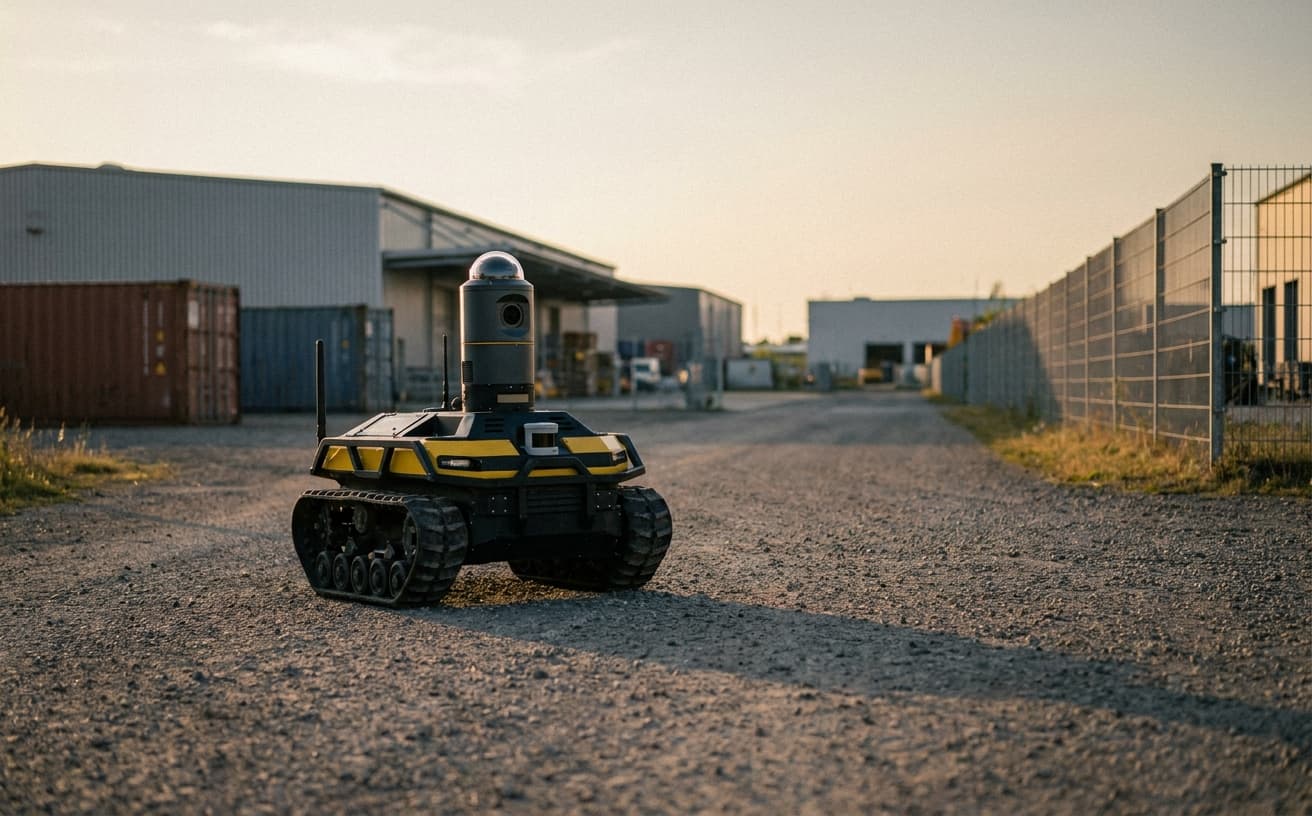
"Outdoor rated" is the most abused phrase on a security robot datasheet, because it conflates a laboratory ingress test with a multi-year operational warranty under wind, salt, hail, and ultraviolet light.
The phrase has acquired the weight of a guarantee while remaining, in technical terms, a snapshot. A device that earned its IP rating in a calibrated chamber at twenty degrees Celsius is not the same device after eighteen months on a coastal logistics yard. What buyers need is not a marketing label but a sober translation: which numbers describe what conditions, and which numbers are missing entirely from the published sheet. Boswau + Knauer builds and operates outdoor robotic platforms, and the gap between what the spec promises and what the field demands is the single most common source of disappointment among first-time buyers of mobile security hardware.
The argument that follows is operator to operator. It works through ingress protection, ambient temperature, sensor behaviour in precipitation, dust loading, ultraviolet and material fatigue, and the question of who is on the hook when the unit stops moving at three in the morning in February. Where standards apply, they are named. Where the field has taught lessons that no standard captures, those lessons are described in their own language.
What the IP rating actually certifies
Ingress Protection codes, defined under IEC 60529, consist of two digits. The first describes protection against solid objects, the second against liquids. A figure such as IP65 means dust-tight and resistant to low-pressure water jets from any direction. IP66 raises the water test to powerful jets. IP67 substitutes immersion at up to one metre depth for the jet test. IP68 extends immersion depth and duration to manufacturer specification. The two digits are not cumulative in the way an intuitive reading suggests, and a device tested under one regime is not implicitly qualified for the others.
What the test does not certify is equally important. The IP rating is a one-off, room-temperature laboratory event. It does not account for thermal cycling, which expands and contracts seals over thousands of cycles. It does not account for ultraviolet degradation of gaskets. It does not account for the static charge that pulls dust into vent grilles and slowly cakes them. It does not account for the operator who opens the service hatch in a downpour to change a fuse and does not properly reseat the gasket. Above all, it is a rating of the enclosure, not of the sensors that look out through windows in that enclosure. A robot can be IP66 and still suffer a camera lens that fogs internally because the dew point inside the housing crossed the glass temperature.
A serious procurement document therefore asks three questions beyond the printed code. First, what is the retest interval, and who performs it. Second, what is the warranty position if a sealing failure is discovered after, say, fourteen months of field operation. Third, what is the documented behaviour of the optical and acoustic apertures under the same conditions that the body survives. IEC 62443, which governs industrial automation security, expects this level of supply-chain transparency on the digital side, and the same discipline should be applied to the physical envelope. Without it, the IP rating becomes a sticker, not a contract.
Ambient temperature, and the difference between rated and operable
Temperature specifications on security robots typically read as a range, for example minus twenty to plus fifty degrees Celsius. The range describes the band in which the manufacturer is willing to stand behind the device. It does not describe the band in which the device performs identically, because no device does. Battery chemistry, lubricant viscosity, image-sensor noise, and processing-board thermal throttling all change across that range, and a robot at the cold end of its rating is not the same machine as the same robot at room temperature.
A German winter on a logistics yard north of Hannover routinely produces ambient temperatures of minus fifteen overnight, with surface temperatures on a steel chassis dropping several degrees lower under clear-sky radiative cooling. Lithium-ion cells lose useable capacity in this range, and discharge rates have to be derated to prevent voltage sag. A Texas summer on a substation perimeter produces ambient temperatures of plus forty in shade, but a robot parked in direct sun under a black housing reaches internal temperatures of sixty-five or higher. At that point, processing boards begin to throttle, frame rates on analytics drop, and the same model that classified intruders cleanly in March begins to miss them in July. The manufacturer has not lied. The buyer has misread the specification.
Boswau + Knauer derates published ranges by approximately ten percent at each end for procurement guidance, and recommends thermal management hardware, active cooling, heated battery compartments, or shaded docking, for any site that operates within five degrees of the published limits for more than a handful of days per year. This is not a counsel of caution. It is a counsel of arithmetic. The NIST Cybersecurity Framework 2.0 speaks of resilience as the ability of a system to maintain its function under adverse conditions. Resilience in outdoor robotics is, in the first instance, a thermal discipline. Anything else is decoration. Where a procurement team is uncertain about the thermal envelope of its site, a three to five day audit on Path II, with seasonal temperature data and shadow analysis, is the cheapest insurance available.
Rain, snow, and the sensors that have to keep seeing through them
A robot that survives rain is not the same as a robot that detects through rain. The IP66 rating addresses the first question. The second is governed by the physics of the sensor suite and the resilience of the analytics that interpret it. Optical cameras, thermal imagers, lidar, and radar each respond differently to precipitation, and the combination chosen by the manufacturer determines whether the platform retains its detection envelope in weather or surrenders it.
Heavy rain attenuates lidar returns at the longer ranges and produces spurious point clouds from raindrops themselves. Optical cameras lose contrast and gain spurious motion as drops cross the field of view. Thermal imagers degrade less in rain than is commonly assumed, but the wet skin of an intruder has a different thermal signature than dry skin, and analytics trained on dry-weather data drop precision sharply in the first hour of a downpour. Snow is harsher still, because accumulation on horizontal surfaces, including sensor windows, occludes the entire aperture within minutes if not actively managed. A heated sensor window solves part of the problem. A wiper or air-knife solves more. A robot that can return to a sheltered dock during the heaviest precipitation solves all of it, at the cost of detection downtime that must be calculated and disclosed.
The honest specification names a precipitation rate at which the manufacturer will warrant continued detection at stated probability of detection and probability of false alarm. The dishonest specification states only that the housing is rated to IP66 and leaves the operator to discover, on a wet November night, that the analytics have effectively switched themselves off. CISA guidance on physical security for critical infrastructure repeatedly emphasises that the most common failure mode of outdoor sensors is not catastrophic damage but silent degradation, in which the sensor continues to report data that is no longer reliable. The remedy is contractual: detection performance bands tied to environmental conditions, with measurement protocols defined before deployment, not after the first incident.
Dust, salt, and the slow corrosion that nobody photographs
Dust is the second-largest cause of premature failure in outdoor security robots, after thermal stress. It is also the least dramatic, because it operates over months rather than minutes. A robot patrolling a construction perimeter accumulates fine particulate on every external surface. The fine particulate finds its way into ventilation paths, into the bearings of pan-tilt units, into the lens coatings of cameras, and into the contact surfaces of charging docks. Each pathway has its own failure curve, and none of them is captured by the IP rating, which tests dust ingress against a defined particle size and concentration over a defined period.
Construction sites are a category of their own. The dust from concrete cutting is alkaline and abrasive, and it bonds to surfaces in the presence of even slight moisture. The dust from earthworks contains silica that scores optical coatings if wiped without proper cleaning protocol. Coastal sites add chloride aerosols, which accelerate corrosion of any exposed metal and which find their way into electrical connectors through capillary action. ASIS International guidance on perimeter protection makes the point indirectly: maintenance intervals for outdoor sensors at coastal sites should be set at roughly half the interval used for inland equivalents, and the additional service cost should appear in the total cost of ownership before contract signature, not after the first quarter of operation.
Boswau + Knauer specifies sealed bearings, conformal coatings on circuit boards, and stainless fasteners on every chassis intended for coastal or heavy-dust deployment. The cost increment is in the low single digits as a percentage of platform price. The avoided cost over a five-year operating life is consistently larger than that increment by an order of magnitude. The arithmetic is not subtle. What is subtle is the willingness of buyers to accept it before they have lived through the failure mode that justifies it. This is one of the reasons the manuscript BOSWAU + KNAUER. From Building to Security Technology insists on field provenance over laboratory provenance: the laboratory does not photograph the slow corrosion, and the laboratory does not pay the service invoice.
Ultraviolet, polymer ageing, and the second-year problem
A robot looks new for one summer. It looks tired by the end of the second. The cause is ultraviolet radiation acting on the polymer components of the housing, the cable jackets, the gasket materials, and the seals around sensor windows. UV ageing is a slow chemical process, and it is invisible until the polymer cracks, the gasket hardens, or the cable insulation begins to crumble when flexed. At that point, the IP rating is no longer meaningful, regardless of what the original test certificate said.
Material selection mitigates this. UV-stabilised polymers, EPDM rather than nitrile for gaskets, and silicone rather than PVC for cable jackets, all extend the second-year envelope. Pigmentation matters. White and light-grey housings absorb less heat and degrade more slowly than black ones, even though black photographs better in marketing material. Mounting matters. A robot that docks under shelter ages substantially more slowly than one that sits in direct sun between patrols. None of this appears on the headline specification, because none of it can be reduced to a single number. It appears, instead, in the maintenance schedule, in the spares list, and in the warranty terms.
The honest manufacturer publishes a recommended replacement interval for UV-exposed components, typically gaskets and external cable runs, with intervals that are shorter in high-insolation environments such as the southern United States, the Middle East, or southern Spain than in northern Europe. ISO 27001 makes the broader point in its own register: an asset is not the device but the device under its operating conditions, and the operating conditions are part of the asset description. A buyer who accepts only the device description is buying half of an asset and paying for the other half later, in unplanned service calls.
Who owns the failure mode
The final question, and the one that determines whether a contract survives its first hard winter, is the allocation of responsibility when an outdoor-rated platform fails to perform outdoors. The IP rating is owned by the manufacturer. The site selection is owned by the operator. The maintenance regime is shared, and the data on environmental conditions is often nobody's, because nobody installed the sensor that would have recorded them. This is the contractual gap into which most disputes fall.
A platform that arrives with a documented thermal profile, a documented precipitation-detection envelope, a documented maintenance schedule indexed to local conditions, and a service-level agreement that names the conditions under which the manufacturer will replace components is a platform that can be operated with confidence. A platform that arrives with an IP66 sticker and a one-year warranty is a platform that will, statistically, generate at least one significant dispute in its first eighteen months of operation. The GDV, the German insurance association, has consistently noted that disputes over outdoor security equipment are dominated not by catastrophic events but by gradual performance degradation that neither party documented at handover. The remedy is to document at handover. Path III, the ninety-day pilot, exists precisely to produce that documentation under real conditions on the customer's own site, with the customer's own data, before any long-term commitment is made.
NIST 800-53 frames this in the language of continuous monitoring: a control is not implemented at the moment of installation but at the moment when its performance is being verified, and verification is a continuous activity. Outdoor security robotics is, in this sense, a continuous activity dressed up as a one-time purchase. The buyers who understand this acquire platforms that age gracefully. The buyers who do not, replace platforms that should have lasted twice as long. The difference is not in the hardware. The difference is in the contract that surrounds the hardware, and in the willingness of both parties to write down what they know about the site before the hardware arrives.
What holds
Outdoor rating is a useful starting point and a misleading destination. The IP code certifies an enclosure against a snapshot test. It does not certify sensor performance, thermal envelope, dust loading, UV ageing, or the service economics that determine whether the platform earns its place over five years. A buyer who reads only the headline number is buying on incomplete information. A buyer who asks the six follow-on questions, on retest, on derating, on precipitation performance, on dust regime, on UV exposure, and on contractual allocation of failure, is buying an asset that can be defended in front of a finance committee and an insurance adjuster alike.
The path from headline to defensible specification is short but it is not free. It requires either an internal team with the discipline to ask the questions, or an external audit that produces the documentation in a few days of structured work. Path II, the three to five day audit described in BOSWAU + KNAUER. From Building to Security Technology, is built for exactly this purpose. Where the questions remain open after that, Path III, the ninety-day pilot on a defined site with a defined success metric, settles them in field data rather than in argument. Either path is cheaper than the alternative, which is to discover the gaps one winter at a time.
Frequently asked questions
Which IP rating do outdoor security robots need?
For most outdoor security applications, IP65 is the working minimum and IP66 is the operational target. IP65 protects against dust ingress and low-pressure water jets, sufficient for typical rain and routine cleaning. IP66 raises the water resistance to powerful jets, which matters in regions with driving rain or where pressure-washing is part of the maintenance regime. IP67 and IP68 address immersion scenarios that rarely apply to security robots. The rating, however, is one input among several. Thermal envelope, UV resistance, and sensor-aperture protection matter equally and are not captured in the IP code.
How do robots perform in heavy rain or snow?
Performance in heavy precipitation depends on the sensor suite, not the housing. Optical cameras lose contrast and gain false motion. Lidar generates spurious returns from raindrops and snowflakes. Thermal imagers degrade less but still drop precision when intruder skin is wet. Snow accumulation on sensor windows can occlude detection within minutes unless actively cleared by heating, wiping, or air-knife systems. Serious platforms publish detection performance bands tied to precipitation rates, and offer sheltered docking for the heaviest weather. A platform without published precipitation performance is, in operational terms, untested in the weather that matters most.
What temperature range do industrial robots tolerate?
Published ranges typically span minus twenty to plus fifty degrees Celsius, with variation by manufacturer and battery chemistry. The published range is not the band of identical performance. At the cold end, battery capacity drops and discharge rates must be derated. At the warm end, processing boards throttle and analytics frame rates fall. Boswau + Knauer recommends derating published limits by approximately ten percent at each end for procurement planning. Sites that operate within five degrees of the published limits for substantial portions of the year require active thermal management: heated battery compartments, shaded docking, or active cooling.
How is sensor calibration maintained outdoors?
Outdoor sensor calibration drifts through a combination of mechanical shock, thermal cycling, UV degradation of optical coatings, and dust accumulation on apertures. The maintenance regime that holds calibration combines scheduled cleaning of sensor windows, scheduled inspection of mounting tolerances, automated self-checks that compare current detections against fixed reference targets, and periodic recalibration by the manufacturer or a certified service partner. Intervals depend on environment. Coastal and high-dust sites typically require service at roughly half the interval of inland low-dust sites. A platform without a documented calibration schedule indexed to local conditions will silently lose accuracy over months.
Related topics
- Security Robots in the Aramco Supply Chain
- Security Robots in the UAE: SIRA Licensing
- Security Robots in Smart Districts: Msheireb Doha
- Security Robots in Kuwait, Bahrain & Oman
- Outdoor Security Robots: What Spec Sheets Hide About IP66
Take the next step: See prices & ROI · Explore the products · Send a no-obligation request. BOSWAU + KNAUER – direct from the factory in Filderstadt, reply within 5 working days.
About the author
Dr. Raphael Nagel (LL.M.) is founding partner of Tactical Management. He acquires and restructures industrial businesses in demanding market environments and writes on capital, geopolitics, and technological transformation. raphaelnagel.com
More reading
Since 1892.
The firm is reached at boswau-knauer.de or +49 177 2266267.