
Blog
Outdoor Security Robots: What Spec Sheets Hide About IP66
IP ratings, temperature envelopes, ingress, vibration. The outdoor spec questions that decide whether the robot survives the second winter.

Dr. Raphael Nagel
December 1, 2024
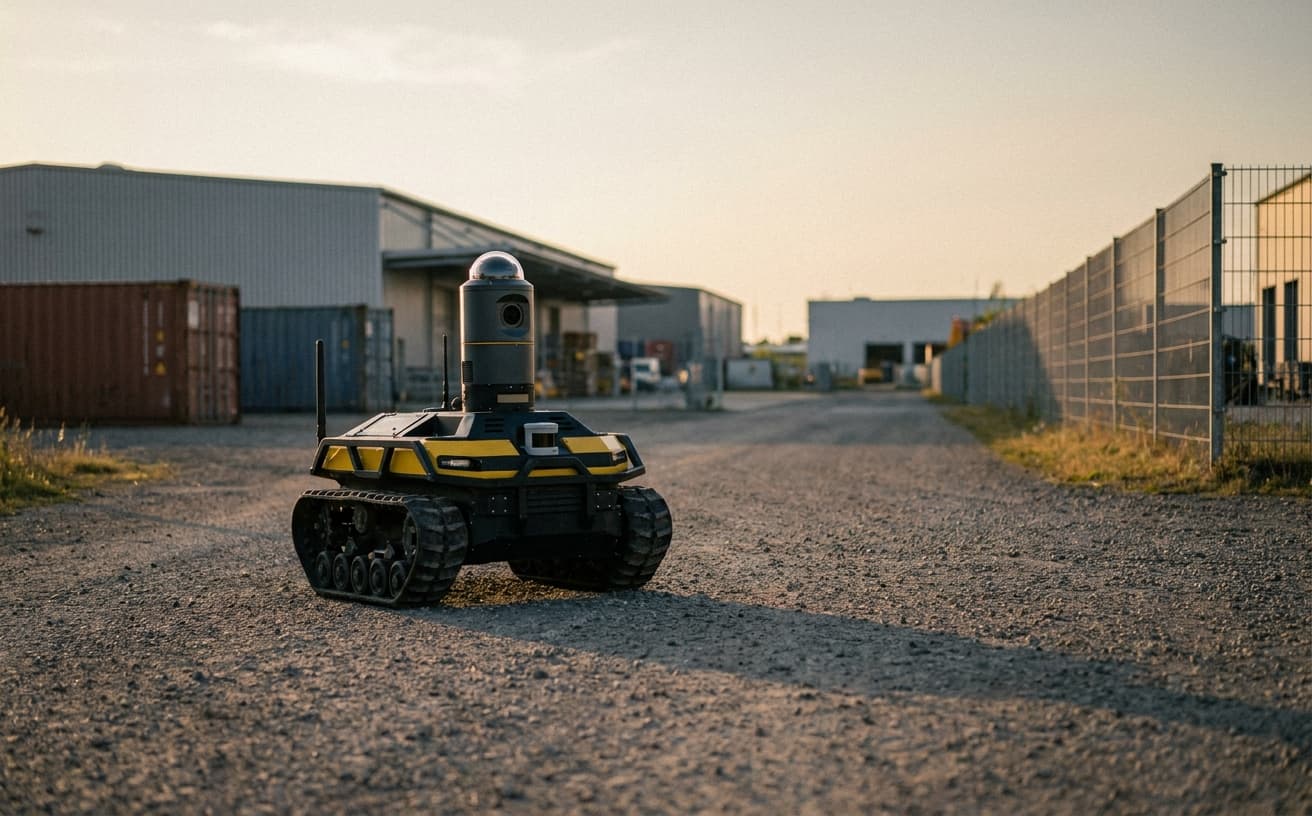
IP66 is a laboratory result, not a field guarantee, and the gap between the two has buried more outdoor robotics programs than any single failure mode in the industry.
The reason sits in the structure of the test itself. An Ingress Protection rating, defined in IEC 60529, is the outcome of a short, controlled procedure on a sample unit in a specified configuration. The number describes what the housing tolerated on that day, under those nozzles, at that water temperature, with those seals fresh from the production line. It does not describe what the same housing will tolerate after eighteen months of UV exposure, after three cleaning cycles with industrial degreaser, after a freeze-thaw season that has compressed and decompressed every gasket on the platform. Procurement teams treat the two digits as a property of the robot. They are a property of a test. The distinction is the difference between a unit that survives the second winter and a unit that does not.
This article is written for the operator who has read the spec sheet and now needs to know what the spec sheet does not say. It is written from the manufacturer side, because the questions that matter are the ones a vendor would prefer not to be asked. The reference frame is industrial: construction sites, logistics yards, substations, perimeter applications where the robot stays outside continuously for years, not for the duration of a demonstration.
What IP66 actually certifies, and what it does not
The first digit in an IP rating describes protection against solid objects. The second describes protection against water. IP66 means dust-tight and protected against powerful water jets from any direction. The procedure for the second digit, under IEC 60529, involves a 12.5 millimetre nozzle delivering roughly 100 litres per minute for a defined period from a defined distance. It does not involve salt, it does not involve pressure cycling, it does not involve thermal shock, and it does not involve the same housing six months later.
What the rating does not cover is more instructive than what it does. It does not address temperature performance. A robot rated IP66 may have seals certified at twenty degrees Celsius that lose elasticity at minus fifteen. It does not address vibration. The test is static. It does not address chemical exposure. Cleaning agents, de-icing salt, fuel vapour, and concrete dust each interact with elastomers and coatings differently, and the IP procedure ignores all of them. It does not address the connectors. Cable glands and bulkhead penetrations are frequently the weakest points on an outdoor enclosure, and they are tested as part of the assembly only if the manufacturer chose to test them that way. There is no obligation.
NIST and CISA both treat physical hardening of field assets as a foundational control in their guidance on operational technology, and IEC 62443 part 3-3 explicitly requires that physical security measures match the threat environment, not the test environment. The implication for procurement is direct. The IP rating is a screening criterion, not a qualification. A unit that fails to reach IP66 should be rejected. A unit that reaches IP66 should then be evaluated on the dimensions that the rating does not cover, and those dimensions are where the differences between platforms become operationally decisive. The vendor who answers detailed questions on seal materials, gland torque specifications, accelerated ageing tests, and field replacement intervals is the vendor who has thought past the certificate. The vendor who points at the certificate and stops there has not.
Temperature envelopes and the seasonal failure curve
Spec sheets list an operating temperature range. The number is almost always the range at which the electronics function. It is rarely the range at which the entire platform, including drive system, battery, seals, optics, and sensors, functions as a system. These are distinct envelopes, and the narrowest of them defines the real operating window.
Lithium-ion chemistry, which powers almost every outdoor security robot on the market, has a charging temperature lower bound of roughly zero degrees Celsius. Below that, charging at normal rates plates lithium on the anode, which is irreversible and progressive. A robot that returns to its dock at minus five and begins charging will degrade its battery on every cycle, and the degradation will not be visible in the first season. It will be visible in the second, when the run time has dropped by thirty percent and the operator concludes that the unit is defective. The unit is not defective. The charging strategy was wrong for the climate.
The discharge envelope is wider than the charge envelope, which is why vendors quote operating temperatures that imply year-round capability. The implication is misleading. A robot that can drive at minus fifteen but cannot charge below zero requires a heated dock, a heated battery bay, or both. These are not optional accessories in continental Europe or in any climate that crosses the freeze line. They are part of the platform, and their absence from the base configuration is a procurement red flag.
Optics behave differently again. Glass and polymer windows fog when interior humidity meets a cold exterior surface, and the fogging cycle deposits residue that progressively reduces image quality. Active heating of camera windows is standard on serious outdoor platforms and absent on consumer-grade equipment marketed for outdoor use. The difference shows up in the third week of November and persists until March.
The upper end of the envelope is rarely discussed and frequently the more dangerous boundary. Direct solar exposure on a dark enclosure in summer can drive internal temperatures above sixty degrees Celsius even when ambient is below thirty. Electronics throttle. Batteries age accelerated. Adhesives soften. The vendor who specifies a maximum operating temperature of fifty degrees without specifying how the figure was measured, in shade or in sun, is leaving the operator to discover the difference. ASIS International guidance on perimeter technology recommends thermal qualification under realistic solar load, not under ambient air temperature, and the recommendation is sound. Operators should require it.
Ingress beyond water: dust, salt, and the chemistry of cleaning
Dust is treated as a single category by IP ratings. In the field it is several categories, and they behave differently. Concrete dust on construction sites is alkaline, abrasive, and hygroscopic. It penetrates around seals through capillary action when moisture is present, and it solidifies inside enclosures over time. Coal and biomass dust at energy sites is fine, conductive when damp, and capable of bridging circuit traces. Agricultural dust carries organic material that supports microbial growth in the presence of condensation. Each of these failure modes is invisible until the unit returns to the workshop, and each is excluded from the IP test.
Salt accelerates everything. Coastal installations and any site exposed to road de-icing operations face chloride loads that the IP procedure does not consider. Stainless fasteners that meet specification on a sunny day in a clean lab fail by crevice corrosion in months under road salt exposure. The cable glands that pass an IP66 test with fresh elastomers harden under salt and UV in eighteen months. The result is not catastrophic failure. The result is creeping ingress that the operator notices only when a control board has corroded and the unit stops responding.
Cleaning chemistry is the third dimension and the one most often ignored at procurement. Outdoor robots accumulate residue. Bird droppings, hydraulic fluid mist, tyre rubber, concrete slurry, organic debris. They must be cleaned, and the cleaning agents used in industrial environments are aggressive. Solvents attack polycarbonate windows. Alkaline degreasers attack aluminium anodising. Quaternary ammonium disinfectants attack certain elastomers used in seals. The manufacturer who specifies which cleaning agents are compatible with the platform, and which are not, has thought about the entire lifecycle. The manufacturer who provides a cleaning instruction that consists of the words "wipe with damp cloth" has not.
The argument extends to the manuscript I have written on the trajectory of this firm, BOSWAU + KNAUER. From Building to Security Technology, in which the chapter on hardware development sets out a principle that the construction industry teaches faster than any laboratory. A robust steel frame with weak fasteners is not robust. A premium sensor in an unsuitable enclosure is not robust. Robustness emerges in the whole assembly, not in the sum of the components, and the test regime that qualifies a platform must reflect that.
Vibration, shock, and the question of moving parts
A static enclosure does not vibrate. A robot does. The drive system, the steering actuators, the surfaces over which the robot moves, and the wind loads on the upper structure all introduce vibration that the IP procedure ignores entirely. Vibration degrades sealed connections, loosens fasteners, fatigues solder joints, and gradually opens gaps in housings that were certified watertight when stationary.
The relevant standard is IEC 60068 part 2-6 for sinusoidal vibration and part 2-64 for random vibration, with industrial qualification levels described in IEC 62443 and in defence specifications such as MIL-STD-810. A platform intended for continuous outdoor patrol over years should be qualified to at least the levels appropriate for ground vehicle equipment, not to office equipment levels. The distinction is significant. Office equipment vibration testing assumes occasional transport. Ground vehicle testing assumes continuous exposure during operation. Outdoor security robots experience the second profile, and most are tested to the first.
Shock is a separate question. A robot that hits a kerb at three kilometres per hour experiences a shock loading that the test bench does not replicate. The cumulative effect of small impacts over a working year is mechanical fatigue in mounting brackets, sensor housings, and cable terminations. Serious manufacturers design for this with strain relief, with redundant fasteners, with vibration-isolated mounts for sensitive electronics. Less serious manufacturers do not, and the result is the failure mode that operators see most often in year two: intermittent sensor faults that resolve when the unit is jolted, then return.
The procurement question is straightforward. What vibration and shock qualification has the platform undergone, in what configuration, to what standard, and what were the results. A vendor that can answer in terms of named test procedures has done the work. A vendor that answers in marketing language has not, and the platform should be assumed to be unqualified until proven otherwise.
Batteries, charging, and the cold-weather margin
Battery sizing on outdoor robots is almost always specified at twenty degrees Celsius, fresh from the factory, on a flat course. The numbers that result from this specification overstate field capacity by thirty to fifty percent across the year. The overstatement is not a deception. It is the consequence of using a single number to describe a function of temperature, age, terrain, and duty cycle.
Cold reduces available capacity. A lithium-ion cell at minus ten delivers roughly seventy to eighty percent of its rated capacity. The reduction is recoverable when the cell warms, but during the cold period the run time is what the cold capacity supports, not what the rated capacity suggests. A robot specified for eight hours of operation at twenty degrees may achieve five hours in February. If the patrol schedule assumes eight, the schedule fails.
Heat reduces battery lifespan. Cells stored or operated at elevated temperatures degrade faster, and the degradation is permanent. A robot that sits in a sun-exposed dock at forty degrees ambient, with the battery climbing higher under the enclosure, loses calendar life on every hour of exposure. The trade-off between thermal management and energy consumption is real, and the manufacturer who has resolved it explicitly, with active cooling or with thermal isolation, is the manufacturer who will deliver the rated lifetime. The manufacturer who has not resolved it will deliver a battery that needs replacement in year two.
Battery enclosures themselves are a separate concern. The cells must be protected from physical damage, from thermal runaway propagation, and from water ingress in a fault scenario. UN 38.3 transport qualification is a minimum. IEC 62619 for industrial battery systems is a more demanding standard and the appropriate one for outdoor security robots. Procurement teams should ask which standards the battery system meets, not which standards the robot meets, because the answers may differ.
Field replacement, serviceability, and the second winter
A robot that cannot be serviced in the field is a robot that returns to the factory whenever a wear part fails. The economics of that arrangement collapse in the second year, when wear parts begin to fail in normal sequence. Tyres, brushes, wipers, gaskets, filters, and connectors all have lifespans shorter than the platform itself, and the design choice that determines whether they can be replaced on site by a trained technician, or only by returning the unit, determines whether the platform is operationally viable over five years.
Modular design with documented service procedures is the marker of a platform built for the full lifecycle. Sealed assemblies with no field-serviceable components are the marker of a platform built for the marketing brochure. The two look identical in the first six months. They look very different by the end of year two.
NIST 800-53 control MA-6, on timely maintenance, addresses this principle in the context of information systems but the logic transfers directly. A platform that cannot be maintained within an acceptable timeframe ceases to provide its security function during the downtime. For outdoor robotics, where the platform is the security function for the perimeter it patrols, every day in transit to the factory is a day of degraded coverage. Operators should require service intervals, mean time between failures by component, and mean time to repair in field conditions. These numbers exist for any platform that has been in service long enough to generate them. The absence of the numbers is itself the answer.
What holds
The spec sheet is the entry point of the evaluation, not the conclusion. IP66 is necessary, not sufficient. Temperature envelopes must be read as systems, not as electronics. Vibration, chemistry, and serviceability are the dimensions on which platforms diverge after the first year, and they are the dimensions on which procurement decisions should turn.
The operator who treats outdoor robotics as a hardware purchase will buy on the spec sheet and discover the limits in the field. The operator who treats it as a multi-year operational commitment will ask the questions the spec sheet does not answer, and will receive useful answers from a small subset of vendors. That subset is the relevant supplier base. The rest are selling to a different customer.
For organisations evaluating outdoor robotics for construction, industrial, or logistics applications, the structured ninety-day pilot is the format in which these questions become measurable rather than theoretical. A pilot at a defined site, with success criteria agreed before deployment, produces the data on which a procurement decision can rest. The alternative is to discover the answers in production, and the cost of that discovery is what this article was written to prevent.
Frequently asked questions
What IP rating do outdoor robots need?
IP66 is the practical minimum for continuous outdoor operation. IP67 adds temporary immersion protection, which matters for flood-prone sites and for platforms that may be submerged briefly during cleaning. IP68 is rarely necessary for security robotics and is sometimes a sign that the manufacturer has tested for a specification rather than for an environment. More important than the digit is what the rating covers: housing only, or the complete platform including connectors, glands, and serviceable interfaces. A platform-level IP66 is materially different from a housing-level IP66, and the distinction is often buried in the documentation.
What temperature range is realistic?
Realistic year-round operation in continental European climates requires a charging-capable temperature range from at least minus ten to plus forty Celsius, and a discharge range from minus twenty to plus fifty. Anything narrower means seasonal gaps in coverage or accelerated battery degradation. The figures must apply to the integrated platform, not to the electronics alone, and they must account for solar loading on the enclosure. Vendors that specify ambient air temperatures without addressing internal temperatures under solar exposure are quoting laboratory numbers. Field temperatures inside a dark enclosure on a sunny summer day routinely exceed ambient by fifteen to twenty degrees.
How is dust ingress handled?
Effective dust protection combines sealed enclosures with positive pressure ventilation or filtered breathing membranes that equalise pressure without admitting particulates. The IP6X test confirms that no dust enters during the test period. It does not confirm that no dust enters over years of pressure cycling, thermal cycling, and seal ageing. Serious platforms specify the filtration approach, the filter replacement interval, and the cleaning procedure for sealed surfaces. They also specify which cleaning agents are compatible, because the wrong solvent will compromise seals faster than dust ever will. The vendor's documented cleaning protocol is a useful proxy for the engineering depth behind the platform.
How is the battery protected?
Battery protection in outdoor robotics operates on four levels. Mechanical protection isolates the cells from impact and vibration. Thermal protection manages charge and discharge temperatures, typically through heating elements for cold-weather charging and through passive or active cooling for warm conditions. Electrical protection includes cell-level monitoring, balancing, and isolation in fault conditions. Environmental protection seals the battery compartment to at least the same IP rating as the platform. Qualification to IEC 62619 is the appropriate standard for industrial battery systems and the one operators should require. UN 38.3 alone is a transport qualification and insufficient for continuous outdoor operation.
Related topics
- Security Robot Rental: What Pricing Says About Vendors
- Security Robots For Sale vs Rental: When CapEx Actually Wins
- Security Robot vs Human Guard: The Honest Five-Year Math
- Extreme Heat & Security Robots in the Gulf: 55C
- Security Robots in Saudi Arabia: Vision 2030 & NEOM
Take the next step: See prices & ROI · Explore the products · Send a no-obligation request. BOSWAU + KNAUER – direct from the factory in Filderstadt, reply within 5 working days.
About the author
Dr. Raphael Nagel (LL.M.) is founding partner of Tactical Management. He acquires and restructures industrial businesses in demanding market environments and writes on capital, geopolitics, and technological transformation. raphaelnagel.com
More reading
Since 1892.
The firm is reached at boswau-knauer.de or +49 177 2266267.