
Blog
Poland Construction Boom and Site Security
CEPiK data, regional construction growth, theft-prevention market gaps. A growing market with an undeveloped security stack.

Dr. Raphael Nagel
May 1, 2025
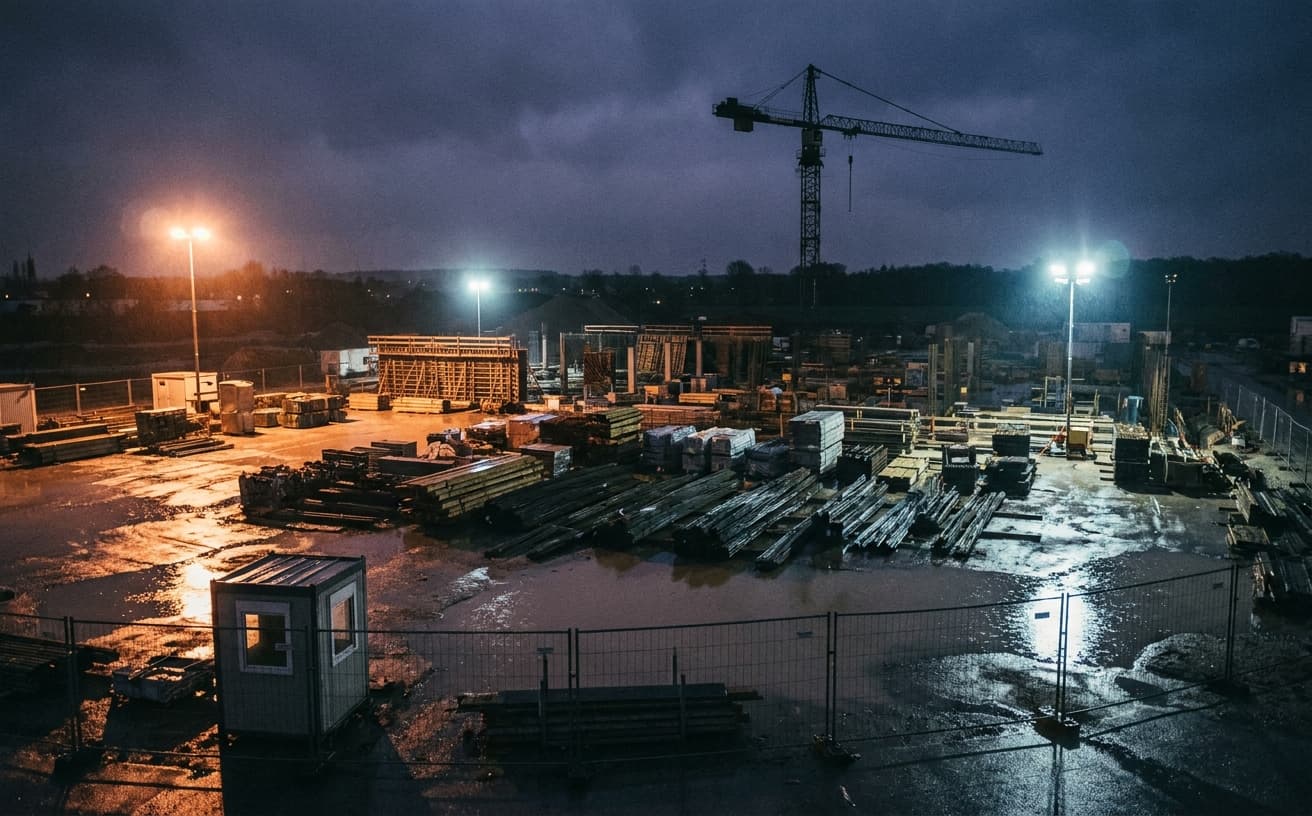
Poland has built more square metres of warehouse, residential and infrastructure space in the last eight years than any other market in the European Union, and the security stack protecting that construction has not moved with it.
The disproportion is the story. Cranes over Warsaw, Wrocław, Gdańsk, Kraków and Katowice describe a construction sector that has matured into one of the European heavyweights, while site protection on those same projects often consists of the same three components used twenty years ago: a fence, a sodium lamp, a watchman in a container. The volume has changed. The materials have changed. The supply chains have changed. The protection has not. Anyone who has walked a Polish jobsite in the last twelve months has seen the gap. The figures behind it confirm what the eye reports.
A market that has outgrown its protective layer
Polish construction output, measured by GUS, has held above the European average for most of the post-2017 cycle. Residential, commercial, logistics and infrastructure segments have each pulled in different directions, but the aggregate trend is consistent: more sites, larger sites, higher unit values per site. The warehouse boom around the A2 and A4 corridors has produced what brokerages classify as the second-largest industrial floorspace inventory in continental Europe. Residential development in the seven major agglomerations has expanded in step. Public infrastructure, supported by EU cohesion funds and national programmes, has added a third layer that runs through almost every voivodeship.
The material values stored on these sites have risen faster than the headcount available to watch them. Cabling, copper, photovoltaic components, prefabricated steel, heat pumps, hydraulic equipment and lithium battery systems for site logistics are now standard inventory on a typical large project. Each of those categories has a resale market. Each has a transport profile that fits into a standard van. Each is, in the language of the trade, fungible: once removed from the site, it cannot be traced back to it without serial-level documentation that most general contractors do not maintain.
CEPiK, the Polish central vehicle register, provides one window into the scale of mobility around theft. Insurance data from the Polish Insurance Chamber and from individual carriers indicate that theft and vandalism claims tied to construction sites have remained elevated through the 2020 to 2024 window, even when general property crime statistics softened. The two trend lines diverge. That divergence is the operational signature of a market in which the targets have multiplied faster than the protective response.
The German experience, for context, is informative but not transferable. GDV has documented for years that German contractors absorb construction site theft as a structural cost of the trade, typically in the hundreds of millions of euro per annum across the federation. The Polish market is younger, denser in certain regions, and exposed to cross-border transport routes that change the threat profile. What works in a German exurb does not transpose directly to a logistics campus near Łódź.
Where the losses actually sit
A site loss is rarely a single event. It is a chain. The visible event is the missing item, recorded the next morning by the site manager. The invisible part is what the missing item triggers: the subcontractor who cannot start, the rental machine whose contract continues to run, the delivery that has to be rescheduled, the inspection that has to be postponed, the handover date that slips, and the contractual penalty that follows the slip. The cost of the stolen item is, in many cases, the smallest line in the chain.
This is the reason why traditional benchmarks based on insurance payouts understate the true exposure. The insurance line captures the replacement cost of the asset. It does not capture the productivity loss, the rescheduling, the reputational effect on the client relationship, or the impact on the cost-plus calculation when the project is closed out. Site managers who run their post-mortems carefully reach a different number than the one their broker shows them. The post-mortem number is usually a multiple of the insurance number.
Small theft accumulates faster than large theft. A site that loses one battery pack per week, one drum of cable per month, and one set of measuring instruments per quarter ends the year with a six-figure exposure in materials alone. The site that loses a generator in a single night sees a more dramatic event in the daily report, but the cumulative drain often comes from the smaller, repeatable losses that never reach the threshold of investigation. Both patterns coexist on most Polish sites today.
Vandalism follows its own logic. It targets effect rather than value, which makes it harder to deter through asset-focused measures and easier to interrupt through presence-based ones. Cable cutting, hydraulic line damage, graffiti on freshly poured concrete and tampering with control panels each carry their own cost profile. The Polish market sees a higher relative share of opportunistic vandalism around urban infill projects than around fenced industrial campuses, and the protective response has to differ accordingly.
The structure of the current Polish security offering
The Polish private security sector is large, fragmented and price-sensitive. It is dominated by labour-based service providers competing on the cost of a guard hour. Margins are thin. Wage pressure, partly from the broader Polish labour market and partly from the migration shifts of the past three years, has compressed the staffing model on which most providers built their offer. The result is a sector that is structurally short of personnel, structurally exposed to wage inflation, and structurally limited in its ability to scale a single site beyond the number of guards that can be physically deployed.
This is where the technology gap appears. The Polish guard-hour, even after recent wage increases, is still priced below the German or Austrian equivalent. That price has, paradoxically, slowed the adoption of technology. As long as a human watchman is cheaper than the comparable Western European cost, the immediate case for camera towers, mobile robotics and analytics-driven monitoring is harder to articulate to a Polish CFO. The case becomes visible only when one calculates the gap between presence and effectiveness, which is what the wage line does not capture.
A handful of integrators have introduced camera towers, perimeter analytics and remote monitoring centres on Polish sites in the last three years. ASIS International chapters in the region track this expansion. Adoption is concentrated in the segments where the foreign general contractor or the foreign investor is present and brings the procurement standard from a home market that already runs on technology. Domestic Polish contractors below that tier still operate predominantly on the traditional stack. This is the structural opening in the market.
National regulation does not pull against the modernisation. Polish data protection authorities follow the GDPR framework, with technical guidance that is broadly aligned with what BSI publishes in Germany and what NIST documents in the United States. CCTV on construction sites is permitted within defined limits. The reference framework is workable. The barrier is commercial habit rather than legal constraint.
The price gap and what it actually measures
A camera tower deployed on a Polish site costs in the same euro range as the equivalent device in Germany, because the components, the software and the development cost are not localised. The labour to install and maintain it is lower in Poland, but the bill of materials is not. This produces a price gap that runs counter to the wage gap. A Polish operator who compares a tower to a watchman compares a device priced in European terms against labour priced in Polish terms.
The mistake in that comparison is the time horizon. A watchman is a recurring cost that does not depreciate downward. A tower is an investment that, over a multi-year deployment across rotating sites, depreciates toward zero per-site cost. The unit economics flip somewhere between the second and the fourth deployment of the same device. Most Polish operators who have tested this on a pilot have confirmed the threshold. Few have yet scaled past it.
The IEC 62443 framework, which governs industrial cybersecurity, is increasingly relevant on the larger Polish sites where building automation overlaps with site security. ISO 27001 certification is a procurement requirement for several of the international general contractors active in the country. NIST CSF 2.0 sets a vocabulary that the Polish IT-security community is adopting, partly because it is referenced in the cross-border tender documents that Polish providers respond to. The technical and regulatory scaffolding for a modern security stack is present. The procurement habit is the lag.
The book BOSWAU + KNAUER. From Building to Security Technology develops the thesis that security on a construction site is not a separate budget line but a determinant of three core project variables: time, cost, and risk. The Polish market is now at the point where this thesis becomes financially testable. Sites are large enough to justify the device cost. Material values are high enough to make the loss case quantitative. Insurance carriers are paying enough attention to the loss ratios to begin pricing technology-equipped sites differently from traditional ones. The conditions for a structural shift are in place.
What a serious response looks like
A serious response does not start with the device. It starts with the diagnosis. A Polish contractor or industrial operator who wants to understand the exposure begins by reconstructing two years of incident history, by quantifying both the direct and the chain costs, and by identifying which sites in the portfolio account for the disproportionate share of losses. In most portfolios, the distribution is uneven. Twenty per cent of the sites carry sixty to seventy per cent of the exposure. The Pareto holds in this market as it does in most.
Once the diagnosis exists, the device selection becomes a derived question rather than a primary one. A camera tower is appropriate where visibility and deterrence carry the case. A mobile security robot is appropriate where the perimeter is too large for fixed coverage and where the unpredictability of patrol paths matters. AI-supported video analytics is appropriate where the volume of footage exceeds what any operator can review and where false alarm rates determine whether the system stays in use after the first quarter. The selection follows the diagnosis. It does not precede it.
The integration question is the third layer. A device that does not speak to the site management software, to the access control infrastructure and to the alerting workflow used by the operations team becomes an isolated installation that erodes over time. Polish operators who have learned this in practice now ask integration questions earlier in the procurement cycle. The market is teaching itself, project by project.
The CISA and NIST 800-53 references are useful as vocabulary even when the formal compliance is not required. They give a Polish security manager a shared language with international counterparties and with the insurance market. ASIS International publishes operational guidance that translates well into the Polish context. Speaking the language reduces the cost of the conversation with the carrier, the auditor, and the international client.
What holds
The Polish construction sector has matured into a European-scale market. The protective infrastructure around it has not. The gap is visible in incident data, in insurance loss ratios, and in the post-mortem calculations of the contractors who run them honestly. The cost of closing the gap, measured against the value of the protected projects, is small. The cost of leaving it open, measured against the chain losses that accumulate on every site without a modern stack, is large.
The opening for serious manufacturers is straightforward. Polish operators do not need a thirty-page sales deck. They need a diagnosis, a portfolio view, and a deployment model that scales devices across rotating sites rather than amortising them against a single project. The path from the current state to a modern stack is shorter than the discourse around it suggests. Most of the work is operational, not technological.
For operators who want to test this without committing to a full programme, three paths are available. A confidential sixty-minute conversation with the manufacturer to map the situation against what has worked elsewhere. A three to five day on-site audit that delivers a written report and a portfolio-level recommendation. A ninety-day pilot on a single site with a defined success metric set before deployment. Each path stands on its own. None requires the next.
Frequently asked questions
How big is Polish construction?
Polish construction output has remained one of the largest in the European Union for most of the post-2017 cycle. GUS data, combined with EU cohesion fund disbursement records, show sustained activity across residential, logistics, commercial and public infrastructure segments. The country hosts the second-largest industrial floorspace inventory in continental Europe according to commercial real estate brokerages. The seven major agglomerations have continued to add residential stock at a pace above the European average, and infrastructure projects funded partly through EU programmes extend the activity across every voivodeship.
What is being stolen?
The categories with the highest theft frequency on Polish sites are copper cabling, photovoltaic components, prefabricated steel elements, heat pumps, hydraulic equipment, lithium battery packs used in site logistics, hand tools and measuring instruments. Each category has a resale market, a transport profile that fits standard vehicles, and limited traceability once removed from the site. Vandalism affects a different set of targets, including hydraulic lines, control panels, freshly poured surfaces and cable trays, where the motivation is disruption rather than resale value.
Who supplies security today?
The Polish private security market is dominated by labour-based service providers competing on the cost of the guard hour. The sector is fragmented, with several large national operators and a long tail of regional providers. Margins are compressed by wage pressure and by procurement practices that prioritise hourly rate over coverage effectiveness. A smaller group of integrators has introduced camera towers, perimeter analytics and remote monitoring centres, primarily on sites where foreign general contractors or international investors set the procurement standard. Domestic mid-tier contractors still rely predominantly on the traditional fence-and-guard model.
What is the price gap?
The component cost of modern security devices, including camera towers, mobile robotics and analytics platforms, is priced in European terms and does not localise meaningfully to the Polish market. Installation and service labour is cheaper than in Germany or Austria. This produces a counterintuitive price structure: the hardware looks expensive against a Polish guard wage, but the unit economics improve sharply when the same device rotates across multiple sites over a multi-year horizon. The break-even point typically falls between the second and fourth deployment of the same device across a portfolio.
Related topics
- Italian Construction Night Security: The Real Cost
- Construction Site Theft Patterns in the GCC: The Data
- Construction Site Theft Statistics 2026: The Numbers
- London Mayor Crime Strategy and the Construction Cordon
- How to Secure a Construction Site Overnight
Take the next step: See prices & ROI · Explore the products · Send a no-obligation request. BOSWAU + KNAUER – direct from the factory in Filderstadt, reply within 5 working days.
About the author
Dr. Raphael Nagel (LL.M.) is founding partner of Tactical Management. He acquires and restructures industrial businesses in demanding market environments and writes on capital, geopolitics, and technological transformation. raphaelnagel.com
More reading
Since 1892.
The firm is reached at boswau-knauer.de or +49 177 2266267.