
Blog
Reducing False Alarms in AI CCTV: Two Techniques
Multichannel confirmation and contextual filtering. Two methods, both well-understood in industrial settings, both rarely deployed correctly.

Dr. Raphael Nagel
December 1, 2025
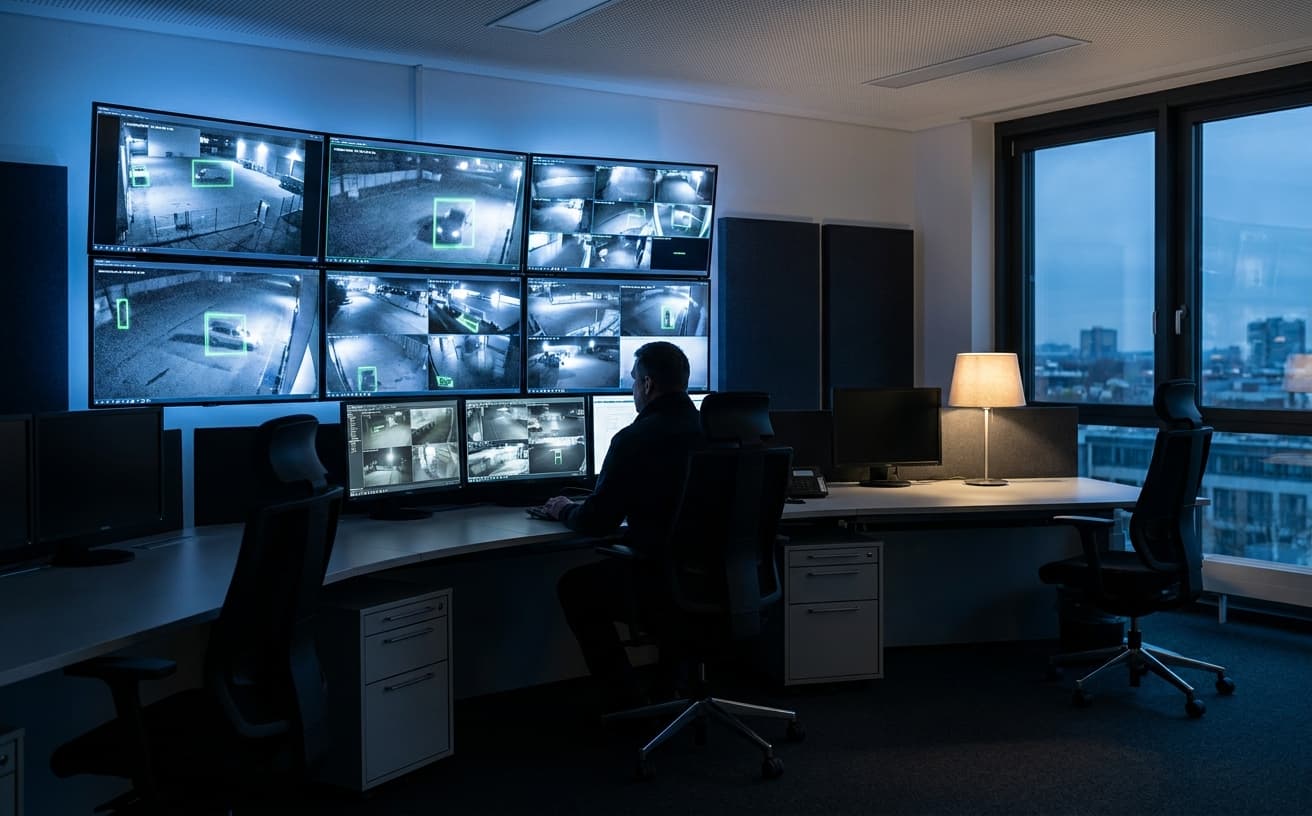
A false alarm is not a nuisance. It is the slow disabling of a security system by the people who paid for it.
Operators who have run AI video analytics for more than a few quarters know the pattern. The system is commissioned with high expectations, runs hot for the first month, drowns the control room in events that turn out to be branches in the wind, plastic sheeting, headlights on a wet road, and shadows cast by a moving crane. By month three, the operator on the night shift has muted the audible alert. By month six, the analytic channel is treated as background noise. By month twelve, the system is technically running and operationally dead. No one wrote it off. No one switched it off. It simply stopped being trusted, and once trust is gone, the asset is gone.
The manufacturer's view on this is unsentimental. False alarm rate is not a soft metric. It is the single variable that decides whether an AI CCTV deployment becomes infrastructure or becomes wallpaper. Two techniques reduce it reliably. Both have been understood in industrial control rooms for decades. Both are rarely deployed correctly in the AI video context, because vendors prefer to sell model accuracy and operators prefer to assume that accuracy alone will fix the problem. It will not. The path that works is multichannel confirmation and contextual filtering, applied with discipline, tuned against site reality, and revisited on a defined cadence.
Why Single-Channel Detection Always Fails at Scale
A single neural network looking at a single video stream is, by construction, a single point of failure. It will fire on patterns that resemble its training distribution, regardless of whether those patterns matter at the site under observation. Industrial AI vision models trained on broad datasets routinely classify reflective surfaces, animals, shadows, weather events, and routine plant movement as persons or vehicles. The model is not wrong in any deep sense. It has identified an object that, in many contexts, would warrant attention. The context does not exist inside the model. It exists at the site.
The structural problem is that single-channel detection couples the cost of a false positive directly to the cost of a true positive. Each event consumes operator attention, each event triggers the same workflow, each event has the same audible signal. When the ratio of false to true tips beyond a threshold that varies by operator and by shift but is empirically somewhere between fifteen and twenty to one, the operator stops processing events individually. They batch, they delay, they suppress. NIST's work on human factors in alarm systems, and the broader ASIS International literature on control room design, has documented this for years. The IEC 62443 family treats alarm flood as a category of operational risk in industrial systems, not as a comfort issue.
The vendor response, raising the detection threshold, makes the problem worse rather than better. A higher threshold suppresses both classes of event in similar proportions. The result is a system that still produces false positives, now produces false negatives in greater number, and presents a confidence figure that has been cosmetically improved. The site is less safe than before. The dashboard looks calmer. This is the worst possible combination, and it is the default outcome when an integrator is judged on detection sensitivity in isolation. Single-channel tuning cannot solve a problem that is structural. The architecture has to change.
Multichannel Confirmation as an Engineering Discipline
Multichannel confirmation is the requirement that an alarm be raised only when two or more independent sensing channels agree that something has happened. The principle is borrowed from process control and safety instrumented systems, where 2oo3 and 2oo4 voting logics have been standard for decades, and from intrusion detection in critical infrastructure, where layered confirmation has long been a baseline expectation under ISO 27001 Annex A controls. In the AI video context, the channels available are video classification, thermal imaging, radar or lidar return, acoustic signature, fence-mounted vibration sensors, ground-based seismic sensors, GPS-tracked patrol presence, access control state, and the time profile of expected activity. The art is choosing two or three channels whose error modes are uncorrelated.
Correlation of error is the key technical point that most integrators miss. Two video analytics channels watching the same scene from similar angles are not independent. They will produce false positives on the same conditions, rain, glare, leaves, and an alarm confirmed by both is no more credible than an alarm raised by one. A video channel paired with a thermal channel is genuinely independent, because thermal signature does not depend on visible-spectrum illumination, and rain produces opposite effects on the two modalities. A video channel paired with a fence-mounted vibration sensor is also genuinely independent, because the vibration sensor responds to mechanical contact rather than visual pattern. The manufacturer's preference is to specify, for each protected zone, which two channels are required to agree and within what time window. The window is usually short, between half a second and three seconds, depending on the geometry and the expected speed of the threat.
The result of disciplined multichannel confirmation, in field deployments the manufacturer has observed across construction, logistics, and industrial sites, is a reduction in nuisance alarms of between eighty and ninety-five percent, with no measurable loss in true positive detection. The remaining alarms are credible enough that the operator processes each one. The audible alert is no longer muted. The workflow holds. This is the only metric that matters. A system that produces fifty alarms a night, of which forty-nine are noise, is functionally inferior to a system that produces three alarms a night, of which all three are inspected and two turn out to be real events. The second system protects the site. The first one trains the operator to ignore it.
Contextual Filtering and What It Actually Means
Contextual filtering is the second technique, and it is the one most often misunderstood. Vendors describe it in marketing material as something the AI does on its own, an emergent property of a sufficiently large model. It is not. Contextual filtering is the deliberate encoding of site rules, schedules, geometries, and exclusion logic into the analytic pipeline, in a form that the operator can read, change, and audit. It is configuration work, not model work, and it is the part of the deployment that determines whether the system fits the site or fights it.
The categories of context that matter are temporal, spatial, behavioral, and operational. Temporal context is the schedule of expected activity, by hour, by day of week, by season, by project phase. A loading bay that sees fifteen truck movements between six and ten in the morning does not require an alarm on each one. The same loading bay seeing one truck movement at three in the morning requires immediate attention. Spatial context is the geometry of legitimate and illegitimate movement, encoded as zones with directionality. A person walking along the inside perimeter of a construction site at midday is routine. A person crossing the same line in the opposite direction at midnight is not. Behavioral context is the combination of object class, trajectory, dwell time, and group composition. Operational context is the state of the site, whether the gate is officially open, whether maintenance is in progress, whether a delivery is expected, whether a contractor is signed in.
The mistake most integrators make is to treat contextual filtering as an exercise in suppression, a set of "do not alarm if" rules added after the fact to silence the loudest sources of noise. That approach degrades over time, because each new rule narrows the detection envelope without anyone documenting why. The discipline that works is the inverse. Contextual filtering should be expressed as a positive specification of what the site expects, with deviation from that specification being the trigger. CISA's guidance on operational technology security, and the broader NIST CSF 2.0 framing under the Detect function, both treat this as the right structural approach. The site is the model. The AI is the sensor. When the sensor reports something that the site model does not expect, the alarm is raised. When the sensor reports something the site model expects, the event is logged but not escalated. This separation is what makes the system auditable, tunable, and survivable across staff turnover and site evolution.
Combining the Two: Where the Real Reduction Lives
Multichannel confirmation and contextual filtering are not alternatives. They are complementary, and they multiply rather than add. A system that uses only multichannel confirmation will still alarm on a person walking through the loading bay at the legitimate shift start, because two channels will correctly identify a person and a vehicle in motion. A system that uses only contextual filtering will still alarm on a shadow at midnight in a restricted zone, because the spatial and temporal rules will correctly flag the location and time even when the underlying detection is wrong. The two techniques together filter the two error modes that neither addresses on its own.
The order of application matters. Multichannel confirmation should run first, at the edge, on the device or on a local gateway. This eliminates the bulk of sensor-level noise before any event reaches the analytic layer. Contextual filtering should run second, on a system that has access to schedules, access control state, weather data, and the site's operational calendar. This eliminates events that are technically valid detections but operationally irrelevant. By the time an alarm reaches the human operator, it has passed two independent gates, each of which has a different failure mode. The events that survive both gates are, in the manufacturer's field experience, true positives at rates between sixty and eighty percent, which is the regime in which operator trust is sustained and the system becomes load-bearing infrastructure.
The book BOSWAU + KNAUER. From Building to Security Technology develops this argument in the context of construction and industrial logistics, where the operator population is rotating, the site is changing weekly, and the analytic layer has to survive conditions that no laboratory demonstration replicates. The conclusion across deployments is consistent. Sites that implement both techniques, with explicit configuration and a defined review cadence, run at false alarm rates that allow the system to be trusted. Sites that implement neither, or only one, run at rates that cause the system to be ignored within a year. The technology is the same. The discipline around it is not.
Tuning Cadence, Ownership, and the Operator-Manufacturer Boundary
The technique does not maintain itself. A site is not static. The construction phase changes the geometry of legitimate movement. A new tenant changes the schedule. A vegetation cycle changes what the video model sees in the background. A change in supplier changes which vehicles are expected at which gate. Each of these shifts the boundary between what counts as routine and what counts as deviation. If the configuration is not revisited, the false alarm rate creeps back up, slowly enough that no one notices until the operator starts muting alerts again.
The cadence that the manufacturer recommends is a structured review every ninety days for the first year, every six months thereafter, with an unscheduled review triggered by any of three events, a change in site layout exceeding ten percent of the protected area, a change in the operational schedule exceeding two hours per shift, or a sustained increase in false alarm rate exceeding a defined threshold over a two-week window. Each review produces a documented change log, signed off by the security manager and the integrator. This is the ISO 27001 management discipline applied to video analytics, and it is the part that most operators skip because no one has been made responsible for it.
Ownership is the second structural issue. The vendor cannot tune the system in isolation, because the vendor does not know the site's operational state. The operator cannot tune the system in isolation, because the operator does not have the analytic depth to evaluate channel independence and model behavior. The correct arrangement is joint, with the operator owning the contextual rules and the manufacturer owning the channel architecture and model behavior. The interface between the two should be documented, version-controlled, and auditable. NIST 800-53 controls under the CM family, configuration management, apply directly. When this boundary is unclear, the system drifts. When it is clear, the system improves over time, because each review feeds back into both layers.
What Holds
False alarm reduction in AI CCTV is not a model problem. It is an architecture problem, and the architecture has two load-bearing elements. Multichannel confirmation handles the noise generated by any single sensor's limitations. Contextual filtering handles the events that are technically detected but operationally irrelevant. Neither technique is exotic. Both are well-understood in industrial settings. Both are rarely deployed with the discipline that makes them work, because the market rewards a higher detection number on a datasheet over a lower false alarm number in production.
Operators who want their AI CCTV to remain trusted infrastructure rather than ignored noise have a narrow set of choices. They can specify multichannel confirmation at the procurement stage, with explicit requirements about which channels must agree and within what window. They can specify contextual filtering as a positive site model rather than a suppression list. They can establish a review cadence and a clear ownership boundary between operator and manufacturer. None of this is expensive relative to the cost of a deployment that fails silently within twelve months. All of it requires a level of operational seriousness that vendors rarely demand of buyers and that buyers rarely demand of themselves.
For operators who want to test these techniques against their own site reality, the manufacturer offers a ninety-day pilot at a defined location, with success metrics specified before commissioning and a documented review at the end. The pilot is the format in which the architecture described here can be observed in operating conditions, against the actual rate of nuisance events that the site produces, without commitment beyond the pilot itself. The data is the deliverable. What is done with it is the operator's decision.
Frequently asked questions
What is a tolerable false alarm rate for industrial AI CCTV?
There is no single number, because tolerability depends on operator load, shift structure, and the cost of a missed true positive. As a working range, the manufacturer treats fewer than three nuisance alarms per camera per twenty-four hour period as a regime in which operator trust is sustained, and fewer than one per camera per day as a target for mature deployments. Above ten per camera per day, operators predictably begin muting and batching. The metric to watch is not the rate alone but the ratio of true to false events, which should sit above one in five to remain operationally credible.
How does multichannel confirmation reduce false alarms?
It requires that two or more independent sensing channels agree, within a defined time window, before an alarm is raised. The reduction comes from the fact that the error modes of genuinely independent channels are uncorrelated. A visible-spectrum camera and a thermal camera fail under different conditions. A video analytic and a fence-mounted vibration sensor respond to different physical phenomena. When both channels confirm the same event, the probability that the event is real rises sharply. Field deployments observed by the manufacturer show reductions of eighty to ninety-five percent in nuisance alarms, with no measurable loss in true positive rate.
What is contextual filtering in video analytics?
Contextual filtering is the deliberate encoding of site rules, schedules, geometries, and operational state into the analytic pipeline, so that detections are evaluated against what the site expects rather than against the model's training distribution alone. It covers temporal context, the schedule of expected activity, spatial context, the geometry of legitimate movement, behavioral context, object class and trajectory, and operational context, the live state of access control, deliveries, and maintenance. Done correctly, it is expressed as a positive site model rather than a suppression list, and it is reviewed on a defined cadence as the site changes.
Who tunes the system, vendor or operator?
Both, with a clear boundary. The manufacturer owns the channel architecture, the model behavior, and the technical configuration of the confirmation logic. The operator owns the contextual rules, the schedules, the zone definitions, and the operational state. The interface between the two should be documented and version-controlled, with reviews every ninety days during the first year and every six months thereafter, plus unscheduled reviews triggered by significant site changes. When this boundary is unclear, the system drifts. When it is enforced, the false alarm rate improves over time rather than degrading.
Related topics
- Object Detection vs Anomaly Detection in Security
- EU AI Act and Physical Security: The Article 6 Test
- AI Video Analytics Software: Nine Vendors Compared
- AI Video Analytics for Perimeter Security: Buyer Guide
- AI CCTV Cameras 2026: Who Actually Trains the Models
Take the next step: See prices & ROI · Explore the products · Send a no-obligation request. BOSWAU + KNAUER – direct from the factory in Filderstadt, reply within 5 working days.
About the author
Dr. Raphael Nagel (LL.M.) is founding partner of Tactical Management. He acquires and restructures industrial businesses in demanding market environments and writes on capital, geopolitics, and technological transformation. raphaelnagel.com
More reading

Since 1892.
The firm is reached at boswau-knauer.de or +49 177 2266267.