
Blog
Security Robots at ADNOC: HSE Manual & Permit to Work
ADNOC HSE manual, Code of Practice and OSHAD rules. What actually gets an autonomous security robot through the gate at an Abu Dhabi upstream site.

Dr. Raphael Nagel
November 28, 2025
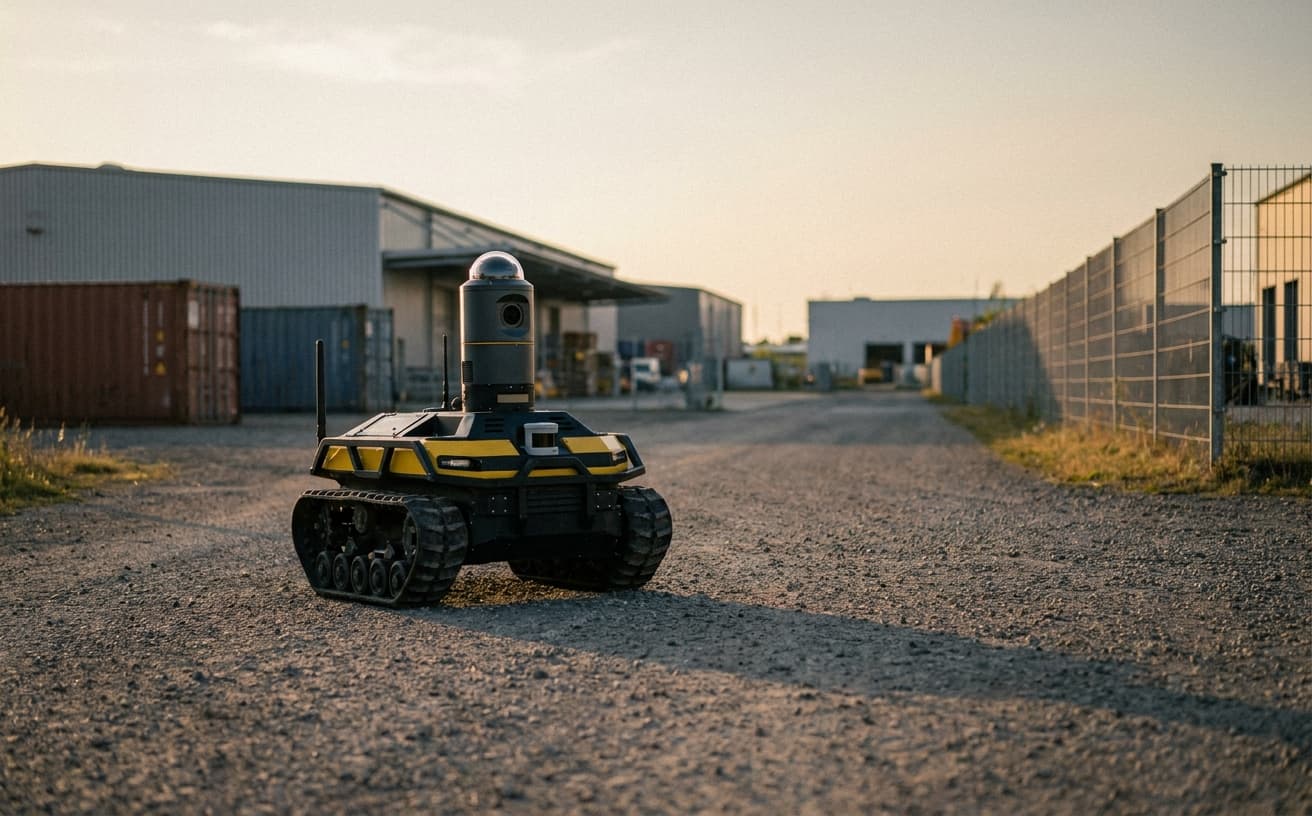
A security robot does not enter an ADNOC upstream site because it is clever. It enters because it has been documented, classified, permitted, and accepted by a chain of people who answer to a written manual. Anything else is a demo.
This distinction is rarely understood by vendors selling autonomous platforms into the Gulf. The conversation tends to start with patrol routes, thermal cameras and AI detection rates. It should start with the ADNOC HSE Management System, the relevant Codes of Practice, the OSHAD Abu Dhabi Occupational Safety and Health framework, and the asset-specific Permit to Work regime. A platform that cannot be mapped onto those four documents will be stopped at the gate, regardless of what it can detect.
What follows is operator-grade reading on the integration path that actually gets a security robot into productive duty on an Abu Dhabi upstream asset. The reference frame is the manufacturer's, not the marketer's. The argument draws on Chapter 14 and Chapter 18 of BOSWAU + KNAUER. From Building to Security Technology, which treat industrial and logistics customers and the discipline of integration as the two halves of the same question.
The ADNOC operating environment as a closed system
ADNOC upstream operations do not behave like a generic industrial customer. They function as a closed regulatory system in which the operator, the contractor, the subcontractor and the technology supplier each occupy a defined position in a documented hierarchy. Above that hierarchy sits the ADNOC HSE Management System, a structured framework that governs how risk is identified, assessed, controlled and audited across the group's assets. Below it sits a layer of Codes of Practice that translate the framework into specific obligations for activities such as confined space entry, hot work, lifting, work at height, driving in the desert, and the use of electrical equipment in classified areas.
A security robot is not exempt from this hierarchy because it is unmanned. The opposite is the case. Anything that moves on an operational site, carries energy, emits radio frequency, records imagery or interacts with personnel is treated as a piece of work equipment with its own risk profile. It must be classified, registered, inspected, and integrated into the asset's own emergency response plan. This applies whether the platform is wheeled, tracked or quadruped, whether it patrols a tank farm, a wellhead, a pipeline corridor or an accommodation perimeter.
The closed nature of the system has a consequence that vendors from European markets often miss. There is no shortcut through a sympathetic procurement manager. The HSE function holds an effective veto, the security function holds an operational veto, and the IT/OT function holds a network veto. All three must be aligned before a platform crosses the perimeter for the first time. A manufacturer that designs only for the security function will be stopped twice. A manufacturer that designs for all three from the first conversation will move faster than competitors who appear, on paper, to have superior detection capability.
This is why the integration work for ADNOC begins long before the robot arrives. It begins in the documentation. A platform that ships with a complete HSE dossier, a maintainable cybersecurity baseline aligned with IEC 62443, an explicit statement of conformity against relevant ISO 27001 controls, and a Permit to Work template adapted to the asset's own forms, has already done the work that decides whether the gate opens. Hardware specifications matter, but they are read second.
What the HSE Management System actually requires
The ADNOC HSE Management System is not a slogan. It is a structured document set with elements that map closely onto international references such as the ISO 45001 occupational health and safety standard and the energy industry's IOGP guidance. It requires that every activity introduced to an asset is preceded by a risk assessment, executed under defined controls, and followed by a verification step. For a security robot, this produces a concrete set of deliverables that the manufacturer must be able to hand over without improvisation.
The first deliverable is a HAZID and HAZOP-style risk register adapted to the platform. The questions are operator questions, not laboratory questions. What happens if the robot loses GPS in a tank farm? What happens if it falls over near a flange? What happens if its lithium battery enters thermal runaway in a zone classified for explosive atmospheres? What happens if it drives onto a hot work area where a Permit to Work is active? Each of these scenarios must have a documented control, and the control must be verifiable by an inspector who has never seen the platform before.
The second deliverable is a classification statement for hazardous areas. Most ADNOC upstream sites contain zones classified under IEC 60079 as Zone 0, Zone 1 or Zone 2 for gas atmospheres. A standard security robot is not certified for any of these zones. The manufacturer must therefore declare, with map references, where the platform may operate and where it may not. This declaration becomes part of the permit boundary. A vendor who claims universal operability is making a claim the HSE function will not accept.
The third deliverable is a competence matrix for the personnel who will deploy, operate, maintain and recover the platform. ADNOC asset owners require evidence that the people touching the equipment have been trained, that the training is recorded, and that the records are auditable. This includes the contractor's operators, the manufacturer's field service engineers, and any third-party integrators. The matrix is not a marketing artefact. It is read during pre-mobilisation audits, and a gap stops the mobilisation.
The fourth deliverable is the integration of the platform into the asset's emergency response plan. If the robot detects an incident, the response chain must be defined. If the robot itself becomes an incident, the recovery chain must be defined. Both chains must be written into the asset's existing procedures, not appended as a separate document. The HSE function does not accept parallel documentation. It accepts amendments to its own.
OSHAD, the Codes of Practice, and where they bite
OSHAD, the Abu Dhabi Occupational Safety and Health system, applies across the Emirate and overlaps with the ADNOC HSE framework on every upstream site. Its Codes of Practice translate generic occupational safety obligations into specific instructions for activities, equipment and sectors. For a security robotics deployment, the relevant Codes converge on a small number of practical questions that determine whether the platform is permitted to operate at all.
The first question concerns mechanical safety. OSHAD Codes of Practice that govern the use of mobile equipment, lifting devices and work equipment require demonstrable conformity with international standards for design, manufacture and inspection. A quadruped or wheeled platform must come with a stability assessment, a documented braking and emergency stop capability, and an inspection regime that aligns with the asset's own preventive maintenance system. Vendors who supply only a CE declaration find that this is a starting point, not an endpoint. The asset owner will request additional evidence aligned to the local regime, and the manufacturer must be able to supply it.
The second question concerns electrical safety, including battery safety. Lithium-ion energy storage on a mobile platform is treated as a controlled hazard in OSHAD's framing. Charging arrangements, storage arrangements, handling arrangements and disposal arrangements must all be documented. The Code of Practice covering electrical safety requires that charging stations be installed by competent personnel and inspected on a defined cycle. A robot that arrives with a consumer-grade charger is rejected. A robot that arrives with an industrial charging dock, an installation manual referenced to the local electrical code, and a battery management system that logs cell-level data, passes the first review.
The third question concerns radio and electromagnetic emissions. Upstream assets contain instrumentation, telemetry and process control systems that operate in defined frequency bands. A security robot that transmits video, telemetry or control signals must declare its frequencies, its power levels and its compliance with the UAE's Telecommunications and Digital Government Regulatory Authority requirements. The asset's instrumentation team will not accept an undeclared emitter operating near safety-critical systems. This is a hard constraint, and a frequent reason for late-stage rejection of platforms that otherwise meet the security specification.
The fourth question concerns environmental conditions. Abu Dhabi upstream operations expose equipment to ambient temperatures that exceed sixty degrees Celsius at the metal surface, to airborne particulates that destroy unsealed bearings, and to humidity profiles that condense inside electronics enclosures during the cooler months. OSHAD does not specify equipment ratings directly, but it requires the operator to demonstrate that the equipment is fit for the conditions. A manufacturer must therefore supply field data, not laboratory data, showing that the platform has operated continuously under comparable conditions for a meaningful period. A range of qualitative evidence from Gulf operations is accepted. Pure desktop assurance is not.
The Permit to Work system as the operational gate
The Permit to Work system is the daily mechanism through which ADNOC controls work on its assets. Every activity that touches the operating site is preceded by a permit, which is reviewed and authorised by named individuals, which lists the controls in force during the activity, and which is closed out at the end of the shift. A security robot does not bypass this system. It operates within it.
For the manufacturer, this has three practical consequences. The first is that the deployment of the platform on a given day is treated as a permitted activity. A Permit to Work is raised, hazards are listed, controls are confirmed, and the permit is signed by an authorising authority before the platform is moved beyond its storage area. The platform's own routine patrol is, in most asset configurations, a recurring permit issued under a standing arrangement, but exceptions, maintenance interventions and route changes require new permits each time.
The second consequence is that the platform must be able to recognise the existence of active permits in its operating area and behave accordingly. If a hot work permit is active in a defined zone, the robot must not enter that zone. If a confined space entry is in progress, the robot must not approach the entry point. This is not achieved through artificial intelligence. It is achieved through integration with the asset's permit management system, through geofencing of permitted areas, and through human supervision at the control room level. The manufacturer who treats this as a software feature underestimates the discipline involved. It is a procedural integration, signed off by the permit authorities of the asset, and tested before go-live.
The third consequence is that incident response involving the robot is itself permit-controlled. If the platform falls over in a process area, the recovery team cannot simply walk in and retrieve it. They require a permit, with isolations confirmed and controls in place. The manufacturer must therefore design the platform for predictable recovery scenarios, with clear handling points, defined safe states, and documentation that allows a recovery team to act under a standard permit rather than an improvised one. Vendors who have not thought through recovery are caught out the first time a platform tips on a sand drift.
The Permit to Work system is, in summary, the operational expression of the HSE Management System. A manufacturer who treats it as paperwork has not understood the asset. A manufacturer who treats it as the daily operating rhythm of the customer designs platforms and procedures that fit into it without friction. The latter approach is what closes deals on Abu Dhabi upstream sites.
Hard integration: IT, OT, and the cybersecurity perimeter
Beyond the HSE and permit dimensions sits the third veto, held by the IT and OT functions of the asset owner. Their concern is not whether the robot is safe to operate. Their concern is whether it can be connected to the asset's networks without introducing a cybersecurity exposure, and whether its data can be handled in a manner consistent with the operator's information security policy.
The reference frame is IEC 62443 for industrial automation and control system security, supplemented by ISO 27001 for information security management and by elements of the NIST Cybersecurity Framework 2.0 where the operator has adopted them. ADNOC group entities have moved over recent years toward a more explicit alignment with these standards, and the assessment of new technology against them is a routine part of the procurement process. A security robot is treated as an industrial endpoint with both control system and information system characteristics, and it is assessed accordingly.
The manufacturer must be prepared to answer a set of questions that go beyond datasheets. What is the patching cycle for the operating system on the platform? How are vulnerabilities reported and remediated? What cryptographic protocols are used for command and control links? How is firmware signed and verified? What logs are produced, where are they stored, and for how long? Is there a software bill of materials available for the platform, and does it identify open source components and their licences? Is the supply chain for critical components documented to the depth required by the operator's third-party risk policy? These are not exotic questions. They are the standard questions an operator-grade integrator will ask, and the absence of a clean answer is a rejection.
Network integration is the second dimension. The asset's OT network is segmented, monitored and tightly controlled. A security robot that needs continuous connectivity to a cloud service hosted outside the country is, in most configurations, not acceptable. The manufacturer must offer an architecture in which command and control, data storage and analytics can be hosted on infrastructure that meets the operator's data residency requirements. This usually means a deployment within the UAE, on infrastructure that can be inspected, and with explicit data flow diagrams that the operator's security team can audit. Manufacturers who insist on a cloud-only model find themselves disqualified at the technical evaluation stage.
Identity and access management is the third dimension. Every person who interacts with the platform, whether at the device level or through a management console, must be identified, authenticated and authorised through a system that integrates with the operator's own identity infrastructure. Local accounts on the platform, shared passwords, or vendor-administered access are not accepted. The integration with the operator's identity systems, often based on standards referenced in NIST 800-53, is a defined work package in any serious deployment, and the manufacturer must support it from the product side.
Finally, the platform's behaviour under cybersecurity incident must be defined. If the command link is disrupted, the robot must enter a defined safe state. If a firmware compromise is suspected, the platform must be capable of being isolated and forensically examined. If sensitive data is collected during an incident, its handling must follow the operator's incident response procedures. These are not optional features. They are the conditions under which the platform is allowed to operate.
Field experience: what holds in fifty degrees
The desert tests assumptions that European laboratories do not. A platform that performs flawlessly in a German integration hall behaves differently when its surface temperature exceeds the manufacturer's stated limits, when its dust ingress protection is tested by a sandstorm that lasts three days, and when its battery capacity degrades faster than the planning assumption. ADNOC upstream sites are particularly demanding because they combine harsh ambient conditions with operational density. Equipment is rarely idle, and there is little tolerance for unplanned downtime.
The discipline that survives these conditions is the same discipline that produces robust equipment in any heavy industry. Components are selected for their behaviour at the upper edge of their specification, not at the centre. Enclosures are designed for ingress protection ratings that exceed the apparent requirement, because the gap between IP65 and IP66 is the difference between a unit that runs for a year and a unit that fails in a month. Cooling is designed actively rather than passively, because the assumption of convective cooling fails when ambient temperature approaches device temperature. Cable glands, connectors and seals are selected from industrial product lines used in oil and gas operations, not from consumer electronics suppliers.
The same discipline applies to software. A firmware update that requires a stable network connection of several hours is not a viable update mechanism on a remote upstream site. The update architecture must tolerate interrupted connectivity, must verify integrity before applying changes, and must be capable of rolling back if a deployment fails. The platforms that establish themselves on ADNOC assets are those whose software discipline matches their hardware discipline. The platforms that fail are those whose hardware ratings are credible but whose software was developed under the assumption of permanent broadband connectivity.
Field experience also teaches that the value of a security robot on an upstream site is rarely the spectacular intervention. It is the routine reduction of cost-per-patrol, the consistency of recorded data across shifts, the elimination of gaps in coverage during the hours when human attention is weakest, and the production of an evidence base that integrates with insurance, regulatory and operational reporting. NICB and ASIS International data on industrial loss prevention, together with the patterns described by BSI and GDV on insured industrial assets, point in the same direction. The wins come from systematic coverage, not from heroic detections. A platform that delivers systematic coverage under Abu Dhabi conditions, that integrates cleanly into the HSE and permit systems, and that satisfies the cybersecurity perimeter, has a place. A platform that does any of these things less than well does not.
What holds
The path of a security robot through the gate of an ADNOC upstream site is not a marketing exercise. It is the disciplined assembly of four bodies of evidence: an HSE dossier aligned to the ADNOC HSE Management System and relevant OSHAD Codes of Practice, a permit framework that integrates into the asset's daily Permit to Work rhythm, a cybersecurity baseline anchored in IEC 62443 and ISO 27001, and a body of field experience that demonstrates the platform holds under Gulf conditions. Each of the four is necessary. None is sufficient.
A manufacturer who treats these requirements as a checklist will produce a checklist response and lose to a competitor who has built the discipline into the product from the beginning. A manufacturer who builds the discipline into the product reduces the friction of every subsequent deployment, because the dossier travels with the platform, the procedures travel with the operators, and the integration patterns travel with the engineering team. This is the slow advantage that compounds.
For asset owners and contractors evaluating security robotics for upstream operations, the more useful first step is rarely a technical demonstration. It is a sixty-minute confidential conversation that establishes whether the manufacturer understands the operator's regulatory environment well enough to be worth a further hour. Path I in the framework of BOSWAU + KNAUER, the sixty-minute conversation, was designed for exactly this question. The audit and the ninety-day pilot follow, when the conversation has shown that the foundations are in place.
Frequently asked questions
What does ADNOC HSE require?
ADNOC HSE requires that any equipment introduced to an asset is risk-assessed, classified for hazardous area suitability, registered as work equipment, and integrated into the asset's emergency response plan. For a security robot, this produces a defined dossier covering HAZID and HAZOP-style assessments, hazardous area declarations referenced to IEC 60079, a competence matrix for all personnel touching the platform, and amendments to existing asset procedures rather than parallel documents. The framework aligns with international references such as ISO 45001 and IOGP guidance, and the HSE function holds an effective veto over deployment.
How does OSHAD apply?
OSHAD applies in parallel with the ADNOC HSE Management System and binds the contractor through its Codes of Practice. For security robotics, the relevant Codes converge on mechanical safety of mobile equipment, electrical safety including lithium-ion battery handling, radio frequency declarations consistent with TDRA requirements, and demonstrated fitness for the local environmental envelope. OSHAD does not specify equipment ratings directly. It requires the operator to demonstrate that equipment is fit for purpose, which shifts the burden of proof to the manufacturer through field evidence rather than laboratory documentation.
What permits are needed?
A security robot operates within the asset's Permit to Work system. Deployment, route changes and maintenance interventions require permits raised by authorising authorities. Routine patrols are usually covered under a standing permit arrangement, but the platform must recognise active permits in its operating area, including hot work and confined space entries, and respect their boundaries. Recovery of a stranded or fallen platform itself requires a permit, with isolations confirmed. The manufacturer must design the platform and procedures so that standard permits, not improvised ones, govern every interaction with it.
Who audits the integration?
Three functions audit the integration before deployment is authorised. The HSE function audits against the ADNOC HSE Management System and applicable OSHAD Codes of Practice. The security function audits against the operational security requirements of the asset. The IT and OT function audits against the cybersecurity baseline, typically referenced to IEC 62443, ISO 27001 and elements of NIST CSF 2.0 where adopted. External assurance providers may be engaged for specific elements, and insurers may conduct their own reviews referencing GDV and equivalent industrial loss prevention frameworks. Approval requires alignment across all three internal functions.
Take the next step: See prices & ROI · Explore the products · Send a no-obligation request. BOSWAU + KNAUER – direct from the factory in Filderstadt, reply within 5 working days.
About the author
Dr. Raphael Nagel (LL.M.) is founding partner of Tactical Management. He acquires and restructures industrial businesses in demanding market environments and writes on capital, geopolitics, and technological transformation. raphaelnagel.com
More reading
Since 1892.
The firm is reached at boswau-knauer.de or +49 177 2266267.