
Blog
Security Robots in the Aramco Supply Chain
Aramco SAES, SAEP-1015, SABP-A-001. The vendor approval reality for autonomous platforms in Saudi oil and gas.

Dr. Raphael Nagel
October 15, 2025
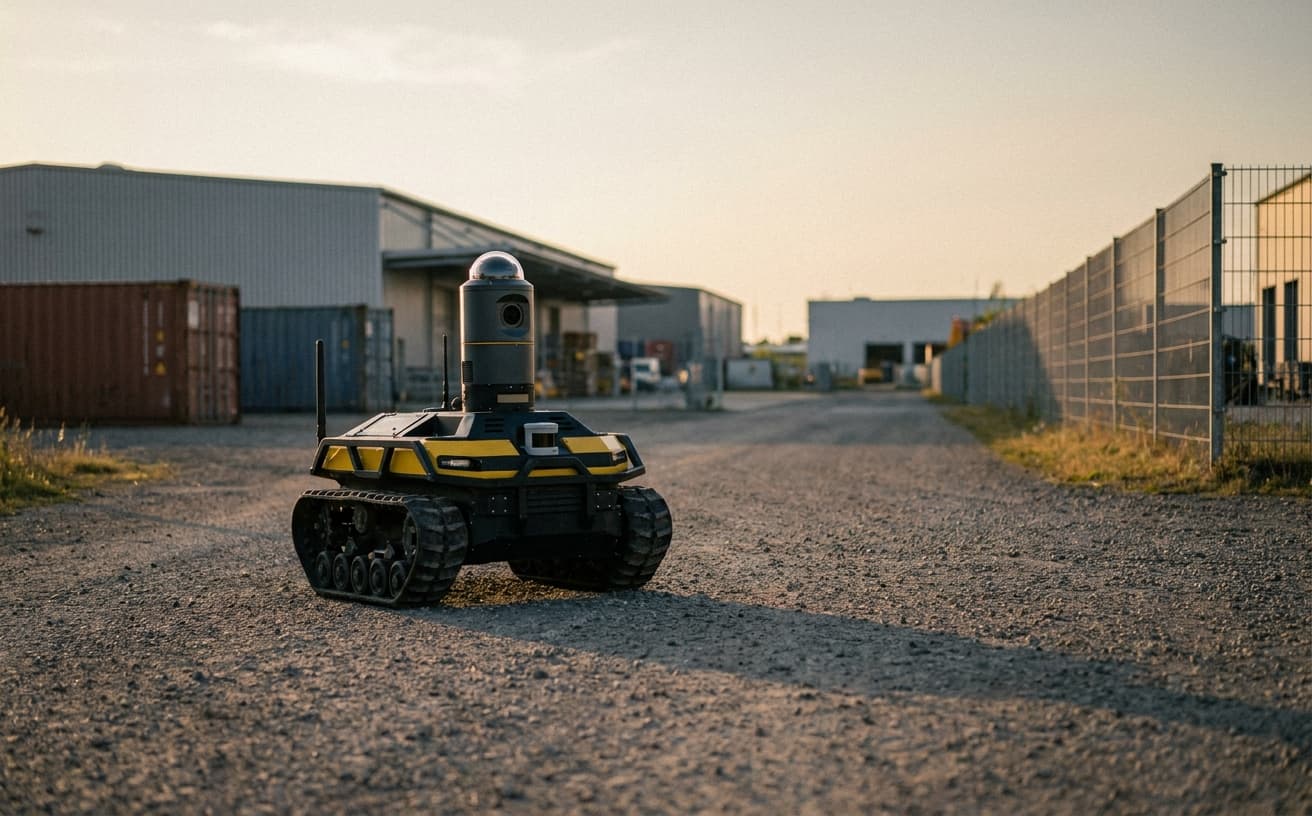
Aramco does not buy security robots. Aramco approves vendors who, after a procedure that takes months and sometimes years, may then deliver a security robot into a defined facility for a defined purpose. The order is not commercial first and technical later. It is the other way around, and any supplier who misreads that sequence has already lost the opportunity before the first meeting.
This distinction matters because the global market for autonomous security platforms has matured faster than the procurement frameworks that govern critical oil and gas infrastructure. A manufacturer who can demonstrate a working robot in Hamburg, Munich or Houston is not automatically a manufacturer who can sell into Saudi Aramco. The gap between technical readiness and supplier eligibility is wider than most foreign vendors expect, and it is filled with documents, audits, site visits, qualified welders, named engineers, traceable components and a quality system that a third party can verify without notice. The hardware is the easy part. The dossier is the hard part.
Boswau + Knauer, as a manufacturer that grew out of the construction trade into security technology, treats the Aramco supply chain not as an exotic export market but as a stress test of how seriously a vendor takes its own engineering. The standards that Aramco enforces, SAES, SAEP, SABP and the associated 9COM material codes, are not arbitrary obstacles. They are the operational memory of a buyer who has paid the price for vendor failures across decades. Reading them in that light changes the conversation.
What Aramco actually buys
Aramco does not purchase a security robot in the way a logistics operator in Rotterdam purchases one. The procurement object is a qualified solution, delivered by a qualified vendor, installed by qualified personnel, integrated into a qualified control architecture and maintained under a qualified service regime. Each of these qualifications has a document trail. Each document trail has a custodian inside Aramco. Each custodian has the authority to stop the process.
The autonomous platform itself, the chassis, the sensor stack, the navigation system, the communication module and the analytics layer, is one node in a larger object. That object includes the cellular and radio infrastructure the robot relies on, the charging stations and their electrical interfaces, the operator console in the control room, the integration with the existing CCTV and access control systems, the cybersecurity layer that protects all of the above and the maintenance plan that keeps the system running across five to ten years of Saudi heat, dust, salinity and operational tempo. A vendor who quotes only the robot is not quoting the object.
The implication for manufacturers is concrete. The bill of materials presented to Aramco must be traceable down to subcomponent level. Each subcomponent has an origin, a manufacturer code, a material certificate where relevant and a position in the 9COM catalogue or an equivalent justification. The software stack must be documented in versions, with hash values, signed firmware images and a clear chain of authorship. The integration architecture must show, on a single diagram, how the robot communicates with the upstream systems and where the cybersecurity boundaries lie. None of this is invented for Aramco. It is what IEC 62443 already requires for industrial automation and control systems in critical environments. Aramco simply enforces it.
The point of detachment for many vendors comes when they realise that the cost of producing this dossier exceeds the contribution margin of the first contract. That is the intended effect. Aramco filters for suppliers who will still be in business in year seven, not for suppliers who will optimise the first quotation. A manufacturer who treats the dossier as a one-off expense has misunderstood the long game. The dossier is the entry ticket to a customer base that, once won, does not shop on price alone.
The standards that suppliers live by
Three standard families dominate the conversation with Aramco for any security technology vendor. The Saudi Aramco Engineering Standards, known as SAES, define the technical content of acceptable solutions. The Saudi Aramco Engineering Procedures, the SAEP series, define the procedural sequence in which solutions are evaluated and approved. The Saudi Aramco Best Practices, the SABP series, define the operational expectations that translate the standards into daily conduct. A vendor who reads one family without the other two will produce an incomplete response.
For autonomous security platforms, the most frequently invoked references include SAES-T for telecommunications and electronic security systems, SAES-B for safety in design where the robot operates in hazardous-classified areas, and the cybersecurity clauses that Aramco has progressively aligned with IEC 62443 and NIST 800-53 control families. SAEP-1015 governs the vendor inspection requirements that determine when and how Aramco-appointed inspectors verify production at the manufacturer's facility. SABP-A-001 sits in the broader framework of operational practices that suppliers are expected to honour once a system is in service. The exact clause numbers move over revisions, and a serious vendor maintains a current copy of the applicable revision rather than relying on a version downloaded three years ago from a third-party portal.
The technical content of these standards is conservative by design. Aramco prefers proven hardware over novel hardware. It prefers documented redundancy over claimed reliability. It prefers field-replaceable units over sealed assemblies. It prefers manufacturers who maintain spare parts for a minimum of ten years over manufacturers who declare end-of-life on a three-year cadence. None of these preferences is unique to Aramco. They are common to operators of critical infrastructure who have learned, expensively, that the total cost of ownership of a security system is dominated by maintenance and obsolescence, not by acquisition. A robot that is brilliant in year one and unsupported in year four is worse than a robot that is adequate in year one and still supported in year eight.
Cybersecurity is the area where the standards have moved fastest. The convergence with IEC 62443, with explicit zones and conduits, with role-based access control, with signed firmware, with documented incident response and with an obligation to disclose vulnerabilities under defined timelines, has reshaped what is acceptable. A security robot that streams video and telemetry over a wireless link is, in cybersecurity terms, an industrial control system endpoint. It must behave like one. Manufacturers who treat cybersecurity as a marketing layer rather than a design discipline do not survive the technical review.
The vendor approval procedure
The procedure begins long before any commercial discussion. A manufacturer who wants to be considered for Aramco supply submits an application that triggers a review of corporate standing, manufacturing capability, quality management, financial stability and references. The review draws on ISO 9001 as a baseline, on ISO 27001 where information security is in scope, and on sector-specific certifications where applicable. A vendor without these baselines is not assessed further.
If the corporate review passes, the technical review begins. Aramco engineers, sometimes supported by third-party inspectors, examine the product against the relevant SAES clauses. The examination is documentary first and physical second. A vendor who cannot produce the engineering documentation in the form Aramco expects, with the level of detail Aramco expects, in the language Aramco expects, does not proceed to the physical examination. The physical examination, when it happens, takes place at the manufacturer's facility under SAEP-1015 logic. Inspectors observe production, verify material certificates, witness factory acceptance tests and assess the consistency between the documented process and the observed process. Deviations are recorded. Significant deviations halt the procedure.
Once the technical review is closed, the system enters a registration phase in which it is associated with material codes, included in the approved vendor list for the relevant category and made available for project-specific procurement. Inclusion in the list is not a contract. It is permission to be considered when a project arises. The first project itself is often a smaller deployment that functions as a proving ground, after which the vendor either earns a broader footprint or quietly disappears from the active rotation.
The timeline for this entire procedure varies, and any vendor who quotes a fixed duration is either inexperienced or selling something. For autonomous security platforms, twelve to twenty-four months from first application to first delivery is a realistic range, and that range assumes a vendor who responds to Aramco requests within days, not weeks, and who treats every clarification request as a priority engineering task. The manufacturers who succeed are the ones who allocate dedicated capacity to the Aramco relationship rather than treating it as one account among many. This is the same logic developed at length in BOSWAU + KNAUER. From Building to Security Technology. A buyer who runs critical infrastructure does not buy from suppliers who treat them as occasional customers.
Cybersecurity as a gating criterion
In the past decade, cybersecurity has moved from a parallel review to a gating criterion in the Aramco vendor approval procedure. A security robot, by virtue of its sensors, its wireless links and its central role in physical protection, is a high-value target. A compromised robot is not only a failed security asset. It is an attack surface that propagates into the wider operational network. Aramco knows this from direct experience with the broader threat environment in the region, and the cybersecurity expectations applied to security technology vendors reflect that experience.
The expectations align with the structure of IEC 62443 and draw on the control families of NIST 800-53 and the functions of NIST CSF 2.0. Identification of assets, protection through hardening and access control, detection through logging and monitoring, response through documented incident procedures, recovery through tested backup and restoration, and now governance as the explicit fifth function added in CSF 2.0. A vendor whose security robot lacks documented capability across these functions does not pass the cybersecurity review. The robot must be able to demonstrate, on demand, who can access what, how access is authenticated, how privileged operations are logged, how firmware updates are signed and verified, how anomalies are detected and how the operator is notified within defined timeframes.
The supply chain dimension has tightened further since the publication of CISA guidance on software bills of materials and the broader push, including from BSI in Germany and corresponding bodies elsewhere, towards transparency of third-party components. A manufacturer who cannot produce an SBOM for the robot's firmware, who cannot identify the open-source libraries embedded in the navigation stack, who cannot show how vulnerabilities in those libraries are tracked and remediated, is not a serious candidate. The bar has risen, and it will continue to rise. Vendors who built their products before this discipline became normal must retrofit it, and the retrofit is expensive. Vendors who built the discipline into the original architecture have a structural advantage.
The cybersecurity review also extends to the vendor's own corporate posture. ISO 27001 certification is a starting point. Beyond that, Aramco assesses how the vendor handles its own systems, its development environment, its source code repositories, its signing infrastructure and its incident history. A vendor who has experienced a breach and disclosed it transparently is treated more favourably than a vendor who has experienced a breach and concealed it. The latter, when discovered, is removed from the list. Concealment is the disqualifier, not the breach itself.
What disqualifies a vendor
The most common disqualification is not a technical failure. It is a documentation failure. A vendor who cannot produce, in the format and timeframe Aramco expects, the engineering documentation, the quality records, the material certificates, the cybersecurity evidence and the operational procedures, is removed from consideration. The robot may be excellent. The vendor is not ready.
The second most common disqualification is misrepresentation. A vendor who claims certifications they do not hold, who claims compliance with standards they have not been tested against, who claims references they cannot produce on request, is removed permanently. Aramco maintains institutional memory, and a vendor disqualified for misrepresentation does not reappear under a new name. The procurement community in the region is small enough that reputational damage is irreversible.
The third disqualifier is financial fragility. A vendor whose financial statements suggest that they cannot sustain a five-year service obligation on a deployed system is not approved, regardless of technical merit. Aramco buys for the life of the asset, not for the moment of delivery. A vendor who would default on obligations in year three is a vendor who imposes a switching cost on Aramco that exceeds the original purchase price. This is the same logic that ASIS International has articulated for enterprise security programmes, that NICB tracks for asset protection in adjacent industries, and that GDV applies in the European insurance context when assessing risk vendors.
The fourth disqualifier, increasingly significant, is the absence of a credible local presence. Saudi Arabia's broader industrial policy, expressed through programmes like IKTVA, expects suppliers to invest in local manufacturing capacity, local employment and local technology transfer where the volume justifies it. A vendor who treats Saudi Arabia as a pure export market, without intention to localise, is at a disadvantage relative to a vendor who has invested in a local entity, local engineering staff and local service capability. The disadvantage grows with each tender cycle.
A fifth disqualifier, less visible but no less real, is poor behaviour in the relationship itself. Vendors who escalate aggressively over commercial disputes, who attempt to bypass technical reviewers by appealing to senior management, who fail to respect the confidentiality of project information, who pressure Aramco engineers in social or commercial settings, are removed quietly. The Aramco supply chain rewards patience and respect for the procedural framework. Vendors who try to shortcut the framework discover that the framework is the relationship.
What holds
The Aramco supply chain is not a market in the ordinary sense. It is an institution that admits suppliers who have demonstrated, across years and across audits, that they understand the difference between selling a product and supporting a critical asset. For manufacturers of security robots, the entry cost is high and the timeline is long, but the relationship that follows is durable in a way that volatile markets do not offer.
The standards, SAES, SAEP, SABP, the alignment with IEC 62443 and ISO 27001, the cybersecurity expectations drawn from NIST CSF 2.0 and NIST 800-53, the inspection regime under SAEP-1015, are not bureaucratic obstacles to be minimised. They are the operating manual of a buyer who has decided what good looks like and who enforces it. A manufacturer who takes the manual seriously builds, in the process, a product and a company that perform better in every other market as well. The Aramco discipline is portable. The vendors who survive it become more competitive elsewhere, not less.
For operators considering autonomous security platforms in critical infrastructure, the practical first step is a sixty-minute confidential conversation in which the standards landscape, the vendor readiness and the operational reality are mapped against each other without commercial pressure. That conversation, Path I in the framework described in the book, is often the first time the picture comes into focus.
Frequently asked questions
What is Aramco vendor approval?
Aramco vendor approval is the procedural admission of a manufacturer or service provider into the supply chain of Saudi Aramco. It is not a single certificate but a sequence of reviews that cover corporate standing, quality management, technical compliance with the SAES standards, inspection capability under SAEP-1015, cybersecurity posture and financial stability. Approval places the supplier on the relevant approved vendor list for specific material categories, after which they become eligible for project-specific procurement. Approval is conditional and revocable. It is renewed and audited across the relationship.
Which SAES standards apply to security tech?
For autonomous security platforms, the most directly relevant references sit within SAES-T for telecommunications and electronic security systems, SAES-B clauses governing safety in hazardous-classified areas, and the cybersecurity provisions that Aramco has aligned with IEC 62443. SAEP-1015 governs vendor inspection. SABP-A-001 sits within the operational best practices framework. The exact applicable clauses depend on the deployment context, the facility classification and the integration scope. A current revision of the standards must be obtained directly through Aramco channels rather than from third-party sources, and the applicable list confirmed with the project's technical authority.
How long does approval take?
For autonomous security platforms, a realistic range is twelve to twenty-four months from first application to first delivery, and that range presumes a vendor who responds promptly to every clarification, who arrives at the technical review with complete documentation, who passes the factory inspection without significant deviations and who has the corporate baselines, including ISO 9001 and ISO 27001, already in place. Vendors who begin the application without those baselines extend the timeline considerably. Cybersecurity reviews can add months if the firmware, the SBOM and the incident response capability are not already documented to the expected depth.
What disqualifies a vendor?
The principal disqualifiers are documentation failures, misrepresentation of certifications or references, financial fragility insufficient to support multi-year service obligations, absence of a credible local presence aligned with Saudi industrial policy, and conduct that breaches the procedural and confidentiality expectations of the relationship. Technical inadequacy of the product itself is a relatively rare disqualifier compared to these procedural and reputational factors. A vendor whose robot is technically sound but whose engineering documentation, cybersecurity evidence or corporate posture is incomplete will be removed from consideration before the product is even physically examined.
Related topics
- All-Weather Security Robots: What Outdoor Rated Means
- Security Robots in the UAE: SIRA Licensing
- Security Robots in Smart Districts: Msheireb Doha
- Security Robots in Kuwait, Bahrain & Oman
- Knightscope's K5 Was a UX Miracle and an ROI Tragedy
- AI Video Models in the Gulf: Thobe vs. Suit
Take the next step: See prices & ROI · Explore the products · Send a no-obligation request. BOSWAU + KNAUER – direct from the factory in Filderstadt, reply within 5 working days.
About the author
Dr. Raphael Nagel (LL.M.) is founding partner of Tactical Management. He acquires and restructures industrial businesses in demanding market environments and writes on capital, geopolitics, and technological transformation. raphaelnagel.com
More reading

Since 1892.
The firm is reached at boswau-knauer.de or +49 177 2266267.