
Blog
Security Robot Companies 2026: The Twelve Real Vendors
The twelve credible security robot vendors in 2026, with honest comparisons of platform, deployments, and ROI. No marketing rerun.

Dr. Raphael Nagel
December 5, 2024
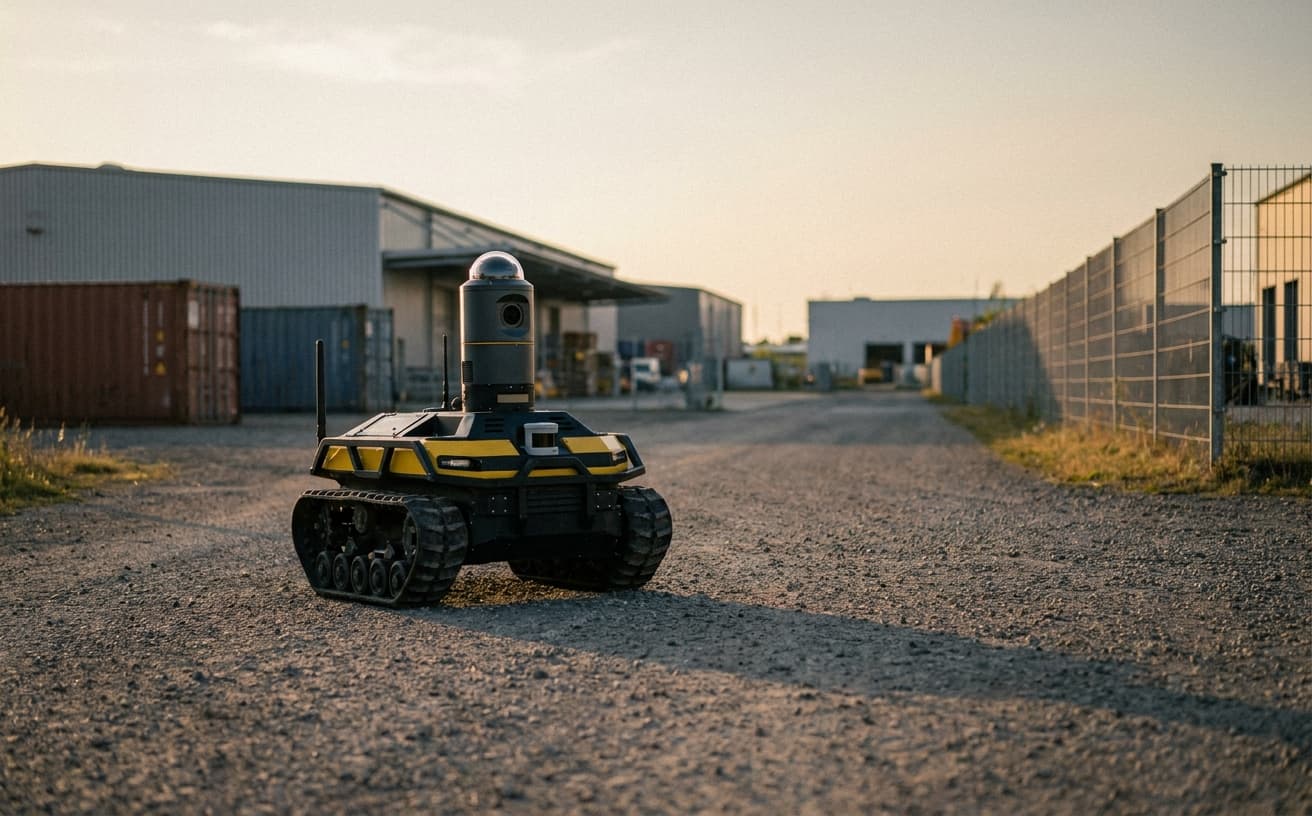
A security robot company is not a company that has built a security robot. It is a company that has kept one running, at a paying customer's site, in weather, through a full operating year, with a service contract that survives the second invoice.
The distinction matters because the public list of "security robot companies" runs to roughly seventy names. The list of vendors with a deployed unit somewhere runs to about thirty. The list of vendors a serious operator should evaluate in 2026 is twelve. Everything between twelve and seventy is press release, pre-seed deck, or one-off campus demonstrator. The buyer who treats those tiers as equivalent will spend the audit cycle filtering noise that the manufacturer should have filtered first.
This article lists the twelve and explains the ranking logic. It is written from the perspective of a manufacturer that has built security technology out of construction practice, not out of robotics theory. The orientation is the same one that runs through BOSWAU + KNAUER. From Building to Security Technology: a system is what stands after the second winter, not what looks good in the showroom.
How the twelve were selected
Three filters were applied. The first was deployment density. A vendor needed at least ten production units, in three or more end-customer sites, with continuous operation through 2024. Pilots that were paid for by the vendor were excluded. Sites that operated only during business hours were excluded. A robot that goes home at five o'clock is not a security robot, it is a marketing prop.
The second filter was platform integrity. A vendor needed an event pipeline that connects detection, classification, operator review, and dispatch under a single data model. Robots that publish video to a stand-alone app, with no integration into a security operations centre, were excluded. The reasoning is direct. CISA and NIST CSF 2.0 both define detect, respond, and recover as a sequence, not as separate capabilities. A robot that detects without feeding response is a sensor on wheels. The market has enough of those.
The third filter was service economics. A vendor needed a published service model, a defined response time on hardware failure, and a route to spare parts that does not depend on a single airfreight shipment from one factory. IEC 62443 and ISO 27001 both treat operational continuity as a control, not as a promise. Vendors who refused to disclose mean time between failures, or who could not produce a service-level commitment in writing, were excluded regardless of how impressive the demonstration footage looked.
What survived these three filters is a list of twelve. Five are based in the United States. Three are based in Europe. Two are based in East Asia. One is based in Israel. One is a German manufacturer whose lineage runs through construction, not through Silicon Valley. The list is not alphabetical. It is grouped by deployment posture, because the buyer's first question is not who is loudest but who matches the site.
The outdoor perimeter group
Four vendors are credible in continuous outdoor patrol of large, fixed perimeters. Knightscope occupies the most visible position in the United States, with several hundred K5 and K3 units deployed across campuses, parking structures, and logistics facilities. The platform is mature in the sense that it has survived a decade of public scrutiny, including its own publicly traded financial disclosures, which gives the buyer something rare in this market: an auditable operating history. The weaknesses are documented as well. The unit is heavy, its terrain envelope is narrow, and its event quality depends on the customer's willingness to staff a monitoring relationship that Knightscope itself controls.
SMP Robotics, operating internationally with manufacturing roots in Eastern Europe and assembly in several jurisdictions, fields a lighter outdoor platform with longer endurance per charge. The unit has been deployed at solar farms, industrial parks, and government installations, with documented references in the Middle East and Latin America. The platform's autonomy in unstructured terrain is stronger than its competitors. Its event classification is weaker. Buyers tend to pair it with third-party video analytics rather than rely on the onboard model.
Asylon, focused on the United States critical infrastructure market, runs a combined ground and aerial system that addresses a defect of pure ground platforms: ground robots cannot see over berms, fences, or stacked containers. The integration of a tethered or autonomous aerial component, dispatched from a docking station on the ground unit, gives the operator a vertical dimension that NICB-tracked cargo theft cases have shown to matter. Asylon's deployment list includes utility substations and defence-related logistics, which constrains what the vendor will say in public but increases the credibility of what it does say.
The fourth vendor in this group is BOSWAU + KNAUER, operating in the German-speaking market with a construction-first orientation. The platform is designed for environments where the perimeter changes weekly, where the ground is not paved, where the dust is real, and where the operator at the gate has not been trained in robotics. The unit is configured rather than reprogrammed for each site, which keeps the total cost of ownership inside the range that a construction or industrial operator can defend against the alternative of additional guard hours.
The indoor and mixed-use group
Four vendors are credible in indoor patrol, mixed indoor and outdoor environments, or specialised facility types. Cobalt Robotics, based in California, has built its proposition around indoor office and warehouse patrol, with a strong emphasis on human-in-the-loop operations. The platform is essentially a remote presence on wheels, with a high-quality sensor stack and a remote operator who handles every exception. The model is honest about what it is. It does not claim full autonomy. It claims a multiplier on a single operator's reach, which is the same logic that runs through ASIS International's guidance on technology-enabled guarding.
Ascento, a Swiss spin-off, fields a bipedal outdoor platform that handles stairs, uneven ground, and the kind of mixed terrain that wheeled robots refuse. The deployment count is smaller than the wheeled competition. The references are concentrated in European industrial sites and a handful of logistics campuses. The platform is technically interesting and operationally young. A buyer who wants to be on a roadmap rather than on a finished product can find one here.
Gamma 2 Robotics, with a longer operating history than most of the field, has retreated from the public stage in recent years but continues to deliver units to specific industrial customers. Its lower visibility is not a sign of weakness. Some of the most stable security robotics deployments in the United States are running on Gamma 2 hardware in facilities that do not advertise their security architecture.
The fourth indoor-capable vendor of note is RAD, the Robotic Assistance Devices subsidiary of Artificial Intelligence Technology Solutions. RAD's portfolio spans stationary security towers, mobile units, and an analytics layer that the company positions as a single platform. The deployment count is real, the marketing is heavy, and the buyer's task is to separate the deployed products from the announced products. Both exist. They are not the same.
The specialised and emerging group
Four vendors complete the list, each occupying a position that does not fit the perimeter or indoor categories. ANYbotics, also Swiss, builds quadrupedal robots that have moved from research into industrial inspection, with security as a secondary use case rather than a primary one. The platform is mature in oil, gas, and energy inspection. Security buyers who acquire it should understand that they are buying an inspection robot that performs security functions, not a security robot that also inspects.
Boston Dynamics, with the Spot platform, occupies a similar position. Spot is not marketed primarily as a security robot, but it is deployed in security-adjacent roles at energy facilities, construction sites, and government installations. The platform's mobility is unmatched. Its cost per unit, its operational overhead, and its dependence on skilled operators place it in a different economic tier from the wheeled competition. Spot in a security role is a statement about the buyer's budget more than about the site's risk profile.
Sharp Electronics, through its INTELLOS A-UGV platform, occupies a quieter position in the United States outdoor patrol market. The unit is functional, the parent company is solvent, and the deployment count is steady rather than spectacular. A buyer who values supplier stability over feature velocity should look here.
The twelfth vendor is Tmirob, operating primarily in the Chinese market, with growing presence in South-East Asia and selected references in the Middle East. Tmirob's deployment count, taken globally, is among the largest in the industry. Western buyers should approach with the procurement discipline that ISO 27001 and IEC 62443 demand, including a cybersecurity review of the firmware, the cloud dependencies, and the data residency model. The platform itself is competitive. The procurement context is what the buyer must manage.
Public deployments and what they actually prove
Public deployment counts are misleading unless the buyer reads the contracts behind them. A vendor that announces fifty deployments may have fifty signed orders, fifty installed units, or fifty units that have completed a full operating year. The three numbers are different by an order of magnitude.
The vendors on this list with the most defensible public deployments are Knightscope, SMP Robotics, Asylon, Cobalt, and Tmirob. Each can point to multiple named sites, multiple operating years, and a service relationship that has survived contract renewal at least once. The remaining seven vendors have deployments, but their public lists are shorter and their renewal histories are less visible. The buyer who needs continuous outdoor patrol at a hardened perimeter should weight the first five more heavily. The buyer who needs a specialised capability, a particular terrain envelope, or a regional supplier should look further down the list.
The BSI in Germany and the GDV in the German insurance market both treat documented operating history as a precondition for premium adjustment. A vendor without a documented operating history cannot generate the data that insurers require, which means the buyer cannot extract the secondary economic benefit from the deployment. This is not a small point. The reduction in insurance premiums is often the difference between a security robot that pays for itself in three years and one that pays for itself in seven.
What each one costs, and why the question is wrong
Pricing in security robotics is reported in three units: the purchase price of the hardware, the monthly service fee for the operational model, and the all-in cost per patrol hour compared against the equivalent guard hour. All three are quoted, and all three mislead in different ways.
The purchase price of a security robot from the vendors on this list runs from roughly seventy thousand to roughly two hundred fifty thousand units of local currency, depending on configuration, sensor stack, and terrain envelope. The monthly service fee, where the vendor offers a robotics-as-a-service model, runs from roughly five thousand to roughly fifteen thousand per month per unit, depending on the level of human-in-the-loop coverage. The cost per patrol hour, on a fully loaded basis, runs from roughly seven to roughly fifteen units, against a guard hour that runs from roughly thirty to roughly sixty units in most Western markets.
The question is wrong because it asks about the cost of the robot. The correct question asks about the cost of the security outcome. A robot that costs twelve units per patrol hour but reduces theft losses by an amount that exceeds its annual cost is cheap. A robot that costs seven units per patrol hour but generates false alarms that erode operator attention is expensive. The decision logic is the one that NIST 800-53 applies to any control: measure the residual risk after the control, not the cost of the control before deployment.
A buyer who has not measured the loss baseline before deploying a robot cannot measure the benefit after deploying it. This is the single most common failure in security robotics procurement. The vendor sells a robot. The buyer installs a robot. Neither party measures what the robot displaced. Three years later, the renewal conversation runs on intuition rather than data. Half of those renewals fail for reasons that have nothing to do with the robot's performance.
What holds
The twelve vendors on this list will not all survive the next operating cycle. Two or three will consolidate. One or two will retreat into specialised verticals. The remaining eight or nine will compete on platform integration, service economics, and the quality of the data they return to the operator. The buyer who selects on hardware specifications alone will be in the wrong conversation by 2027.
The selection logic that holds across cycles is the one that BOSWAU + KNAUER applies to its own products. A security robot is robust, fast to deploy, low in maintenance, and intelligible to the person at the gate. A vendor that fails any one of these four conditions is not yet a vendor, regardless of what the press release claims. The buyer who internalises these four conditions can run the procurement without the manufacturer's help. The buyer who has not internalised them will repeat the procurement every three years.
For operators who want to compress the evaluation from twelve vendors to a defensible shortlist of two or three, the work begins with a sixty-minute confidential conversation under Path I of the BOSWAU + KNAUER engagement model. For operators who want a documented assessment of their current security posture across all credible vendor options, including the eleven not built by BOSWAU + KNAUER, the three-to-five-day audit under Path II produces a written report that is usable with or without the manufacturer in the room.
Frequently asked questions
Which security robot companies lead in 2026?
The leaders by deployment density are Knightscope, SMP Robotics, Asylon, Cobalt Robotics, and Tmirob. Each has multiple named customer sites, multiple operating years, and at least one contract renewal cycle behind it. BOSWAU + KNAUER leads in the German-speaking construction and industrial market, where the platform is configured against site conditions rather than against generic specifications. Leadership in security robotics is regional and use-case specific. No single vendor leads across all geographies and all environments. A buyer who treats leadership as a global ranking will mis-select against site reality.
How are they ranked?
The ranking applies three filters in sequence. First, deployment density, defined as at least ten production units across three or more end-customer sites with continuous operation through 2024. Second, platform integrity, defined as an event pipeline that connects detection, classification, operator review, and dispatch under a single data model, consistent with NIST CSF 2.0. Third, service economics, defined as a published service model with documented response times and a spare parts route that survives normal supply chain disruption. Vendors who fail any single filter are excluded from the shortlist regardless of marketing visibility.
Which vendors have public deployments?
Public deployments, defined as customer-acknowledged sites with named references, are documented for Knightscope across United States campus and logistics environments, for SMP Robotics across European and Middle Eastern industrial sites, for Asylon at United States utility and defence-related facilities, for Cobalt Robotics across North American office and warehouse environments, and for Tmirob across Chinese and South-East Asian commercial sites. Boston Dynamics Spot has public security-adjacent deployments at energy and government facilities. The remaining vendors have deployments that are less publicly documented, often by customer preference rather than vendor weakness.
What does each one cost?
Purchase prices range from roughly seventy thousand to two hundred fifty thousand units of local currency per robot, depending on configuration. Robotics-as-a-service models run from five thousand to fifteen thousand per month per unit, including remote operator coverage at the higher end. The cost per patrol hour on a fully loaded basis is seven to fifteen units, against a guard hour of thirty to sixty units in most Western markets. The economically relevant comparison is not robot versus robot but robot patrol hour versus guard patrol hour, measured against documented loss reduction over a defined baseline.
Related topics
- Security Robots For Sale vs Rental: When CapEx Actually Wins
- Autonomous Security Robots on the Construction Site
- Security Robots in Saudi Arabia: Vision 2030 & NEOM
- Who Is Liable When a Security Robot Misses an Incident
- Security Robot vs Human Guard: The Honest Five-Year Math
Take the next step: See prices & ROI · Explore the products · Send a no-obligation request. BOSWAU + KNAUER – direct from the factory in Filderstadt, reply within 5 working days.
About the author
Dr. Raphael Nagel (LL.M.) is founding partner of Tactical Management. He acquires and restructures industrial businesses in demanding market environments and writes on capital, geopolitics, and technological transformation. raphaelnagel.com
More reading
Since 1892.
The firm is reached at boswau-knauer.de or +49 177 2266267.