
Blog
Security Robots at DEWA: Utility Perimeter
DEWA Generation, Hassyan, Mohammed bin Rashid Solar Park. How autonomous security extends across one of the world largest utility footprints.

Dr. Raphael Nagel
May 21, 2025
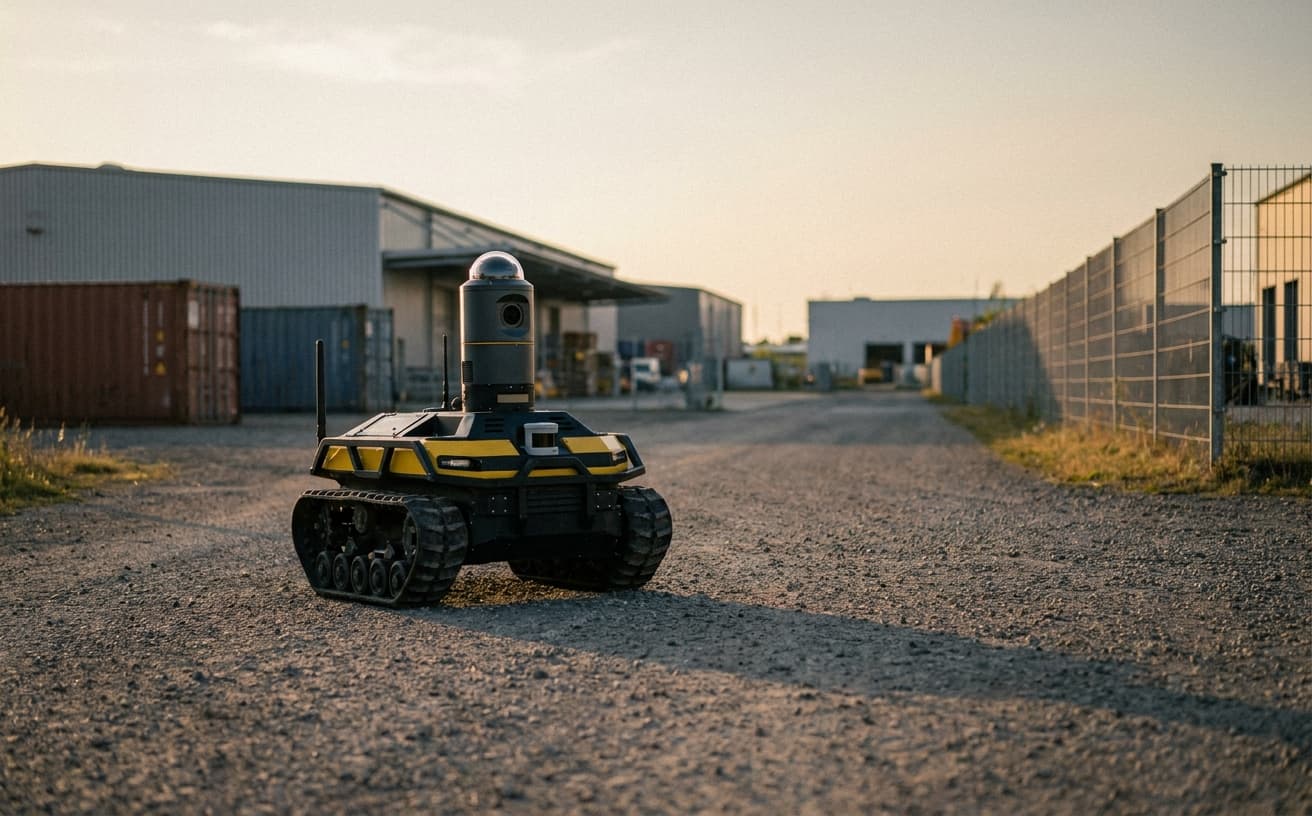
A utility perimeter is not a fence. It is a regulated state, audited by an authority that does not accept verbal assurance.
The Dubai Electricity and Water Authority operates an estate whose physical footprint runs across desert, coast and dense urban interface, and whose regulatory weight extends further than the footprint itself. DEWA does not behave as a customer in the sense in which a private operator behaves as a customer. It behaves as an authority that procures, inspects and certifies in one motion. The security architecture that surrounds its generation plants, its solar park, its substations and its water assets is therefore shaped less by the threat catalogue than by the documentation regime. Operators who enter this market without that distinction in mind tend to underestimate the volume of evidence that an autonomous platform must produce on its own.
The point of this article is to set out what an autonomous security platform has to deliver, in operational and regulatory terms, to function inside the DEWA estate and inside utility estates of comparable maturity. The reference frame is not a vendor's brochure. It is the working manual of an operator who has to defend the system in front of an inspector, a procurement officer and a board, in that order.
The scale of the estate and what it implies
DEWA generation, transmission and distribution assets cover several distinct asset classes that share little beyond their owner. Hassyan, on the coast south of Jebel Ali, is a thermal generation complex with deep-water intake structures, fuel handling, switchyards and a perimeter that runs through industrial neighbours. The Mohammed bin Rashid Al Maktoum Solar Park, south of Dubai city, is a photovoltaic and concentrated solar installation whose footprint runs into the thousands of hectares and whose perimeter is largely open desert. Add to that the substation grid distributed across the emirate, the water production facilities, the desalination intakes, and a fibre and SCADA backbone that ties them together, and the security problem ceases to be a perimeter problem in the singular. It is a problem of dozens of perimeters, each with its own threat profile, run under a single regulatory and reporting regime.
The implication for autonomous security is straightforward. A robot or a sensor tower deployed at the solar park has to handle dust ingress, surface temperatures that exceed sixty degrees in summer, a flat optical environment in which thermal contrast collapses at midday, and a perimeter whose nearest response unit may be twenty minutes away by road. A robot or a tower deployed at Hassyan has to handle salt aerosol, industrial RF noise from the switchyard, vehicle traffic, contractor presence and a perimeter that abuts third-party industrial property. A substation deployment has to handle confined geometry, public adjacency, and the fact that the asset itself is unattended for most of its operating life. The same platform cannot meet all three contexts without explicit configuration, and configuration without a documented baseline does not survive an audit. The platform model that BOSWAU + KNAUER. From Building to Security Technology argues for, modular hardware with configuration in software and a single data layer, is the only model that scales across an estate of this composition without producing islands.
The numerical scale matters in a second sense. A utility operating at the scale of DEWA produces thousands of perimeter events per day across its estate, most of them benign. Wind on a fence, a stray dog, a contractor vehicle outside its scheduled window, a maintenance team that did not log into the access system before entering a substation yard. The cost of a security architecture is set far more by its false alarm rate than by its hardware count, because false alarms consume operator attention and, past a threshold, lead the operator to disable the function. The architectures that survive in utility environments are the ones that fuse two or more independent channels before raising an alarm and that document the suppression of routine events as carefully as they document the alarms themselves.
What the regulator actually watches
The federal and emirate-level oversight regime that surrounds critical infrastructure in the United Arab Emirates draws on a layered set of references. The UAE Information Assurance regulation, issued by the Telecommunications and Digital Government Regulatory Authority, sets baselines for the protection of information assets that touch SCADA and OT environments. The Critical Information Infrastructure Protection regime issued in coordination with national authorities adds requirements that touch physical perimeter, access control and incident reporting. At the international layer, IEC 62443 sets the reference for industrial automation and control system security, ISO 27001 covers the information security management system that wraps around it, and the NIST Cybersecurity Framework, in its 2.0 revision, provides the function-by-function articulation that procurement teams increasingly use to test vendor claims. CISA advisories on substation physical attack, published after the North Carolina and Pacific Northwest events of the last several years, are read in Dubai as carefully as they are read in Washington.
The regulator's interest in autonomous security is not the technology. It is the evidence chain. An inspector who asks whether a perimeter robot detected a particular event at a particular time wants to see the sensor log, the classification confidence, the operator action, the chain of custody on the recorded video and the disposal record after retention expiry. A platform that cannot produce that chain in a form the inspector recognises is, from the regulator's standpoint, indistinguishable from a platform that did not detect the event at all. The architectural consequence is that logging, time synchronisation, tamper evidence on the log and operator authentication are not features added to the security platform. They are the platform. The patrol function sits on top of them.
This shapes procurement in a particular way. DEWA and comparable utility regulators tend to favour platforms that can be inspected, not platforms that can only be demonstrated. An inspectable platform exposes its decision logic to audit, accepts the regulator's clock as authoritative, retains data for the periods the regulation specifies, and produces reports in a form that the regulator can read without bespoke tooling. A demonstrable platform produces a convincing dashboard for a vendor visit and falls apart under a serious evidence request. The distinction is rarely visible in a proof of concept. It becomes visible in the first regulatory exercise after deployment, by which time the procurement decision has been made.
The thermal and environmental envelope
Dubai's environmental envelope is not extreme by the standards of the published industrial specification. It is extreme by the standards of how that specification was actually tested. Ambient temperatures of forty-five to forty-eight degrees Celsius during the summer months, combined with direct solar load that pushes surface temperatures on horizontal equipment past sixty-five, sit at or above the upper bound of the test regimes that many commercial sensor and compute platforms were validated against. Add to that humidity that swings between twenty percent in the inland desert and ninety percent at the coast, salt aerosol within several kilometres of the shoreline, and a fine dust load that penetrates seals rated for ordinary industrial environments, and the failure modes of imported hardware become predictable.
The platforms that survive in this envelope share a small number of design choices. Compute is placed in a thermally managed enclosure, not bolted to the back of a mast where it absorbs solar radiation. Bearings, seals and connectors are specified for the upper bound of the local envelope with margin, not for the nominal specification of the device's home market. Power systems account for the derating of photovoltaic and battery components at high temperature and for the increased self-discharge that comes with it. Optical systems include both visible and thermal channels because the visible channel saturates and loses contrast at midday on light surfaces, and the thermal channel loses contrast when ambient and target temperatures converge in the late afternoon. The combination of the two channels, fused in software, is what produces a detection rate that holds across the diurnal cycle.
The operating practice that surrounds the hardware matters as much as the hardware itself. A robot that completes its patrol cycle at noon is a robot that has spent the worst three hours of the day stationary on a charging pad. The patrol scheduling that emerges from field experience in the Gulf places the heaviest patrol load in the cool hours, dawn to nine and after sunset, and uses the midday window for charging, diagnostics and software updates. This pattern is invisible to a buyer who has only seen the platform demonstrated in a European or North American climate. It is the first thing that an operator learns in the first summer of deployment.
Who supplies the market and what that means for the buyer
The autonomous security supplier base for utility environments in the Gulf is concentrated. A small number of international robotics vendors, drawn from the United States, Singapore, China and Europe, supply the majority of mobile platforms in current deployment. A larger field of integrators wraps those platforms in the local service, regulatory and reporting layer that the end customer actually consumes. Sensor and tower suppliers are more fragmented, with a mix of Israeli, European and East Asian hardware behind the integrator's brand. The video analytics layer is dominated by a handful of platforms that have invested in the model training required to handle the local environment, with a long tail of regional players that resell underneath them.
The implication for a utility buyer is that the supplier name on the procurement document is rarely the entity that determines the system's behaviour in the field. The behaviour is determined by the integrator, by the configuration of the analytics, by the service contract and by the operator workforce that sits behind the dashboard. A platform that performs identically in two demonstrations performs very differently in two deployments if the integration choices around it differ. The questions that distinguish a serious procurement from a checklist procurement are not about the robot's top speed or the camera's pixel count. They are about who owns the data, who authenticates the operator, how an event is escalated outside business hours, how a software change is validated before it reaches the field and how the platform behaves when the network link to the central operations centre fails.
A utility buyer working at DEWA scale will, in practice, run several suppliers in parallel across the estate. This is not a procurement failure. It is a deliberate hedge against single-vendor risk in a category where the regulatory cost of a platform-wide failure is severe. The architectural consequence is that interoperability is not a nice-to-have. It is a hard requirement, and the standards that support it, OSDP for access control, ONVIF for video, MQTT and OPC UA for sensor and control data, are non-negotiable. Any platform that requires a proprietary stack to deliver its core function will not sit comfortably inside a utility estate that is already running three other platforms for the same function.
The operations centre and the human in the loop
Autonomous security in a utility context does not remove the human operator. It changes the operator's job. The job moves from patrol, where a guard walks a route and observes, to supervision, where an operator manages a fleet of autonomous platforms and adjudicates the events that those platforms cannot classify with confidence. The ratio of operators to perimeter kilometres improves by a factor that depends on the asset class, the false alarm rate and the local response geometry. In a well-tuned solar park deployment, a single operator can supervise tens of kilometres of perimeter and dozens of patrol cycles per shift. In a substation deployment, where the asset density is higher and the consequence of a missed event is more severe, the ratio is tighter.
The architecture of the operations centre is therefore as much a design decision as the architecture of the robot. The interface that the operator sees has to surface the right event at the right time, with enough context to permit a decision in seconds, and it has to record the decision in a form that an auditor can reconstruct months later. The training regime that produces a competent operator is measured in weeks, not days, and the retention of trained operators is a strategic concern that procurement documents rarely address. The platforms that perform well over years are the ones whose vendor has invested in the operator interface and the training material with the same seriousness as the patrol algorithm. The ones that fail tend to fail because the operator interface was an afterthought and the operator workforce churned faster than competence could be built.
The interface to the wider organisation matters as much as the interface to the operator. A security event that does not reach the right person in the right business unit within the time window in which action is still possible is, operationally, a non-event. The integration of the security platform with the SCADA estate, the work order system, the access control system and the corporate communications layer is what determines whether detection becomes response. This integration is hard, it is slow, and it is rarely demonstrated at the time of procurement. It is, however, the largest single determinant of whether an autonomous security investment produces the benefit that the business case assumed.
What holds
The utility perimeter is a regulated state, sustained by an evidence chain that an inspector can read. Autonomous security platforms earn their place inside a utility estate not by detecting more events than a human guard but by producing the evidence in a form the regulator accepts and by sustaining that production over years of operation under an environmental envelope that punishes shortcuts. The architectural choices that make this possible, modular hardware, open interfaces, fused multi-channel detection, audit-grade logging and an operator interface designed for sustained supervision, are visible in the platforms that survive and absent in the platforms that do not.
The operator who is preparing to enter or to renew this category of investment has a narrow set of questions to answer. Whether the platform under consideration produces evidence the local regulator accepts. Whether the supplier behind the brand is the entity that will actually be present when the platform misbehaves. Whether the environmental envelope of the deployment site has been tested, not assumed. Whether the operations centre and the workforce around it can sustain the platform over the contract life. These questions are answered through structured assessment, not through demonstration, and the assessment is what BOSWAU + KNAUER offers in the three to five day audit described in the manuscript as Path II. For an operator at the early stage of the decision, the sixty-minute confidential conversation that constitutes Path I is the appropriate entry point. The pilot that constitutes Path III follows only when the prior two have produced a defined success criterion.
Frequently asked questions
How big is DEWA footprint?
DEWA serves the emirate of Dubai with installed generation capacity in the range of fifteen to sixteen gigawatts, drawn from thermal, solar and imported sources. The Mohammed bin Rashid Al Maktoum Solar Park alone covers a planned footprint of roughly seventy-seven square kilometres at full build-out, making it among the largest single-site solar developments globally. The Hassyan complex on the coast, the Jebel Ali generation and water production complex, and a distributed substation and water network across the emirate add several hundred discrete sites under a single regulatory and security umbrella. The aggregate perimeter runs into the hundreds of kilometres.
What perimeter tech does DEWA standardize on?
DEWA does not publish a single standardised technology stack, and the operator should not expect to. The estate combines fixed perimeter detection, video analytics on fixed and mobile platforms, autonomous ground robots in selected high-value installations, drone surveillance under coordinated airspace agreements, and access control integrated with the corporate identity system. The standards that bind these layers together are international rather than proprietary, with IEC 62443, ISO 27001 and the NIST Cybersecurity Framework 2.0 serving as the most consistent references in procurement documents and audit exercises across the regulated utility space in the United Arab Emirates.
Who supplies them today?
The supplier base is a mix of international robotics and sensor vendors integrated by regional system integrators with the regulatory and service footprint to deliver in the local environment. Naming individual suppliers in a journal article would misrepresent a market in which contracts move and integrators rebrand. The more durable observation is that no single supplier holds the estate, that several platforms run in parallel across asset classes, and that interoperability through open standards is the procurement requirement that distinguishes serious vendors from those who will not survive the next regulatory cycle.
How are extreme temperatures handled?
Extreme temperatures are handled by hardware specification with margin above the local envelope, by thermal management of compute and battery components, by patrol scheduling that places heavy load in cool hours and maintenance in the midday window, and by the fusion of visible and thermal optical channels to compensate for the loss of contrast that each channel experiences at different points in the diurnal cycle. The platforms that perform reliably in Gulf conditions were not designed for nominal industrial specification. They were designed, or selected, for the upper bound of the actual environment, and they were validated through deployment seasons, not laboratory cycles.
Related topics
- Extreme Heat & Security Robots in the Gulf: 55C
- Security Robots in Qatar: MOI Standards & Legacy
- UK Data Centre Corridor: Slough, Docklands & West London
- Security Robot vs Human Guard: The Honest Five-Year Math
- Security Robots in Saudi Arabia: Vision 2030 & NEOM
Take the next step: See prices & ROI · Explore the products · Send a no-obligation request. BOSWAU + KNAUER – direct from the factory in Filderstadt, reply within 5 working days.
About the author
Dr. Raphael Nagel (LL.M.) is founding partner of Tactical Management. He acquires and restructures industrial businesses in demanding market environments and writes on capital, geopolitics, and technological transformation. raphaelnagel.com
More reading
Since 1892.
The firm is reached at boswau-knauer.de or +49 177 2266267.