
Blog
Security Robots Across Dubai Free Zones: JAFZA & More
Free-zone-specific licensing, DP World logistics, customs interaction. How robotic security navigates Dubai zoning maze.

Dr. Raphael Nagel
September 12, 2025
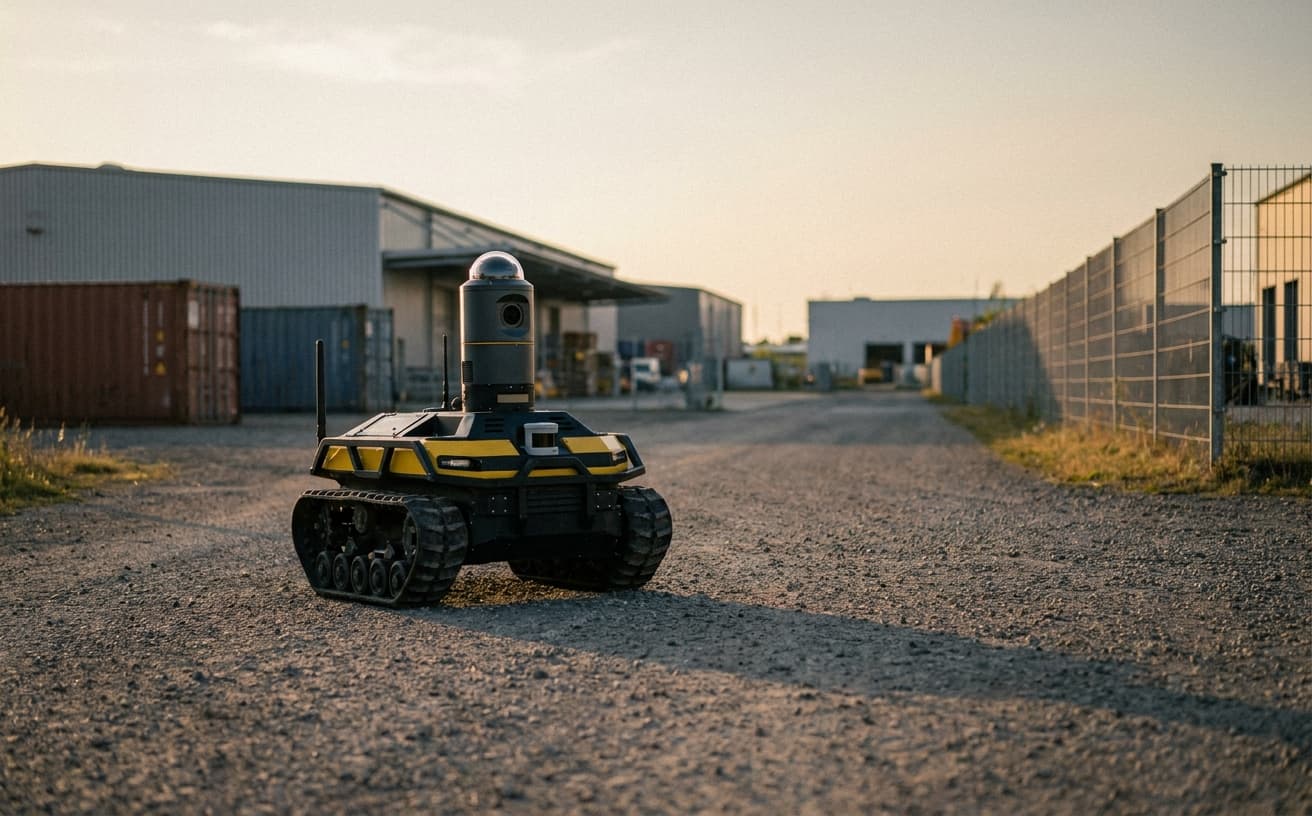
A free zone is a contract, not a place. Whoever deploys a security robot across Dubai's free zones without internalising that distinction will, sooner or later, ship hardware into a jurisdiction that quietly rejects it.
The robot itself is the easy part. The hard part is the licensing perimeter around the robot, the customs status of the parcel it inspects, the contracting party who holds the security mandate inside the zone, and the data path from the sensor to whichever authority is entitled to look at the footage. Dubai operates several dozen free zones, each with its own regulator, its own licensing categories, its own data residency expectations and, in practice, its own appetite for autonomous physical security. JAFZA, DAFZA and Dubai South dominate the conversation because they handle the volumes that justify the technology, but the three are not interchangeable. They are governed by different authorities, serve different cargo profiles, and impose different obligations on whoever operates a patrolling robot inside their fences.
The licensing perimeter that decides everything
The first question is not which robot, but which licence. A security robot operated inside JAFZA is regulated under the Jebel Ali Free Zone Authority and, by extension, the DP World corporate framework that governs the port and adjacent zones. A robot deployed at DAFZA falls under the Dubai Airport Free Zone Authority, with proximity rules driven by aviation security and the General Civil Aviation Authority. Dubai South, which contains the Al Maktoum logistics corridor and the expansion areas behind it, is administered separately again, with its own licensing tracks for logistics, aviation and e-commerce operators. The point is not that the rules diverge radically. The point is that the licensing document under which the robot operates determines who the contracting party can be, where the recorded data may reside, and which authority must be notified when an incident is logged.
In practice, a manufacturer that wants to deploy a fleet across all three zones will hold, or partner with someone who holds, a service licence in each zone. A JAFZA licence does not authorise commercial activity inside DAFZA, even if the customer is the same multinational. The Security Industry Regulatory Agency, the federal layer above the zones, sets minimum standards for guarding services and for the operators who supervise robotic systems, and its rules apply regardless of which zone the robot patrols. ISO 27001 for the operator's information security management and an IEC 62443 posture for the robot's control system are not optional decorations. They are the entry tickets to procurement conversations with the tenants who matter, which is to say the global logistics operators, the pharmaceutical importers, the high-value electronics distributors and the aviation service providers who actually pay for security technology in these zones.
A robot crossing from a JAFZA bonded warehouse into a non-bonded yard inside the same zone changes its operating context within a few metres. The licence that covers patrolling the bonded area may not cover the yard outside it, and the customs status of any container the robot images shifts at the same line. This is not a technical problem. It is a documentation problem, and it is the reason serious deployments start with the licence map, not the hardware specification.
JAFZA and the DP World logistics logic
JAFZA is the largest of the three by footprint and by cargo throughput, and it is the zone where robotic security has the clearest economic case. The Jebel Ali Port handles container volumes that place it among the busiest in the world, and the adjacent free zone holds tenants whose inventories run into hundreds of millions of dirhams per warehouse. DP World, which operates the port and the zone, has its own internal security architecture, and any robotic deployment inside JAFZA must integrate with that architecture rather than parallel it. This is the operational reality: the robot is not the security system. It is a sensor and presence node inside a larger system that DP World already runs.
The integration question splits into three layers. First, the physical layer. Patrol routes inside JAFZA cross between tenant compounds, common roadways, customs inspection areas and bonded zones. Each transition has a documentary trail, and the robot's geofencing must respect those boundaries automatically, because a robot that wanders into a bonded customs area without the right authorisation creates a customs incident, not just a security one. Second, the data layer. Video and sensor data captured inside JAFZA are subject to data residency expectations that, in conservative practice, keep the primary recording inside the UAE and inside infrastructure that the zone authority can audit. Cloud architectures that backhaul footage to European or American data centres without an in-zone master copy will run into procurement friction. Third, the response layer. A robot detects, classifies and alerts. The intervention is performed by a licensed guarding company under contract either to the tenant or to DP World, and the contractual chain from detection to intervention is what insurers actually examine when a loss occurs.
The economic logic for JAFZA tenants is direct. A medium-sized warehouse compound that previously required four to six guards per shift can, with a robotic patrol layer and a remote operator console, be operated with two guards per shift and a centralised supervisor covering several compounds. The cost reduction is real, but it is not the headline figure. The headline figure is the reduction in inventory shrinkage and in delayed shipments, which for high-value cargo runs into multiples of the security budget. CISA's guidance on critical logistics infrastructure and the ASIS International protection standards both point in the same direction: layered detection, documented response, and continuous evidence. A robotic platform delivers all three in a form that the tenant can show to the auditor without rummaging through guard logbooks.
DAFZA and the aviation adjacency
DAFZA sits against Dubai International Airport, and its tenant base is dominated by aviation services, high-value electronics, pharmaceuticals and luxury goods. The proximity to the airfield changes the rules. Anything that flies, even a tethered drone for elevated observation, is regulated under aviation rules and is not a casual addition to a security architecture. Ground robots, however, are well-suited to the DAFZA environment, which consists of dense warehouse blocks, narrow service roads and high-frequency cargo movements. The patrol distances are short, the lighting is good, the surface is predictable, and the value density of the cargo is among the highest in the region.
The DAFZA licensing track is administered by the zone authority directly, and the security services category requires both the corporate licence and the individual licensing of operators under federal rules. A robot deployed inside DAFZA is, in regulatory terms, a tool used by a licensed security operator rather than an autonomous agent. The operator remains the responsible party, and the audit trail must show, for each alert, which human accepted the alert and which intervention followed. NIST 800-53 controls for access management and audit logging map cleanly onto this requirement, and a deployment that cannot produce the audit trail on demand will not pass the tenant's compliance review.
The customs interaction inside DAFZA is more frequent and more granular than in JAFZA, because the cargo turns over faster and the parcel sizes are smaller. A robot patrolling a pharmaceutical distributor's cold chain area is, in effect, watching goods whose customs status changes hourly. The robot does not perform customs functions. It produces evidence, time-stamped and geolocated, that customs authorities can request when an investigation arises. This evidentiary role is undervalued in vendor pitches and overvalued in the procurement conversation, which is the correct ratio. The tenant does not want a robot that performs customs. The tenant wants a robot whose recordings hold up when customs asks.
Dubai South and the longer horizon
Dubai South is the youngest of the three and the one with the largest growth runway. It includes the logistics district behind Al Maktoum International, the aviation cluster, the e-commerce free zone and the residential and commercial expansion areas. The licensing structure is administered through the Dubai South authority, with the e-commerce zone running under its own track and the logistics areas under a separate one. For a security robotics deployment, Dubai South offers something that JAFZA and DAFZA cannot: greenfield site planning. New warehouses can be designed with robotic patrolling in mind, which means surfaces, lighting, charging infrastructure and network coverage are specified into the building rather than retrofitted afterwards.
The cost difference is significant. A retrofit deployment into an existing JAFZA warehouse typically requires surface remediation, line-of-sight clearances and additional wireless infrastructure, all of which add to the per-unit deployment cost. A Dubai South greenfield deployment can absorb the same robot at a markedly lower setup cost, because the building does the work the retrofit otherwise asks of the robot. The longer horizon also matters: tenants signing twenty-year leases at Dubai South are willing to capitalise security infrastructure differently than tenants on five-year JAFZA leases, which changes the procurement model from operating expense to capital expense and shifts the conversation from monthly service fees to integrated building systems.
The aviation adjacency at Dubai South is more diffuse than at DAFZA, because the airport is further from most warehouse blocks and the airfield perimeter is more clearly delineated. This makes Dubai South a more flexible environment for combining ground robotics with mobile video towers, which are useful for the open yards and the construction phases that still characterise much of the zone. The combination of a patrolling robot inside a finished warehouse and a mobile video tower on an adjacent construction site, both reporting into the same operator console, is the kind of architecture that the chapter on industrial and logistics customers in BOSWAU + KNAUER. From Building to Security Technology describes as the natural extension of platform thinking into the logistics environment.
Customs, bonded zones and the evidentiary chain
Customs is the variable that vendors most often underestimate. A free zone is, by definition, a customs construct. Goods inside a bonded area are not yet imported into the UAE customs territory in the legal sense, even though they are physically inside the country. A robot patrolling a bonded warehouse is therefore patrolling space whose contents have a customs status different from the space outside the fence. Two consequences follow. First, the recordings the robot produces may be requested by Dubai Customs as evidence in an investigation into duty evasion, mis-declaration or restricted goods, and the operator must be able to produce them in a form that satisfies the request. Second, the robot itself, when first imported, has a customs status that must be cleared correctly, particularly when the unit contains lithium batteries, encrypted communication modules or thermal imaging sensors that may fall under dual-use controls.
The evidentiary chain runs from the sensor to the operator to the tenant to the authority, and each link must hold under scrutiny. NIST CSF 2.0's functions of detect, respond and recover translate directly into this chain, and ISO 27001's clauses on evidence handling and incident response provide the documentary scaffold. A robot whose footage cannot be authenticated, whose timestamps cannot be reconciled with the operator's console, or whose chain of custody breaks between the on-board storage and the central archive is not producing evidence. It is producing video, which is not the same thing. The distinction matters when an incident becomes a dispute, and disputes inside free zones tend to move quickly from operational to legal.
The GDV's published loss ratios for logistics warehouses in Europe, and the NICB's data on cargo theft patterns in North America, both suggest that the majority of high-value losses inside logistics facilities involve either insider participation or external actors with insider information. A robotic security layer does not eliminate either category, but it changes the calculus by producing continuous, time-stamped evidence that is not subject to the gaps in human guard coverage during shift changes, breaks and night hours. The BSI's guidance on physical security for critical infrastructure converges on the same point: continuous evidence is more valuable than intermittent presence, and the robot delivers continuity that human patrols cannot match at comparable cost.
What holds
The free zones of Dubai are not a single market for security robotics. They are three different markets, each with its own licensing logic, its own dominant tenants and its own integration requirements. Whoever treats them as interchangeable will produce a proposal that fits none of them. Whoever maps the licensing perimeter first, the integration requirements second and the hardware specification third will produce a proposal that survives procurement.
The economics work in all three zones, but they work differently. JAFZA rewards integration with DP World's existing security architecture and pays back through inventory protection and operator efficiency. DAFZA rewards evidentiary discipline and pays back through faster customs and insurance resolution. Dubai South rewards greenfield planning and pays back through lower lifetime deployment cost. None of the three rewards the vendor who arrives with a generic specification and expects the zone to adapt.
For operators considering a deployment, the appropriate first step is not a procurement process. It is a sixty-minute confidential conversation about which zone, which tenant profile and which licensing path applies, followed, where the case warrants, by a three to five day audit that produces the documentation a credible proposal requires. The ninety-day pilot follows the audit, not the other way round. That sequence is the one that holds.
Frequently asked questions
Which free zone licenses security robots?
All three zones, JAFZA, DAFZA and Dubai South, license security services under their respective authorities, with the federal Security Industry Regulatory Agency setting minimum standards for guarding and remote operations. A robotic platform is not licensed as a robot. It is licensed as a tool used by a licensed security service provider, and the operator behind the console must hold the appropriate individual qualifications. A deployment across multiple zones requires either separate corporate licences in each zone or a partnership with a holder of those licences in each, since one zone's licence does not extend to another.
How does DP World use them?
DP World operates Jebel Ali Port and JAFZA as an integrated logistics environment, and its internal security architecture covers terminal operations, container yards and the adjacent free zone areas. Robotic patrolling inside JAFZA is integrated into that architecture rather than added in parallel. Tenants who deploy robots inside their own compounds report into DP World's broader incident framework, and the robots provide continuous evidence, perimeter detection and presence in areas where human patrols are inefficient. The model is layered: robot detects, operator triages, licensed guard intervenes, with DP World maintaining oversight of the overall security posture.
What is the cost per zone?
Costs vary by deployment scope, but the structural pattern is consistent. JAFZA retrofit deployments carry the highest setup costs due to existing infrastructure adaptation, with ongoing service fees typically between twenty and forty per cent below the equivalent guarded coverage. DAFZA deployments are mid-range, reflecting smaller compound sizes and higher value density per square metre. Dubai South greenfield deployments are the lowest on setup, because new buildings absorb the requirements into construction. Across all three, the meaningful economic figure is not the unit cost but the total cost of security per square metre of protected area over a five-year horizon.
Who is the contracting party?
The contracting party depends on the deployment model. In tenant-led deployments, the tenant contracts directly with the security service provider, who operates the robotic platform under their licence. In landlord-led or zone-led deployments, the contract sits with the zone authority or with a designated operator who covers common areas and tenant compounds under a master agreement. The robot manufacturer is rarely the contracting party for ongoing security services, since the licensing structure places that role with the licensed service provider. The manufacturer supplies hardware, software and maintenance under separate commercial terms.
Related topics
- Security Robot vs Human Guard: The Honest Five-Year Math
- Extreme Heat & Security Robots in the Gulf: 55C
- Security Robots in Saudi Arabia: Vision 2030 & NEOM
- Security Robot Rental: What Pricing Says About Vendors
- Security Robots in Qatar: MOI Standards & Legacy
Take the next step: See prices & ROI · Explore the products · Send a no-obligation request. BOSWAU + KNAUER – direct from the factory in Filderstadt, reply within 5 working days.
About the author
Dr. Raphael Nagel (LL.M.) is founding partner of Tactical Management. He acquires and restructures industrial businesses in demanding market environments and writes on capital, geopolitics, and technological transformation. raphaelnagel.com
More reading
Since 1892.
The firm is reached at boswau-knauer.de or +49 177 2266267.