
Blog
Security Robots For Sale vs Rental: When CapEx Actually Wins
A CFO-side reading of the buy-vs-rent decision for security robotics. The three deployment patterns where capex beats opex, and the rest.

Dr. Raphael Nagel
February 11, 2025
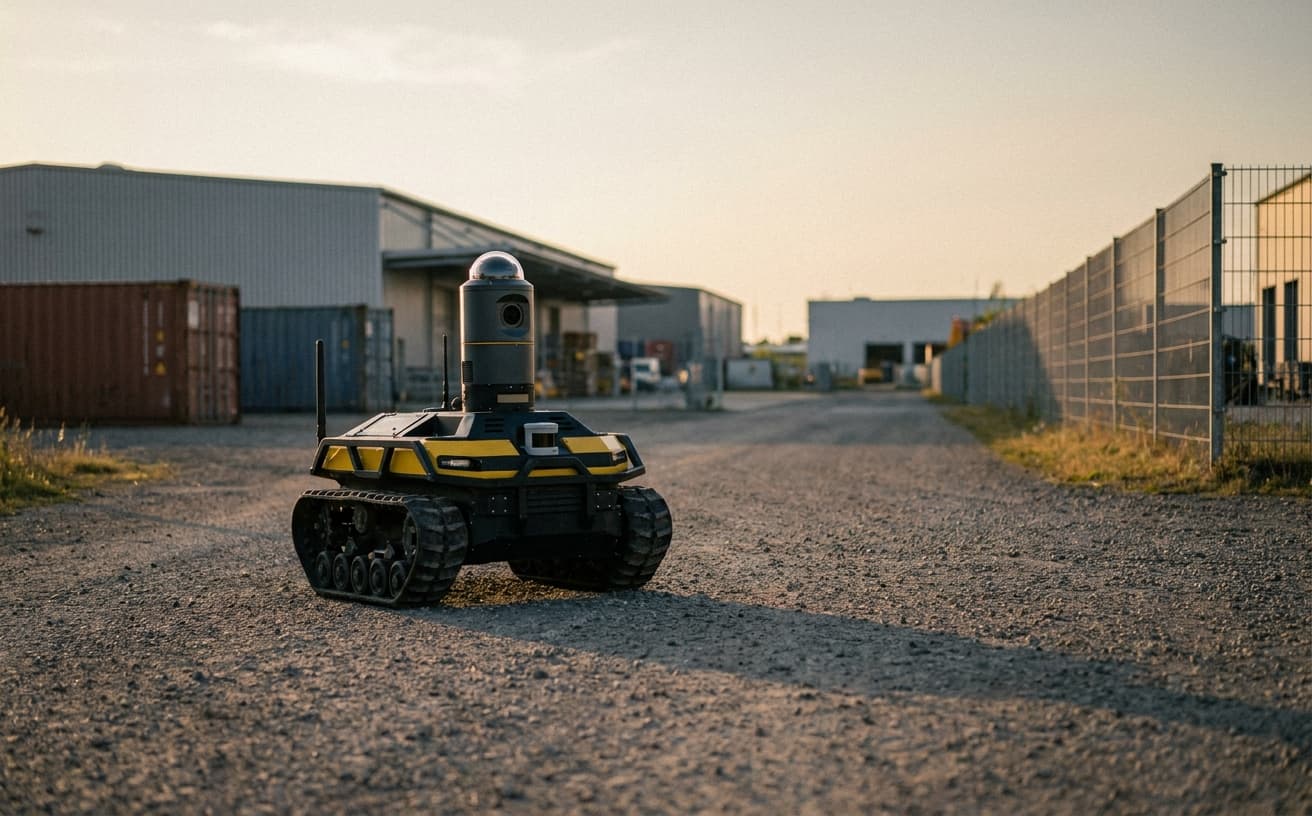
"Buy or rent" is the wrong opening question for a security robot. The right one is whether the asset will live long enough, in stable enough conditions, with a stable enough operator on the other end, to make ownership the cheaper structure. Most buyers ask the question in the wrong order and then anchor on the sticker price.
The buy-versus-rent choice is, in essence, a duration question dressed up as a finance question. A unit that patrols the same logistics yard for sixty months will be paid for many times over by a rental schedule. A unit that follows a construction project across four sites in eighteen months may never reach the break-even line that ownership requires. The hardware is the same. The economics are not. What this article does is separate the three deployment patterns in which capex actually wins from the larger set in which renting, or a service model, remains the rational answer. The frame is the one used inside BOSWAU + KNAUER. From Building to Security Technology: the same machine is sold, rented, or operated as a service depending on which structure preserves the operator's control and protects the unit economics.
The default assumption that quietly costs money
The default assumption in most procurement files is that renting a security robot is the safer financial move. It keeps the balance sheet light, it shifts maintenance risk to the supplier, and it lets the operator exit if the technology disappoints. Each of these arguments is defensible in isolation. Together they form a habit that quietly costs money in cases where the underlying use is stable and long-lived.
A rental contract for a security robot, in the European market, typically prices the unit at a monthly rate that recovers the supplier's hardware cost over roughly twenty-four to thirty-six months, then continues to pay margin for as long as the contract runs. The supplier carries the financing risk, the warranty risk, and the obsolescence risk, and prices accordingly. That price is fair. It is also expensive if the operator never intended to exit and the obsolescence risk is, on inspection, smaller than the supplier's pricing implies.
Capex inverts the structure. The operator carries the financing risk, takes the warranty exposure after the manufacturer's term, and accepts that the unit might be technologically overtaken before it is mechanically retired. In exchange, the operator owns an asset that, after roughly thirty months, costs only its service and consumables. On a sixty-month horizon, that gap is not marginal. It is often the difference between a security line item that grows with inflation and one that flattens after the third year. The question is which deployments earn that flattening curve and which do not. CISA, in its physical-security guidance, and NIST CSF 2.0, in its asset-management functions, both push operators toward inventory clarity before procurement choices. That order matters here. Without a clean view of where a unit will actually live and how long, the buy-versus-rent question cannot be answered honestly.
Pattern one: the fixed-site industrial perimeter
The first pattern in which capex wins cleanly is the fixed-site industrial perimeter. A refinery, a chemical plant, a high-value warehouse, a substation cluster, a data-center campus. The defining characteristic is that the site exists for decades, the perimeter is geographically stable, and the security function is a permanent line item that no one expects to discontinue. In this pattern, the robot is not a project asset. It is infrastructure.
When a unit patrols the same loop, on the same surfaces, in the same weather envelope, with the same charging dock, the variables that drive rental pricing collapse. The supplier's pricing of redeployment risk becomes irrelevant, because there will be no redeployment. The supplier's pricing of accelerated wear becomes irrelevant, because the operator can predict and budget the wear pattern from the first quarter. The supplier's pricing of operator error becomes irrelevant, because the same team operates the unit for years and develops genuine familiarity. The operator has, in effect, bought out three risk premiums that the rental rate continues to charge for.
The capex case in this pattern is straightforward. A robot in the range of one hundred twenty to two hundred fifty thousand euros, depending on configuration and sensor payload, amortized over a realistic service life of six to eight years under IEC 62443 industrial-grade conditions, lands at a monthly equivalent cost that is meaningfully below market rental rates after the second year. Add a service contract priced at ten to fifteen percent of hardware value per annum, and the total cost of ownership remains, in most cases, below a five-year rental schedule by a margin that justifies the capital tie-up. The operator also retains a residual value, which is not zero, and which can be realized either by redeployment to a secondary site or by sale into a secondary market that is beginning to form for industrial robotics. ISO 27001 and NIST 800-53, on the cyber side, both require asset-ownership clarity for control implementation. Ownership simplifies that clarity. A rented unit sits in someone else's asset register and someone else's patch cycle, which complicates the operator's own compliance posture in ways that rarely show up in the procurement spreadsheet but show up in audit findings.
Pattern two: the multi-site security service provider
The second pattern in which capex wins is the security service provider building a portfolio of contracts in which robotics is a billable component. ASIS International data on contract-security pricing, and the broader European trend toward technology-supplemented manned guarding, both point to a market in which guards alone no longer win tenders against competitors offering hybrid solutions. The provider that owns its robotic fleet has a structurally different cost base than the provider that rents.
A guarding company that rents a unit to assign to a client contract pays the rental rate plus its own margin, and prices the bundle to the client at a level that must absorb both. A guarding company that owns the unit pays only its amortized hardware cost plus service, and prices the same bundle to the client with substantially more headroom. On a contract by contract basis, the difference is meaningful. On a portfolio basis, it is decisive. The owned-fleet provider wins more tenders at the same price, or wins the same tenders at higher margin. Both outcomes compound.
The capex case here rests on utilization. A unit that runs across multiple client contracts in succession, moving from a construction site to a logistics yard to an industrial perimeter as projects begin and end, generates revenue continuously rather than per contract. The fleet operator effectively becomes its own rental company, but with the rental rate redirected from a supplier's margin into the operator's own balance sheet. The constraint is operational discipline. Redeployment between contracts is expensive in time and in calibration, and a fleet operator that cannot move a unit between sites in under a working day will not realize the utilization that the capex case assumes. This is where manufacturers who came out of construction, with deep experience in rapid installation and field conditions, hold a real advantage over those who came out of pure robotics. The unit must be designed to redeploy. Many are not. The provider should verify deployment time as a contractual specification, not as a marketing claim. The GDV, in its loss data on guarding-supplemented sites, indicates that consistent technological coverage reduces loss frequencies meaningfully against pure manned schedules, which is the financial logic the provider passes through to its clients.
Pattern three: the long-horizon construction enterprise
The third pattern is the large construction enterprise running a portfolio of overlapping projects, each lasting twelve to thirty-six months, with a continuous pipeline. This is the pattern in which conventional wisdom says rental wins, because projects end. Conventional wisdom is wrong when the enterprise is large enough that projects overlap and a unit moves from one site to the next without sitting idle.
The arithmetic is similar to the service provider case but the buyer is the construction company itself. A general contractor running thirty to fifty active sites at any given time, with a pipeline of similar volume behind, has the same utilization profile as a fleet operator. The unit never sits in the warehouse. It moves from the site that is reaching handover to the site that is starting groundwork. The supplier's rental rate, built on the assumption that the unit returns between contracts, becomes a premium the operator pays for a return that never happens. Owning the fleet captures that premium.
The construction case has an additional dimension that the industrial case does not. Construction losses, on the BSI's and the German insurance industry's published ranges, run at between one and three percent of project value, with copper theft, fuel theft, and tool theft as the most common categories. A robot that demonstrably reduces those losses pays for itself faster on a construction site than on an industrial site, because the loss baseline is higher. The capex case therefore reaches break-even sooner. The constraint, again, is operational. A construction company that buys robots but cannot move them between sites efficiently, that does not train its project managers on the operating logic, and that treats the units as the sole concern of a central security department disconnected from the site, will underutilize the fleet and undermine its own economics. The capex case requires the discipline to treat the robots as construction equipment, not as security devices. They live in the equipment yard. They move with the project schedule. They are tracked the same way a tower crane or a generator is tracked. Where this discipline exists, ownership wins. Where it does not, rental remains the right answer despite the higher per-unit cost.
Where rental remains the rational answer
Outside the three patterns above, rental is the rational structure. A construction project of unique scope and duration, with no clear successor project, does not justify capex. A pilot deployment, where the operator is still validating whether the technology fits the operational reality, must not be locked into capex before the validation is complete. A site with seasonal security needs, where the unit would sit unused for half the year, cannot reach the utilization that ownership requires. A market in which the operator is uncertain about regulatory developments, particularly around drone interaction, automated patrol authority, and data retention under GDPR successor regimes, may not want to own an asset whose legal envelope could narrow.
Rental also remains the right answer in the early years of a relationship between operator and manufacturer. Trust is built through performance under load, and a rental contract structures that trust into a clean exit option. The operator that commits to capex in year one, without the field data that only year one can produce, is buying conviction it has not yet earned. Manufacturers who push hard for capex in the first conversation are signaling something about their own cash position rather than about the operator's interest. The cleaner sequence is rental in year one, audit in year two, capex in year three for the deployments that have proved themselves. This is the sequence that underlies the three engagement paths described in BOSWAU + KNAUER. From Building to Security Technology, and it is the sequence that survives most procurement reviews intact.
There is also a category of operator for whom service, not rental and not capex, is the right answer. The operator that wants the outcome without the operational responsibility, that prefers a single line item covering hardware, software, monitoring, response, and reporting, and that values predictability over ownership. The service model is not a compromise between rental and capex. It is a distinct structure with its own logic, suited to operators whose core business is far enough from security that internal operating capacity does not exist and should not be built. The mistake is to confuse the three. Rental is capex postponed. Service is capex outsourced. Capex is capex.
What holds
The buy-versus-rent decision for security robotics is not a financial question first. It is a deployment-pattern question whose financial implications follow. The three patterns in which ownership wins, fixed-site industrial perimeter, multi-site service provider with continuous utilization, and large construction enterprise with overlapping projects, share one structural feature: the unit runs continuously, in conditions the operator controls, for long enough that the supplier's rental premium becomes the operator's avoidable cost. Outside those patterns, rental or service remains the right structure, and the operator that forces capex into a deployment pattern that does not support it has not saved money. It has merely moved the loss from one budget line to another.
The operator that wants to test the question against its own deployment should not start with a price comparison. It should start with a deployment map. Where will the units actually live, for how long, under what conditions, operated by whom, against what threat baseline. Once that map exists, the financial structure follows almost mechanically. The operators who skip the map are the ones who buy when they should have rented and rent when they should have bought.
For operators considering the question seriously, three paths are available. A sixty-minute confidential conversation that pressure-tests the deployment map against the financial structure, without committing to either side of the question. A three-to-five-day audit that documents the current security posture, the loss baseline, and the deployment patterns across all sites, producing a written report the operator owns and uses as it sees fit. A ninety-day pilot at one site, on a defined success metric agreed before installation, that produces the field data on which a capex decision can defensibly rest. Most operators benefit from the audit first. It is the document that turns the buy-versus-rent debate from a procurement argument into a structural decision.
Frequently asked questions
When does buying a robot win?
Buying wins in three patterns. First, a fixed-site industrial perimeter where the unit will run on the same loop for five years or more under stable conditions. Second, a security service provider with continuous utilization across a portfolio of client contracts. Third, a large construction enterprise with overlapping projects in which the unit moves from site to site without idle time. Outside these patterns, rental or service is the rational structure. The deciding factor is not the price of the unit. It is the duration and stability of the deployment that the unit will actually serve.
How is the depreciation handled?
Under standard accounting treatment, a security robot is depreciated over its useful economic life, which most operators set at five to seven years for industrial-grade units, in line with comparable security equipment. The depreciation profile is typically straight-line, though some jurisdictions allow accelerated schedules for technology assets. Service contracts and software licenses are expensed as incurred. Operators should align the depreciation schedule with the realistic redeployment horizon rather than the manufacturer's stated maximum life. Tax treatment varies by jurisdiction, and the audit report should reference the operator's own tax framework rather than rely on a manufacturer's generic guidance.
What is the typical capex price?
A capable industrial security robot, configured with multi-sensor payload, thermal imaging, autonomous navigation, and integration with a command platform, prices in the range of one hundred twenty to two hundred fifty thousand euros, depending on specification. Lower-end units exist below this band but rarely meet IEC 62443 industrial reliability requirements. Higher-end units, particularly those configured for hazardous environments or specialized inspection roles, can exceed three hundred thousand. Annual service contracts typically run at ten to fifteen percent of hardware value. The operator should request a written total-cost-of-ownership projection over five years, including service, software, and expected consumables, before treating any sticker price as comparable.
Who finances the deal?
Several structures exist. Direct capital purchase from operating cash or capital reserves is the simplest and the least expensive over the asset life. Equipment financing through a bank or specialized lender, typically over thirty-six to sixty months, preserves cash at the cost of interest. Manufacturer financing is sometimes offered, often at rates above bank financing, and should be compared against bank terms before acceptance. Operating lease structures sit between rental and capex and warrant careful accounting review under IFRS 16 or comparable standards. The right structure depends on the operator's cost of capital and balance-sheet preferences. The manufacturer's job is to deliver the asset, not to dictate the financing.
Related topics
- Security Robot Companies 2026: The Twelve Real Vendors
- Security Robots in Saudi Arabia: Vision 2030 & NEOM
- Security Robot Rental: What Pricing Says About Vendors
- Who Is Liable When a Security Robot Misses an Incident
- Outdoor Security Robots: What Spec Sheets Hide About IP66
Take the next step: See prices & ROI · Explore the products · Send a no-obligation request. BOSWAU + KNAUER – direct from the factory in Filderstadt, reply within 5 working days.
About the author
Dr. Raphael Nagel (LL.M.) is founding partner of Tactical Management. He acquires and restructures industrial businesses in demanding market environments and writes on capital, geopolitics, and technological transformation. raphaelnagel.com
More reading
Since 1892.
The firm is reached at boswau-knauer.de or +49 177 2266267.