
Blog
Security Robots in Qatar: MOI Standards & Legacy
Qatari MOI, Lusail smart city, QIA-funded mega-projects. The infrastructure boom that needs structured perimeter security.

Dr. Raphael Nagel
July 18, 2025
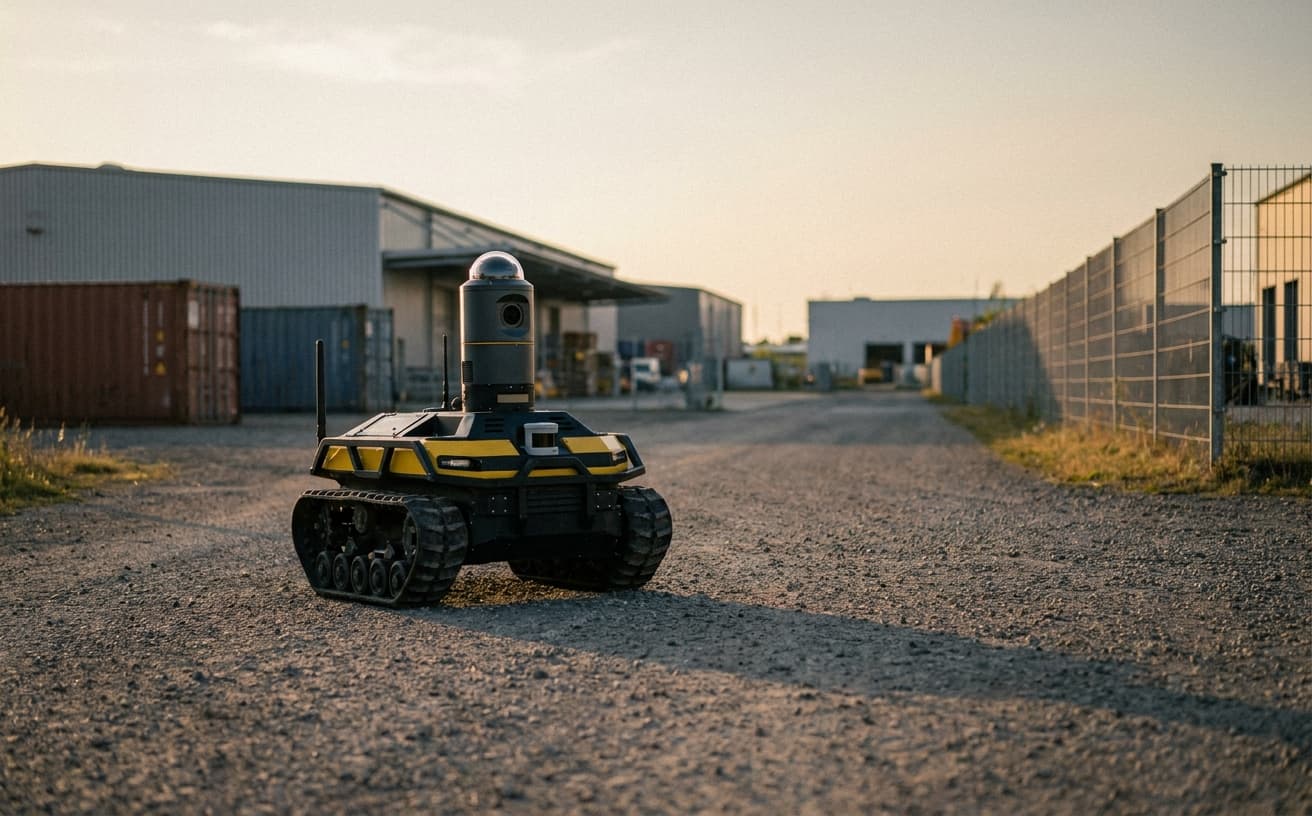
Legacy, in the Qatari context, is not a stadium that empties after the final whistle. It is a perimeter that must hold for the next forty years.
The 2022 World Cup left Qatar with eight stadiums, a metro system, a new city at Lusail, hotel capacity for several years of demand it has yet to fully absorb, and a security doctrine that was tested under conditions no other Gulf state has faced at the same intensity. What followed the tournament is the harder phase. The stadiums became districts. The fan zones became commercial real estate. The temporary command centres became permanent rooms inside the Ministry of Interior. And the perimeter, which during the tournament was carried largely by deployed personnel, has had to be rebuilt as an industrial system that runs without surge staffing.
This is the moment at which security robotics, mobile video towers and integrated video analytics stop being optional and start being the only way the arithmetic works. Qatar has the capital, the regulatory will and the building stock to install a serious technical layer. What it does not have, and will not have in the medium term, is the manpower to police kilometres of fenceline by foot. Manufacturers who understand both the construction reality and the regulatory environment have a window. Those who arrive with European catalogue products and no field discipline will not survive the first inspection.
The MOI framework and what it actually demands
The Qatari Ministry of Interior, through the General Directorate of Civil Defence and the security departments attached to specific sectors, operates a permitting and inspection regime that is more prescriptive than most European operators expect. CCTV installations on commercial and infrastructure sites require approval. Camera placement, recording retention, image quality at defined distances, and the integration of the system into a central monitoring capability are checked at commissioning and again at renewal. Sites tied to the energy sector, to ports, to aviation, and to the Qatar Investment Authority's flagship developments operate under additional layers.
For manufacturers of mobile and autonomous security platforms, three points matter. First, the equipment must be approvable. That means traceable supply chain, documented cybersecurity posture aligned with IEC 62443 for industrial control elements and with ISO 27001 for the data handling layer, and a clear position on where the data resides. Qatari authorities increasingly expect that operational data on sensitive sites remains within the country. A security robot that streams its analytics to a European cloud without local mirroring is a problem in approvals, not a feature in the brochure.
Second, the equipment must be operable by the personnel actually on site. The labour market for security on Qatari projects is shaped by a workforce drawn largely from South Asia, with shift patterns and supervisory structures that have their own logic. A platform whose interface assumes a Western European operator with three days of vendor training does not fit. The interfaces have to work at the level of the man at the gate, with bilingual prompts and a fault behaviour that does not require a phone call to Munich.
Third, the system must produce records that the inspection authority can read. The Civil Defence inspector who arrives unannounced does not want to hear a vendor explanation. He wants to see logs, retention proof, response times and the chain of custody on alarms. A platform that cannot produce these in a structured export within minutes is a platform that will be flagged. The architecture has to anticipate the audit, not survive it.
NIST CSF 2.0 and NIST 800-53 are not Qatari frameworks, but the larger contractors operating in Qatar, particularly those tied to the Qatar Investment Authority's international portfolio, increasingly map their internal controls against them. A manufacturer whose documentation already speaks that language enters the conversation already half-credentialled.
Lusail and the smart city as a real customer
Lusail is the test case. Built largely from raw desert into a planned city for around 200,000 residents and a working population well beyond that, it concentrates the typical post-2022 challenge: high-value buildings, long perimeters, an installed sensor base that was specified during the construction phase and is now being asked to do something it was not entirely designed for, and a governance layer that is still being formalised.
What this means in operational terms is straightforward. The construction perimeters of the late tournament era are giving way to district-level perimeters. The marina, the boulevard, the residential towers and the commercial districts each carry their own access regime. The legacy CCTV grid, dense as it is, has gaps at ground level and in the transitional zones between districts. Mobile platforms, whether wheeled robotic patrols or rapidly deployed video towers, are the natural answer because they cover the ground that fixed infrastructure does not, and they cover it at a marginal cost per hour that no human roster can match.
The Lusail planning bodies have not yet published a single binding standard for mobile autonomous security assets in public urban space. What exists is a layered consensus: the developer's security specification, the MOI's general requirements, the Civil Defence's life safety overlay, and the specific demands of operators such as the metro, the energy backbone and the high-value retail tenants. A serious manufacturer engages all four layers simultaneously and accepts that the specification will harden in stages over the next several years. Those who arrive with a finished, inflexible product line will find that the goalposts move. Those who arrive with a platform logic, modular by design and configurable at the software layer, will be in a position to absorb the changes without rebuilding the hardware.
The smart city dimension adds a further requirement. Lusail's command and control ambitions assume that data from physical security, traffic, utilities and environmental sensors converge into operator workstations that can see the district as a whole. A security robot whose data stays in a proprietary silo is, in that environment, an isolated node. The platforms that will win are those that publish documented APIs, that respect open data formats where the operator demands them, and that do not treat integration as a paid extra to be negotiated after installation.
QIA-funded mega-projects and the procurement reality
The Qatar Investment Authority is the engine behind a portfolio of projects that extends well beyond Lusail. Hospitality complexes, logistics hubs around Hamad Port, the industrial expansions tied to the North Field gas development, education and research campuses, and the cultural infrastructure around the museums district all carry security budgets that have grown rather than contracted since 2022. The procurement logic on these projects has shifted. Where in the build-up to the tournament the priority was delivery on time at almost any cost, the priority now is operational cost per square metre of secured perimeter per year, measured over a fifteen to twenty year horizon.
This shift favours manufacturers who can produce honest total-cost-of-ownership numbers. The Qatari procurement teams on the larger projects are well advised, often by international consultancies, and they read past the brochure. They want to see mean time between failures, mean time to repair, the cost of spare parts five years into the lifecycle, and the training burden on the operator. They want to see that the platform survives 50-degree afternoons in July, dust storms that arrive without warning, and the salt-laden air along the coastline. Those conditions are not in any European IP rating in a meaningful way. They are in the field history, or they are not.
The procurement reality also favours manufacturers who arrive with a local partner who carries weight. Pure import-export relationships without service capacity in country do not pass scrutiny. The expectation is that critical spares are held in Qatar, that a technician can be on site within hours rather than days, and that the relationship between manufacturer and integrator is contractually clear. A manufacturer that walks into the conversation with that structure already in place is in a different category from one that proposes to build it after winning the tender.
The book BOSWAU + KNAUER. From Building to Security Technology develops the underlying logic at some length: the manufacturer position is what allows a serious conversation about lifecycle economics, because the manufacturer carries the warranty, the development roadmap and the service obligation in one hand, rather than passing them through a chain of intermediaries who optimise each link for their own margin. Qatari procurement, increasingly, recognises this distinction.
Which firms supply the technical layer, and what the gaps look like
The supplier landscape in Qatar is layered. At the top sit the large systems integrators, often subsidiaries or partners of multinational defence and security houses, who carry the prime contracts on the most sensitive sites. Below them sit specialist suppliers in CCTV, access control, perimeter intrusion detection, and increasingly in autonomous platforms. Below those sit the local installation and maintenance firms who carry the day-to-day burden.
The gap in this structure is at the level of the autonomous and mobile layer. Fixed CCTV is mature in Qatar. Access control is mature. Perimeter intrusion detection on critical sites is mature, with mature meaning that several established vendors are present and that the integrators know how to specify and commission the systems. What is not mature is the integration of mobile robotic patrols and rapidly deployable video towers into the larger operational picture. Several pilots have run. Few have scaled. The reasons are familiar to anyone who has watched this market segment in Europe: vendor lock-in concerns, immature service capacity, interfaces that do not speak to the existing command and control software, and a procurement culture that has not yet built a category for these assets.
This is the gap in which a manufacturer with a serious platform proposition can establish a position. The condition is that the manufacturer arrives prepared to enter at the pilot scale, to absorb the cost of demonstrating the operational case on a real site over ninety days or more, and to accept that the first contract will be smaller than the eventual relationship. The Qatari operators who have learned, often painfully, from earlier waves of technology procurement are not interested in a year-one revenue case. They are interested in whether the manufacturer is still going to be answering the phone in year seven.
CISA's guidance on operational technology, ASIS International's standards on physical security operations, and the BSI's published doctrines on critical infrastructure protection are all readable in this market. They do not have force of law in Qatar, but they form part of the reference framework that the senior security advisors carry in their heads. A manufacturer who can map his offering against those references, without overclaiming compliance, enters the room with the right vocabulary.
Language, training and the operator on the ground
The language question is more substantive than it appears. The MOI documentation is in Arabic. The operational language on most large sites is English. The working language on the ground, among the security personnel actually carrying out patrols and operating the consoles, is a mix that varies by employer. A manufacturer who delivers documentation only in English and training only in English will find that the system is operated at a level below its design capability, because the layer of personnel who interact with it daily is not the layer that was trained.
The serious response is bilingual at minimum, with Arabic and English coverage of the operator interface, the alarm messages, the maintenance prompts, and the structured exports that go to the inspecting authority. It is also a training architecture that does not assume that a single intensive vendor course delivers lasting competence. Refresher cycles, on-site mentoring, and the use of remote support to walk an operator through a non-routine situation in real time are the elements that distinguish a platform that runs from a platform that sits.
The same logic applies to the maintenance layer. The technicians who service the platforms in country need documentation, spare parts catalogues and diagnostic tools that work in their operational language. The vendor whose diagnostic software is locked behind a single-language interface and a server in Europe will find that maintenance response times do not meet the contractual commitments. The vendor who has localised the maintenance stack will not have that problem.
What holds
Qatar after the World Cup is a market that has the capital and the regulatory will to install a serious security technology layer across its post-tournament infrastructure. The MOI framework is becoming more prescriptive, not less. The Lusail district plans are evolving toward integrated command and control environments in which mobile and autonomous assets are an expected component rather than a novelty. The QIA-funded portfolio is procuring on lifecycle terms that reward manufacturers who can demonstrate field discipline.
What the market does not reward is brochure-grade engagement. The operators who matter have seen too many pilots that did not scale and too many promises that did not survive the second summer. They are looking for manufacturers who arrive with a platform logic, a local service capability, a bilingual operational stack and a willingness to enter at pilot scale before discussing scale.
For operators who want to test that proposition under controlled conditions, the structured route is a ninety-day pilot on a defined site, with the success metrics agreed before installation and the data shared transparently at the end. That is Path III in the framework set out in BOSWAU + KNAUER. From Building to Security Technology. The earlier paths, a confidential conversation of around sixty minutes or a three to five day audit, exist for operators who are not yet at the pilot stage but who need to take an honest position on where their current security architecture actually stands.
Frequently asked questions
What does the Qatari MOI require?
The Ministry of Interior operates a permitting and inspection regime covering CCTV, perimeter security and integrated monitoring on commercial and critical infrastructure sites. Approvals address camera placement, image quality, retention, data residency and integration with central monitoring. Sensitive sectors carry additional layers from Civil Defence and sector-specific authorities. For autonomous and mobile platforms, the practical requirements are traceable supply chain, documented cybersecurity posture aligned with IEC 62443 and ISO 27001 where applicable, local data handling, and structured exports that an inspector can read on demand without vendor support.
How are Lusail district plans evolving?
Lusail is transitioning from a construction-era perimeter logic to a district-level operational logic. Fixed CCTV density is high, but ground-level coverage and transitional zones between districts carry gaps that mobile platforms and rapidly deployable video towers are well placed to fill. The smart city ambition assumes convergence of physical security data with traffic, utilities and environmental sensors into shared operator workstations. Specifications are hardening in stages, which favours modular platforms with documented APIs over closed product lines. Open integration is increasingly a procurement requirement, not a negotiation point.
Which firms supply security tech?
The Qatari market is layered. Large international systems integrators hold prime contracts on the most sensitive sites. Specialist vendors cover CCTV, access control and perimeter intrusion detection at maturity. Local installation and maintenance firms carry day-to-day operations. The gap sits at the autonomous and mobile platform layer, where pilots have run but few have scaled. Manufacturers entering this gap need a credible local partner, in-country spares, defined service response times, and a willingness to demonstrate the operational case on a real site before discussing scale-up across a portfolio.
What language obligations apply?
MOI documentation is in Arabic. Operational language on large sites is typically English. Security personnel on the ground work in a mix that varies by employer. A serious manufacturer delivers operator interfaces, alarm messages, maintenance prompts and inspector-facing exports in both Arabic and English at minimum. Training cannot rest on a single vendor course. Refresher cycles, on-site mentoring and remote support during non-routine situations are the difference between a system that runs at design capability and one that operates well below it. The same bilingual discipline applies to the maintenance stack.
Related topics
- Extreme Heat & Security Robots in the Gulf: 55C
- Security Robots at DEWA: Utility Perimeter
- UK Data Centre Corridor: Slough, Docklands & West London
- Security Robot vs Human Guard: The Honest Five-Year Math
- Security Robots in Saudi Arabia: Vision 2030 & NEOM
Take the next step: See prices & ROI · Explore the products · Send a no-obligation request. BOSWAU + KNAUER – direct from the factory in Filderstadt, reply within 5 working days.
About the author
Dr. Raphael Nagel (LL.M.) is founding partner of Tactical Management. He acquires and restructures industrial businesses in demanding market environments and writes on capital, geopolitics, and technological transformation. raphaelnagel.com
More reading
Since 1892.
The firm is reached at boswau-knauer.de or +49 177 2266267.